

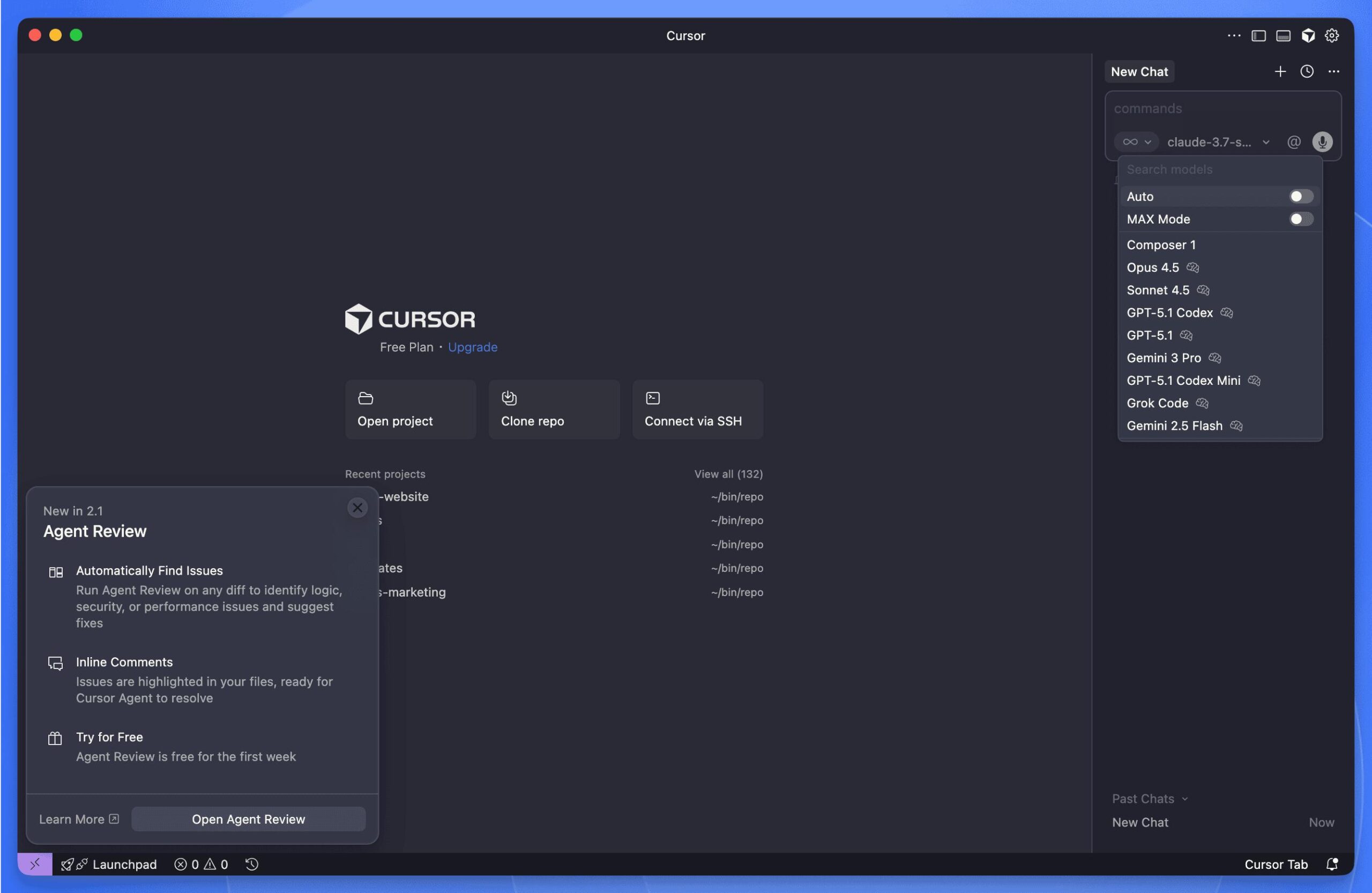
Cursor rebuilt the code editor around AI instead of treating artificial intelligence as a plugin.
While everyone else built chatbots for coders, a small team rebuilt the code editor itself around AI.
Most AI coding tools were plugins bolted onto existing editors. Cursor’s founders made a different bet: that AI needed to be the foundation of the editor, not a feature added on top of one.
Startup Strategy • Case Study • Developer Tools • AI
The Plugin Ceiling
By the time Cursor emerged, AI coding assistants were everywhere: autocomplete plugins, chat sidebars, code-review bots, all living as extensions inside editors like VS Code. They were useful, but limited by the constraints of the host editor’s plugin architecture. Cursor’s founders, a group of MIT graduates, made a contrarian bet: instead of building another plugin, they would fork VS Code itself and rebuild the editing experience around AI from the ground up. The story of Cursor is a story about what happens when a startup refuses to treat AI as a feature and instead treats it as the product’s entire reason for existing.
Why This Story Matters
For founders, this is a case study in choosing depth of integration over speed to market. For investors, it demonstrates how a tiny team can compete with incumbents that have orders of magnitude more engineers, by owning a layer those incumbents cannot easily replicate. For operators, it is proof that developer trust is earned through daily utility, not marketing spend. Cursor’s rise remains one of the fastest enterprise-software adoption stories among technical users, and one of the fastest-growing companies in software history by revenue.
Quick Facts
| Developer | Anysphere, Inc. |
| Product | Cursor (AI-native code editor) |
| Founded | 2022, by Michael Truell, Sualeh Asif, Aman Sanger, and Arvid Lunnemark (MIT graduates) |
| Cursor Launched | 2023 |
| Foundation | Fork of Visual Studio Code (VS Code) |
| Core Users | Professional software developers; reported use across roughly 70% of Fortune 1,000 companies |
| Distribution Model | Freemium, with paid individual, team, and enterprise tiers |
| Scale (2025 to 2026) | Grew from roughly $100 million to over $1 billion in annual recurring revenue in 2025, reportedly approaching $2 billion ARR by early 2026 |
| Valuation | $29.3 billion as of its November 2025 Series D; reportedly in talks for a valuation near $50 to 60 billion in early 2026 |
| Industry | Developer Tools, AI, SaaS |
Background: Built by People Who Felt the Pain
Cursor’s founders were developers who had used early AI coding assistants daily and found them frustrating: context windows too small, suggestions disconnected from the broader codebase, and an interface that treated AI as an afterthought. Rather than pitch their idea as “Copilot but better,” they chose to build an entire editor, accepting the enormous switching cost that asking developers to change their daily tool implies.
That switching cost became, paradoxically, a moat. Once a developer adopted Cursor and configured it to their workflow, the cost of going back to a plain editor with bolted-on AI felt like a downgrade, not because Cursor had more features, but because AI was woven into every interaction rather than summoned through a separate panel.
How It Happened: Three Moves That Changed Everything
Move 1: Owning the Editor, Not Renting Space In It
By forking VS Code, Cursor inherited a familiar interface, so most developers could switch with minimal relearning, while gaining full control over how AI integrated into every layer: autocomplete, chat, codebase-wide search, and multi-file edits. Plugin-based competitors were structurally limited to the APIs their host editor exposed.
Move 2: Codebase-Level Context, Not File-Level Context
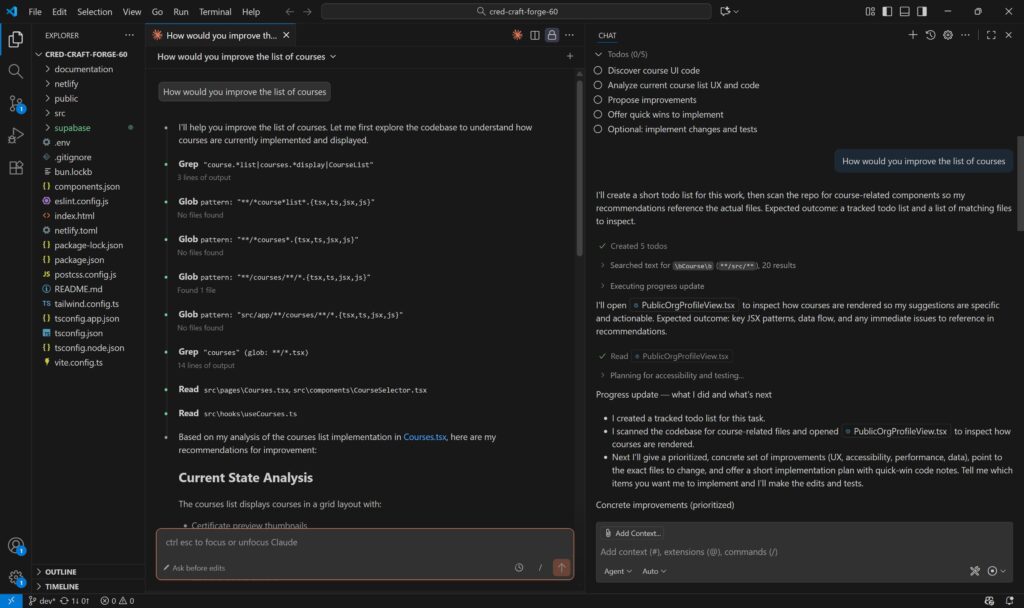
Cursor’s core technical bet was that AI suggestions needed to understand an entire codebase, not just the open file. This required building custom indexing and retrieval systems most plugins could not replicate within existing editor constraints. The result was suggestions that felt aware of a project’s conventions, not generic boilerplate.
Move 3: Developer-to-Developer Trust, Not Top-Down Sales
Cursor grew primarily through individual developers adopting it for personal use, then advocating for it inside their teams and companies. This bottom-up motion, a hallmark of successful developer tools, meant enterprise contracts followed grassroots usage rather than the reverse, giving Cursor credibility that top-down enterprise sales pitches rarely achieve.
The Strategy Behind the Success
Cursor’s rise rests on three convictions competitors underestimated: depth of integration beats breadth of features, switching cost can be a moat if the new experience is meaningfully better, and developer trust must be earned at the individual level before it can be sold at the organizational level.
Business Model Breakdown
Cursor operates on a freemium SaaS model: a free tier provides limited AI usage to drive adoption and word-of-mouth, while paid individual and team tiers unlock higher usage limits, more capable underlying models, and team collaboration features. Enterprise plans add security, compliance, and centralized billing, a familiar developer-tools monetization path applied to an AI-native product.
What Competitors Missed
Large incumbent editor makers assumed AI could be layered onto existing products through extensions and partnerships without disrupting the core editing experience. This protected their existing user base in the short term but left an opening for a product where AI was not an addition but the architecture itself. Other AI coding startups, including well-funded competitors like GitHub Copilot and the now Cognition-owned Windsurf, focused heavily on chat-based assistants, underestimating how much value came from ambient, in-flow suggestions rather than a separate conversational interface.
Risks & Challenges
- Dependence on underlying foundation models from third-party AI labs creates cost and capability exposure outside Cursor’s direct control.
- Large incumbents can replicate UI patterns relatively quickly once a feature proves popular.
- Developer tools face notoriously high churn if a product’s perceived edge narrows.
- Maintaining a VS Code fork requires continuous engineering investment to track upstream changes.
- Competition is intensifying fast: Anthropic’s Claude Code reportedly crossed $500 million in run-rate revenue within months of its full launch, and OpenAI has its own coding tool, Codex, putting pressure on Cursor’s category from multiple well-capitalized directions.
What Founders Can Learn
- Owning the core experience layer can be more defensible than building on top of someone else’s platform, even at higher initial cost.
- Switching costs work both ways. They protect incumbents, but a sufficiently better product can convert them into a moat for the challenger.
- Bottom-up, developer-led adoption often produces more durable enterprise relationships than top-down sales.
- Deep technical bets, like codebase-wide context, can be the differentiator competitors find hardest to copy quickly.
- Category leadership can move fast: Cursor went from a small startup to one of the most valuable private AI companies in the world in roughly three years, but its position is being contested almost immediately by equally well-funded rivals.
Expert Analysis
Cursor’s trajectory reflects a broader pattern in developer tools: the products that win are often the ones developers did not realize they wanted until they tried them, because the previous paradigm had quietly normalized friction as “how things work.” By rebuilding the editor itself, Cursor exposed how much latent value plugin architectures had been leaving on the table. Its rapid jump from roughly $100 million to over $1 billion in annual recurring revenue within a single year is also a signal that AI-native developer tools can scale revenue far faster than traditional enterprise software ever did.
Future Outlook
As AI capabilities continue to advance, the competitive question shifts from “which tool has the smartest model” to “which tool is most deeply embedded into a developer’s actual workflow.” Cursor’s early bet on owning that workflow layer positions it to benefit from model improvements industry-wide, regardless of which AI lab produces them. At the same time, reports of a potential new funding round at a valuation near $50 to 60 billion suggest investors believe Cursor can keep extending that lead, even as Anthropic, OpenAI, and Cognition all push competing coding agents into the same workflow.
The Bottom Line
Cursor did not win by having a smarter chatbot. It won by recognizing that the editor itself, the place developers already spent their entire day, was the right battleground for AI, and that no amount of plugin innovation could match a product built around that insight from the ground up. The editor was never just a text box. It was the last interface developers spent hours in every day that AI hadn’t fully rebuilt, until someone did.
Key Takeaways
- Cursor chose to rebuild the code editor around AI rather than add AI to an existing editor.
- Codebase-wide context, not just file-level suggestions, became its core technical differentiator.
- Bottom-up developer adoption drove enterprise growth, not the reverse.
- High switching costs, normally a barrier, became an advantage once developers experienced the upgrade.
- Owning the core workflow layer is more defensible than building features on someone else’s platform, though that position is now being actively contested by Anthropic, OpenAI, and other well-funded competitors.
TFN LENS
At The Founder Nation, we track stories like Cursor’s because they show how a small, technically focused team can out-execute much larger incumbents by choosing the right layer to own. Every week, our team surfaces grants, accelerator programs, and early-stage funding opportunities for Indian founders building developer tools, infrastructure, and AI-native products.
Building something of your own?
Follow The Founder Nation and NamasteVC for curated startup funding news, grant alerts, and founder stories from India’s startup ecosystem, delivered straight to your feed, every week.
Frequently Asked Questions
What makes Cursor different from other AI coding assistants?
Cursor is built as a full code editor (a fork of VS Code) rather than a plugin, allowing AI to be integrated into every part of the editing experience, including codebase-wide context for suggestions.
Why did Cursor choose to fork VS Code instead of building a plugin?
Plugin architectures limit how deeply AI can be integrated into an editor. Forking VS Code gave Cursor’s team full control over the editing experience while retaining a familiar interface for developers switching over.
How does Cursor make money?
Through a freemium model: a free tier for individual use, paid tiers for higher usage and advanced features, and enterprise plans with additional security and collaboration tools.
How did Cursor grow its user base?
Primarily through bottom-up adoption. Individual developers tried it, found it useful, and advocated for it within their teams, leading to organic enterprise adoption that reportedly now spans roughly 70% of Fortune 1,000 companies.
How big is Cursor now?
As of its November 2025 Series D, Anysphere (Cursor’s parent company) was valued at $29.3 billion after raising $2.3 billion, with annual recurring revenue that grew from roughly $100 million to over $1 billion during 2025. Reports in early 2026 indicated the company was in talks for a new round that could value it near $50 to 60 billion.
Sources
- 2. TechCrunch–https://techcrunch.com/2025/06/05/cursors-anysphere-nabs-9-9b-valuation-soars-past-500m-arr/
- 3. Contrary Research–https://research.contrary.com/company/cursor
- 4. The Next Web–https://thenextweb.com/news/cursor-anysphere-2-billion-funding-50-billion-valuation-ai-coding
- 5. Tech-Insider.org–https://tech-insider.org/cursor-60-billion-valuation-anysphere-ai-coding-2026/
©️ The Founder Nation | All rights reserved | Written by TFN Research Desk |