
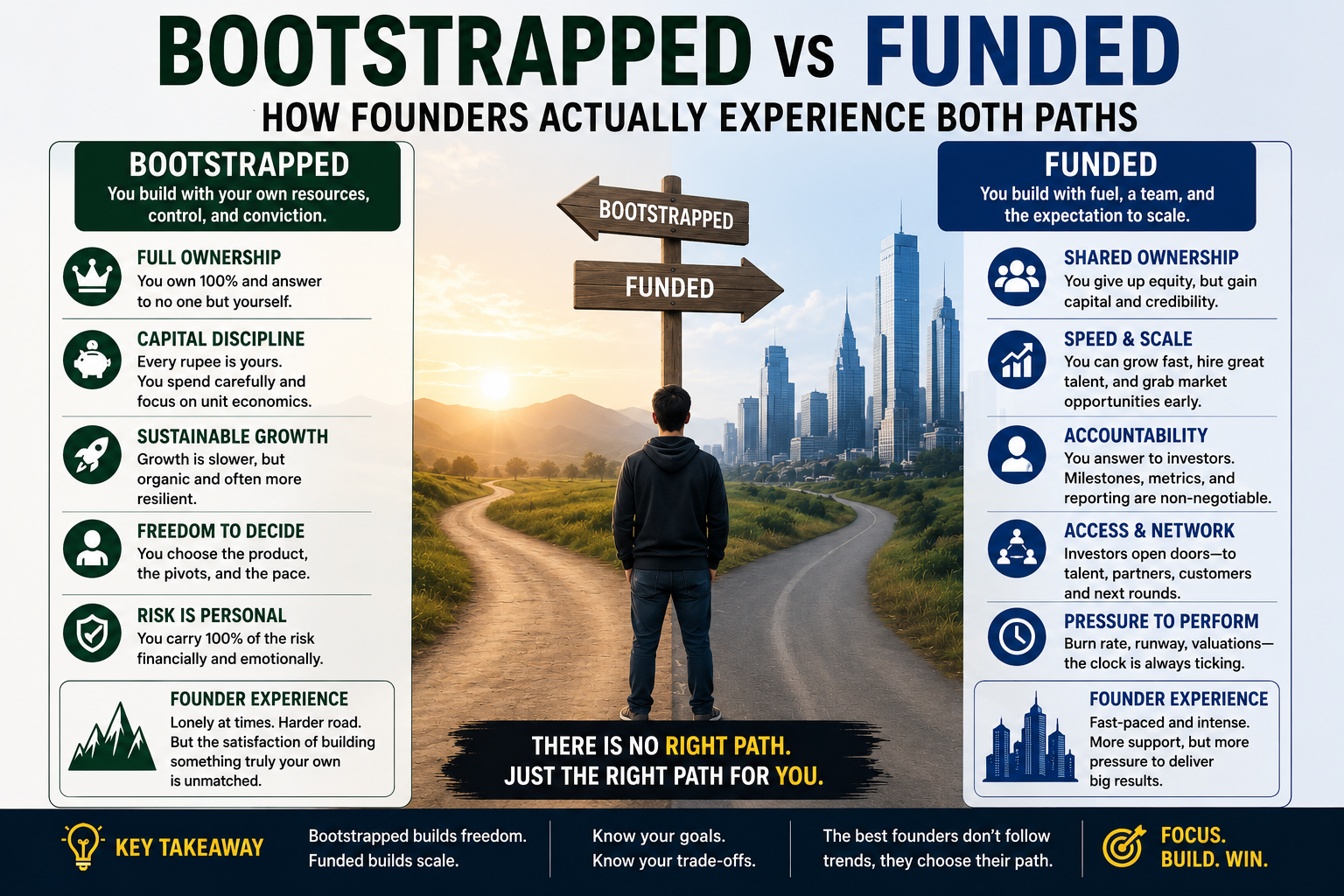
Bootstrapped vs Funded: A visual comparison of how founders experience ownership, growth, fundraising, risk, and decision-making throughout their startup journey.
Compare the realities of building a bootstrapped startup versus a venture-backed company, from ownership and growth to fundraising and long-term control. Learn which path best fits your startup’s goals, market, and stage of growth.
Written by TFN Research Desk | covering startups, technology, venture capital, and business strategy.
Two founders start companies on the same day, in the same city, solving similar problems.
One spends the next six months building a pitch deck, meeting investors, and negotiating a term sheet. The other spends those same six months talking to customers, shipping a paid product, and watching the bank balance instead of a cap table.
Neither founder is wrong. But ask each of them, three years later, what their day actually looks like, and you will get two completely different answers. This is what that difference looks like in practice, not in theory.
What “Bootstrapped” Actually Means Day to Day
Bootstrapping means funding the company from personal savings, early revenue, and whatever low-cost financing a founder can find, without giving up equity to outside investors. Sridhar Vembu built Zoho this way, from 1996 to a company serving over 60 million users today, without ever taking a single dollar of venture capital.
The day-to-day reality is constant tradeoffs. Every hire, every tool subscription, every marketing spend competes directly against the founder’s own runway. There is no board meeting, but there is also no safety net. A bad month in revenue is felt immediately, not absorbed by a cushion of investor cash sitting in the bank.
What this builds, almost by necessity, is discipline around unit economics from day one. A bootstrapped founder cannot afford to lose money on every customer while chasing growth, because there is no next funding round to bail them out. ChartMogul’s research across thousands of SaaS companies found that top-performing bootstrapped companies reach one million dollars in annual recurring revenue only about four months behind their VC-funded peers, while owning the entire outcome.
What “Funded” Actually Means Day to Day
A funded founder’s day looks different from the first week after the round closes. There is suddenly a board, even if it is informal at the seed stage. There are investor updates to write, usually monthly. There is pressure, explicit or not, to show the kind of growth that justifies the valuation the investor paid.
Flipkart and Paytm are the examples most often cited for what funding makes possible: rapid scaling, aggressive hiring, and the ability to capture market share before competitors can react. Funded founders get access to networks, mentorship from people who have built and exited companies before, and enough capital to take swings that a bootstrapped founder simply could not afford to take.
The tradeoff is control. Every funding round dilutes ownership, and by the time a company has raised through several rounds, founders often hold a minority stake in the company they started. High performance expectations and constant scrutiny from stakeholders become part of the job, not an occasional event.
The Founder Mindset Shift Nobody Talks About
Here is the part that rarely makes it into comparison articles. The mindset required to succeed at bootstrapping and the mindset required to succeed with venture funding are not just different strategies. They are different relationships with risk, time, and what “success” even means.
A bootstrapped founder optimises for the question: how long can this business survive and grow on its own revenue? Every decision gets filtered through that lens. A funded founder optimises for a different question: how fast can this business reach a scale that justifies the next round, or an exit? Both questions are valid. But a founder who raises money while still thinking like a bootstrapper, obsessing over small cost savings instead of pursuing the growth the investor is paying for, often frustrates their own investors. Equally, a bootstrapped founder who starts spending like they have raised a round, before the revenue justifies it, runs out of runway fast.
Why More Indian Founders Are Reconsidering Bootstrapping in 2026
The calculation has shifted recently, and not just philosophically. Startup funding in India dropped nearly 39 percent in 2025 as investors became more focused on profitability instead of rapid growth. At the same time, AI tools, cloud infrastructure, and no-code platforms have meaningfully reduced what it costs to build and launch a product, making the bootstrapped path more viable than it was even five years ago.
Zerodha is the reference point Indian founders bring up most often here. It stands as the most successful bootstrapped startup in India’s fintech space, built without external funding while competitors raised hundreds of millions of dollars. The lesson founders take from this is not that funding is bad, but that the absence of funding does not cap how large a company can become, if the unit economics work from the start.
This has changed the question many Indian founders ask before raising. It used to be “how fast can we raise money?” It is increasingly “how long can we build a profitable business without needing to?”
When Funding Genuinely Makes Sense
None of this means bootstrapping is always the right call. There are specific situations where outside capital is not just helpful but close to necessary.
The clearest signal is product-market fit that has already been proven, often represented by meaningful annual recurring revenue, where the constraint is no longer “does this work” but “how fast can we capture the market before someone else does.” A second signal is facing a well-funded competitor directly. If a rival with significant capital is using that capital to acquire the same customers, staying bootstrapped can mean losing the race before the better product even gets a fair test. A third signal is a market that genuinely requires capital to own, such as anything involving physical infrastructure, inventory at scale, or regulatory capital requirements.
Outside of these situations, raising money primarily because it is the expected next step, rather than because a specific bottleneck requires it, is how founders end up with investor expectations that do not match the business they actually want to run.
| Factor | Bootstrapped | Funded |
|---|---|---|
| Ownership retained | Full, by default | Diluted with each round |
| Speed to ARR ($1M) | Roughly 4 months behind VC peers | Faster, subsidised by capital |
| Pressure source | Revenue and runway | Investors and board expectations |
| Risk tolerance required | High personal financial risk | Shared risk, higher growth expectations |
| Best suited for | Founders prioritising control and long-term independence | Founders with proven PMF facing capital-intensive markets |
The Take Nobody In The Room Will Tell You
Here is what most founders only realise after choosing one path and living with it for a year or two.
The choice between bootstrapped and funded is not really a one-time decision made at the start. It is a decision that has to be re-made, honestly, every time circumstances change. A bootstrapped founder who hits a wall that genuinely requires capital but refuses to raise out of identity, “we’re a bootstrapped company”, can stall a business that would otherwise have grown. A funded founder who took money before truly needing it often spends the next two years working around investor expectations that no longer match what the business actually needs to do.
The founders who navigate this best are the ones who treat the label, bootstrapped or funded, as a description of their current situation, not a personality. Zoho stayed bootstrapped because it kept working, not because Sridhar Vembu was philosophically opposed to investors. Founders who hold their funding status as an identity, in either direction, tend to make decisions to protect that identity rather than to serve the business.
If you are deciding right now, the honest question is not “which path sounds better.” It is “what specific thing would change about how I run this company if I had outside capital, and is that change actually something my business needs right now, or something I want because it feels like progress.”
Frequently Asked Questions
Can a bootstrapped startup in India really compete with VC-funded competitors?
Yes, Zerodha is the most cited example of a bootstrapped Indian startup that became a market leader in fintech while competitors raised hundreds of millions of dollars. The key factor is whether the bootstrapped company can build sustainable unit economics that do not require subsidising growth through losses.
How much money do I need to bootstrap a startup?
This depends heavily on the business model. SaaS businesses often start with five thousand to fifty thousand dollars, service businesses can start with one thousand to ten thousand dollars, and creator-led businesses can start with as little as five hundred to five thousand dollars, often combined with early revenue rather than savings alone.
Is it true that most VC-funded startups fail?
A commonly cited figure suggests around 75 percent of venture-backed startups fail, while roughly 90 percent of bootstrapped startups that reach one million dollars in revenue are still operating a decade later. This does not mean funding causes failure, but it does suggest that funding does not guarantee survival the way it is sometimes assumed to.
At what stage should a bootstrapped founder consider raising money?
The clearest signals are having proven product-market fit, often represented by meaningful annual recurring revenue, facing a well-funded competitor that is winning on capital rather than product, or operating in a market that structurally requires significant capital, such as physical infrastructure or inventory-heavy businesses. Outside of these situations, raising primarily because it feels like the expected next step is a common mistake.
Why did startup funding in India drop so significantly in 2025?
Startup funding in India fell nearly 39 percent in 2025 as investors shifted focus toward profitability and sustainable unit economics rather than rapid growth at any cost. This shift has made bootstrapping comparatively more attractive, since the gap in speed to revenue between bootstrapped and funded companies has narrowed.
Does bootstrapping mean a founder has to do everything alone?
No, bootstrapping refers to the funding source, personal savings and revenue rather than outside investment, not the size or structure of the team. Bootstrapped companies can and do hire employees, the difference is that hiring decisions are funded entirely by the business’s own cash flow rather than investor capital.
Stay in the Loop
For more stories, breakdowns, and unfiltered takes on what is really happening in Indian and global business and tech, follow TheFounder Nation.
Instagram Handle : https://www.instagram.com/thefoundernation?igsh=MTZobDUwc2xqZWdhOA==
We cover what the mainstream business press won’t.
© TheFounder Nation | All rights reservedWord count: ~1,460 | Read time: ~7 minutesPrimary keyword: bootstrapped vs funded founder perspectives | Secondary: bootstrapping vs venture capital India, Zoho bootstrapped success, Zerodha bootstrapped fintech, startup funding India 2026, when to raise venture capital, founder equity dilution, bootstrapped startup India examples