
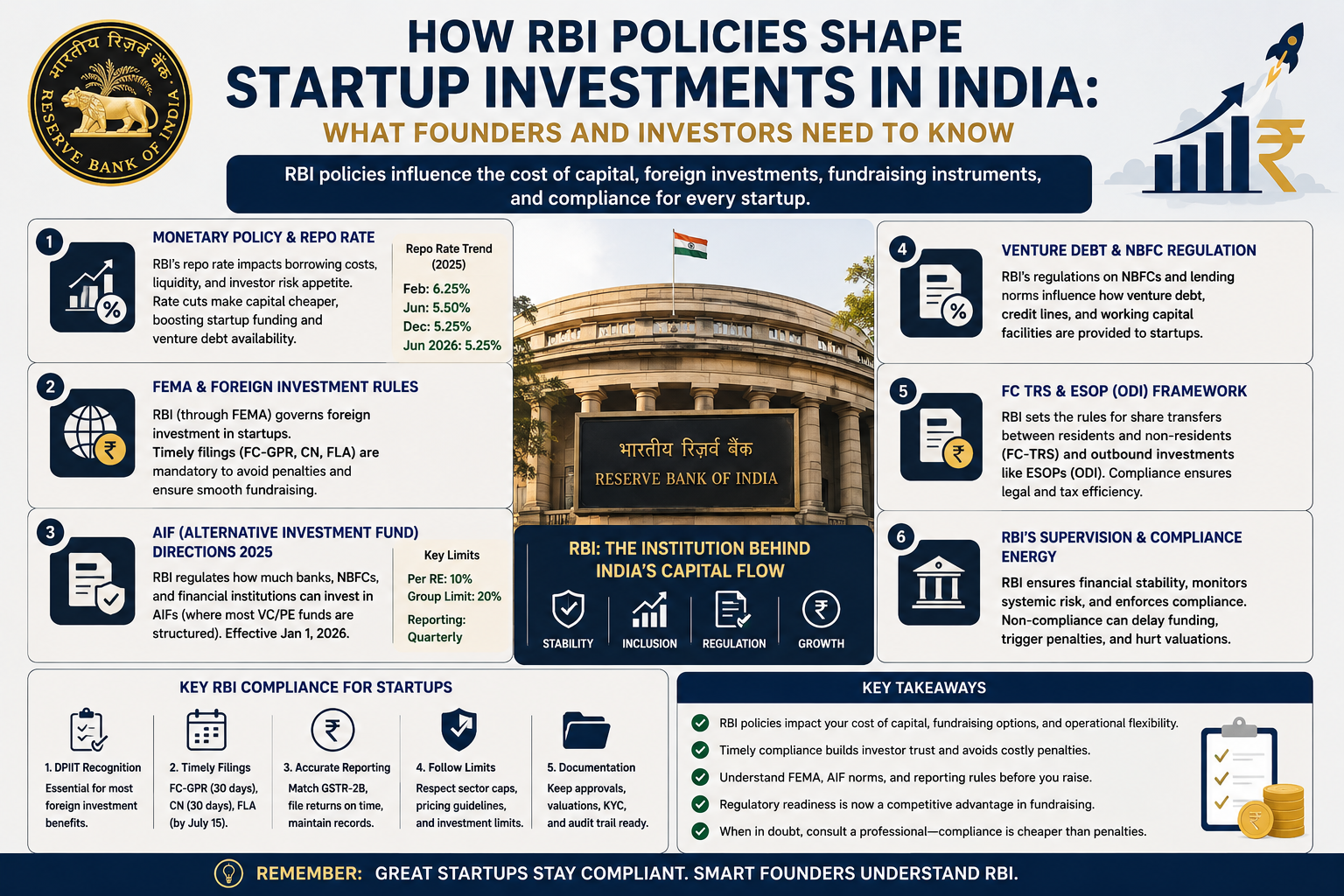
A visual guide to how RBI policies shape startup fundraising, foreign investments, venture debt, and regulatory compliance for Indian founders and investors.
Explore the RBI policies that directly impact startup fundraising, foreign investments, venture debt, and fintech compliance. Learn how understanding these regulations can help founders raise capital smoothly and avoid costly compliance mistakes.
Written by TFN Research Desk | covering startups, technology, venture capital, and business strategy.
Most founders encounter the RBI the first time they mess something up. A foreign investor wires money, the deadline for filing Form FC-GPR passes, and suddenly a routine seed round has a penalty clock running. That is how most people in the Indian startup world first understand what the Reserve Bank of India actually does in their lives.
But that view is too narrow. The RBI is not just a compliance obstacle between you and your investor’s wire. It sets the cost of capital in the country, decides how much institutional money can flow into venture funds, controls whether foreign investors can use instruments like convertible notes, and now even shapes who can fund M&A deals. If you are building a startup in India, or investing in one, the RBI is in the room every time a funding decision gets made.
This is a breakdown of the key RBI policies that affect startup investments in 2025-26 what they mean, how they work in practice, and where the friction points are.
The Repo Rate: How Monetary Policy Reaches Your Cap Table
The relationship between the repo rate and startup funding is indirect but real. When the RBI lowers the repo rate, banks borrow cheaper, and that cost reduction eventually reaches venture debt providers, NBFCs lending to startups, and institutional LPs deploying into AIFs.
In February 2025, the RBI cut the repo rate for the first time in five years, bringing it down from 6.50% to 6.25%. It did not stop there. By June 2025, it delivered a sharper 50 basis points cut, taking the rate to 5.50%. By December 2025, the rate had come down further to 5.25%. In its June 2026 MPC meeting, the RBI held it steady at 5.25%, maintaining a neutral policy stance.
What this means practically: working capital loans, venture debt facilities, and NBFC credit lines to startups all become cheaper during a rate-cutting cycle. For early-stage companies that cannot raise large equity rounds, this is meaningful. It also shifts investor behaviour. When fixed deposit rates drop and bond yields compress, domestic institutional capital looks harder at equity-adjacent instruments, including those that flow through AIFs into startups.
The rate cut cycle that started in early 2025 is not a one-time event. It reflects the RBI’s read that India’s growth needs support and inflation is under control, with CPI dropping to 3.2% in April 2025, a six-year low. That macro backdrop creates a better fundraising environment for startups, even if the direct connection takes time to show up in deal flow.
FEMA and Foreign Investment: The Paperwork That Can Kill a Round
For any Indian startup raising money from a foreign investor, FEMA is the operative framework and the RBI is the regulator enforcing it. The mechanics matter because non-compliance is not forgiven retroactively. A missed filing from two years ago will surface during Series B due diligence and become your problem.
Here is how the framework works in practice. When a foreign entity or NRI invests in your startup under the automatic route (which covers most sectors including tech), the FDI is permitted without prior approval. But within 30 days of allotting shares, you must file Form FC-GPR through your Authorised Dealer bank on the FIRMS portal. Every year, by July 15, you also need to file the Foreign Liabilities and Assets (FLA) return covering any year in which you had outstanding foreign investment.
Late FC-GPR filings attract a compounding penalty of 0.025% of the investment amount per day of delay. A missed FLA return draws a flat penalty of Rs 10,000 per return plus elevated scrutiny on future transactions.
The good news is that DPIIT-recognized startups get specific advantages under this framework. They can issue Convertible Notes to foreign investors, a tool that lets founders defer valuation negotiations to the next round. The minimum per foreign investor is Rs 25 lakh in a single tranche, the note must convert into equity within five years, and it must be reported to the RBI via Form CN within 30 days of issuance. Non-residents (excluding those from countries sharing land borders with India without prior government approval) can now subscribe to these notes after 2024 reforms also eased the process for individual non-resident investors.
The 2024 FEMA reforms also introduced a useful structural change: deferred consideration in FDI transactions. Part of the purchase consideration for shares can now be held in escrow for up to 18 months, enabling milestone-based funding structures where investors release capital in tranches tied to performance.
| Filing | Trigger | Deadline | Penalty for Default |
| Form FC-GPR | Foreign equity allotment | 30 days from allotment | 0.025% of amount per day |
| Form CN | Convertible note issuance or transfer | 30 days | Penalties under FEMA, compounded by RBI |
| FLA Return | Any year with outstanding FDI | July 15 annually | Rs 10,000 per return |
| Form FC-TRS | Transfer of shares between resident and non-resident | 60 days from transfer | FEMA penalties |
DPIIT recognition is not optional for founders planning international fundraising. It should be the first step, not something addressed before a Series A.
The AIF Directions 2025: How RBI Controls Institutional Capital into Venture Funds
This is the policy most founders do not know about, even though it directly affects how much institutional capital flows into the VC funds investing in their companies.
In July 2025, the RBI issued the RBI (Investment in AIF) Directions, 2025, effective January 1, 2026. These directions govern how much banks, small finance banks, NBFCs, and co-operative banks (collectively called Regulated Entities or REs) can invest in AIFs, which is the structure under which most Indian VC and PE funds operate.
The new rules set two hard limits. A single RE cannot invest more than 10% of the corpus of any AIF scheme. The collective investment by all REs in a single AIF cannot exceed 20% of its total corpus. These caps are designed to prevent any one institutional investor from dominating a fund’s LP base, which reduces systemic concentration risk.
For startups, the downstream effect works like this: VC and PE funds that were relying on bank or NBFC capital as LP commitments now face restrictions on how much that institutional money can contribute. Category III AIFs (primarily hedge funds) were effectively barred from bank investment under the group-level restrictions introduced in December 2025. Category I AIFs, which include startup and SME-focused funds, are treated differently. The new framework distinguishes between equity-type exposure (exempt from the harsher provisioning requirements) and debt exposure, which benefits funds investing in startup equity.
The practical implication is that VC funds raising new vehicles in 2026 need to think harder about LP composition. Funds that were quietly relying on bank or NBFC anchor commitments now need alternative institutional LPs. That may slow new fund formation at the margin, but it also makes surviving funds more disciplined about capital structure.
The Acquisition Finance Rules: RBI Opens the Door for M&A
In February 2026, the RBI issued final guidelines for acquisition finance, effective April 1, 2026. This is a significant shift. For decades, Indian banks were largely prohibited from lending money for corporate buyouts. That gap was filled by foreign lenders and private credit funds, often at high cost and with complex cross-border structures.
The new rules allow commercial banks to fund acquisition transactions with loans covering up to 75% of the deal value. The acquirer needs to contribute only 25% in equity. To qualify, the company needs a minimum net worth of Rs 500 crore, three consecutive years of net profit, and an investment-grade credit rating for unlisted acquirers.
For late-stage startups or scaleups approaching acquisition either as a target or as a buyer, this matters in two ways. First, strategic acquirers now have domestic bank financing available, which could increase the number of credible buyers and improve exit valuations. Second, the rules also raised limits for individual investors: loans against shares went up to Rs 1 crore per person (from Rs 20 lakh), and IPO and ESOP subscription loans now go up to Rs 25 lakh per individual with a 25% cash margin.
The fine print matters: financing related-party transactions is prohibited unless the purpose is increasing a stake in an entity already controlled by the acquirer. Debt-to-equity post-acquisition cannot exceed 3:1. These guardrails are firm.
The Regulatory Sandbox and Fintech Startups
Fintech founders face a distinct layer of RBI interaction. The RBI’s Regulatory Sandbox framework allows fintech startups to test innovative products in a controlled environment before obtaining full licensing. This is relevant for founders building in digital lending, payment aggregation, cross-border remittances, or any product that touches regulated financial services.
In 2025-26, the RBI has tightened rules on payment aggregators, digital lending, and First Loss Default Guarantee (FLDG) structures. Digital lending guidelines mandate that loan disbursals and repayments flow directly between the lender and borrower, cutting out pass-through arrangements that some fintechs were using to obscure their actual risk exposure. For founders building embedded finance or BNPL products, these restrictions require structural redesigns that can take months.
Payment aggregator licensing has also become more rigorous. Any platform processing third-party payments now needs an RBI licence, and the scrutiny on KYC, fraud monitoring, and fund flow documentation has increased substantially. Founders in this space who skipped licensing because they were “small” are now catching up under threat of enforcement.
The Take Nobody Will Say Out Loud
The RBI is doing two contradictory things at the same time, and very few people are tracking both moves simultaneously.
On one hand, it is opening doors: cheaper money through rate cuts, cleaner foreign investment through simplified FEMA reporting, acquisition finance that gives Indian companies a domestic funding option for M&A, and AIF rules that distinguish between equity and debt in a way that actually protects startup-focused funds.
On the other hand, it is tightening the screws on anything that smells like regulatory arbitrage. The AIF directions are partly a response to banks using fund structures to evergreen bad loans. The fintech rules are partly a response to digital lenders obscuring who bore actual credit risk. The acquisition finance guardrails prevent the same companies from treating cheap bank money as speculation capital.
Founders who read the RBI’s moves as “opening up” are not wrong. Investors who read them as “tightening up” are not wrong either. Both are correct, and that is the point. The RBI is trying to build an investment environment that can absorb serious institutional capital without replicating the structural failures that caused the NBFC crisis of 2018-19.
What that means for you: do not treat RBI compliance as a legal department problem. Understanding which regulatory windows are open right now, and which are closing, is itself a strategic advantage.
Frequently Asked Questions
Does DPIIT recognition automatically mean RBI compliance? No. DPIIT recognition gives you access to tools like Convertible Notes and certain pricing guideline exemptions, but compliance with FEMA filing deadlines, FLA returns, and reporting through the FIRMS portal remains your responsibility. Recognition opens doors; it does not close the ones you leave unlocked.
What happens if a foreign investor’s convertible note is not filed on time with the RBI? The delay triggers penalties under FEMA, compounded by the RBI based on the amount involved. Repeated or prolonged non-compliance can draw enhanced regulatory scrutiny on all future transactions, including any future FDI rounds. Compounding applications through the RBI exist as a remediation path but are not guaranteed or fast.
Can an angel investor from the US invest via a convertible note in an Indian startup? Yes, as long as the startup is DPIIT-recognized, operates in a sector open to 100% FDI under the automatic route, and the minimum investment per investor is at least Rs 25 lakh in a single tranche. The startup must file Form CN within 30 days of issuance on the RBI’s FIRMS portal.
How do the new AIF investment caps affect a VC fund that relies on NBFC LPs? From January 1, 2026, any single NBFC or bank cannot exceed 10% of the AIF’s corpus, and all regulated entities combined cannot exceed 20%. Funds whose LP base included large NBFC anchor commitments above these thresholds need to restructure or replace that capital. Existing commitments have transitional options, but fresh commitments are governed by the new directions.
Do the new acquisition finance rules help startup founders looking for exits? Yes, indirectly. Allowing Indian banks to fund up to 75% of acquisition deals lowers the cost and complexity of corporate M&A for domestic acquirers. That increases the pool of credible strategic buyers for late-stage startups, which should improve exit optionality for founders and early investors.
What is the FIRMS portal and why does it matter? FIRMS stands for Foreign Investment Reporting and Management System. It is the RBI’s online platform through which all FDI-related filings are submitted, including FC-GPR, Form CN, and FC-TRS. Your Authorised Dealer bank handles the actual submission, but the data and documentation are the company’s responsibility. FIRMS is where FEMA compliance either gets built or gets broken.
Is the repo rate cut cycle likely to continue in 2026? As of the June 2026 MPC meeting, the RBI held the repo rate steady at 5.25% with a neutral stance. The inflation trajectory and global trade environment will determine whether further cuts follow. For startups, the more immediate benefit is that the cost of venture debt and working capital credit has already come down meaningfully since February 2025.
Sources
- Cyril Amarchand Mangaldas — RBI (Investment in AIF) Directions, 2025 analysis
- https://corporate.cyrilamarchandblogs.com/2025/08/rbi-notifies-restrictions-on-investments-by-regulated-entities-in-aifs/ Chambers and Partners — Analysis of new AIF directions
- https://chambers.com/articles/the-rbi-s-new-directions-on-investments-by-regulated-entities-in-alternative-investment-funds Business Outreach — RBI Capital Market Rules 2026
- https://www.businessoutreach.in/rbi-capital-market-rules-2026-ipo-ma-funding/ KC Shah & Associates — FEMA compliance guide for startups
- https://kcshah.com/blog-fema-compliance-startups.html GenZ CFO / GrowthX — FDI compliance under FEMA for startups
- https://genzcfo.com/growthx/fdi-compliance-under-fema-for-startups-raising-foreign-capital IP and Legal Filings — RBI 2024 FEMA reforms
- https://www.ipandlegalfilings.com/rbi-simplifies-forex-rules-for-start-ups Press Information Bureau — RBI June 2025 Monetary Policy
- https://www.pib.gov.in/PressNoteDetails.aspx?ModuleId=3&NoteId=154573 ClearTax — Repo rate history 2025-26
- https://cleartax.in/s/repo-rate TechCrunch — India approves ₹100 billion Fund of Funds 2.0
- https://techcrunch.com/2026/02/14/india-doubles-down-on-state-backed-venture-capital-approving-1-1b-fund/ SEBI / Virtual Auditor — SEBI AIF changes 2026
- https://virtualauditor.in/learn/sebi-circulars-2026-startup-impact/
Stay in the Loop
For more stories, breakdowns, and unfiltered takes on what is really happening in Indian and global business and tech, follow TheFounder Nation.
Instagram Handle : https://www.instagram.com/thefoundernation?igsh=MTZobDUwc2xqZWdhOA==
We cover what the mainstream business press won’t.
© TheFounder Nation | All rights reserved