

Explore how Make in India and the Production Linked Incentive (PLI) scheme are shaping India’s startup ecosystem, manufacturing, and deep-tech innovation. Learn where founders can benefit, which sectors offer the biggest opportunities, and why government policy is influencing private investment.
Written by TFN Research Desk | covering startups, technology, venture capital, and business strategy.
There is a version of the Make in India story that the government tells and a version that founders live through. They are not the same story.
The official version: Make in India, launched in 2014, created a manufacturing renaissance. The Production Linked Incentive scheme followed in 2020, committing Rs 1.97 lakh crore across 14 sectors. Investments under PLI crossed Rs 2 lakh crore by September 2025. Incremental production and sales hit Rs 18.70 lakh crore. Over 12.60 lakh direct and indirect jobs were created. By 2026, India’s Global Innovation Index rank had improved to 38th, up from 66th in 2019.
The founder version: PLI is primarily a scheme for companies that can invest crores in capital-intensive manufacturing at scale. The eligibility thresholds for most PLI categories are calibrated for large firms, not pre-revenue startups. The sectors that received the biggest cheques mobile phones, pharmaceuticals, automobiles were largely captured by Foxconn, Tata, Samsung, and Dr. Reddy’s. The startup got the press release. The large corporate got the incentive.
Both versions are true. Understanding how depends on which part of the manufacturing ecosystem you are in and what stage you are at.
What Make in India and PLI Actually Are
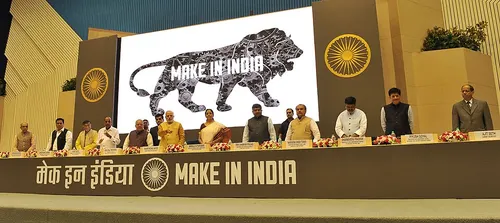
Make in India is the policy umbrella. It was designed to raise manufacturing’s share of GDP from around 15% to 25% by 2025, attract foreign direct investment into manufacturing, and reduce dependence on imports. It opened sectors to FDI, simplified some regulatory clearances, and built the narrative around India as a production destination.
PLI is the implementation instrument. Rather than building industrial parks or handing out grants, PLI pays companies a percentage of their incremental sales above a base year threshold. The incentive rate varies by sector, running between 4% and 18% of incremental sales, typically structured over five to six years. The model rewards actual output, not intent, which is theoretically sound. The problem is structural: to receive a meaningful PLI payout, a company first needs to invest heavily in production capacity, which requires capital most early-stage startups simply do not have.
By 2026, 806 applications have been approved across all 14 PLI sectors. Cumulative incentives disbursed stand at Rs 23,946 crore. Of the direct beneficiaries, only around 176 are MSMEs. Everything else in that approval count is larger enterprises.
Where Make in India Is Actually Creating Startup Funding
The impact on startup funding is real, but it operates through indirect channels rather than direct PLI disbursals. Three mechanisms are worth understanding.
The first is supply chain creation. When Apple ramped up iPhone production in India in 2025, exports reportedly rose 76% year-on-year. Foxconn alone committed USD 1.5 billion near Chennai. That scale of manufacturing does not happen in isolation. Large PLI beneficiaries create extensive supplier networks, and that is where startups and MSMEs enter the picture. Startups building in embedded systems, IoT devices, printed circuit board design, component manufacturing, and electronic testing equipment now have actual domestic anchor customers in Foxconn, Dixon Technologies, and Tata Electronics. For founders building in these categories, government-induced manufacturing volume translates into a real demand signal that investors respond to.
The second mechanism is investor confidence. When a government commits Rs 1.97 lakh crore to a policy direction, it changes what private capital considers fundable. VC funding for deep tech as a share of total Indian VC has grown meaningfully over the past three years. Deep tech investments in India reached USD 1.57 billion across 265 deals in 2025, a 25.8% jump from the prior year. The number of advanced manufacturing startups in India has grown nearly tenfold over the last four to five years, according to Accel. That pace of startup formation tracks directly with the policy signal that manufacturing is a government priority.
The third is the India Deep Tech Alliance, a USD 1 billion-plus private investor coalition formed in early 2026 that includes Accel, Blume Ventures, Celesta Capital, Premji Invest, Ideaspring Capital, Qualcomm Ventures, and Kalaari Capital, with Nvidia as an adviser. This coalition was explicitly catalysed by the government’s public capital commitments, including the Rs 1 lakh crore Research, Development and Innovation fund and the Startup India Fund of Funds 2.0. When the government anchors a policy direction with serious capital, institutional investors build structures around it.
The PLI Sectors Generating Startup Opportunity: A Breakdown
Not all 14 PLI sectors are equal for startup opportunity. Some are essentially closed to startups by their scale requirements. Others have created genuine entry points.
Drones are the clearest example of a PLI vertical that was designed with startups in mind. The scale requirements are lower, the technology is IP-intensive rather than capital-intensive, and the government has paired PLI with procurement mandates. Companies like Garuda Aerospace, ideaForge, and Throttle Aerospace have raised meaningful private capital in a market that PLI helped legitimise.
Semiconductors are the most strategically important PLI bet. Ten semiconductor manufacturing and packaging projects have been approved as of August 2025, with cumulative investments of around Rs 1.60 lakh crore. The government’s approach favours fabless chip design, where India can win on engineering talent, over capital-heavy fabrication. Startups like Mindgrove Technologies have taped out India’s first 28nm secure IoT chip. The domestic semiconductor market is projected to grow from USD 54 billion in 2025 to USD 108 billion by 2030. Investors following this trajectory are already positioning.
Advanced manufacturing, covering robotics, precision components, and EV batteries, is where the startup formation rate has been highest. EV startups benefit from a rare alignment of PLI-backed battery manufacturing, state-level purchase subsidies across Delhi, Maharashtra, Gujarat, and Tamil Nadu, and genuine consumer demand as India electrifies two-wheelers and last-mile logistics vehicles.
| PLI Sector | Startup Entry Point | Funding Signal |
| Drones | Direct PLI eligibility at lower thresholds | Strong: procurement mandates + PLI disbursals |
| Semiconductors | Fabless chip design, IoT, embedded systems | Growing: DLI scheme + government procurement |
| Electronics / Mobile | Component and PCB supply chain | Moderate: requires large anchor customer |
| EV Batteries | Cell tech, BMS software, charging infra | Strong: demand + multi-state subsidies aligned |
| Space tech | ISRO ecosystem, launch and satellite services | Growing: government deregulation + global demand |
| Defence tech | IDEX grants + import substitution demand | Strong: large procurement budgets, long cycles |
The Honest Problem: Make in India Favours the Already-Large
The structural critique of Make in India and PLI is not that the policy failed. On its own terms, the production and investment numbers are real. The critique is that the policy architecture systematically advantages companies that already have capital, established operations, and existing regulatory relationships.
To illustrate: the mobile phone PLI required minimum committed investment thresholds that effectively screened out all but the largest domestic manufacturers and global OEMs. Samsung and Apple’s contract manufacturers qualified. A hardware startup building accessories or components did not, unless it entered as a supplier to a company that did.
A finfluencer debate that reached mainstream coverage in April 2025 crystallised a sharper version of this critique. The argument made was that India’s most celebrated startups, including Ola, Zomato, and Paytm, are essentially contextualised copies of global business models rather than original Indian inventions. Make in India’s deeper goal, building genuine IP-led product companies, has not been achieved by the software unicorn class. The first-principles innovation is now being attempted by deep tech startups, not the app companies that dominated the last decade.
That tension is real. Of India’s 117-plus unicorns as of 2026, the vast majority built software distribution businesses, not manufacturing companies. Make in India’s legacy in startup terms is not the unicorns it helped create. It is the permission structure it established for the next wave: hardware founders, deep tech engineers, and manufacturing startups who now have a government policy direction aligned behind their bets.
The Fund of Funds Effect: Public Capital Catalysing Private Investment
The most tangible startup funding effect of Make in India policy is not PLI incentives. It is the Fund of Funds model that the government has deployed twice.
The first Fund of Funds, launched in 2016 as part of Startup India, committed Rs 10,000 crore to 145 private VC funds. Those funds invested over Rs 25,500 crore in more than 1,370 startups, a better than 2.5x multiplier on government capital.
The second iteration, Startup India Fund of Funds 2.0, received cabinet approval in February 2026 with the same Rs 10,000 crore corpus. This version is more targeted: deep tech and manufacturing startups, early-stage founders outside major metros, and smaller VC firms that lack LP access to institutional capital. The notified FoF 2.0 explicitly names electronics manufacturing, semiconductor design, and technology-led manufacturing as priority sectors, making the Make in India alignment explicit.
The RDI Fund, a separate Rs 1 lakh crore mechanism announced in the 2025 Union Budget, will use long-term loans, equity infusions, and direct allocations to deep tech VC funds. Unlike a standard Fund of Funds, RDI is designed to take direct positions in startups and provide grants alongside capital. The first batch of fund managers under RDI had been identified by early 2026, with deployment expected through 2026-27.
The Take Nobody Will Say Out Loud
Make in India did not create the Indian startup funding boom. That boom was driven by global liquidity, domestic demographic tailwinds, UPI-enabled distribution, and a decade of compounding private market activity. What Make in India did was give the next category of Indian startups, the hardware founders, the chip designers, the drone builders, and the defence tech engineers, a reason to exist in India rather than incorporate in Singapore and build for the world from abroad.
The policy is genuinely more useful to a 2026 founder than it was to a 2016 founder. The supply chains are more developed. The public capital is more targeted. The private investors who follow government signals have built dedicated deep tech funds. Celesta Capital, Speciale Invest, and IvyCap now focus on what Sequoia and Accel focused on a decade ago: spotting the first movers before the category becomes obvious.
The real beneficiary of Make in India is not the startup that applied for PLI and got rejected because its balance sheet was too small. It is the startup that built a product the PLI beneficiaries now need to buy. That is not the story the government tells. But it is the one that produces durable companies.
Frequently Asked Questions
Can an early-stage startup directly apply for PLI benefits? Most PLI schemes have investment and sales thresholds that are calibrated for medium to large manufacturers. The drone PLI is the clearest exception, with lower entry requirements. For most sectors, the realistic path for early-stage startups is to become a supply-chain partner to a larger PLI beneficiary, not a direct applicant. Sectors like drones, medical devices, and food processing have relatively lower thresholds and are more accessible to startups with Rs 5-50 crore in capital.
How does the Startup India Fund of Funds 2.0 reach startups? The government does not invest directly in startups under the Fund of Funds structure. It commits capital to SEBI-registered VC and PE funds as an LP, and those funds deploy into startups on commercial terms. Startups access this capital by raising from VC funds that have received FoF 2.0 commitments. The benefit to startups is indirect: the government anchor LP makes it easier for smaller VC funds to raise their own corpus, which deepens the pool of investors available at pre-seed and seed stages.
Which sectors under Make in India are best for a first-time founder? Drones, defence tech through IDEX grants, and semiconductor-adjacent software and design. These sectors have explicit government procurement commitments, which provide a first customer that does not depend on private market demand. Space tech has also opened up meaningfully after ISRO deregulation. EV charging infrastructure and battery software are attractive for founders with a consumer market orientation rather than a pure B2B industrial focus.
Is the criticism that Make in India only benefits big corporates fair? Partly. The PLI disbursals are concentrated among large manufacturers. Of the 806 approved PLI applicants across 14 sectors, only around 176 are MSMEs. The scheme was not designed as a startup program. Where the criticism overstates the case is in ignoring the second-order effects: the supply chains, the investor confidence, and the fund-of-funds capital that flows downstream to startups building in the same sectors. The policy benefits are real, but they are indirect for most early-stage founders.
What is the RDI Fund and how is it different from the Fund of Funds? The Research, Development and Innovation Fund is a Rs 1 lakh crore mechanism announced in the 2025 Union Budget. Unlike the Fund of Funds, which only invests in startups indirectly through VC funds, the RDI Fund can take direct equity positions in deep tech startups, provide long-term loans, and disburse grants. It is designed for science-led and IP-intensive companies with longer development timelines where traditional VC capital is insufficient. The first fund managers were being identified in early 2026.
Does Make in India affect how investors value manufacturing startups differently now? Yes, in a meaningful way. Investors who previously dismissed hardware and manufacturing startups on the grounds of capital intensity and low margins are now revisiting those assumptions. Advanced manufacturing was described by Accel as a clear “right to win” for India in 2025. The availability of government-backed patient capital through FoF and RDI reduces the risk profile of investing in manufacturing startups, which changes the IRR calculation for institutional funds.
If India’s startup funding fell 17% in 2025, did Make in India fail? The 2025 funding decline was not a Make in India failure. It reflected global investor caution, high interest rates through most of the year, and a reset from the over-valued 2021-22 peak. Within that declined total, deep tech and manufacturing were the two sectors that saw year-on-year growth in both deal count and deal value. The Make in India-aligned sectors performed better during the funding winter than the software-first sectors that dominated the previous decade.
Sources
- Press Information Bureau — Economic Survey 2025-26
- https://www.pib.gov.in/PressReleaseIframePage.aspx?PRID=2219992 TechCrunch — Startup India Fund of Funds 2.0 cabinet approval
- https://techcrunch.com/2026/02/14/india-doubles-down-on-state-backed-venture-capital-approving-1-1b-fund/ TechCrunch — India changes deep tech startup rules
- https://techcrunch.com/2026/02/07/india-has-changed-its-startup-rules-for-deep-tech/ TechCrunch — India startup funding 2025
- https://techcrunch.com/2025/12/27/india-startup-funding-hits-11b-in-2025-as-investors-grow-more-selective/ CFA Institute — VC investment in India’s deep tech sector
- https://www.cfainstitute.org/insights/articles/india-deep-tech-startup-venture-capital-trends Open The Magazine — Deep tech funding in India
- https://openthemagazine.com/business/explained-why-venture-capital-is-betting-big-on-indias-deeptech-startups Bajaj Finserv — PLI scheme overview
- https://www.bajajfinserv.in/production-linked-incentive-pli-scheme Electronics For You — Startup India FoF 2.0 notification
- https://www.electronicsforyou.biz/industry-buzz/government-notifies-%e2%82%b9100-billion-startup-fund-push-likely-for-electronics-manufacturing-ecosystem/ Business Today — Make in India criticism
- https://www.businesstoday.in/india/story/make-in-india-a-failed-campaign-finfluencer-highlights-problems-with-indias-startups-470495-2025-04-03 Best Startup India — Q1 2026 funding
- https://beststartup.in/india-startup-funding-q1-2026/
Stay in the Loop
For more stories, breakdowns, and unfiltered takes on what is really happening in Indian and global business and tech, follow TheFounder Nation.
Instagram Handle : https://www.instagram.com/thefoundernation?igsh=MTZobDUwc2xqZWdhOA==
We cover what the mainstream business press won’t.
© TheFounder Nation | All rights reserved