

Written by TFN Research Desk — covering startups, technology, digital media, and business strategy.
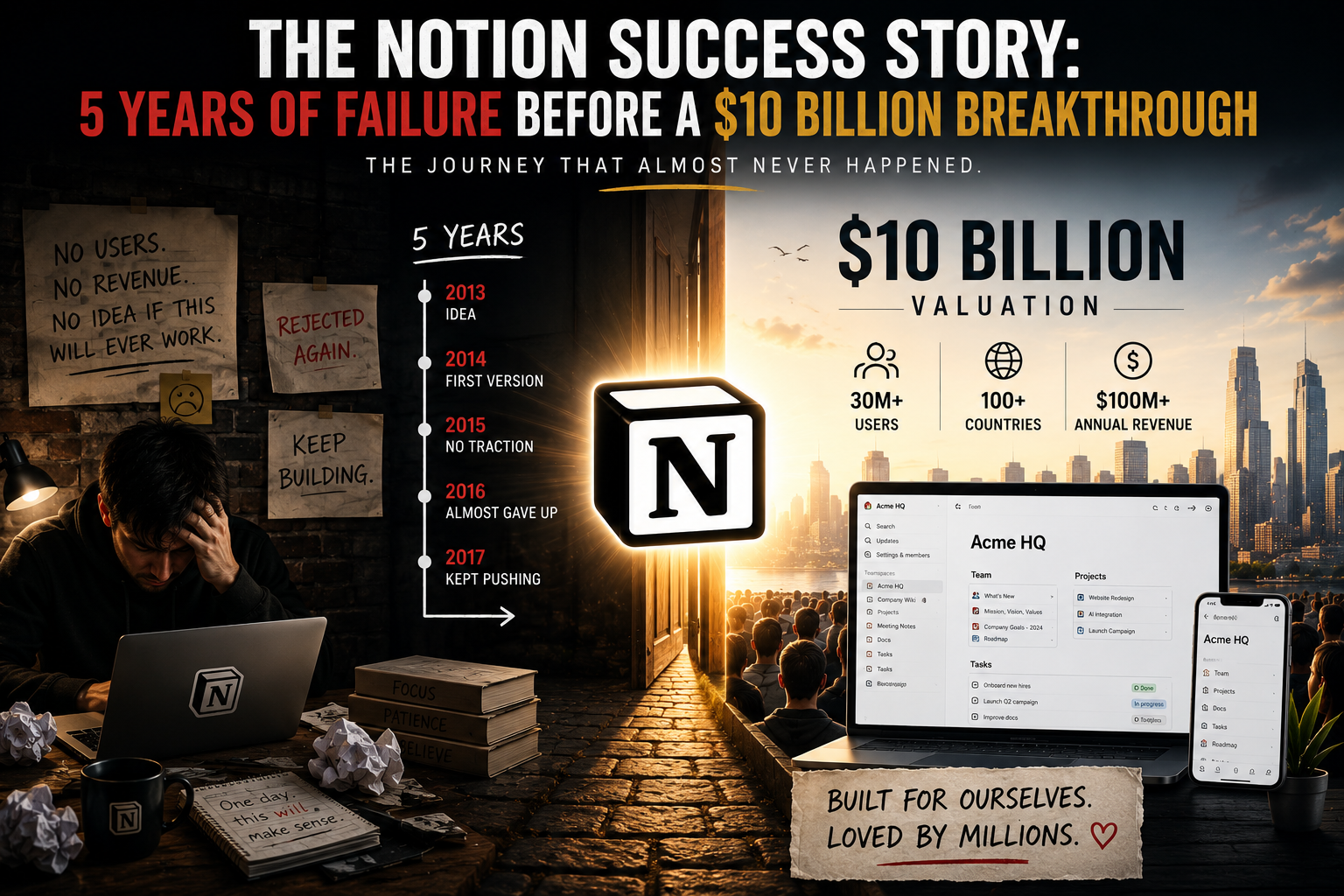
In 2015, Notion had no money, no users, and no working product.
Its founders had just fired all their employees. They borrowed $150,000 from a mother who believed in something she could not fully explain. Then they packed their bags and flew to Japan, not for a vacation, but to disappear from Silicon Valley long enough to rebuild everything from scratch.
No press coverage. No funding announcements. No Product Hunt launches. No growth.
Just two engineers in a rented apartment in Kyoto, eating cheap noodles, rewriting code, and refusing to quit.
That was Notion in its darkest years. And almost nobody knew it was happening.
Then, in March 2018, a single blog post landed. And everything changed.
What Actually Happened With Notion?
Notion was founded in 2013, but spent five years rebuilding its product from scratch, nearly going bankrupt in the process, before a successful 2018 relaunch triggered viral growth. A Notion 2.0 blog post and Product Hunt launch in March 2018 became the turning point that took Notion from near-zero to 1 million users by September 2019, and eventually to a $10 billion valuation by 2021 with over 100 million users.1 2
Before Notion, There Was Just a Dream That Would Not Load
The story most people skip is that Notion’s first version was technically impressive and practically unusable.
When Ivan Zhao and Simon Last built the first version of Notion in 2013, they built it on Web Components and CouchDB, with an offline-first architecture. It sounded brilliant. It crashed constantly. Users lost data. The product was ambitious and broken, in exactly equal measure.3
By 2015, the company was out of money. A minimal seed investment had been burned through. The tech stack was producing a product nobody could rely on. The team was trying to build a horizontal tool, something that could replace docs, wikis, tasks, and databases all at once, and failing to explain to anyone why they should care.4
In the startup world, this is usually where the story ends.
Ivan Zhao had a different idea. He called his mother.
She wired $150,000. He and Simon Last laid off the rest of the small team, packed up, and moved to Kyoto, Japan, to rewrite Notion from the ground up.1 The main GitHub repository for the new codebase was named “notion-next.” It was a bet that the original version was simply not save able.
They were right.
What Notion Actually Built (On the Fourth Try)
The version of Notion that exists today was not the first version. It was not the second or the third either.
Ivan Zhao has said publicly that the team rebuilt Notion four times during those lost years.2 Each rebuild was an attempt to solve the same core problem: how do you hide enormous computing complexity behind an interface so simple that a homemaker, a student, or a startup founder could pick it up in five minutes?
One rebuild had a feature where you could press a key to “X-ray” all the blocks on a page. Nobody asked for this. Nobody used it. It was deleted.2
What emerged from the Japan rewrite was the block-based architecture that Notion users know today. Everything is a block. A block can be a paragraph, an image, a database, a checklist, a calendar, or an embedded spreadsheet. You drag blocks. You nest them. You combine them. The complexity sits underneath, invisible, while the surface stays clean.
The final product launched as Notion 1.0 in March 2016. It hit number one on Product Hunt for Product of the Day, Week, and Month.1
That sounds like a success. It was not, not yet.
Real traction did not come from the 2016 launch. Users came, looked around, and left. Growth was slow. The team was still small. The business still had no clear path.
Ivan Zhao has said it plainly: real signs of traction did not arrive until 2018.2
The Numbers That Explain Everything
| Metric | Figure |
|---|---|
| Founded | 2013 |
| Years before meaningful traction | 5 |
| Product rebuilds before launch | 4 |
| Times hit #1 on Product Hunt | 2 (2016 and 2018)1 |
| Users by September 2019 | 1 million1 |
| Growth rate in 8 months post-2019 | 400%1 |
| Valuation by 2021 | $10 billion4 |
| Users by 2024 | 100 million+2 |
| Employees hired during pandemic | Unicorn status in April 20201 |
The company that reached a $10 billion valuation had spent half a decade being invisible. That is not a bug in the Notion story. It is the entire point of it.
Why the 2018 Blog Post Changed Everything
Notion 2.0 launched in March 2018. This time, something was different.
The rewrite was complete. The product was fast, stable, and genuinely flexible in ways that no productivity tool had achieved before. The team had spent two years since the 2016 launch quietly improving, listening to the small community that had stuck around, and building the version they had originally imagined.
The 2018 Product Hunt launch hit number one again. Product of the Day, Week, and Month, for the second time in two years.1
But the real trigger was not the Product Hunt ranking. It was the community response that followed.
Bloggers, productivity writers, and power users started publishing detailed breakdowns of how they used Notion. YouTube tutorials appeared. Reddit threads grew. Each piece of user-generated content was effectively a personalised product demo that reached exactly the kind of person who would love Notion.
The sharing mechanic was built into the product itself. Every Notion page had a public share link. Every user who built something in Notion and shared it with a colleague was simultaneously introducing that colleague to the product. Viral growth was not an accident. It was an architectural decision.4
What Notion did not do is equally important. They spent almost nothing on advertising. There were no celebrity endorsements, no billboard campaigns, no aggressive sales teams. The product grew because the product was worth talking about, and because the infrastructure for sharing it was already built in.
Why Every Other Productivity Tool Missed the Opportunity
Here is the uncomfortable part of this story for every SaaS company that existed before Notion.
Microsoft had Word, Excel, OneNote, and SharePoint. Google had Docs, Sheets, Drive, and Keep. Evernote was valued at $1 billion. Asana and Trello were the default project management tools for startups everywhere.
None of them were doing what Notion did.
The entire productivity software industry in 2016 was built on the assumption that different tasks needed different tools. You took notes in one app. You managed projects in another. You built wikis in a third. You stored files in a fourth. The idea of doing all of it in one place, with one consistent interface, was either laughed at or ignored.
Notion did not disrupt Evernote. It made the entire category redundant.
The insight was not technical. The technical piece, the block-based architecture, the relational databases hidden behind clean drag-and-drop surfaces, was hard to build. But the insight itself was simple: people do not want more tools. They want fewer tools that do more.
Every competitor had the resources to build what Notion built. Not one of them believed it was worth building.3
The Akshay Kothari Chapter Nobody Reads Closely Enough
In the fall of 2018, Notion had eight employees and a product that was finally working.
Ivan Zhao knew he needed a business partner. He was a product person. The company needed someone who understood how to grow a business. After a long search, Akshay Kothari, the co-founder of Pulse News, which had been acquired by LinkedIn, joined as COO and later co-founder.3
On his first day, Ivan made him turn on push notifications for Intercom, the customer support tool.
Every time a user sent in a support ticket, Akshay’s phone buzzed. For months, his phone buzzed every three seconds.3
This was not an accident or a hazing ritual. It was a deliberate management decision. Ivan believed that every person in leadership needed to feel, physically, in their body, what it was like to have real users with real problems. Not dashboards. Not weekly summaries. Buzzes. Constant, interrupting, unavoidable buzzes.
That obsession with user contact is what separated Notion from the companies that built productivity tools in boardrooms and shipped them to users who then complained on Reddit.
Notion built in public, in private, one support ticket at a time.
What Almost Killed It (Twice)
The first near-death was 2015. The tech stack collapsed. The money ran out. The team was fired.
The second near-death was quieter and more dangerous.
Between 2016 and 2018, Notion had a working product and almost no growth. The 2016 Product Hunt launch had generated attention but not the kind of self-sustaining momentum that makes investors write checks and founders sleep at night. The company was running lean, funded by the belief that the product would eventually find its audience, and not much else.
The horizontal tool problem was real. When your product can do everything, explaining what it is becomes the hardest thing you will ever have to do. Most productivity tools win by being the best at one specific thing. Notion refused to be the best at one specific thing. It insisted on being a platform, a canvas, a foundation on which users could build their own systems.
That bet took five years to pay off.
The moment it paid off was not a single event. It was a slow accumulation. A Reddit post here. A YouTube tutorial there. A student who built their entire academic system in Notion and showed it to their entire university cohort. A designer who built a client portal and sent the link to a client who had never heard of Notion but signed up the same day.
The product grew the way forests grow. Slowly, then all at once, and by the time people noticed, it was already enormous.
The Take Nobody In The Industry Wants To Say Out Loud
Our editors weigh in.
Notion’s real story is not a story about a great product.
It is a story about what happens when founders refuse to accept that the world has decided their idea is finished.
Every indicator in 2015 said Notion should not exist. The money was gone. The team was gone. The product was broken. The category was dominated by companies with billions of dollars and millions of users. Silicon Valley had looked at Ivan Zhao and Simon Last and made its quiet judgment: not this, not now, probably not ever.
They went to Japan , rewrote everything and came back.
The productivity software industry had been building the same tools in the same way for twenty years. Separate apps. Separate data. Separate logins. The assumption was so deeply embedded that nobody stopped to ask whether users actually wanted it this way, or whether they had simply never been given an alternative.
Notion asked the question. The answer turned out to be worth $10 billion.
But here is what the Notion story should make every founder genuinely uncomfortable about.
The five years of darkness were not a bug. They were the product.
The patience to rebuild four times. The discipline to move to another country to eliminate distractions. The decision to turn on push notifications and feel every customer complaint in your pocket. The refusal to ship a marketing campaign before the product was actually ready to convert. All of it happened in the years when nothing was happening.
The blog post in 2018 did not create the product. The product created itself, slowly and painfully, in the years before the blog post existed.
There is a startup somewhere right now that has been quiet for three years. They have rebuilt twice. The founders have told their investors to be patient. The industry has not noticed them.
In two years, you will read about their overnight success.
Frequently Asked Questions
Who founded Notion?
Ivan Zhao and Simon Last founded Notion in 2013. Akshay Kothari joined as COO and later co-founder in 2018.3
Why did Notion almost fail?
By 2015, Notion had burned through its seed funding, its tech stack was producing constant crashes, and the team could not explain the product clearly enough to attract new users. Ivan Zhao borrowed $150,000 from his mother to keep it alive.1
Why did Notion move to Japan?
Ivan and Simon moved to Kyoto to eliminate social distractions, cut costs, and focus entirely on rewriting the product from scratch. The main git repository from this period is still called “notion-next.”2
How many times did Notion rebuild its product?
Four times, by Ivan Zhao’s own account, before arriving at the version that launched in 2016 and was refined into Notion 2.0 in 2018.2
When did Notion hit 1 million users?
September 2019, roughly 18 months after the Notion 2.0 launch.1
How did Notion grow without advertising?
Through product-led growth: every shared Notion page was a product demo. The built-in share link turned users into an involuntary distribution network. Community content, tutorials, and template sharing did the rest.4
What is Notion’s current valuation?
Notion was valued at $10 billion in 2021, making it one of the most valuable productivity software companies in the world.4
How many users does Notion have?
Over 100 million users globally as of 2024, with a 20% paying conversion rate that is considered extraordinarily high for a freemium SaaS product.2
Stay in the Loop
For more stories, breakdowns, and unfiltered takes on what is really happening in Indian and global business and tech, follow TheFounder Nation.
Instagram Handle : https://www.instagram.com/thefoundernation?igsh=MTZobDUwc2xqZWdhOA==
We cover what the mainstream business press won’t.
© The Founder Nation | All rights reserved