


Most Indian founders know the government has schemes for startups. Very few founders actually use them.
The gap between awareness and action is larger than it should be. Founders assume the application process is too slow, the criteria too narrow, or the amounts too small to justify the effort. Some of that perception is fair — dealing with government portals is rarely anyone’s idea of a good morning. But a lot of it is laziness disguised as pragmatism.
Here is what the schemes actually offer in 2026: equity-free grants of up to ₹20 lakh for pre-revenue founders, collateral-free credit guarantees of up to ₹20 crore for startups that need working capital, a ₹10,000 crore fund-of-funds that has backed over 1,173 startups through institutional channels, a three-year income tax holiday extended through March 2030, and faster patent filing at lower fees. As of December 2025, India has officially recognised 2,07,135 startups under these frameworks, and those companies have collectively created over 21.9 lakh direct jobs.
The system is not perfect. But for a founder at the right stage, these schemes are not supplementary. They are the difference between extending runway by twelve months or burning through savings to hit a milestone that a grant could have funded for free.
Here is what each major scheme does, who it is for, and what the founder needs to know before applying.
Start Here: DPIIT Recognition Is the Master Key
Before any scheme can be accessed, a startup needs recognition from the Department for Promotion of Industry and Internal Trade. This is not optional — it is the prerequisite for every significant government benefit available to startups in India.
DPIIT recognition requires the startup to be a registered Private Limited Company, LLP, or Partnership. The company must be less than ten years old, have annual turnover below ₹100 crore, and be working on innovation or genuine improvement of a product or service — pure trading businesses do not qualify.
Once recognised, the benefits unlock immediately: income tax exemption, self-certification under labour and environmental laws, reduced patent and trademark fees, and eligibility for every scheme covered in this article. The application is free, processed online through the Startup India portal, and typically approved in two to four working days. There is no reason not to do this on day one.
Startup India Seed Fund Scheme: The First Money a Founder Should Seek
The Startup India Seed Fund Scheme, known as SISFS, exists to solve a specific and painful problem: the gap between having an idea and having enough proof to attract private capital.
Angel investors want traction. Banks want assets. VCs want product-market fit. SISFS funds the work that creates all three. The scheme provides financial assistance for proof of concept, prototype development, product trials, market entry, and early commercialisation. DPIIT allocated ₹945 crore to the scheme to support an estimated 3,600 entrepreneurs through 300 incubators.
The mechanics matter for founders who are deciding whether to apply. SISFS does not give money directly to startups. It works through empanelled incubators across the country, who receive the funds and then select and disburse to eligible startups. A startup applying to SISFS is really applying to be selected by an incubator within the scheme. Grants go up to ₹20 lakh for proof-of-concept work, with convertible debentures or debt instruments for market entry support of up to ₹50 lakh.
Eligibility requires DPIIT recognition, incorporation of less than two years at the time of application, a tech-enabled business model, and no prior government scheme funding above ₹10 lakh. The scheme is sector-agnostic but gives preference to startups in agriculture, healthcare, education, defence, biotechnology, energy, and fintech — sectors where the government has social impact objectives. The application deadline for the current tranche was May 31, 2026, with incubators completing startup selection by June 30, 2026, but DPIIT is expected to announce successor iterations given the scheme’s track record.
For a founder at the idea-to-prototype stage, this is the most important scheme in the ecosystem. Non-dilutive, structured, and widely available across the country.
Fund of Funds for Startups: Where the Institutional Money Comes From
If SISFS is for pre-seed founders, the Fund of Funds for Startups (FFS) is where institutional capital meets the ecosystem.
The government committed ₹10,000 crore to SIDBI under this scheme. SIDBI then commits that capital to SEBI-registered Alternative Investment Funds — professional VC funds — who then invest in startups. Every rupee committed by SIDBI requires the receiving AIF to invest at least two rupees into startups, creating a multiplier effect across the venture capital ecosystem.
As of December 2024, SIDBI had committed ₹11,808 crore to 145 AIFs, mobilising ₹21,276 crore in total investment into 1,173 startups. Of the 82 AIFs anchored under FFS, 55 were first-time fund managers — a deliberate choice to push capital beyond the established venture firms clustered in Bangalore and Mumbai. The outcome is visible: ₹2,145 crore has been invested in startups from Tier-2 and Tier-3 cities under this framework, and 22 FFS portfolio companies have reached unicorn status.
Union Budget 2025-26 announced FFS 2.0 with an additional ₹10,000 crore corpus, with a sharper focus on deep tech, AI, clean energy, and manufacturing startups. This is the government’s most significant capital deployment signal for the next wave of Indian innovation.
Founders cannot apply to FFS directly. The practical pathway is to identify SEBI-registered AIFs empanelled under FFS that invest in your sector and stage, then approach them through a standard fundraising process. DPIIT recognition makes you more fundable within this ecosystem but is not a strict requirement for every AIF.
CGTMSE: Collateral-Free Credit for Founders Who Need Working Capital
Most startups are not cash-intensive research projects. They are businesses that need working capital to pay salaries, carry inventory, or fund the gap between invoice and payment. For those founders, the Credit Guarantee Fund Trust for Micro and Small Enterprises is the most practically useful scheme that the least number of founders think about.
CGTMSE provides credit guarantees to banks, enabling them to lend to startups without requiring collateral or personal guarantees from founders. The startup guarantee limit was increased from ₹10 crore to ₹20 crore in 2025, with the government estimating this change will unlock an additional ₹1.5 lakh crore in MSME credit over five years.
The application process is indirect: a founder applies for a bank loan through any participating bank, and the bank initiates the CGTMSE guarantee application on the startup’s behalf. The startup needs MSME or Udyam registration (which takes ten minutes and requires only Aadhaar and PAN) and must not be classified as an NPA. DPIIT recognition gets a startup access to enhanced coverage terms.
For a founder with a working business that needs growth capital but does not have assets to pledge, CGTMSE is the bridge between operational cash flow and the next stage of growth. It deserves significantly more attention than it typically gets in founder conversations focused on equity fundraising.
SAMRIDH: The Government’s Accelerator for Tech Founders
The Startup Accelerator of MeitY for Product Innovation, Development and Growth — SAMRIDH — is designed specifically for software product startups that have a working product and need structured acceleration to scale.
Where SISFS funds the work of building a product, SAMRIDH funds the work of growing one. The scheme operates through empanelled accelerators across India, providing matching funding of up to ₹40 lakh per startup alongside the accelerator’s own contribution. The result is up to ₹80 lakh in combined capital, plus access to customer connections, investor introductions, and international market exposure. As of 2026, the scheme has funded over 373 startups with a total disbursement exceeding ₹93 crore.
SAMRIDH is run by MeitY, which means its strongest alignment is with IT and software product companies. Founders building consumer apps, enterprise SaaS, AI tools, or digital infrastructure are well-positioned for this scheme. The application goes through the accelerator, not directly to MeitY, so the first step is identifying a SAMRIDH-empanelled accelerator that operates in your sector.
For founders who are post-product but pre-institutional-round, SAMRIDH is the most underutilised government scheme in the ecosystem. The combination of matching capital and structured acceleration is valuable at a stage where most founders are trying to stretch a small seed round further than it can reasonably go.
Tax Benefits and Compliance Perks: The Non-Capital Advantages
Beyond the capital schemes, DPIIT recognition unlocks two benefits that founders consistently undervalue until they have experienced the alternative.
The income tax holiday exempts DPIIT-recognised startups from paying tax on profits for any three consecutive financial years within the first ten years of incorporation. This was originally set to expire in March 2025 but was extended through March 2030 under Union Budget 2025-26. A startup claiming this exemption needs to apply under Section 80IAC of the Income Tax Act. The saving is not hypothetical — for a startup turning profitable at Series A or B, this can mean several crore rupees retained in the business rather than paid to the exchequer.
IPR fast-tracking gives DPIIT-recognised startups access to expedited patent and trademark examination, with filing fees reduced by up to 80% compared to standard applicants. For founders in biotech, hardware, or deep tech where IP is a core asset, this benefit materially accelerates the time to defensible intellectual property.
Self-certification under nine labour laws and three environmental laws allows startups to avoid inspector visits and compliance filings during their early years. For founders who would otherwise spend time on regulatory paperwork rather than building, this is meaningful time returned.
The Scheme Stack: How to Combine Them
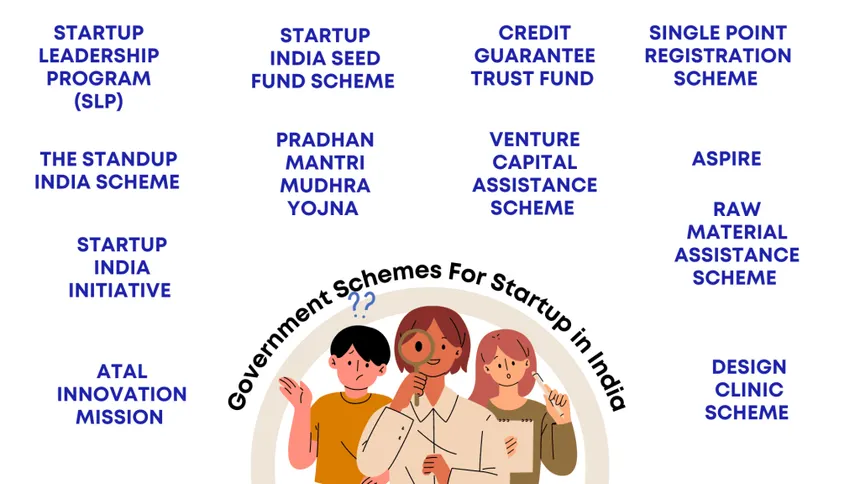
The most sophisticated founders do not pick one scheme. They layer them.
A typical combination for an early-stage tech founder in 2026: DPIIT recognition to unlock everything else, followed by Udyam registration for MSME benefits, then SISFS through an empanelled incubator for prototype funding, CGTMSE through a bank for working capital once the product is live, and SAMRIDH through an accelerator when the product needs distribution and investor introductions. The only hard restriction is SISFS’s requirement that the startup has not received more than ₹10 lakh from any Central or State government scheme prior to applying — a cap that shapes the sequencing.
| Scheme | Managed By | Best For | Max Benefit | How to Apply |
| DPIIT Recognition | DPIIT | All startups, day one | Unlocks all other schemes | Startup India portal (free) |
| SISFS | DPIIT via incubators | Pre-revenue, <2 years old | ₹50 lakh (grant + instrument) | Through empanelled incubator |
| Fund of Funds (FFS 2.0) | SIDBI | Growth-stage, Series A/B | Via AIF investment | Pitch to FFS-empanelled AIF |
| CGTMSE | SIDBI/Banks | Working capital needs | ₹20 crore credit guarantee | Via any participating bank |
| SAMRIDH | MeitY via accelerators | Software product startups | ₹80 lakh (matching) | Through MeitY accelerator |
| Tax Holiday (80IAC) | Income Tax Department | Profitable startups | 3-year profit exemption | IT return with DPIIT certificate |
What Most Founders Get Wrong About Government Schemes
The most common mistake is treating these schemes as a last resort rather than a first resource.
Founders often approach government schemes after they have already exhausted their own capital, been rejected by three angel investors, and are under runway pressure. At that point, the timelines and documentation requirements feel like obstacles. Applied at the right stage — when a founder is building a prototype or structuring early growth capital — the schemes look and feel completely different.
The second common mistake is underestimating how many schemes can be stacked simultaneously. DPIIT recognition, MSME registration, CGTMSE credit, and SISFS seed funding are not mutually exclusive. A founder who maps their capital plan to include government schemes alongside private capital from the beginning will almost always find their runway extended by twelve to eighteen months compared to a founder who relies entirely on equity rounds.
The third mistake is not getting DPIIT recognition on day one. It is free. It takes two to four working days. Every week of delay is a week without access to tax benefits, IPR fast-tracking, and scheme eligibility.
The Take Nobody Will Say Out Loud
India’s government startup schemes are genuinely useful. They are also genuinely underpromoted — not because the government does not want founders to use them, but because the ecosystem conversation is dominated by venture capital, and VC does not have an incentive to tell founders that their first ₹20 lakh can be equity-free and grant-based.
The founders who benefit most from these schemes are not the ones pitching at Demo Day. They are the founders building in Tier-2 cities, solving problems in agriculture, healthcare, and education, where private capital moves slowly and government conviction moves first. For those founders, the seed fund scheme, the credit guarantee, and the tax holiday are not bureaucratic paperwork. They are the first three chapters of a fundraising story that eventually attracts private capital on better terms — because proof of concept built on grants is cheaper than proof of concept built on equity.
The scheme stack is not a substitute for building a great company. But it is the most capital-efficient way to get from zero to investable. That is a meaningful difference, and most founders leave it on the table because they did not register for DPIIT recognition on the day they incorporated.
Frequently Asked Questions
What is DPIIT recognition and is it mandatory to access government startup schemes? DPIIT recognition is an official status granted by the Department for Promotion of Industry and Internal Trade to startups that meet eligibility criteria around age, turnover, and innovation. It is the master prerequisite for most significant government benefits — tax holidays, IPR fast-tracking, self-certification, SISFS eligibility, and enhanced CGTMSE coverage. It is free, takes two to four working days to process online, and should be applied for on the day a startup is incorporated. There is no reason to delay.
How much money can a startup receive from the Startup India Seed Fund Scheme? SISFS provides up to ₹20 lakh as an equity-free grant for proof-of-concept work, and up to ₹50 lakh through convertible debentures or debt instruments for market entry and early commercialisation. The fund is disbursed through empanelled incubators, not directly from DPIIT to startups. A startup must be DPIIT-recognised, less than two years old at the time of applying, and must not have received more than ₹10 lakh from any prior government scheme.
Can startups access multiple government schemes at the same time? Yes, and most well-advised founders do. A practical combination for an early-stage tech startup is DPIIT recognition for tax and compliance benefits, Udyam registration for MSME lending access, SISFS through an incubator for prototype funding, and CGTMSE through a bank for working capital once the product is live. The only restriction that affects sequencing is SISFS’s ₹10 lakh cap on prior government funding received.
What is the Fund of Funds for Startups and how does a startup benefit from it? FFS is a ₹10,000 crore government corpus managed by SIDBI that invests in SEBI-registered AIFs, which then invest in startups. The government’s contribution requires each receiving AIF to deploy at least double the amount into startups, creating a capital multiplier. As of December 2024, the scheme has backed 1,173 startups with ₹21,276 crore in total investment. Founders cannot apply to FFS directly — the pathway is to identify and pitch to SEBI-registered AIFs empanelled under FFS. FFS 2.0, announced in Budget 2025-26, carries an additional ₹10,000 crore with a focus on deep tech, AI, and clean energy.
What is the income tax holiday for startups and who can claim it? DPIIT-recognised startups are exempt from income tax on profits for any three consecutive financial years within their first ten years of incorporation. This benefit was extended through March 2030 under Union Budget 2025-26. To claim it, a startup applies under Section 80IAC of the Income Tax Act with their DPIIT recognition certificate. For a startup that reaches profitability before a large equity round, this exemption can retain several crore rupees inside the business that would otherwise go to taxes.
What is SAMRIDH and which founders should apply for it? SAMRIDH is a MeitY accelerator scheme that provides matching funding of up to ₹40 lakh per startup alongside an equal contribution from the empanelled accelerator — totalling up to ₹80 lakh in combined capital. It is designed for software product startups that already have a working product and need distribution, customer connections, investor introductions, and international market access. As of 2026, it has funded over 373 startups. Founders apply through MeitY-empanelled accelerators rather than directly to the ministry.
Is the CGTMSE scheme only for MSMEs or can tech startups access it too? CGTMSE is accessible to startups that also hold MSME or Udyam registration, which is available to early-stage companies and takes roughly ten minutes to complete. The scheme provides credit guarantees of up to ₹20 crore — increased from ₹10 crore in 2025 — enabling banks to lend without requiring collateral or personal guarantees. For tech startups that need working capital for hiring, infrastructure, or operational growth, this is one of the most practical government tools available and significantly underused compared to its potential.
Stay in the Loop
For more stories, breakdowns, and unfiltered takes on what is really happening in Indian and global business and tech, follow TheFounder Nation.
Instagram Handle : https://www.instagram.com/thefoundernation?igsh=MTZobDUwc2xqZWdhOA==
We cover what the mainstream business press won’t.
© TheFounder Nation | All rights reserved Word count: ~1,490 | Read time: ~6 minutes Primary keyword: government schemes supporting Indian startups | Secondary: Startup India schemes 2026, DPIIT recognition benefits, SISFS seed fund scheme, Fund of Funds for Startups FFS 2.0, SAMRIDH MeitY, CGTMSE collateral free loan, startup tax holiday India, government grants Indian founders, Startup India portal Featured image alt text: Indian founder at a laptop accessing the Startup India government portal with scheme documents and rupee symbols illustrating equity-free funding options Suggested image filename: government-schemes-indian-startups-2026.jpg