



Most founders begin fundraising the wrong way. They finish their pitch deck on a Friday, send it out on Monday, and then spend the next four months confused about why nothing is closing. The problem is not the deck. The problem is that they had no timeline.
A fundraising timeline is not a calendar of meetings. It is a reverse-engineered plan that starts from the moment you need money in your account and works backward to the moment you need to start building relationships. Get this wrong, and you run out of runway mid-raise. Get it right, and you walk into every investor conversation from a position of control.
In India, a typical fundraising cycle runs between three and nine months from initial outreach to term sheet. In 2026, with investors doing longer diligence and concentrating capital into fewer, stronger deals, the upper end of that range is becoming the norm for first-time founders. That means you need to plan earlier and prepare harder than you think.
Here is how to build a fundraising timeline that actually works.
Start with the End: What Does Closing Look Like?
Before you map a single date on a calendar, answer this question: what does the world look like when this round is closed?
That means knowing your target raise amount, your expected dilution, and your planned use of funds. Pre-seed raises in India typically run between ₹25 lakh and ₹2 crore. Seed rounds land between ₹50 lakh and ₹5 crore. Series A can range from ₹25 crore to ₹100 crore depending on sector and traction. These numbers are not fixed. They are your starting point for working backward.
Once you know what you are raising, calculate the runway it buys you. At pre-seed and seed stage, plan for 12 to 18 months of operation. At Series A, target 18 to 24 months. That runway is the bridge to your next milestone, not a comfort cushion. The money should run out right when you are ready to raise again, not before.
With a close date in mind, work backward through every phase of the process.
Phase One: Preparation (Months 1 to 2)
Nothing moves until this is done, and founders consistently underestimate how long it takes.
Preparation means having a pitch deck that tells a coherent story, a financial model that holds up to scrutiny, and a data room with the basics. Legal documents, incorporation certificates, cap table, any existing contracts with customers or partners. Investors will ask for all of this during diligence. Having it ready before you start outreach saves weeks.
In 2026, Indian VC firms are going deeper on governance earlier. If you have never sent investor updates or kept a clean cap table, that becomes visible during diligence and slows everything down. Fix it before you start talking to investors.
The preparation phase should also include a target investor list. Not a long list. A focused one. For angel and pre-seed rounds in India, you are looking at networks like LetsVenture, Indian Angel Network, Mumbai Angels, or Chennai Angels. For seed and beyond, it is firms like Blume Ventures, 100X.VC, Sequoia Surge, or Accel India depending on your stage and sector. Research each fund, understand their thesis, and identify who inside the fund covers your domain. A cold email to the wrong partner at the right firm is still a wasted email.
Phase Two: Early Relationship Building (Months 2 to 4)
This phase trips up first-time founders more than any other.
Fundraising is not a one-time pitch event. It is a relationship process. Investors in India, particularly angels and early-stage VCs, back founders they have seen develop over time. Walking into a room with a deck and no prior touchpoints puts you at an immediate disadvantage against founders who have been in the investor’s orbit for months.
The practical approach is to start conversations before you are officially raising. Share updates about your traction. Ask for feedback on a specific problem. Introduce yourself through a mutual contact and let the conversation breathe. By the time you formally launch a round, the investor should already know who you are and what you are building.
Warm introductions remain the most reliable path to a first meeting in India. Not cold emails. Not LinkedIn requests. A mutual contact who can say “this founder is worth your time” does more than any pitch deck can.
Phase Three: Active Fundraising (Months 3 to 6)
This is the phase most founders mistake for the entire process.
Active fundraising means running a structured process: first meetings, follow-ups, deep dives, reference calls, and term sheet negotiations happening simultaneously across multiple investor conversations. The goal is to compress the calendar, not stretch it.
For a seed round in India, a typical breakdown looks like this. The first two to four weeks go toward outreach and scheduling first meetings, aiming for 30 to 50 targeted investor contacts. The next four to eight weeks are first meetings, follow-ups, and deeper sessions with interested investors. Diligence by serious investors runs two to six weeks in parallel. Term sheet negotiation and documentation takes another two to four weeks. Money in the bank adds one to two weeks on top of that.
Add it up and you are looking at three to six months minimum, assuming things go smoothly. In practice, first-time founders without warm networks take longer. Founders who started relationship-building in Phase Two close faster.
One number worth keeping in mind: expect to pitch 20 to 30 investors before receiving a single term sheet. This is not failure. It is the nature of the process. Build that ratio into your timeline and your emotional expectations.
Phase Four: Diligence and Documentation (Months 5 to 7)
When an investor is serious, the conversations shift. You will see more structured meetings, requests for financial models, customer reference calls, and founder background checks. This phase is where a disorganised data room becomes expensive.
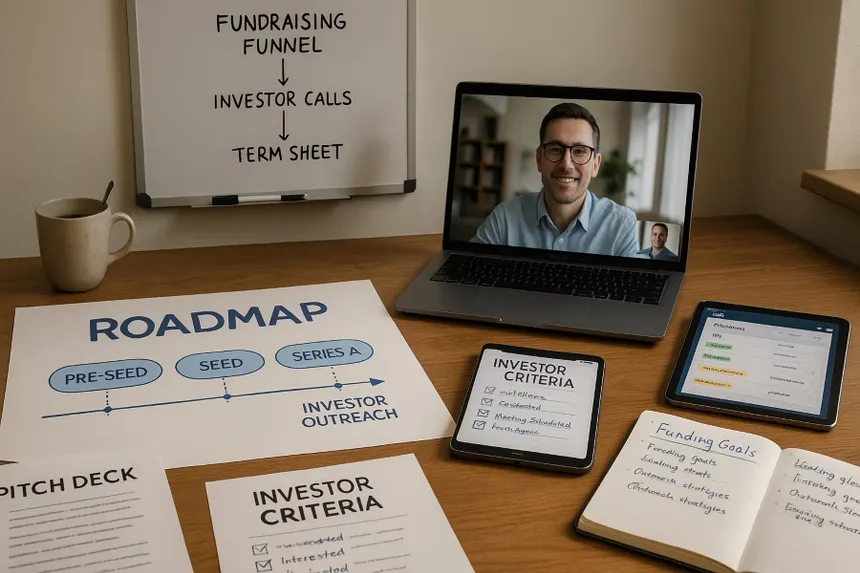
Diligence in India has become more rigorous over the past two years. The firms investing in 2026 are not the same as the ones writing fast cheques in 2021. They want clean unit economics, clear go-to-market plans, and founders who can articulate their path to profitability. If your numbers are not ready, diligence will expose that, and the deal will slow or die.
The documentation phase that follows is often underestimated by first-time founders. Term sheets need legal review. Shareholders’ agreements, share subscription agreements, and company filings take time. Budget two to four weeks for documentation even after a term sheet is signed. The money is not real until it clears your bank account.
The Fundraising Timeline at a Glance
| Phase | Duration | Key Activities |
| Preparation | Weeks 1 to 8 | Pitch deck, financial model, data room, investor list |
| Relationship building | Months 2 to 4 | Warm intros, investor conversations, visibility building |
| Active fundraising | Months 3 to 6 | First meetings, follow-ups, 30 to 50 targeted pitches |
| Diligence | Months 5 to 7 | Financials, references, background checks |
| Documentation and close | Months 6 to 9 | Term sheet, legal, signing, fund transfer |
When to Start: The Runway Rule
The single most useful rule in fundraising is this. Start when you have nine months or more of runway remaining.
Founders who begin their raise with less than six months left negotiate from a position of desperation. Investors know it. The terms reflect it. A founder with nine or more months of runway has options. They can walk away from a bad deal. They can wait for a better investor. They have leverage.
In 2026, the gap between seed and Series A has stretched. Carta data shows the median interval between closing a seed round and closing a Series A is now over 600 days, roughly 20 months. That is longer than the 18 months of runway most Indian seed-stage founders plan for. If you raise a seed round and budget 18 months of runway, you may be approaching zero cash before you have the traction to raise a Series A. Build in buffer. Raise more at seed if you can. Do not treat 18 months as a ceiling when 24 is safer.
Common Mistakes That Break Timelines
Three mistakes show up repeatedly in first-time founder raises.
The first is starting too late. Founders wait until they have eight months of runway, then spend two months on preparation, which leaves six months for an active raise that realistically needs nine. The math does not work.
The second is running a sequential process instead of a parallel one. Talking to one investor, waiting for their answer, then moving to the next, means a raise that could close in four months takes nine. Run conversations simultaneously.
The third is treating every investor the same. Not all capital is equal. A cheque from an angel with deep sector connections is worth more than one from a generic fund that treats your startup as a line item. Prioritise quality over quantity in who you spend time with, especially in the later stages of your process.
The Take Nobody Will Say Out Loud
Here is what most fundraising guides will not tell you. The timeline is not the most important thing. The relationship is.
Indian investors, particularly angels and early-stage VCs, are backing founders over long periods. The best outcomes happen when an investor and a founder have developed enough mutual trust that the term sheet feels like the next natural step in a conversation, not the beginning of a negotiation. Founders who treat fundraising as a sprint get worse terms, worse investors, and worse board dynamics than those who treat it as a slow burn.
The market in 2026 is more selective than it was three years ago. Indian startups are competing for fewer active cheques. Investors who deployed capital at pace in 2021 and 2022 are being more deliberate. That is not bad news for founders who plan well. It is bad news for founders who plan late.
Start earlier than you think you need to. Build relationships before you need money. And when you do raise, run a tight, parallel process with a clear close date in mind. That is not a hack. That is how rounds get closed.
Frequently Asked Questions
How long does a fundraising round take in India? For a seed round, expect three to six months from initial outreach to money in the bank. Pre-seed rounds can move faster, especially if you have warm introductions and a tight investor list. Series A takes longer, often five to eight months, due to deeper diligence requirements. The total timeline from preparation to close is often nine months or more for first-time founders.
When should I start fundraising relative to my runway? Start the process when you have nine months or more of runway remaining. This gives you time to prepare, build relationships, run an active process, and complete documentation without negotiating from a position of desperation. Founders who start with six months or less typically close on worse terms or fail to close at all.
How many investors should I pitch in a seed round? Plan to pitch 30 to 50 targeted investors to generate enough active interest for a term sheet. For every term sheet you receive, expect to have had 20 to 30 conversations that did not progress. This is normal. Build it into your expectations and your timeline from the start.
What is the difference between a warm and a cold introduction in Indian fundraising? A warm introduction is when a mutual contact, typically a founder, operator, or investor the VC already trusts, makes a direct introduction to the investor on your behalf. A cold email is one the investor receives without prior context. Warm introductions in India convert to first meetings at significantly higher rates. Most first-time founders underestimate how much this matters.
How do I build a timeline if I am a first-time founder with no investor network? Start with accelerators and incubators. Programmes like Sequoia Surge, Y Combinator (India cohorts), and iStart Rajasthan connect early-stage founders with investors systematically. Apply early. These programmes compress the relationship-building phase and give first-time founders credibility they would otherwise spend 12 months earning independently.
What should be in my data room before I start fundraising? At minimum: incorporation documents, cap table, last 12 months of financial statements, current financial model, any signed customer contracts or letters of intent, and a one-page company overview. For seed and above, add board resolutions, regulatory filings with the Registrar of Companies, and any DPIIT recognition under Startup India if applicable.
Does the fundraising timeline change for different sectors? Yes. Deeptech, hardware, and climate tech startups typically have longer timelines because diligence is more technical and investor conviction takes longer to build. SaaS and fintech rounds often move faster because metrics are easier to benchmark. Investors can compare your ARR growth, churn rate, and CAC payback against dozens of similar companies they have already evaluated.
Stay in the Loop
For more stories, breakdowns, and unfiltered takes on what is really happening in Indian and global business and tech, follow TheFounder Nation.
Instagram Handle : https://www.instagram.com/thefoundernation?igsh=MTZobDUwc2xqZWdhOA==
We cover what the mainstream business press won’t.
© TheFounder Nation | All rights reserved Word count: ~1,480 | Read time: ~6 minutes Primary keyword: how to create a fundraising timeline | Secondary: startup fundraising timeline India, pre-seed seed Series A timeline, when to start fundraising, startup runway India 2026, fundraising process India, investor outreach timeline, seed round duration India, fundraising phases startup Featured image alt text: A founder mapping out a fundraising timeline on a whiteboard with funding stage labels and dates Suggested image filename: startup-fundraising-timeline-india-2026.jpg