

Written by TFN Research Desk | covering startups, technology, digital media, and business strategy.
While analysts debate ARPU versus subscriber count, the more interesting question for founders is why two companies in the same market, selling the same product, have built completely opposite businesses and both won.
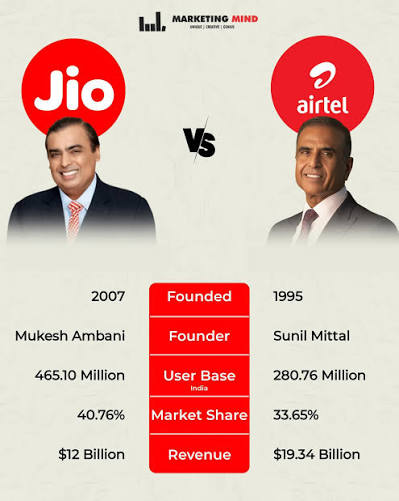
In Q3 FY26, Bharti Airtel reported India revenue of Rs 39,226 crore. Reliance Jio reported Rs 37,262 crore. Airtel had 46.6 crore subscribers. Jio had 51.5 crore. Airtel’s ARPU was Rs 259. Jio’s was Rs 213.7 (Angel One, February 2026). Airtel made more money per customer. Jio had more customers. Both are growing. Both are profitable. And the competitive dynamic between them is one of the clearest business school cases in India that nobody is teaching at business school.
Sector Analysis • Indian Ecosystem • Startup Strategy • Telecom
The war that ended by producing two winners
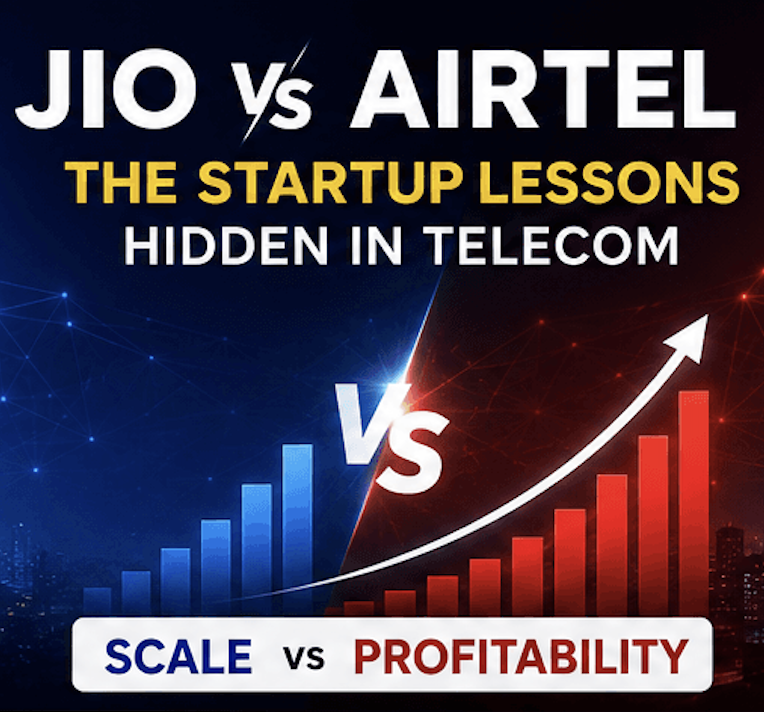
Most competitive markets resolve into a dominant player and a struggling second. India’s telecom market did something different: it resolved into a duopoly where both players are structurally healthy but strategically opposite. Jio built the country’s largest subscriber base through price disruption and ecosystem expansion. Airtel held its premium positioning, accepted fewer customers, and monetised each of them more effectively.
For founders, this outcome contains a lesson that is more useful than most MBA frameworks: in a large enough market, you do not have to pick the same customers as your competitor. You can pick different ones deliberately, build the business that serves them well, and both companies can be worth building. The Jio-Airtel dynamic is a practical demonstration of how two radically different go-to-market strategies can produce radically different, and equally defensible, business models in the same market.
Why this story matters
India’s telecom market is now effectively a duopoly. Vodafone Idea holds declining market share and BSNL has minimal consumer presence. What remains is a two-player market where Jio holds roughly 43.5% active subscriber share and Airtel holds 35.8% (Business Standard, December 2025). Understanding how each player built their position illuminates strategic choices that extend well beyond telecom: price leadership versus margin leadership, scale versus monetisation, and what happens when a late entrant disrupts a market so thoroughly that the incumbents are forced to choose identity over survival. [INTERNAL LINK: Mukesh Ambani’s next big bet: what Reliance does after Jio]
Quick facts
| Metric | Reliance Jio (Q3 FY26) | Bharti Airtel (Q3 FY26) | Source |
|---|---|---|---|
| India revenue | Rs 37,262 crore | Rs 39,226 crore | Angel One, February 2026 |
| YoY revenue growth | 12.7% | 13.2% (India) | Angel One, February 2026 |
| Active subscribers | 51.5 crore | 46.6 crore | Upstox, February 2026 |
| ARPU | Rs 213.7 | Rs 259 | Upstox, February 2026 |
| Net profit (Q2 FY26) | Rs 7,379 crore | Rs 6,792 crore | TelecomTalk, November 2025 |
| Active subscriber market share | 43.5% | 35.8% | Business Standard, December 2025 |
| IPO status | Planned 2026 ($4B, 2.5% stake) | Listed (NSE/BSE) | Upstox, February 2026 |
| 5G positioning | Greenfield all-IP network | Upgraded existing infrastructure | Appreciate Wealth, March 2026 |
| International operations | India only | 15 countries | Angel One, February 2026 |
Background
Before September 2016, India’s telecom market had over a dozen players, high data costs, and some of the lowest smartphone internet penetration rates among large economies. The price of 1GB of mobile data in India was among the highest globally relative to per-capita income. Then Reliance Jio launched with an offer that had no precedent: free voice calls, free SMS, and 4G data at near-zero cost during an extended promotional period.
The result was the fastest mass-market digital adoption event in any country’s recorded history. India became the world’s largest mobile data consumer by volume within 18 months of Jio’s launch. Airtel, Vodafone, and Idea were forced into a brutal pricing war they had neither anticipated nor provisioned their balance sheets for. Vodafone and Idea eventually merged to survive. BSNL retreated to government-supported irrelevance. Airtel, after a punishing few years of margin compression, managed something that no other incumbent achieved: it held its premium positioning, shed unprofitable low-ARPU subscribers deliberately, and emerged from the disruption as a structurally stronger company.
By 2026, the two survivors have settled into a duopoly that is entering its next phase: not subscriber growth, but ARPU expansion. Analysts expect ARPU to grow 10-12% annually for the next three years across both players (Business Standard, January 2026), reflecting a market that has moved from acquisition to monetisation as its primary growth lever.

Timeline
| Year | What happened |
|---|---|
| 2016 | Jio launches with free data and calls; triggers industry-wide price war |
| 2017 | India becomes world’s largest mobile data consumer; Airtel, Vodafone, Idea begin margin compression |
| 2018 | Vodafone and Idea announce merger to cut costs and survive |
| 2019 | Vodafone-Idea merger completes; telecom market consolidates from 12+ players to three effective competitors |
| 2020 | Jio raises $27 billion from Meta, Google, KKR, and others for Jio Platforms |
| 2021 | Airtel stabilises; begins deliberate subscriber quality strategy over subscriber volume |
| 2023 | Jio crosses 500 million subscribers; Airtel focuses on 4G and 5G quality markets |
| 2024 | India telecom tele-density reaches 86.65%; sector enters ARPU growth phase |
| Q3 FY26 (Dec 2025) | Airtel ARPU: Rs 259; Jio ARPU: Rs 213.7; Airtel revenue higher despite fewer subscribers |
| 2026 | Jio IPO imminent; ARPU expected to grow 10-12% annually for next three years |
How it happened: the two strategies that defined a duopoly
Strategy 1: Jio’s price-disruption-to-ecosystem play
Jio’s 2016 entry was not a pricing strategy. It was an infrastructure investment with a consumer disruption wrapper. Reliance had spent approximately Rs 2 lakh crore building a greenfield, all-IP 4G network before the launch (Appreciate Wealth, March 2026). The free data and calls offer was not sustainable as a telecom business model. It was designed to compress the market, eliminate weaker players, and accumulate the subscriber base that Jio’s parent company, Reliance Industries, needed to monetise through a broader digital ecosystem.
The logic is now visible in the outcomes. Jio’s 51.5 crore active subscribers are the distribution layer for JioMart, JioFiber, JioPhone, JioHotstar, and the planned Reliance Intelligence AI infrastructure. The telecom subscription is the entry point. The ecosystem is the monetisation vehicle. This is why Jio’s per-subscriber revenue is lower than Airtel’s but its strategic value is higher: each Jio subscriber is a potential customer for five other Reliance services, not just one.
Strategy 2: Airtel’s deliberate quality-over-volume positioning
Airtel’s response to the Jio disruption is the more counterintuitive case study. Faced with an opponent that was effectively giving away its core product, Airtel did not match the pricing. It accepted subscriber losses, focused its network investment on urban and premium markets, and maintained a higher ARPU base by catering to users who valued network quality over price.
The result is a business that generates more revenue per customer than any other Indian telecom operator, despite having fewer customers than Jio. Airtel’s ARPU of Rs 259 versus Jio’s Rs 213.7 (Upstox, February 2026) is the financial expression of a positioning choice: Airtel chose to serve customers who pay more, even at the cost of serving fewer of them.
Airtel also diversified internationally in a way Jio has not. Its overall revenue was Rs 53,982 crore in Q3 FY26, up 19.6% YoY, supported by operations across 15 countries including Africa (Angel One, February 2026). This geographic diversification gives Airtel a growth engine independent of India’s domestic ARPU trajectory.
Strategy 3: The market’s next move — both companies converge on monetisation
The phase that both companies are now entering is the most interesting for founders to study, because it is the phase where the strategies converge. Jio is raising its floor prices — it discontinued low-cost 1GB/day plans in August 2025, setting a new minimum tariff of Rs 299 (Business Standard, August 2025) — to close the ARPU gap with Airtel. Airtel is investing in 5G quality and enterprise products to deepen the premium positioning. The “Jio is cheap, Airtel is premium” binary is narrowing as both companies mature.
Devangshu Datta, writing in Business Standard, captured the structural reality as early as 2018: “Two of those three have dodgy balance-sheets, and dangerously high levels of debt. They are also struggling to cope with recent losses.” (Business Standard, January 2026) The incumbents who survived the Jio disruption were precisely those who could absorb the transition period without collapsing. Airtel survived by being profitable enough at premium pricing to outlast the disruption. The lesson for founders is structural: a premium positioning that generates higher margins per customer gives you more optionality during a competitive crisis than a volume strategy that requires perpetual capital to sustain.
Comparison: Jio vs Airtel — strategy decoded
| Dimension | Reliance Jio | Bharti Airtel |
|---|---|---|
| Core strategy | Scale first, ecosystem monetise later | Margin-first, premium positioning |
| Subscriber philosophy | Volume: widest possible base | Quality: higher-value customers |
| ARPU (Q3 FY26) | Rs 213.7 | Rs 259 |
| Revenue (Q3 FY26 India) | Rs 37,262 crore | Rs 39,226 crore |
| Profitability | Higher net profit despite lower ARPU | Higher revenue despite fewer subscribers |
| 5G approach | Greenfield, all-IP, built for scale | Upgraded existing, focused on quality |
| Geographic scope | India only (telecom) | 15 countries |
| Parent company ecosystem | Reliance Industries (retail, energy, AI) | Standalone listed telecom |
| IPO status | Planned 2026 | Long-listed (NSE/BSE) |
| Next growth lever | Ecosystem services, AI, JioFiber | ARPU expansion, enterprise, Africa |
By the numbers
- Jio has 51.5 crore active subscribers versus Airtel’s 46.6 crore, giving Jio a 43.5% active subscriber market share against Airtel’s 35.8% (Business Standard, December 2025).
- Despite having more subscribers, Jio earns less per customer: its ARPU of Rs 213.7 compares to Airtel’s Rs 259, a 21% gap that translates directly into Airtel generating higher India revenue despite the subscriber deficit (Upstox, February 2026).
- Analysts project ARPU for both companies to grow 10-12% annually for the next three years, as the sector shifts from subscriber acquisition to monetisation (Business Standard, January 2026).
- Airtel’s total Q3 FY26 revenue, including Africa and enterprise, was Rs 53,982 crore — a 19.6% YoY increase — giving it significant revenue diversification beyond Indian consumer telecom (Angel One, February 2026).
- India’s telecom tele-density reached 86.65% as of September 2025 (StockGro, January 2026), meaning the market has limited room for subscriber growth — the next decade of value creation is ARPU, not acquisition.
What competitors missed
What the incumbents who did not survive Jio’s disruption (Tata Docomo, Uninor, Telenor India, Aircel, RCOM) missed was the same thing: they competed on price when Jio moved, rather than on positioning. The temptation, when a well-capitalised entrant enters with below-cost pricing, is to match them. The result of that temptation, in telecom, was a market-wide ARPU collapse that killed everyone who needed margin to survive.
Airtel’s survival is not attributable to being smart faster. It was attributable to having a strong enough balance sheet and a premium enough customer base to survive the disruption period without abandoning its positioning. Companies with thin margins and commoditised products could not survive Jio’s price aggression. Airtel could, because enough of its customers were paying for quality, not just price.
The structural lesson is one of the oldest in competitive strategy, which is that price leadership and premium positioning are both defensible positions, but the middle is fatal. Companies that are “somewhat cheaper than the premium” and “somewhat better than the cheapest” have no answer for a competitor that goes lower on price or higher on quality. [INTERNAL LINK: India’s unicorn boom: who made it and who did not]
What founders can learn
- Volume and margin are both valid strategies, but you must choose. Jio chose volume deliberately and built an ecosystem to monetise it later. Airtel chose margin deliberately and accepted the subscriber losses that came with it. Both chose. The companies that tried to hold volume while maintaining margin during Jio’s disruption found themselves unable to do either. For Indian founders in markets with a dominant low-cost competitor, the clearest strategic question is not “how do we match their price?” but “which customer do we want, and what are we willing to give up to serve them well?”
- Infrastructure investment before revenue is only viable with a patient capital base. Reliance spent Rs 2 lakh crore on network infrastructure before Jio generated meaningful revenue. This was only possible because Reliance Industries’ cash flows from petrochemicals and retail could fund the investment. Founders who try to replicate Jio’s land-and-monetise-later strategy without Reliance’s parent company capital are building a different business under different constraints. The lesson to take is the strategic logic, not the capital structure.
- ARPU expansion is more valuable than subscriber growth in a maturing market. India’s telecom tele-density is at 86.65%. There is a ceiling on subscriber addition. The next decade of value creation in Indian telecom is ARPU expansion, which means persuading existing customers to spend more. This pattern applies to every consumer internet business in India that has reached scale but has not yet monetised effectively. Zomato, Swiggy, and Meesho are all in the phase that Jio is now entering: the transition from user acquisition to ARPU expansion. The companies that execute this transition well build the durable businesses; those that cannot find themselves with large user bases and small revenues.
- The duopoly outcome is evidence that market size matters. India’s telecom market is large enough that two structurally different strategies can both produce winning businesses. Most Indian startup markets are not yet at the scale where a second player with a different strategy can survive. Founders who understand their market’s maturity level can calibrate whether they are in a winner-takes-all market or a market large enough for two different approaches.
- Premium positioning is not elitist. It is selective. Airtel did not abandon lower-income customers because it is indifferent to them. It chose to serve customers who valued network quality over price, because those customers generate the economics that fund the network quality investment. The circularity is the strategy: quality attracts quality-paying customers, whose revenue funds quality investment, which attracts more quality-paying customers. For founders building premium products in Indian markets, the question is not whether premium is viable in India. Airtel is proof that it is. The question is whether your product has a quality dimension that enough customers will pay for.
- Ecosystem monetisation requires a distribution asset, not just a subscriber asset. Jio’s 51.5 crore subscribers are valuable because Jio has the ecosystem services to monetise them: JioMart, JioFiber, JioHotstar, and planned AI services. A large subscriber base without ecosystem services is simply a large list of people who pay you a small amount each month. The strategic value of Jio’s subscriber base comes from the distribution it creates for adjacent services. Indian founders building consumer platforms should be asking: what is the second thing my customers will pay for, and am I building the infrastructure to deliver it? [INTERNAL LINK: What is social commerce and why India is its biggest market]
Expert analysis
The Jio-Airtel dynamic is, at its core, the “scale vs efficiency” debate that runs through every large consumer market. As Appreciate Wealth’s analysts observed: “The Jio vs Airtel debate ultimately reflects a broader investment theme: scale vs efficiency. Jio represents scale, ecosystem expansion, and long-term digital dominance. Airtel represents efficiency, profitability, and disciplined growth.” (Appreciate Wealth, March 2026)
What this framing misses is that both strategies are correct for their respective contexts. Jio’s scale strategy is correct for a company with Reliance’s balance sheet and ecosystem ambition. Airtel’s efficiency strategy is correct for an independently listed company that must generate returns without a parent company’s cross-subsidisation.
For founders without Reliance’s capital base, the Airtel model is the more replicable lesson: hold your pricing, serve your target customer better than anyone else, and survive the disruption period by being more profitable per customer than your lower-price competitor. The most dangerous response to a price-aggressive competitor is matching their price. It eliminates the margin that lets you survive long enough to outlast them. [INTERNAL LINK: Why is B2B becoming more attractive than B2C?]
Future outlook
The next chapter of Jio vs Airtel is being written not in subscriber growth but in three areas: 5G monetisation, AI infrastructure, and enterprise services. Jio’s planned AI infrastructure investment of Rs 10 lakh crore over seven years and Airtel’s push into enterprise and Africa position them differently for the next decade. Jio is betting that being India’s AI infrastructure operator is more valuable than being its largest telecom operator. Airtel is betting that premium positioning plus international diversification creates more durable shareholder value than ecosystem breadth.
Both bets could be right. India’s market is large enough. The analysis that matters for founders is simpler: which strategy produces the kind of business you want to build, and does your capital structure support the patience that strategy requires? [INTERNAL LINK: What is social commerce and why India is its biggest market]
The bottom line
Jio disrupted Indian telecom by being cheaper than everyone. Airtel survived by being better than Jio on the one dimension Jio decided not to compete on: premium network quality. The result is a duopoly where both players are growing, both are profitable, and both are right. That is the most useful telecom lesson for Indian founders: in a large market, there is usually room for more than one strategy to win. Choose yours deliberately.
Key takeaways
- Jio leads on subscriber count (51.5 crore vs Airtel’s 46.6 crore) while Airtel leads on ARPU (Rs 259 vs Jio’s Rs 213.7), producing similar revenue despite opposite strategies.
- India’s telecom market is now a functional duopoly with Jio at 43.5% active subscriber share and Airtel at 35.8%.
- Jio built a distribution platform, not just a telecom company: its subscriber base is the foundation for ecosystem services across retail, entertainment, and AI infrastructure.
- Airtel survived Jio’s 2016 price disruption by refusing to abandon premium positioning, shedding unprofitable subscribers, and focusing on quality-over-volume.
- ARPU expansion, projected at 10-12% annually for the next three years, is the next growth phase for both companies — subscriber acquisition has reached a ceiling.
- Airtel’s geographic diversification into 15 countries gives it a growth engine independent of India’s domestic ARPU trajectory.
- For founders, the strategic takeaway is that price leadership and premium positioning are both defensible; the danger is the middle, where you are neither the cheapest nor the best.
Conclusion
India’s telecom market spent five years looking like a story about Jio destroying everyone. It turned out to be a story about a market large enough for two radically different strategies to coexist and thrive. Jio built the widest consumer distribution platform in Indian history. Airtel built the most profitable per-customer consumer telecom business in India. Both are winning, in different ways, at different things.
The lesson for founders is not to copy Jio’s price disruption or Airtel’s premium positioning. It is to understand that both strategies required a clear choice at the start: who is your customer, what do they value, and what are you willing to sacrifice to serve them well? The companies that could not answer that question are the ones that are not in this story anymore.
The TFN Lens
The Scale-vs-Margin Trap
Indian startup funding culture celebrates scale. Subscriber counts, user bases, and download numbers are the metrics that attract early-stage capital and generate press coverage. Jio is the template that is most-cited in these conversations: launch free, accumulate users, monetise later.
What this narrative consistently omits is that Jio’s model required Rs 2 lakh crore in pre-revenue infrastructure investment, a parent company with the cash flows to sustain it, and a decade-long monetisation horizon. Airtel’s model required something simpler and more replicable: discipline. The willingness to say “we will serve fewer customers and charge them more” is available to every founder. The capital required to sustain a Jio-style land-and-expand play is available to almost none of them.
The most useful application of the Jio-Airtel lesson for Indian founders is not “which one should I copy?” It is “which one can I actually build with my capital structure?” The answer, for most Indian startups, is closer to Airtel than to Jio. Build for the customer who values what you do, price accordingly, and hold the positioning when a well-funded competitor tries to buy the market.
Building something of your own? Follow The Founder Nation and NamasteVC for curated startup funding news, grant alerts, and founder stories from India’s startup ecosystem, delivered straight to your feed, every week. [INTERNAL LINK: How do venture capitalists actually make money?]
Frequently asked questions
Who is winning: Jio or Airtel in 2026? Both are winning, but by different measures. Jio leads on subscriber count with 51.5 crore active subscribers versus Airtel’s 46.6 crore. Airtel leads on revenue with Rs 39,226 crore in India revenue in Q3 FY26, compared to Jio’s Rs 37,262 crore, because its ARPU of Rs 259 is higher than Jio’s Rs 213.7. Jio had a slightly higher net profit in Q2 FY26. The answer depends entirely on which metric you are using to define winning.
What is Jio’s ARPU in 2026? Jio’s ARPU in Q3 FY26 (December quarter 2025) was Rs 213.7, up from Rs 207 in the previous quarter, reflecting a 6% sequential increase. Analysts project industry ARPU to grow 10-12% annually for the next three years as the market shifts from subscriber acquisition to monetisation.
What is Airtel’s ARPU in 2026? Airtel’s ARPU in Q3 FY26 was Rs 259, compared to Rs 248 in Q2 FY26, reflecting 6.5% sequential growth. Airtel consistently maintains the highest ARPU among Indian telecom operators, reflecting its deliberate premium positioning strategy. This is the core driver of Airtel generating higher revenue than Jio despite having fewer subscribers.
How did Airtel survive Jio’s disruption? Airtel survived by refusing to match Jio’s below-cost pricing fully. It accepted a significant loss of price-sensitive subscribers, focused its network investment on quality markets, and maintained the margin buffer that allowed it to outlast the disruption period. Several competitors, including Tata Docomo, Uninor, and Aircel, matched Jio’s pricing more aggressively and could not sustain the margin compression. Airtel’s survival is evidence that premium positioning is defensible in Indian markets if the quality justification is genuine.
What does Jio vs Airtel teach founders about strategy? The core lesson is that price leadership and premium positioning are both defensible strategies in a large market, but the middle is fatal. Companies that tried to be “somewhat cheaper than Airtel while somewhat better than Jio” had no answer for a competitor who moved decisively to one end of the spectrum. The second lesson is that scale without an ecosystem monetisation plan is a large user base, not a large business. Jio’s subscriber count is valuable because Reliance has the ecosystem to monetise it. A startup with Jio’s subscriber count but without Jio’s ecosystem services is simply carrying a large cost base.
Is Jio planning an IPO in 2026? Jio’s IPO has been formally announced. At Reliance Industries’ 48th AGM in August 2025, Mukesh Ambani confirmed plans to list Jio in the first half of 2026. The planned offering is a 2.5% stake sale worth approximately $4-4.5 billion, which would make it India’s largest-ever IPO. As of June 2026, regulatory approvals are pending and the IPO filing has not been formally submitted. Jefferies estimated Jio’s standalone valuation at $180 billion in November 2025.
Why does Airtel earn more than Jio despite fewer subscribers? Because Airtel’s customers pay more per month. Airtel’s ARPU of Rs 259 is 21% higher than Jio’s Rs 213.7. When you multiply a higher revenue-per-customer by 46.6 crore customers, the total revenue exceeds what Jio generates from 51.5 crore customers at a lower ARPU. This is the mathematical expression of the premium positioning strategy: fewer customers paying more generates more aggregate revenue than more customers paying less, up to a certain point.
What is the future of Indian telecom beyond Jio and Airtel? India’s telecom tele-density reached 86.65% as of September 2025, meaning subscriber growth is limited. The next growth phase is ARPU expansion (both companies are targeting 10-12% annual ARPU growth), 5G monetisation through enterprise and industrial applications, and adjacent ecosystem services. Jio’s AI infrastructure investment and Airtel’s enterprise push are both attempts to find the next revenue layer beyond consumer mobile. Vodafone Idea’s survival depends on government support. BSNL’s relevance is limited to remote areas and government contracts.
Sources
- Angel One, Airtel vs Jio Q3 FY26 Results Compared, February 7, 2026
- Upstox, Airtel Outperforms Reliance Jio in Q3 Revenue, February 6, 2026
- Business Standard, India Adds 5.7 Million Active Mobile Users in October, December 3, 2025
- Business Standard, ARPU Gains, Dividend Trigger for Bharti Airtel, January 9, 2026
- TelecomTalk, Airtel Has Better ARPU, Jio Reports Better Net Profit, November 5, 2025
- Appreciate Wealth, Bharti Airtel vs Jio: A Deep Dive, March 30, 2026
- StockGro, Jio vs Airtel: Which is Better in 2026?, January 19, 2026
- Business Standard, No Endgame to the Telecom Face-off Yet (Devangshu Datta), republished January 2026
© 2026 The Founder Nation. All rights reserved.