



The term sheet arrives. Congratulations are exchanged. The investor says the process from here is straightforward. What they mean is that the process from here is thorough, and if anything material surfaces, everything that just got agreed upon is back on the table.
Due diligence is not a formality that follows a decision. It is the process by which a decision gets made or unmade. Founders who treat it as a box-ticking exercise after the pitch win are the ones who discover, four weeks into a live deal, that a three-year-old documentation gap is now a closing condition they cannot quickly resolve.
The founders who close faster, at cleaner valuations, with fewer surprises, are almost always the ones who ran their own due diligence before they went fundraising. They knew what the investor’s lawyer would find. They found it first, fixed what they could, and had a clear explanation ready for what they could not.
This guide covers every category an investor examines in an Indian startup due diligence process, what they look for within each, and what consistently causes rounds to stall or collapse.
How Indian Due Diligence Actually Works
Most Indian funding rounds run through three distinct phases of due diligence, and understanding the sequence helps founders know what to prepare for and when.
The first phase is preliminary review. This happens before the term sheet. An investor evaluates the market, team, product, and headline financial metrics based on the pitch deck and a basic data pack. This is commercial diligence, and it determines whether a term sheet gets issued at all. The quality of the deck, the clarity of the unit economics, and the founder’s ability to answer first-principles questions about the business all feed into this phase.
The second phase is detailed diligence, which begins after indicative terms are agreed. This is where lawyers and accountants enter the process and review the complete document set by category: corporate, financial, legal, IP, and HR. This phase typically runs four to twelve weeks for a Series A, shorter for angel or seed rounds. This is the phase most founders are underprepared for because it tests documentation, not narrative.
The third phase is confirmatory diligence, which runs concurrently with legal drafting of the SHA and SSA. Final checks are made on representations and warranties before funds transfer.
Building a clean data room before the first investor meeting compresses the second phase significantly. Investors who receive a complete, well-organised data room early trust faster, ask fewer follow-up questions, and move to term sheet with more confidence. Those who receive fragmented documents across weeks of back-and-forth develop doubts that are difficult to reverse even when the underlying business is strong.
Track One: Corporate and Governance Documents
This is where investor diligence begins. The corporate track answers one question: is this company legally what the founder says it is?
The Certificate of Incorporation, MoA, and AoA are the foundational documents. Investors check whether the AoA allows for the investment structure being contemplated, whether CCPS (Compulsorily Convertible Preference Shares) issuance is permitted, and whether there are provisions for pre-emptive rights, tag-along, and drag-along. An AoA drafted from a generic template without investor-specific provisions will need amendment before closing, which adds time and RoC filings to the diligence process.
Board and shareholder resolution minutes are reviewed since incorporation. Every allotment of shares, every ESOP grant, every related-party transaction, and every significant commercial decision should have a corresponding resolution. Missing resolutions for past allotments or ESOP grants are the most common governance gap found in Indian startup data rooms. They signal either carelessness or, in the worst case, undocumented equity arrangements that complicate ownership.
Statutory registers, including the Register of Members, Register of Charges, Register of Directors and Key Managerial Personnel, and the Register of Contracts, must be current and consistent with all other documents in the data room. A cap table that does not reconcile to the Register of Members and the board resolutions is a red flag that halts diligence until it is resolved.
Annual compliance records matter more than founders expect. Missing or late RoC filings, outstanding Annual Returns (MGT-7), unsubmitted Financial Statements (AOC-4), and pending DIR-3 KYC for directors are all finding categories that investors flag as governance signals. One pending RoC notice has delayed IPO diligence timelines by two to three months in documented cases.
Track Two: Cap Table and Equity Structure
The cap table track is where the largest number of Indian due diligence rounds slow down or collapse.
Investors need a fully diluted cap table showing all issued shares, ESOP grants (vested, unvested, and exercised), convertible instruments (CCPS, CCDs, convertible notes), and any side letters or informal equity commitments. Every line item on the cap table must reconcile to a corresponding board resolution, PAS-3 filing with the RoC, and entry in the Register of Members. Gaps between any of these are treated as ownership uncertainty, and investors do not close on ownership uncertainty.
The six patterns that most commonly stall Indian funding rounds at the cap table stage: ESOP grants that lack EGM resolution authorising the pool; informal equity promises to early advisors or contractors that never became formal instruments; convertible notes from earlier rounds that have not been modelled into the fully diluted ownership; past allotments to Indian residents that lack Rule 11UA valuation reports, which can create residual angel tax exposure on earlier rounds even after the general abolition effective April 2025; cap table percentages that have been maintained in a spreadsheet but never checked against statutory filings; and share transfers between founders or early employees that were executed without board approval or proper documentation.
The practical fix is to run a cap table reconciliation exercise before fundraising begins. Compare every line in the cap table spreadsheet against every PAS-3 filing and every board resolution. Where gaps exist, resolve them with a Company Secretary before the data room is shared.
Track Three: Financial Diligence
Financial diligence verifies whether the business is performing as represented and whether its financial position is accurately disclosed.
Audited financial statements for all prior financial years, or clean management accounts for very early-stage companies, are the starting point. Monthly MIS reports covering revenue, burn rate, runway, gross margin, and key operating ratios are reviewed for internal consistency. Investors check whether the revenue numbers in management accounts reconcile to GST returns and to the statutory financial statements. A discrepancy between GST filings and management accounts is one of the most common findings in Indian startup diligence and almost always has a benign explanation (timing differences, deferred revenue recognition), but it must be reconciled formally with documentation before closing.
The financial model is reviewed for assumption quality, not just outputs. Growth projections that assume 10x revenue without a bottom-up build of customer acquisition mechanics, sales headcount, and unit economics are treated as founder optimism rather than financial planning. Investors want to see the model tied to operational drivers: what is the CAC, what is the LTV, what does month-on-month revenue growth look like by cohort, and what does the business need to be true for the projections to hold.
Revenue concentration is specifically reviewed. If more than 25 to 30 percent of revenue comes from a single customer, investors examine the contract terms, renewal history, and relationship quality for that customer very carefully. Concentration risk in customer contracts is a valuation discount factor that founders frequently underestimate.
Bank statements for the last 12 to 24 months are requested at Series A. Investors look for unusual outflows, related-party payments, and consistency between reported expenses and actual bank debits.
Track Four: Legal and Contracts
The legal track covers all agreements that govern the startup’s relationships: with founders, employees, customers, vendors, and any prior investors.
The founders’ agreement is the first document reviewed. Investors check for vesting schedules on founder equity with a one-year cliff and four-year vest being standard, IP assignment from each founder to the company, non-compete and non-solicitation clauses, and good leaver and bad leaver definitions. A founders’ agreement missing the IP assignment clause means the company’s ownership of its own technology is legally ambiguous, and no institutional investor closes on that ambiguity without remediation.
Customer contracts are reviewed for revenue quality signals: average contract value, term length, auto-renewal clauses, termination provisions, and pricing protections. Enterprise contracts with government break clauses, uncapped liability provisions, or termination-for-convenience rights at the customer’s sole discretion reduce perceived revenue quality. Vendor contracts with extended payment obligations or exclusivity provisions are also flagged.
Prior investor documents, including term sheets, SHAs, SSAs, and any convertible note agreements, are reviewed for provisions that might affect the new round’s structure. Anti-dilution clauses from prior rounds, consent rights that require existing investors to approve new investments, and drag-along provisions that affect the founder’s ability to accept a future acquisition offer are all material to a new investor’s decision.
Track Five: Intellectual Property
IP diligence answers a single question: does the company actually own what it claims to own?
Pre-incorporation IP is the most common and most serious gap. If founders built the product, wrote the code, or developed the business concept before the company was incorporated, that work was created in their personal capacity. A written IP assignment agreement executed between each founder and the company, assigning all relevant work to the company, is required. Without it, the founders may personally own the technology the company is selling.
Contractor IP is the second most common gap. Every freelancer, agency, or contract developer who built any part of the product must have signed an agreement assigning their work to the company. Open-source licence compliance is also reviewed. Research from Fenwick and West’s 2025 Startup Survey found that open-source licence conflicts delayed or blocked approximately one in five Series A closings in 2025, driven primarily by GPL-licensed code embedded in proprietary products without appropriate handling.
Patent filings, trademark registrations, and domain name ownership are listed and verified. DPIIT-recognised startups benefit from an 80% rebate on patent filing fees, making this a lower-cost action for recognised startups than is commonly assumed.
Track Six: HR and Team
The team track verifies that the people running the business are who the founder says they are and that the company’s obligations to them are properly documented.
Employment agreements for all current employees must be signed, current, and contain NDA and IP assignment clauses. An employee who joined on a handshake and was never given a formal offer letter with IP assignment and confidentiality provisions potentially owns work they created during their tenure.
ESOP documentation is reviewed: the scheme document, the EGM resolution authorising the pool, and individual grant letters for every employee holding options. Vested but unexercised options, unvested options, and any options that have lapsed must all be categorised correctly in the cap table and supported by documentation. Investors specifically check that ESOP grants were formally approved and that the pool size authorised by shareholders matches what appears in the cap table.
Key person risk is assessed. If the business is operationally dependent on one or two individuals and those individuals have no contractual lock-in, investors build that risk into valuation or request specific founder lock-in provisions as a closing condition.
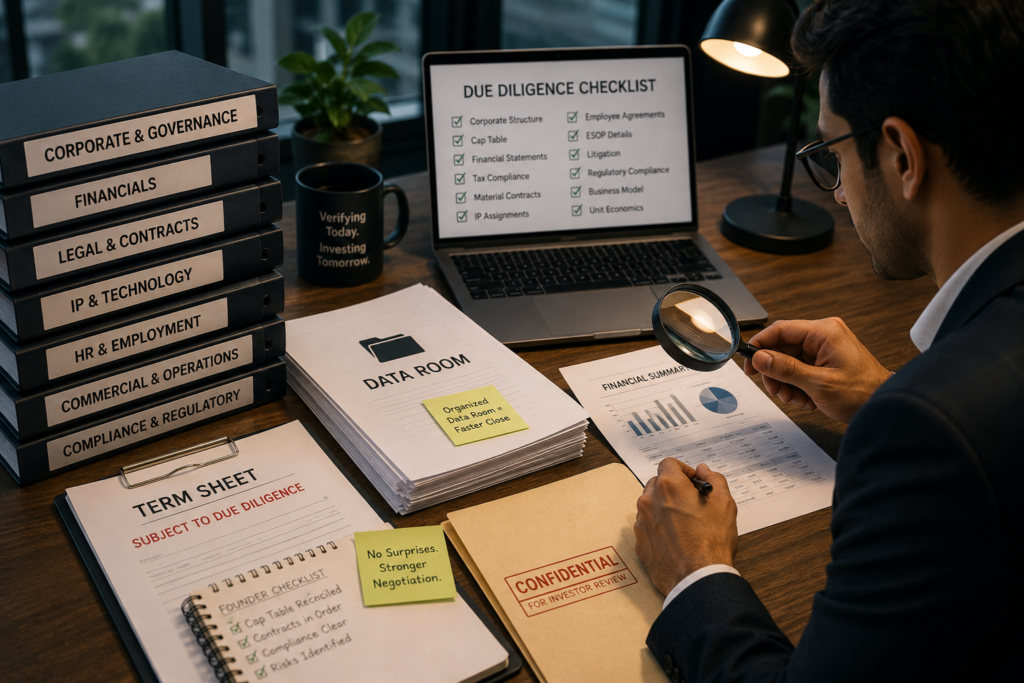
The Data Room: Structure Is a Signal
How a founder organises a data room tells an investor something before a single document is read.
A well-structured data room uses eight top-level folders covering Corporate, Financial, Legal and Contracts, IP and Technology, Team and HR, Product and Metrics, Cap Table and Equity, and Tax and Compliance. Files are named with dates and version numbers. A live index lists every document in the room. Access is permission-based, with view-only access granted initially and expanded as engagement deepens.
The contrast with a disorganised data room is not subtle. Folders named “Final FINAL” or “Docs for Investors,” files with no versioning, contradictory information across different documents, items described in the pitch deck but absent from the room, these signals compound quickly into a general impression of management discipline that investors find very difficult to separate from how they view the underlying business.
Documents by Diligence Track: Quick Reference
| Track | Key Documents | Most Common Gap |
| Corporate | CoI, MoA/AoA, board and shareholder minutes, statutory registers | Missing resolutions for ESOP grants or allotments |
| Cap Table | Fully diluted cap table, PAS-3 filings, convertible instrument models | Cap table does not reconcile to RoC filings |
| Financial | Audited financials, monthly MIS, financial model, bank statements | Revenue in management accounts differs from GST returns |
| Legal | Founders’ agreement, customer contracts, prior investor documents | IP assignment clause missing from founders’ agreement |
| IP | IP assignment agreements, patent filings, open-source audit | Pre-incorporation IP not formally assigned to company |
| HR and Team | Employment agreements, ESOP scheme and grant letters, org chart | ESOP grants lack EGM resolution or individual letters |
The Take Nobody Will Say Out Loud
Founders spend six months preparing a pitch. Refining the deck, rehearsing the narrative, building the financial model, getting warm introductions to the right partners. All of that work gets the meeting. None of it closes the deal.
The deal closes or falls apart during due diligence, in documents and filings that nobody rehearsed, in the gap between what the pitch said and what the data room proved. A VC who loved the pitch at 9am can be asking for a 15% valuation discount by 4pm after their lawyer flags three cap table discrepancies and a missing IP assignment.
The founders who avoid that conversation are the ones who treated the data room as a product, not a filing cabinet. They built it before the raise, not during it. They ran their own internal due diligence, found the gaps, resolved what could be resolved, and had honest explanations for what could not. When the investor’s lawyer arrived, there was nothing to discover that the founder had not already disclosed.
That level of preparation is rare. It is also the single clearest signal a founder can send that they are serious about building something, not just raising something.
Frequently Asked Questions
When should a founder start building their data room? The data room should be built before the first serious investor meeting, not after a term sheet arrives. Building it before fundraising surfaces every compliance gap, missing document, and cap table inconsistency in a low-pressure environment where there is time to fix them. Founders who begin assembling the data room after a term sheet arrives are working under time pressure, with an investor who is already aware that something was missing when asked for.
What is the single most common due diligence finding that kills or delays Indian startup rounds? Cap table discrepancies. Specifically, a cap table spreadsheet that does not reconcile to the company’s statutory registers, board resolutions, and PAS-3 filings. This is found in the majority of Indian startup due diligence processes at Series A and is the most consistently cited reason for diligence taking longer than expected. The fix is a formal cap table reconciliation exercise before fundraising begins, ideally conducted with a Company Secretary.
Does a founder need to disclose problems proactively in the data room? Yes, with a remediation plan attached. Investors find problems anyway. A founder who discloses a known issue clearly, paired with a documented plan to resolve it, comes across as trustworthy and organised. A founder whose problems are discovered by the investor’s team rather than disclosed proactively loses credibility that is almost impossible to rebuild within the same deal. Transparency paired with a fix plan shortens diligence. Concealment extends it or ends it.
What financial documents are required for a seed round versus a Series A? A seed round typically requires management accounts since incorporation, a current financial model, and a basic cap table. Audited financials are not always required but strengthen the data room significantly. A Series A requires audited financial statements for all prior financial years, monthly MIS for the trailing 12 to 24 months, a detailed financial model with bottom-up assumptions, bank statements, and revenue reconciliation against GST filings. The depth of financial diligence scales with the round size.
What open-source licence issues should founders be aware of? GPL and AGPL licences carry a copyleft requirement: any product that incorporates GPL-licensed code may be required to release its own source code under the same licence. For a startup whose competitive advantage depends on proprietary code, this is a material IP risk. Founders should conduct an open-source licence audit of all third-party code used in the product and ensure that any copyleft-licensed components are either replaced, segregated, or handled through a commercial licence before entering diligence.
How should founders handle ESOP documentation in the data room? The ESOP section of a data room should contain four things: the EGM resolution authorising the ESOP scheme and the pool size; the ESOP scheme document specifying grant mechanics, vesting schedule, exercise price, and treatment on exit; individual grant letters for every employee who holds options; and a current ESOP register showing each grant, vesting status, and exercise history reconciled against the cap table. Missing any one of these is a diligence finding. Missing all of them means the ESOP pool in the cap table has no legal foundation, which is treated as an ownership uncertainty that must be resolved before closing.
What is the right tool for hosting a startup data room? Purpose-built Virtual Data Room platforms offer permission-based access control, audit trails that show which documents investors viewed and for how long, version control, and Q&A workflow. This is preferable to shared folders on Google Drive or Dropbox for serious fundraising processes. Access tracking in particular is useful for founders: knowing which sections an investor spent time on, and which documents were viewed multiple times, helps in anticipating follow-up questions and understanding where investor concern is concentrated.
Stay in the Loop
For more stories, breakdowns, and unfiltered takes on what is really happening in Indian and global business and tech, follow TheFounder Nation.
Instagram Handle : https://www.instagram.com/thefoundernation?igsh=MTZobDUwc2xqZWdhOA==
We cover what the mainstream business press won’t.
© TheFounder Nation | All rights reserved Word count: ~1,490 | Read time: ~6 minutes Primary keyword: due diligence checklist for founders India | Secondary: startup due diligence India 2026, data room checklist startup India, cap table due diligence India, IP assignment due diligence startup, Series A due diligence documents India, ESOP documentation due diligence, investor due diligence checklist India, startup legal due diligence India, financial diligence startup India