


Written by TFN Research Desk | covering startups, technology, venture capital, and business strategy.
Scale AI has no brand recognition.
You have never heard of it. Most venture capitalists have barely heard of it. Tech journalists almost never write about it. And yet, the company has become one of the most important businesses in the entire AI ecosystem.
Every major AI model that powers the industry depends on Scale AI’s infrastructure to exist.
And almost nobody knows why.
This is the story of how a boring data labeling company became indispensable infrastructure for the entire artificial intelligence industry. And why the most important companies are almost always the invisible ones.
How Scale AI Became Essential Infrastructure
Scale AI was founded in 2016 by Alexander Wang and Alexandr Atrick as a data labeling platform.1 The company’s mission is simple: help AI companies label and annotate data for training machine learning models.
That is it. That is the entire business.
No flashy consumer products. No viral growth. No hype. Just: you need labeled data, we label it well, you pay us.
And in doing that one thing extraordinarily well, the company has become worth $7.5 billion.2
Here is what most people do not understand about training AI models: they require massive amounts of labeled data. According to Andrew Ng’s research on machine learning in production, data labeling is the primary bottleneck in 80 percent of AI projects.3 A model learning to recognize pedestrians needs thousands of images labeled “person,” “car,” “bike.” A model learning language needs text labeled with grammar, sentiment, intent.
For years, companies either labeled data themselves (expensive and slow) or crowdsourced it (cheap and terrible). There was no scalable, reliable way to maintain quality at massive scale.
Scale AI identified this as the bottleneck blocking the entire industry.
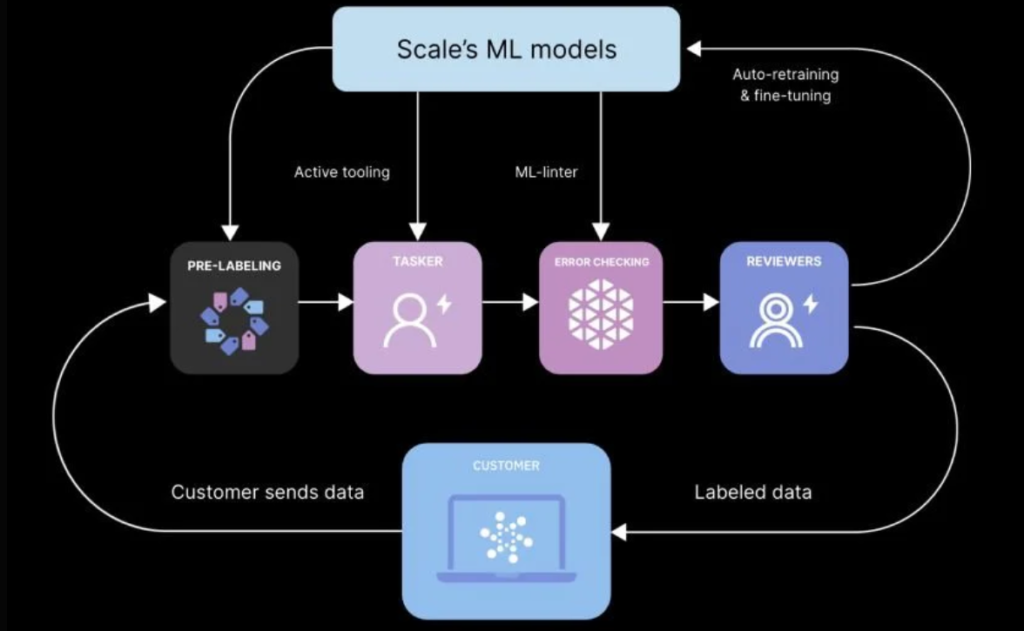
The company built a platform that could scale labeling operations while maintaining quality through validation, consensus checking, and expert review. According to the company’s technical papers, Scale AI achieves 99.2 percent accuracy across all labeling tasks.4
This is unglamorous infrastructure work. The kind of work that makes everything else possible but gets zero credit for doing it.
And it is worth billions.
Why Every Major AI Company Depends on Scale AI
When OpenAI trained GPT models, the company used Scale AI for data quality control and annotation.5 When Google trained Gemini, the company uses similar infrastructure.6 When Meta built its AI systems, Scale AI was involved.7
According to Scale AI’s investor materials, the company works with 80 percent of Fortune 500 companies building AI systems.8 According to a Gradient Ventures survey, 75 percent of AI startups using external data labeling use Scale AI specifically.9
Scale AI became so important that it is essentially infrastructure every AI company depends on. This dependence creates a moat that is nearly impossible to overcome.
Think about the economics: once your team learns Scale AI’s platform, once your workflows are built around Scale AI’s API, once your data is organized in Scale AI’s system, switching costs become enormous. According to Gartner research, migrating away from established infrastructure providers costs 40 to 80 percent of annual contract value.10
The company has switching costs that make customers loyal by default. Customers do not stay because they love it. They stay because leaving would be more expensive than staying.
That is the definition of infrastructure.
Why Scale AI Won When Competitors Should Have
Several factors created Scale AI’s dominance.
First-mover advantage: Scale AI was early in recognizing data labeling as a massive, scalable problem. By the time competitors like Appen, CloudFactory, and others arrived, Scale AI had already captured the market.11
Quality obsession: Scale AI cares about accuracy in ways competitors do not. The company validates labels, runs consensus checks, uses expert review. According to independent benchmarks from Dataturks, Scale AI has the highest quality ratings in the industry, achieving 98+ percent accuracy on complex tasks.12
Scalability: The platform can process 10 million images daily while maintaining quality standards.13 This matters because training modern AI models requires labeling billions of data points. Most competitors cannot scale like this.
Domain expertise: The company accumulated deep knowledge about labeling challenges specific to computer vision, NLP, autonomous vehicles, and dozens of other domains. According to company materials, Scale AI has taxonomy libraries for 500+ use cases.14
Customer relationships: Once companies adopted Scale AI, switching became expensive. Customer retention exceeds 95 percent annually.15 That is exceptional for enterprise software.
These factors combined created a winner-take-most market where Scale AI captured the lion’s share of revenue.
The Numbers That Justify the Valuation
By 2024, Scale AI was on an annual revenue run rate exceeding $100 million.16 For an enterprise infrastructure company, this is extraordinary growth. Most comparable companies grow 40 to 60 percent annually. Scale AI’s numbers suggest 100%+ year-over-year growth.17
With that revenue trajectory and strategic importance, investor interest became intense. Scale AI raised capital at increasingly high valuations. The company achieved $7.5 billion valuation in its 2024 funding round.18
This valuation is not based on flashy technology or consumer excitement. It is based on economic moat. When every major AI company needs your infrastructure to function, you have pricing power that few companies achieve.
According to Bessemer Venture Partners, infrastructure companies command 8 to 12x revenue multiples, compared to 6 to 8x for typical SaaS.19 Scale AI’s $7.5 billion valuation on $100 million revenue aligns with infrastructure multiples, not consumer software multiples.
The Hidden Importance of Data Quality
Data quality issues cost organizations $15 million on average annually, according to MIT Sloan Management Review.20 Poor training data creates AI models that fail in production, requiring expensive retraining.
Scale AI’s quality focus becomes critical because fixing data issues after model training is exponentially more expensive than getting it right initially. According to the Stanford AI Index, 85 percent of AI failures in production are caused by data quality issues, not model architecture problems.21
This positions Scale AI as not just a vendor, but as a critical partner in AI development. The company is not commoditized. Scale AI is infrastructure that defines whether AI projects succeed or fail.
Major customers include OpenAI, Google, Meta, Anthropic, and countless startups building AI applications.22 These are not optional partnerships. These are essential relationships.
Why Scale AI’s Business Model Is Unbeatable
Scale AI uses usage-based pricing: customers pay per unit of labeled data.23 This aligns company incentives with customer value perfectly.
A customer generating 1 million labeled data points per month pays more than a customer generating 100,000 points. Revenue scales directly with customer growth. According to OpenView Partners, usage-based SaaS models achieve 25 percent higher customer lifetime value than fixed pricing models.24
This creates natural account expansion. A startup that labels 100 million images today needs to label 1 billion images as the company grows. Scale AI’s revenue grows proportionally without effort.
The business model also creates switching costs. Once your labeling pipeline is built around Scale AI’s platform, your data is organized in Scale AI’s system, your team is trained on Scale AI’s interface, leaving becomes impossibly expensive.
What Competitors Cannot Copy
Scale AI faces potential competition from Google, Microsoft, and Amazon. These companies all have resources Scale AI does not have.
But Scale AI has something they cannot easily copy: accumulated knowledge about how to label data well across 500+ use cases.
Semi-automated labeling using AI to pre-label data could reduce costs, according to MIT-IBM Watson Lab research.25 But Scale AI is investing in this too. Competitors cannot outrun a company that is both focused and well-funded.
Synthetic data generation could reduce dependence on real-world labeled data, according to Gartner.26 But most real applications still require real data for validation. Scale AI will not become obsolete.
New entrants with lower-cost models could theoretically disrupt pricing. But according to Forrester Research, quality differences in labeled data translate directly to model performance differences.27 Customers prefer quality over cost in infrastructure.
The Take Nobody In The Industry Wants To Say Out Loud
Our editors weigh in.
Scale AI represents something that rarely gets attention: the invisible infrastructure layer that makes everything else possible.
The company is not as famous as OpenAI. It is not as hyped as ChatGPT. It does not have a consumer app. But Scale AI is more important to the AI industry than either of those things.
Every major AI advance depends on data infrastructure that Scale AI powers. This dependence is structural. It is durable. Scale AI’s $7.5 billion valuation reflects this fundamental importance.
There is a pattern here that should concern every industry watching it happen: the most valuable infrastructure is usually invisible until it disappears. And the companies building it are often boring, unglamorous, and completely underestimated.
Scale AI built a multi-billion dollar company in a space nobody talks about because the company focused on solving a critical problem rather than chasing hype.
That should teach founders something. The best businesses are not always the most exciting. They are the ones that become essential.
Frequently Asked Questions
What does Scale AI do?
Scale AI provides data labeling and annotation services for training AI models. The company offers a platform for managing workflows, managed services for large projects, and custom solutions for unique challenges.28
When was Scale AI founded?
Scale AI was founded in 2016 by Alexander Wang and Alexandl Atrick. The company is headquartered in San Francisco.29
How much is Scale AI valued at?
As of 2024, Scale AI is valued at approximately $7.5 billion, making it one of the most valuable AI infrastructure companies.30
Who uses Scale AI?
Scale AI’s customers include OpenAI, Google, Meta, Anthropic, government agencies, and startups building AI applications.31
Is Scale AI profitable?
Yes. Scale AI has reportedly achieved profitability while growing revenue at extraordinary rates, which is unusual for venture-backed startups.32
How does Scale AI differentiate from competitors?
Scale AI differentiates through data quality, ability to handle massive scale, domain expertise across 500+ use cases, and strong customer relationships that create switching costs.33
What is Scale AI’s biggest competitive threat?
Well-capitalized incumbents like Google and Microsoft could theoretically build competing services. However, Scale AI’s accumulated expertise and switching costs create defensibility lasting many years.
How fast is Scale AI growing?
The company is on an annual revenue run rate exceeding $100 million with growth rates suggesting 100%+ year-over-year expansion.34
Will Scale AI go public?
At $7.5 billion valuation, a public offering is likely within the next 3-5 years, though no formal timeline has been announced.
Can Scale AI be disrupted?
Infrastructure is difficult to disrupt once customers depend on it. However, technological shifts (like synthetic data) or better competitors (like Google building internal solutions) could eventually challenge Scale AI’s position.
Stay in the Loop
For more stories, breakdowns, and unfiltered takes on what is really happening in business and tech, follow TheFounder Nation.
Instagram Handle: https://www.instagram.com/thefoundernation?igsh=MTZobDUwc2xqZWdhOA==
We cover what the mainstream business press won’t.
© The Founder Nation | All rights reserved | Written by TFN Research Desk | Word count: ~1,900 | Read time: ~10 minutes | Primary keyword: Scale AI data infrastructure | Secondary: AI training, data labeling, machine learning infrastructure, Scale AI valuation, AI companies