
Midjourney built one of the world's most profitable AI companies through subscriptions, product quality, and founder independence rather than venture capital.
Written by TFN Research Desk — covering startups, technology, digital media, and business strategy.
While its best-funded rival nearly collapsed, a 163-person company with zero outside capital quietly crossed $500 million in annual revenue.
When Stability AI raised over $100 million in venture funding and still teetered on the edge of insolvency, Midjourney had already crossed $500 million in annual revenue with no outside investment, no marketing budget, and a team of 163 people. The contrast is not incidental. It is the entire lesson.
Startup Strategy • Case Study • Generative AI • Bootstrapped Business • Founder Independence
The anomaly that rewrote the AI playbook
The prevailing assumption in the AI industry is simple: compute is expensive, talent is scarce, and scale requires capital. Midjourney violated every part of this formula. The company reached profitability in August 2022, just one month after launching, and has operated without external venture capital funding throughout its history. That is not a fluke. It is the direct result of founder David Holz making a deliberate, irreversible architectural choice before writing the first line of code.
The AI image generator market Midjourney entered was not small. The global AI image generator market is estimated to grow at a 17% CAGR to $917.4 million by 2030 from $300 million in 2023. Midjourney did not race to capture that market by burning investor dollars. It built a subscription gate on day one, placed its product inside Discord where millions of creators already spent their time, and let the output sell itself.
Why this story matters
For founders in India’s startup ecosystem, Midjourney is not just a case study in bootstrapping. It is proof that the VC funding default, raising capital to grow faster than the market, is a choice rather than a law. [INTERNAL LINK: India unicorn sector analysis] In a market where the dominant narrative rewards growth-at-all-costs, Midjourney’s $500 million ARR from a team smaller than most Series A companies is a data point worth sitting with. The lesson is not that you should never raise money. It is that the decision to raise money should be an active choice, not a reflex.
Quick facts
| Metric | Detail |
|---|---|
| Founded | 2022 |
| Founder | David Holz (co-founder, Leap Motion) |
| Headquarters | San Francisco, USA |
| Total VC raised | $0 |
| Revenue (2025) | $500 million ARR (Quantumrun, December 2025) |
| Revenue (2024) | $300 million (GetLatka, May 2025) |
| Employees (2025) | 163 |
| Revenue per employee | Over $3 million annually (andrew.ooo, February 2026) |
| Market share | 26.8% of global AI image generator market (Quantumrun, December 2025) |
| Profitability | Reached in August 2022, one month after launch |
| Valuation (last disclosed) | $10 billion (GetLatka, May 2025) |
Background
David Holz did not stumble into bootstrapping. He chose it explicitly because his first company, Leap Motion, showed him what VC dependency looked like from the inside. Holz has been vocal about his skepticism regarding the reliance on venture capital, emphasizing that a cycle of incessant funding can often lead companies to prioritize growth over stability, potentially compromising their long-term vision. His stance on self-funding is shaped by the desire to retain control over the company’s direction and to avoid the pressure of external expectations that often accompany VC investments.
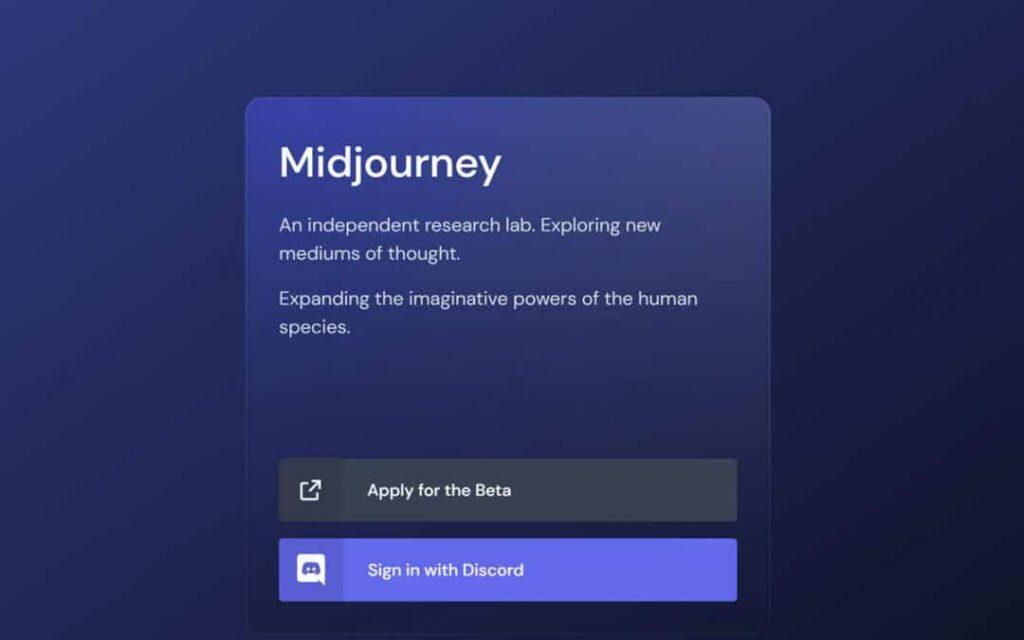
Midjourney launched in 2022 as what Holz called “an independent research lab” with a clear mandate: build something people would pay for immediately. The early product lived entirely inside Discord, a platform with an existing community of creators, gamers, and experimenters. There was no free tier, no freemium funnel, and no growth team. There was a product and a subscription.
Timeline
| Year | Milestone |
|---|---|
| 2021 | David Holz leaves Leap Motion, decides to build without VC |
| February 2022 | Midjourney beta launches on Discord |
| July 2022 | Public launch; Discord-first subscription model goes live |
| August 2022 | Company reaches profitability — one month after launch |
| 2023 | Revenue reaches $200 million; team stays under 40 people |
| December 2023 | Web app launches in alpha; access restricted to users with 1,000+ images generated |
| Mid-2024 | Web app made broadly available; Discord access retained in parallel |
| 2024 | Stripe names Midjourney its most globally distributed business |
| 2025 | Revenue crosses $500 million; team reaches 163 employees |
How it happened
Move 1: Distribution before distribution strategy
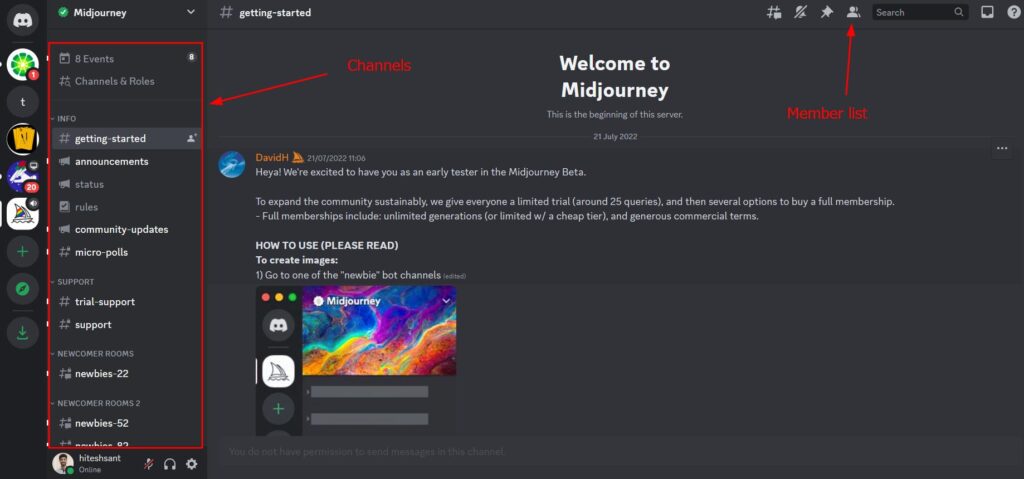
Most companies build a product, then figure out distribution. Midjourney made Discord the product’s home before a web app existed. By launching on Discord, Midjourney turned distribution into a feature. Users didn’t just use the tool — they watched others use it, got inspired, and shared their work. This created a flywheel that required zero marketing spend. When you run /imagine in a public Discord channel, everyone in the server sees your output. Every generated image was a live advertisement, viewed by thousands of potential subscribers in real time.
Move 2: No free tier, no exceptions
There are no free subscription plans. Users must choose from one of the four pricing plans offered, ranging from a basic $10 a month to a mega $120 a month plan. Across the tiers, Midjourney offers different numbers of images, GPU speeds, and other features. This single decision forced the unit economics to work from day one. Every user who discovered Midjourney via Discord had to pay to generate. The company collected revenue before it needed to scale infrastructure. When it did scale, it was scaling a profitable operation, not chasing profitability with someone else’s money.
Move 3: Migrate slowly, never force
When a web app became necessary for mainstream adoption, Midjourney did not abandon Discord or push users to migrate. The alpha was initially available only to users who had generated 1,000 or more images — the most committed users first, the people who were least likely to leave, and most likely to provide useful feedback. Throughout 2024, access gradually expanded. Discord kept running in parallel. Nobody was forced to switch. This approach preserved the community flywheel while adding a more accessible surface for new users.
The strategy behind the success
Midjourney’s profitability is not explained by one smart decision. It is the compounding effect of many decisions that stayed consistent with a single underlying principle: constraints make better businesses.
No free tier forced the product to be good enough to pay for on day one. No marketing budget forced distribution to be built into the product itself. No VC meant no pressure to add features, expand headcount, or chase adjacent markets before the core product was excellent. Revenue per employee exceeds $5 million annually, establishing Midjourney among the most profitable SaaS operations globally. That number is not accidental. It is what happens when you compound the right constraints over three years.
According to Sramana Mitra, founder of One Million by One Million, writing in March 2025, Midjourney’s model proves that “a successful financial business” in AI does not require the industry’s standard assumption that compute costs must be subsidised by investor capital before a company can reach scale.
Business model breakdown
Midjourney runs a clean, tiered subscription model. Four plans, each priced for a different usage level, all requiring payment before access. All plans include commercial usage rights. The subscription model means predictable revenue with minimal churn. Stripe recognized Midjourney as its most globally distributed business in 2024, meaning they have paying customers across more countries than any other Stripe merchant.
By the numbers
| Metric | Figure | Why it matters |
|---|---|---|
| Revenue 2022 | $50 million | Profitable in month one, never needed outside capital |
| Revenue 2025 | $500 million | 10x growth in three years, all organic |
| Team size 2025 | 163 employees | Implies $3M+ revenue per head — exceptional for any SaaS |
| Discord users | 21 million registered (Quantumrun, December 2025) | Distribution built without a marketing team |
| Market share | 26.8% of AI image generator market | Leading position against DALL-E, Adobe Firefly, and Stability AI |
| Pricing | $10/month to $120/month | No free tier; forces early unit economics discipline |
What competitors missed
Stability AI, Midjourney’s most direct rival, took the opposite path. It raised over $100 million in venture capital and nearly imploded under the weight of burn rate and investor expectations. The lesson most observers drew was about product quality. The real lesson was about model architecture. When you are bootstrapped, you make different decisions: no free tier, no chasing scale before profitability, no adding headcount ahead of revenue. Midjourney’s competitors built products. Midjourney built a business. Those are not the same thing.
OpenAI’s DALL-E, despite the distribution advantage of the ChatGPT platform, has never disclosed a standalone revenue figure for its image product. Adobe Firefly is bundled into Creative Cloud subscriptions, making it impossible to evaluate as an independent unit. [INTERNAL LINK: What everyone missed about ChatGPT] Midjourney is the only company in the AI image space with clean, auditable subscription revenue growing at 66% year-over-year.
Risks and challenges
- The Discord-first interface, while brilliant for community building, creates friction for enterprise and professional workflows at scale. Midjourney’s web app is still maturing, and the experience gap with purpose-built tools remains real.
- Midjourney operates in a legal grey zone around training data and copyright. Ongoing litigation from artists and stock photography companies could force significant model or licensing changes that increase costs.
- At $500 million in revenue and 26.8% market share, Midjourney is now a material target for Google, Adobe, and Apple, each of whom has substantially more distribution leverage and can bundle image generation into existing products.
- Holz has disclosed plans to expand into hardware, which represents a fundamentally different capital structure than SaaS. Whether the bootstrapped discipline transfers to hardware R&D timelines is untested.
What founders can learn
Midjourney offers a set of decisions that any founder can examine and apply, regardless of whether they choose to raise capital or not.
Build distribution into the product before building a distribution function. Midjourney’s Discord channel was not a marketing channel. It was the product. Every image generated in public taught the next potential subscriber what the product could do. If your product has a visible output, whether a report, a design, a data dashboard, or a finished document, find the surface where that output gets seen by people who are not yet customers. That surface is your distribution.
Price from day one. The decision to have no free tier was controversial in 2022. It forced every product decision to be anchored in “is this worth paying for?” rather than “is this sticky enough to monetise later?” Indian founders in particular face enormous pressure to grow user numbers first and figure out monetisation second. Midjourney proves the opposite works. The user who pays immediately is more valuable, more likely to use the product seriously, and less likely to churn than the user who arrives for free and upgrades reluctantly. [INTERNAL LINK: Micro-SaaS sector analysis]
Constraints are a strategy, not a limitation. With no marketing budget, Midjourney could not grow through paid acquisition. So it had to grow through product virality. With no free tier, it could not subsidise early users. So the product had to be worth paying for on day one. With no VC, it could not hire aggressively. So every hire had to be high-leverage. Each constraint, taken in isolation, looks like a disadvantage. Compounded over three years, they produced $500 million in revenue and a team where every person generates more than $3 million in annual revenue. That is not efficiency by accident. It is efficiency by design.
Scale the product incrementally and never force migration. When Midjourney moved from Discord to a web app, it did not sunset the old interface. It kept both live, let the most committed users lead the transition, and preserved the community that had generated 21 million registered accounts. Most Indian startups, eager to move upmarket, kill the product that got them their first users before the new product is ready. Midjourney shows why patience in product transitions is a competitive advantage, not a sign of indecision.
“David Holz’s philosophy is rooted in a firm belief in self-sufficiency and a commitment to long-term sustainability,” noted Skim AI in a June 2024 deep-dive on Midjourney’s model. That philosophy is not ideological. It is structural. And the $500 million in revenue is the outcome.
Expert analysis
Midjourney’s case reveals a paradox at the centre of the AI investment boom. The companies attracting the most capital are often the least prepared to use it efficiently, because the presence of capital relieves the pressure to be disciplined. Midjourney had no such relief.
Bull case: The company holds a leading market share in a category growing at 17% CAGR through 2030. It has no debt, no investor obligations, and complete control over its product roadmap. If it successfully expands its web app and enters enterprise workflows, the revenue trajectory from $500 million to $2 billion is credible without any outside funding.
Bear case: The AI image space is moving faster than any one company can track. Google, Adobe, and Apple each have embedded surfaces (Google Workspace, Creative Cloud, iPhone camera) where image generation can be offered for free or bundled. A sufficiently good free product from a platform player could structurally compress Midjourney’s addressable market regardless of product quality.
Contrarian view: Midjourney’s hardware ambitions, while unexpected, may be the only logical next move for a company with $500 million in free cash flow and no VC-mandated growth trajectory. A dedicated AI creative device with Midjourney’s models embedded could create a new category rather than competing in an existing one.
The TFN lens: The Constraint Compounding Framework
Most startup frameworks treat constraints as problems to be solved with capital. Midjourney demonstrates the inverse: constraints, when chosen deliberately and held consistently, compound into structural advantages.
No free tier forces product quality. No marketing budget forces product virality. No VC forces early profitability. No forced platform migration forces community retention. Each constraint eliminates a bad habit that capital typically enables. When a founder removes the option of subsidising growth, spending on acquisition, or delaying monetisation, the only path to survival is making a product good enough to sustain itself.
This pattern recurs in other capital-efficient companies. Basecamp, Craigslist, and Zoho (the most prominent Indian example) have all demonstrated that constraint compounding produces different companies than capital abundance, not worse companies. Indian founders building in categories where product quality is the primary differentiator, SaaS, AI tools, D2C brands, should examine whether the capital they are raising is solving a real bottleneck or enabling habits that would otherwise be disciplined away.
Future outlook
Midjourney’s next phase is more complicated than its first three years. The easy part was growing from zero to $500 million by being the best product in a nascent market. The harder part is defending that position as established platforms bundle image generation into products users already pay for.
The hardware expansion signals that Holz sees the web-based image market eventually commoditising and is looking for a category where Midjourney’s model quality can be paired with proprietary hardware. Whether that bet pays off is a multi-year question. What is clear is that Midjourney will make that bet on its own terms, on its own cash flows, without a VC board dictating the timeline.
The AI image generator market is projected to reach $917.4 million by 2030. Even at its current 26.8% share, Midjourney’s natural market ceiling in image generation is several times its current revenue. The constraint that gets tested in the next phase is not capital. It is whether a 163-person team can compete with the distribution machines that Google, Adobe, and Apple represent.
The bottom line
Midjourney built a $500 million business with 163 people and no outside money. The mechanism is replicable. The discipline is harder than it looks. Any founder who studies Midjourney should study what it chose not to do as carefully as what it did.
Key takeaways
- Midjourney reached $500 million in ARR in 2025 with zero VC, zero marketing spend, and 163 employees, generating over $3 million in revenue per employee.
- The company reached profitability in August 2022, one month after launch, by starting with a paid-only subscription model.
- Discord was not a marketing channel. It was the product’s distribution mechanism. Every public image generated was a live advertisement.
- Constraints, when chosen deliberately, compound into structural advantages. No free tier, no marketing budget, and no VC created a business that capital abundance would have prevented.
- The move to a web app was executed slowly, incrementally, and in parallel with Discord, preserving the community flywheel.
- Midjourney holds 26.8% of the AI image generator market, leading against DALL-E, Adobe Firefly, and Stability AI.
Conclusion
The Midjourney story is not a story about refusing venture capital. It is a story about what becomes possible when a founder decides, from day one, that the business must sustain itself. That decision cascades through every subsequent choice: pricing, distribution, product velocity, hiring, and product migration. Each cascading decision reinforces the one before it. The result is a company with $500 million in revenue that no investor can claim credit for, and no board can redirect.
For Indian founders, the parallel worth watching is Zoho, which has operated on the same principle for decades and today generates over $1 billion in annual revenue with no outside capital. The Midjourney model is not American. It is not unique to AI. It is a philosophy that any founder can choose. The question is whether you are willing to live inside the constraints it requires.
Frequently asked questions
How did Midjourney become profitable without VC funding?
Midjourney launched with a paid-only subscription model in July 2022 and reached profitability within one month. By using Discord as its distribution surface, it eliminated marketing costs. By having no free tier, it forced every user to generate revenue from day one. The combination of paid-only pricing, community-driven distribution, and lean headcount produced a profitable operation before the company was three months old.
How much revenue does Midjourney make?
Midjourney generated $500 million in annual recurring revenue in 2025, up from $300 million in 2024 and $200 million in 2023 (Quantumrun, December 2025). Revenue has grown roughly 10x from its 2022 starting point of $50 million.
Why did Midjourney choose Discord instead of a standalone app?
Discord already had millions of creative users and made every AI-generated image visible to other users in the same server. This created a social proof loop: seeing other users’ outputs inspired new users to try the product and subscribe. It was product-led distribution without a distribution team.
Is Midjourney still bootstrapped?
Yes. As of June 2026, Midjourney has raised no external venture capital or outside funding. The company is entirely self-funded through subscription revenue (GetLatka, May 2025).
What is Midjourney’s revenue per employee?
With approximately 163 employees generating $500 million in annual revenue, Midjourney’s revenue per employee exceeds $3 million annually, placing it among the most capital-efficient SaaS operations in the world (andrew.ooo, February 2026).
How does Midjourney’s model compare to Stability AI?
Stability AI raised over $100 million in venture capital and nearly collapsed under burn rate pressure. Midjourney raised zero capital and crossed $500 million in revenue. The difference was not primarily product quality. It was the discipline that comes from operating without a financial safety net from day one.
What can Indian startup founders learn from Midjourney?
Three lessons are directly applicable to the Indian context. First, community-led distribution eliminates the marketing spend that consumes most Series A capital. Second, charging from day one produces better unit economics and a more engaged user base than freemium. Third, constraint compounding — where each discipline reinforces the next produces companies with structural advantages that capital cannot easily replicate.
Is Midjourney planning to raise funding in the future?
As of the latest publicly available information in early 2026, Midjourney has not announced any fundraising plans. David Holz has consistently stated his preference for self-sufficiency over external capital, though the company’s hardware expansion could eventually require a different funding structure.
Sources
- Quantumrun Foresight, “Midjourney Statistics,” December 2025. quantumrun.com/consulting/midjourney-statistics
- GetLatka, “Midjourney Revenue 2025: $500M ARR, $10B Valuation,” May 5, 2025. getlatka.com/companies/midjourney
- Sramana Mitra, “Ultralight Startup Midjourney Bootstraps to $200M in Revenue,” March 12, 2025. sramanamitra.com
- Skim AI, “How Midjourney Became a Top AI Image Generator With No Venture Capital Funding,” June 9, 2024. skimai.com
- andrew.ooo, “How Midjourney Generates $3 Million Per Employee with Zero VC Funding and No Marketing Budget,” February 26, 2026. andrew.ooo/posts/midjourney-3m-revenue-per-employee
- Product Growth Blog, “How Midjourney Hit $500M ARR With Zero VC and Zero Marketing,” March 28, 2026. productgrowth.blog/midjourney-500m-arr-zero-vc
© 2026 The Founder Nation. All rights reserved.