
Blinkit is expanding beyond grocery delivery by investing in dark stores, higher-value categories, and new logistics capabilities.
Written by TFN Research Desk | covering startups, technology, venture capital, and business strategy.
While Amazon committed Rs 2,800 crore to chase Blinkit and Flipkart crossed 800 dark stores in months, Blinkit quietly shifted the game from speed to infrastructure scale, and the gap is widening.
Blinkit built a 10-minute delivery empire on groceries. Now it wants to be the instant layer beneath everything urban India buys. The race is no longer about who delivers fastest. It is about who owns the infrastructure of instant retail.
Topic tags: Case Study • Startup Strategy • Quick Commerce • Indian Startups • Retail Tech
The first war is over. The second has begun.
A year ago, everyone was asking whether quick commerce was a real business.
Blinkit answered the question with 46% market share, 2,243 dark stores as of Q4 FY26, and a Net Order Value of Rs 14,386 crore in that quarter alone (Quash, May 2026).
The 10-minute grocery company has won the first war.
Now it is preparing for the second one. And this time, the competition is not Zepto and Swiggy Instamart. It is Amazon and Flipkart, with tens of thousands of crores behind them.
What is Blinkit doing next? And what does it tell us about the future of Indian retail?
Why this story matters
Quick commerce is no longer a niche urban experiment. It already accounts for roughly 40% of all online grocery sales in India, and the sector as a whole served approximately 230 million people across 2,600 pincodes as of April 2026 (Business Standard, April 2026).
What Blinkit is building is not a grocery app. It is the physical layer beneath instant retail, a distributed network of micro-warehouses that can deliver almost anything in under 10 minutes to anyone in a dense Indian urban area.
Founders in any category touching Indian urban consumers need to understand this: Blinkit is not just a distribution option. It may become their most important distribution partner, or their most dangerous competitor. [INTERNAL LINK: “India quick commerce sector analysis 2026”] breaks down the competitive landscape across all six players. And goes deeper on what shelf placement in a dark store actually costs.
Quick facts
| Metric | Value | Source |
|---|---|---|
| CEO | Albinder Dhindsa | Eternal Ltd |
| Parent company | Eternal Ltd (formerly Zomato) | Eternal Ltd |
| Dark store count (Q4 FY26) | 2,243 stores across 150+ cities | Entrackr, April 2026 |
| Dark store target | 3,000 by March 2027 | Franchise India, October 2025 |
| Market share | 46% of quick commerce | StartupFeed, June 2026 — editor to confirm live URL |
| Q4 FY26 NOV | Rs 14,386 crore | Quash, May 2026 |
| Monthly transacting users (Q4 FY26) | 27.2 million | Quash, May 2026 |
| Products available | 30,000+ SKUs across the catalogue | Markhub24, June 2026 |
| Q4 FY26 adjusted EBITDA | Rs 37 crore | Entrackr, April 2026 |
Background
In 2021, Grofers (Blinkit’s former identity) was struggling. The next-day grocery delivery model was not working. Margins were thin. Customer retention was worse.
Then it made a decision that looked either visionary or desperate depending on who you asked: it pivoted to 10-minute delivery, rebuilt around dark stores, and changed its name to Blinkit.
The logic was simple. Indian urban consumers do not want to wait. Not for a day. Not for two hours. Not even for an hour. They want milk and eggs in the same window they expect WhatsApp messages to arrive.
Blinkit bet on that psychology and won.
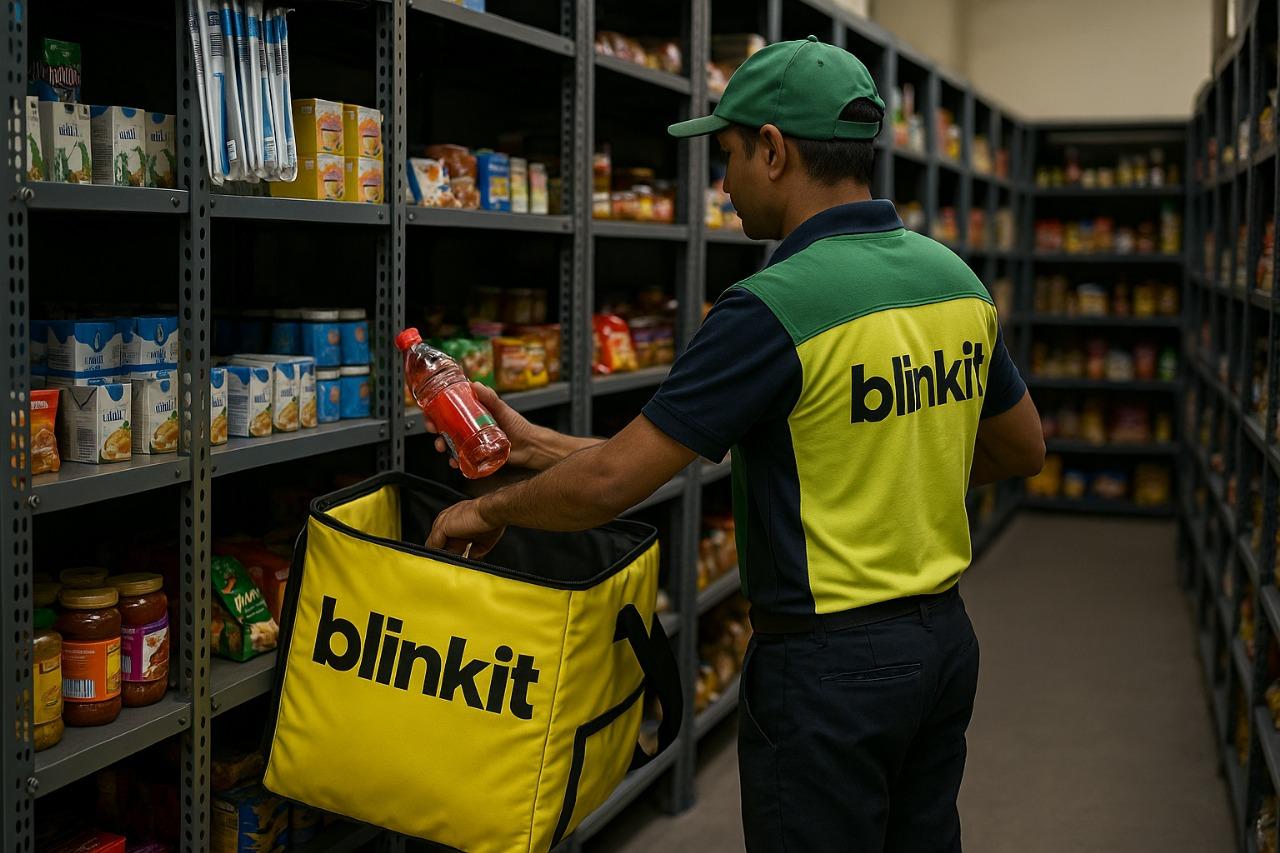
The operational model is precise. Each dark store is a 1,000 to 4,000 square-foot micro-warehouse embedded within residential neighbourhoods, close enough to deliver within a 1 to 2 kilometre radius on a two-wheeler in under 10 minutes. AI-powered demand prediction manages inventory at each store. High-velocity SKUs across groceries and FMCG keep turnover high and waste low.
From 383 dark stores in mid-2023, Blinkit scaled to 526 by Q4 FY24, then accelerated sharply, crossing 1,000 by December 2024 ahead of its own stated target, and reaching 2,243 stores across more than 150 cities by Q4 FY26 (Markhub24, June 2026).
Parent company Eternal Ltd has invested Rs 2,600 crore into Blinkit across 2025 and early 2026 specifically to fund dark store expansion (Brineweb, April 2026).
Timeline: Blinkit’s journey from Grofers to quick commerce leader
| Period | Milestone |
|---|---|
| December 2013 | Founded as Grofers by Albinder Dhindsa and Saurabh Kumar as a scheduled grocery delivery platform |
| 2021 | Rebranded to Blinkit; pivoted to 10-minute delivery model built around dark stores |
| August 2022 | Acquired by Zomato (now Eternal Ltd) in an all-stock deal valued at approximately $568 million (TechCrunch, January 2025) |
| Mid-2023 | Approximately 383 dark stores operational; GOV per store around Rs 6 lakh per day |
| Q4 FY24 | 526 dark stores; contribution margin turns positive across entire network |
| December 2024 | Crosses 1,000 dark stores — one quarter ahead of target |
| Q2 FY26 (September 2025) | 1,816 dark stores; 3,000-store target by March 2027 stated by CEO (Franchise India, October 2025) |
| Q4 FY26 (March 2026) | 2,243 dark stores; NOV Rs 14,386 crore; adjusted EBITDA Rs 37 crore (Entrackr, April 2026) |
| 2026 onwards | Amazon commits Rs 2,800 crore to dark store expansion (Inc42, April 2026); Flipkart crosses 800 dark stores (TechCrunch, April 2026) |
How it happened
Move 1: Density before diversity
Blinkit’s core strategic insight was that density, not breadth, was the product. Every time it added a dark store in a dense neighbourhood, the 10-minute promise became more reliable. Every time the promise became more reliable, consumer behaviour shifted toward quick commerce across more categories.
The company did not start with 30,000 SKUs. It started with the fastest, most reliable grocery delivery in each city. Once consumers trusted the 10-minute window on essentials, expanding into electronics, beauty, and pet care became a natural extension of an already-trusted platform. By Q4 FY26, Blinkit’s catalogue had grown to over 30,000 SKUs across more than 150 cities (Markhub24, June 2026).
Move 2: Inventory ownership as margin lever
In Q1 FY26, Eternal began transitioning Blinkit from a marketplace model, where third-party sellers fulfilled orders, to an inventory-led model, where Blinkit purchases goods wholesale and sells them at retail prices. By Q3 FY26, approximately 90% of Blinkit’s NOV was already on owned inventory (Quash, May 2026).
This shift has two compounding effects. First, it improves gross margins by an estimated one percentage point of EBITDA, more than half of which had already been captured by Q3 FY26. Second, it gives Blinkit full control over pricing, availability, and the customer experience in a way a pure marketplace model never could.
The result: Q4 FY26 revenue from operations reached Rs 13,232 crore, up from Rs 1,709 crore in Q4 FY25, though Eternal has been explicit that this jump reflects the model change rather than a clean like-for-like comparison (Quash, May 2026). NOV is the correct metric for comparing performance across periods.
Move 3: Racing to 3,000 before the competition catches up
CEO Albinder Dhindsa has stated publicly that Blinkit will reach 3,000 dark stores by March 2027, and that it will do so while remaining profitable (Franchise India, October 2025).
The urgency is real. The industry as a whole operated 5,700 to 6,000 dark stores across all players as of April 2026 (Business Standard, April 2026). Flipkart has crossed 800 stores and is targeting 1,500 to 1,600 by year-end (TechCrunch, April 2026). Amazon has committed Rs 2,800 crore to expansion and plans to reach 100 cities (Inc42, April 2026). At 3,000 nodes, Blinkit’s infrastructure becomes a general-purpose instant retail network that competitors would need years, not months, to replicate.
The strategy behind the success
The insight that Blinkit’s competitors missed: speed is not the product. Certainty is.
When a consumer orders from Blinkit, they do not think about logistics. They think: it will arrive in 10 minutes. That certainty changes behaviour. It makes impulse purchases rational. It makes Blinkit a utility, not a convenience.
Density is what creates certainty. The more dark stores, the shorter the delivery radius, the more reliably the 10-minute promise holds. Blinkit understood that infrastructure density was the product, not the SKU catalogue, not the app design. Others missed it because they tried to grow SKU count before achieving density. Without density, speed is a promise, not a guarantee.
By the numbers
| Metric | Value | Source | Why it matters |
|---|---|---|---|
| Dark stores (Q4 FY26) | 2,243 across 150+ cities | Entrackr, April 2026 | Physical scale competitors cannot quickly replicate |
| Target dark stores by March 2027 | 3,000 | Franchise India, October 2025 | Infrastructure arms race, not a marketing battle |
| Market share | 46% of Indian quick commerce | StartupFeed, June 2026 | Dominant position with nearest rival Zepto at 1,139 stores (Business Standard, June 2026) |
| Q4 FY26 NOV | Rs 14,386 crore | Quash, May 2026 | More than doubled from Rs 9,421 crore in Q4 FY25 |
| Industry dark stores (April 2026) | 5,700 to 6,000 total across all players | Business Standard, April 2026 | Shows the full scale of the infrastructure war underway |
Comparison table: the six-player quick commerce war
| Player | Dark stores (2026) | Backing | Key advantage | Key vulnerability |
|---|---|---|---|---|
| Blinkit | 2,243 (Q4 FY26), targeting 3,000 by March 2027 | Eternal Ltd | Density lead, inventory model, adjusted EBITDA positive | Thin margins (Rs 37 crore EBITDA on Rs 14,386 crore NOV) |
| Zepto | 1,139 (end FY26) | VC-backed, IPO in progress | Operational efficiency, profitability improving | IPO pressure limits aggressive reinvestment |
| Swiggy Instamart | 1,143 (end FY26) | Swiggy (public) | Swiggy app integration, brand recognition | Growth slowest among top three; profitability focus |
| Flipkart Minutes | 800+ (April 2026), targeting 1,500+ by year-end | Walmart | Distribution network, capital depth, Tier-2 ambition | Late entrant; no density advantage in core metros yet |
| Amazon Now | 450 to 500 (April 2026), adding ~2 stores daily | Amazon | Rs 2,800 crore committed; 100-city ambition | Latest entrant; brand not yet associated with 10-minute delivery |
| BB Now | Scaling | Tata | Tata ecosystem, BigBasket brand trust in groceries | Smallest scale among major players |
Sources: Business Standard, June 2026; TechCrunch, April 2026; Inc42, April 2026; Entrackr, April 2026
What competitors missed
Swiggy Instamart grew its dark store count slowly, reaching only 1,143 stores by end of FY26 while Blinkit reached 2,243 (Business Standard, June 2026). That gap in infrastructure density made delivery reliability comparisons predictable.
Amazon Now is arriving late and spending enormously to catch up. Its Rs 2,800 crore commitment shows that quick commerce cannot be won at a discount (Inc42, April 2026), but Blinkit’s head start in urban density will be extremely difficult to close. As retail consultancy Technopak Advisors partner Ankur Bisen put it: “When the product is identical, the same tomatoes, the same soft drinks, the same pet food, and delivery times are within minutes of each other, the only remaining competitive levers are price and infrastructure scale.”
Zepto, for its part, chose IPO preparation over maximum dark store expansion, introducing a profitability tension at a moment when the market is rewarding aggression.
The common error: treating quick commerce as a race to the best app. Blinkit treated it as a race to the best physical infrastructure. covers the diverging paths in more detail.
Risks and challenges
- Margins remain extremely thin. Blinkit reported an adjusted EBITDA of just Rs 37 crore on Rs 14,386 crore of NOV in Q4 FY26, a margin of approximately 0.3% (Entrackr, April 2026). Sustaining the infrastructure investment at this margin level depends entirely on Eternal’s continued capital support.
- Amazon and Flipkart have capital depth that exceeds Eternal Ltd’s. If they achieve density in the top 10 cities, Blinkit’s margins compress in its most profitable markets and the war of attrition benefits the deeper pockets.
- The Rs 525 average order value (Quash, May 2026) is under pressure from a cost-conscious consumer environment. Quick commerce grew during a period of rising urban incomes; sustained AOV depends on consumers continuing to trade convenience over price.
- Category expansion to 30,000+ SKUs increases operational complexity at the dark store level. Stocking electronics and perishables in the same micro-warehouse creates inventory management challenges that groceries alone never required.
- Bernstein research has flagged that dark store consolidation or rationalisation may be necessary in metros to improve profitability, suggesting the current expansion phase has limits (Business Standard, April 2026).
What founders can learn
- Build the infrastructure layer before optimising the experience layer. The dark store network is not a backend detail. It is the product. Blinkit’s app is good. Its infrastructure lead is what makes the app defensible.
- Use density as a moat. A service that gets better as it scales is a compounding advantage. Design that compounding in from day one, not as a retrofit.
- Expand category breadth only after achieving delivery reliability. Blinkit did not start with 30,000 SKUs. It earned the right to expand them by first making the core promise unbreakable.
- Understand that in infrastructure-first businesses, the right metric is not revenue. Blinkit leads on NOV, not on revenue, because the model change makes revenue comparisons misleading. Track the metric that reflects true business volume.
- Inventory ownership changes the economics of platforms. Moving from marketplace to inventory model costs capital in the short term and improves margins structurally. Blinkit timed this shift at scale, which is why it is capturing the benefit efficiently.
Expert analysis
Bull case: Blinkit’s dark store network, at 3,000 stores, becomes a platform that transcends grocery. Advertising revenue, brand placement fees, and third-party logistics partnerships create revenue streams that transform the economics of quick commerce entirely. At 3,000 urban nodes, the network effect is genuinely defensible. Goldman Sachs has valued Blinkit at $13 billion, more than Zomato’s own food delivery business (Brineweb, April 2026).
Bear case: Amazon and Flipkart have capital depth, customer trust, and logistics expertise that cannot be dismissed. Flipkart alone is targeting 1,500 plus stores by year-end (Entrackr, April 2026). If they achieve density in the top 10 cities, Blinkit’s margins compress in its most profitable markets. A margin war benefits Amazon more than Blinkit.
Contrarian view: The real test for Blinkit is not Amazon or Flipkart. It is whether Indian consumers will continue paying a premium for instant delivery as household budgets tighten. Quick commerce grew during a period of expanding urban incomes. The Rs 525 average order value may prove fragile if those incomes stagnate or if competitors subsidise aggressively enough to reset consumer price expectations.
Future outlook
The quick commerce infrastructure war of 2026 is the most capital-intensive build-out Indian retail has seen since the e-commerce expansion of 2014 to 2016. The difference is that this time, the incumbents (Amazon, Flipkart) are entering after the market has been proven, not before.
Blinkit’s path to defensibility runs through the 3,000-store target. At that density, the infrastructure becomes a platform and not just a delivery service. Brands will pay for shelf placement in dark stores the way they pay for shelf placement in modern retail. Third-party logistics and last-mile delivery become services Blinkit can offer to other businesses. The dark store network becomes a general-purpose urban fulfilment layer.
The profitability question will define the next phase. Blinkit’s Rs 37 crore adjusted EBITDA on Rs 14,386 crore of NOV is a margin that reflects the investment phase, not the mature business. As the store network matures and ad revenue scales, the unit economics of individual stores will improve. The question is whether Eternal can sustain the investment pace long enough to reach the density threshold before Flipkart or Amazon achieves comparable coverage in the metros that generate the most order value.
The bottom line
Blinkit does not deliver groceries. It delivers certainty. And certainty, at 2,243 locations across India and counting, is the most valuable product in retail.
Key takeaways
- Blinkit holds approximately 46% of India’s quick commerce market with 2,243 dark stores as of Q4 FY26, and is targeting 3,000 by March 2027 (Franchise India, October 2025).
- The company’s Q4 FY26 Net Order Value reached Rs 14,386 crore, more than 50% above the Rs 9,421 crore recorded in Q4 FY25 (Quash, May 2026).
- Amazon Now and Flipkart Minutes are entering aggressively. Flipkart has crossed 800 stores and is targeting 1,500 plus by year-end; Amazon has committed Rs 2,800 crore to expansion (TechCrunch, April 2026; Inc42, April 2026).
- Blinkit’s shift to an inventory-led model has improved margins structurally; approximately 90% of NOV was on owned inventory by Q3 FY26 (Quash, May 2026).
- The real strategic insight is density as a moat: the more dark stores, the more reliable the 10-minute promise, the more consumer behaviour permanently shifts toward quick commerce.
- Despite 2,243 stores and Rs 14,386 crore in NOV, Blinkit posted only Rs 37 crore in adjusted EBITDA in Q4 FY26, meaning margin expansion is the defining challenge for the next phase (Entrackr, April 2026).
Conclusion
Blinkit won the first phase of India’s quick commerce war by understanding something its competitors missed: infrastructure density was the product, not the delivery promise.
The second phase is harder. Amazon and Flipkart are not startups underestimating the capital requirements of dark store expansion. They are global-scale operators with deep enough pockets to sustain a multi-year war of attrition. The margin environment in quick commerce is thin enough that sustained subsidies from either company could force painful choices for Blinkit and Eternal.
What Blinkit has that Amazon and Flipkart do not is a head start measured in years and thousands of stores, in the most valuable urban pincodes in the country. That head start compounds as long as Blinkit keeps adding stores faster than competitors can close the gap in the cities that matter.
The 3,000-store target by March 2027 is not an aspiration. It is the line that makes the infrastructure defensible as a platform. Everything Blinkit is doing right now is aimed at crossing that line before the competition gets close enough to make the race uncertain.
TFN LENS
The real lesson from Blinkit is not that quick commerce is a high-growth market.
The real lesson is that Blinkit understood it was building infrastructure, not running a delivery service. Infrastructure compounds. Delivery services commoditise.
Every time Blinkit adds a dark store, the 10-minute promise becomes more reliable. Every time the promise becomes more reliable, consumer trust deepens. Every time consumer trust deepens, the category of things people buy via Blinkit expands. The flywheel only works if you build the physical layer first. That is as true for a logistics business as it is for a marketplace, a platform, or any business where the core value is reliability at scale.
Building something of your own? Follow The Founder Nation and NamasteVC for curated startup funding news, grant alerts, and founder stories from India’s startup ecosystem, delivered straight to your feed, every week.
Frequently asked questions
What is Blinkit’s current market share in quick commerce?
Blinkit holds approximately 46% of India’s quick commerce market as of June 2026. Its nearest competitors, Zepto and Swiggy Instamart, each operate around 1,100 to 1,143 dark stores, compared to Blinkit’s 2,243 as of Q4 FY26 (Business Standard, June 2026).
How many dark stores does Blinkit have in 2026?
Blinkit operated 2,243 dark stores across more than 150 Indian cities as of Q4 FY26, which ended March 2026 (Entrackr, April 2026). CEO Albinder Dhindsa has publicly stated the target is 3,000 stores by March 2027 (Franchise India, October 2025).
Is Blinkit profitable?
Blinkit turned adjusted EBITDA positive but the margins remain thin. In Q4 FY26, it reported Rs 37 crore in adjusted EBITDA on Rs 14,386 crore in Net Order Value, a margin of approximately 0.3% (Entrackr, April 2026). The business is investment-phase profitable, meaning it is not burning cash at the operating level, but the margins do not yet reflect the economics of a mature dark store network.
Who owns Blinkit?
Blinkit is owned by Eternal Ltd, formerly known as Zomato. Zomato acquired Blinkit in August 2022 in an all-stock deal valued at approximately $568 million. The parent company subsequently rebranded to Eternal Ltd to reflect its ambition beyond food delivery.
How is Blinkit responding to competition from Amazon and Flipkart?
Blinkit’s response is acceleration, not defence. It is racing to 3,000 dark stores by March 2027, ahead of both Amazon and Flipkart in coverage density. Eternal Ltd has committed Rs 2,600 crore in investment across 2025 and early 2026 specifically for this expansion. The company is also expanding its SKU catalogue to over 30,000 products and deepening its inventory-led model to improve margins structurally.
What is Blinkit’s revenue model in 2026?
Following its transition to an inventory-led model in FY26, approximately 90% of Blinkit’s Net Order Value now comes from buying goods wholesale and selling them at retail prices. The remaining 10% comes from third-party marketplace fees. Additional revenue streams include advertising and sponsored product placements by brands, and private-label products where Blinkit controls sourcing and pricing directly (Quash, May 2026).
©️ The Founder Nation | All rights reserved | Written by TFN Research Desk |