


Written by TFN Research Desk | covering startups, technology, venture capital, and business strategy.
While experienced investors passed on Airbnb because the idea sounded unsafe, three founders in credit card debt were learning that resourcefulness is a more fundable quality than a perfect pitch.
In 2008, three broke roommates in San Francisco pitched an idea to prominent Silicon Valley investors: strangers should be able to rent out an air mattress in their living room to travellers. Eight of the first fifteen investors said no. The other seven did not bother to reply. The founders were $40,000 in debt, living on cereal, and running out of time. Within a year, one of those rejected pitches had become the foundation of a company that, by 2023, was worth approximately $75 billion (CNBC, 2023). What changed an investor’s mind, and why did it take a box of cereal to do it?
Topic tags: Founder Story • Case Study • Marketplace • Startup Funding • Product Market Fit
Quick facts
| Metric | Value | Source |
|---|---|---|
| Founders | Brian Chesky, Joe Gebbia, Nathan Blecharczyk | (CNBC, 2023) |
| Founded | 2008, San Francisco | (CNBC, 2023) |
| Early investor rejections | 8 of first 15 said no; 7 did not reply | (Brian Chesky, Medium, 2015) |
| Y Combinator investment | $20,000 for 6%, 2008 | (Founder Stories, via Medium, 2015) |
| Sequoia Capital seed round | $600,000, April 2009 | (Crunchbase, 2024) |
| Cereal box revenue | Approximately $30,000 from 1,000+ boxes at $40 each | (Brian Chesky, Medium, 2015) |
| Market capitalisation | Approximately $75 billion, as of 2023 | (CNBC, 2023) |
| Active listings by end of 2022 | Over 6.6 million across 100,000 cities | (Yahoo Finance, citing company data, 2022) |
Why this story matters
Airbnb’s early rejections are now a reference point for an entire generation of marketplace and platform startups, from ride-sharing to creator economy platforms to peer-to-peer lending. Every one of these categories asked strangers to trust each other with something valuable, and every one faced early investor skepticism rooted in the same instinct that rejected Airbnb: this sounds unsafe, so it will not work.
For founders building in trust-dependent categories today, including AI agents handling personal data or peer-to-peer commerce, Airbnb’s history is a reminder that the biggest opportunities often live exactly where investors’ first instinct is discomfort. [INTERNAL LINK: suggested topic, “marketplace startup lessons for Indian founders”]
Background
Airbnb almost did not happen, and when it did, it happened by accident.
Brian Chesky, Joe Gebbia, and Nathan Blecharczyk were sharing an apartment in San Francisco in 2007 when a design conference left the city short on hotel rooms. They put an air mattress on the living room floor and rented it out, calling the idea Air Bed and Breakfast. They tried to turn this into a business around major events, launching again around the 2008 Republican and Democratic national conventions in Denver. Demand spiked during the conventions, then disappeared the moment they ended.
The founders approached the first fifteen angel investors they could find. Eight rejected the idea outright. Seven never replied at all (Brian Chesky, Medium, 2015). By mid-2008, the three were $40,000 in credit card debt.
How it happened
Move 1: The cereal box that bought a second chance
To survive, the team designed and sold novelty cereal boxes themed around the presidential election, called Obama O’s and Cap’n McCain’s, selling more than 1,000 boxes at $40 each and raising approximately $30,000 to keep the company alive (Brian Chesky, Medium, 2015).
On June 26, 2008, a mutual contact introduced them to several prominent investors, hoping to raise $150,000 at a $1.5 million valuation. Five investors rejected them outright. Two never responded. Chesky later wrote that the investors who passed were smart people, and that the founders likely did not look impressive at the time (Brian Chesky, Medium, 2015).
Move 2: The Y Combinator pitch
The turning point came when the team pitched Paul Graham, co-founder of startup accelerator Y Combinator. Graham reportedly asked the obvious question: why would anyone actually want to live with strangers? The pitch, by most accounts, was unsteady. But before the founders left the room, Joe Gebbia pulled out one of the leftover cereal boxes.
Graham’s reasoning became startup legend. If these three could convince people to pay $40 for a $4 box of cereal, he concluded, they might be able to convince strangers to share a home. Y Combinator accepted Airbnb into its programme, investing $20,000 for 6% of the company in 2008 (Founder Stories, via Medium, 2015).
Move 3: The first institutional yes and the photography intervention
Even inside Y Combinator, doubt persisted. Fred Wilson of Union Square Ventures passed on the deal, later admitting publicly in 2011 that his firm could not get past the concept of air mattresses as a serious hotel alternative, even though they respected the team (Fred Wilson, AVC blog, 2011).
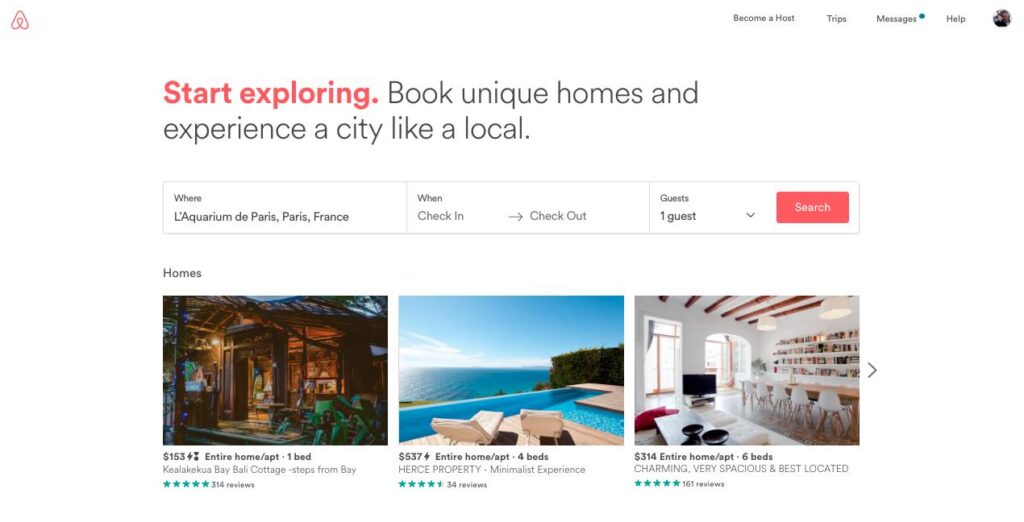
In April 2009, after the company rebranded from Air Bed and Breakfast to Airbnb, Sequoia Capital provided a $600,000 seed investment (Crunchbase, 2024), and the company moved from surviving on cereal to what Chesky described as ramen profitable. The practical intervention that accelerated early bookings was not a marketing campaign but a product decision: the founders personally photographed host listings in New York, replacing low-quality amateur photos with professional-standard images, after noticing that poor photographs were suppressing conversion. Bookings in New York doubled shortly after (Brian Chesky, Medium, 2015).
By the numbers
| Metric | Value | Why it matters |
|---|---|---|
| Early investor rejections | 8 of first 15 angels rejected; 7 ignored (Brian Chesky, Medium, 2015) | Shows how unconvincing the original pitch was, even to friendly contacts |
| Founder debt before YC | $40,000 in credit card debt (Brian Chesky, Medium, 2015) | Illustrates how close the company came to not surviving to the pitch |
| Cereal box revenue | Approximately $30,000 from 1,000+ boxes (Brian Chesky, Medium, 2015) | The bridge that kept the company alive long enough to demonstrate resourcefulness to YC |
| Y Combinator investment | $20,000 for 6%, 2008 (Founder Stories, Medium, 2015) | One of the highest-return early-stage investments in startup history |
| Sequoia seed round | $600,000, April 2009 (Crunchbase, 2024) | The first institutional vote of confidence after the rebrand |
What competitors missed
Traditional hospitality companies, hotel chains, and booking platforms were not paying attention to Airbnb in its early years because the inventory, air mattresses and spare rooms, did not look like hospitality. Existing travel platforms focused on professionally managed properties: hotels, registered bed and breakfasts, licensed rentals.
What they missed was the size of the supply that had never been considered inventory before: ordinary homes. By the time hotel chains recognised Airbnb as a competitor, it had already normalised the idea of staying in someone else’s home at a scale no traditional player could quickly replicate, because that supply did not come from construction. It came from millions of individual hosts opening their doors.
The trust problem that investors used as a reason to pass was also the product problem Airbnb was actively solving through design, reviews, and verified profiles. Investors who said no were evaluating the idea at its most uncomfortable, before the product had engineered the trust layer that made it feel normal. [INTERNAL LINK: suggested topic, “trust layer design in Indian marketplace startups”]
Risks and challenges
- Safety and liability exposure. The trust gap that nearly prevented Airbnb’s launch has remained a recurring cost in the form of safety incidents, regulatory disputes, and host and guest claims. None of these were ever fully resolved, only managed at scale.
- Regulatory risk in key markets. Cities including New York, Barcelona, and Amsterdam have introduced restrictions on short-term rentals that directly reduce Airbnb’s supply in high-value markets, a risk that grows as municipal governments respond to housing affordability pressure.
- Host supply dependency. Unlike hotels, Airbnb cannot control its own inventory. Host behaviour, pricing, availability, and quality are all outside the platform’s direct management, creating a structural quality inconsistency that repeat users eventually notice.
- Platform commoditisation. As Booking.com, Vrbo, and other competitors have added comparable home-stay inventory, the differentiation between platforms has narrowed, increasing price sensitivity and reducing Airbnb’s pricing power in established markets.
What founders can learn
- Use scrappy, even unconventional, side projects to demonstrate resourcefulness when the core pitch is not landing. The cereal boxes were not a funding strategy. They were a survival tactic that accidentally became the most persuasive proof of founder character in Airbnb’s early history.
- Treat the uncomfortable part of your idea as the product problem to solve, not the reason to give up. Investors said strangers would not trust each other. Airbnb’s founders built reviews, profiles, and host verification to engineer that trust rather than abandon the premise.
- Do the unscalable thing yourself first. The New York photography intervention was manual, time-consuming, and impossible to replicate at scale. It was also the intervention that proved the model worked when trust signals were high enough, which justified building the platform to create those signals at scale.
- Treat an accelerator programme as a signal amplifier, not just a capital source. Y Combinator’s $20,000 investment was not what kept Airbnb alive. The credibility signal of YC’s acceptance was what reopened conversations with institutional investors who had previously ignored the team.
Expert analysis
The bull case from Airbnb’s early history is clear. Genuinely new categories of supply, spare rooms, spare cars, spare time, can create markets that did not exist on any spreadsheet before, and the first mover that solves the trust problem can capture an enormous and defensible share of that new market. Airbnb’s 6.6 million listings across 100,000 cities by end of 2022 (Yahoo Finance, 2022) represent a supply-side moat that competitors cannot replicate through capital alone.
The bear case is that the same trust gap that nearly sank Airbnb in 2008 has remained a recurring operational cost ever since, in the form of safety incidents and regulatory responses. The company has managed these costs, but never eliminated them, and the long-term regulatory risk in high-density urban markets is real.
The contrarian view is that Airbnb’s success may say as much about timing as about strategy. The 2008 financial crisis left many households needing extra income from spare rooms at the exact moment a platform appeared to help them monetise that space. A less economically stressed environment might have produced slower host-side adoption, a longer path to critical supply density, and a harder fundraising journey even after the cereal box moment.
Future outlook
Airbnb has continued to expand beyond its original urban, shared-space model into longer-term stays, rural and remote properties, and experiences. The post-pandemic shift in work patterns, particularly remote and hybrid work, created a structural tailwind for longer-stay bookings that Airbnb was well-positioned to capture. The regulatory environment in dense urban markets remains the primary structural risk to its core business.
For the Indian market specifically, the opportunity in domestic travel and rural homestay is significant and largely untapped at the platform level. Indian hosts in tier 2 and tier 3 cities and in rural heritage destinations represent a supply category similar in character to Airbnb’s original inventory: real, available, and not yet considered part of the tourism supply chain.
The bottom line
Airbnb was not funded because of a great pitch. It was funded because of a great cereal box, and because three founders who would sell novelty breakfast food to survive were more fundable than a polished deck from a team who might not.
Key takeaways
- Airbnb’s founders were rejected by 8 of the first 15 angel investors they approached, with 7 more not responding.
- The team sold novelty cereal boxes for $40 each to raise approximately $30,000 and survive long enough to pitch Y Combinator.
- Y Combinator invested $20,000 for 6% of the company in 2008 after the founders demonstrated resourcefulness, not product polish.
- Sequoia Capital provided a $600,000 seed round in April 2009, after the rebrand from Air Bed and Breakfast to Airbnb.
- The founders’ personal photography intervention in New York, replacing amateur listing photos with professional-standard images, doubled bookings in that market.
- By 2023, Airbnb’s market capitalisation had reached approximately $75 billion.
Conclusion
Airbnb’s early history is a story about what investor rejection actually reveals. The investors who passed were not wrong that the idea sounded uncomfortable. They were wrong about whether that discomfort was permanent. Airbnb’s founders treated the trust problem as a design problem and spent the next decade engineering their way around the objection that caused every early no.
The cereal box moment is often told as a quirky fundraising anecdote. It is actually a story about proof of character under pressure. Paul Graham did not invest in the home-sharing idea. He invested in three people who would do whatever it took to survive long enough to prove the idea out.
TFN LENS
For Indian founders, the Airbnb story contains one lesson that is especially relevant in a funding environment where investor confidence often follows proof of founder resilience as much as proof of product traction. The founders who raise in difficult environments, or in categories that investors find uncomfortable, are usually the ones who can demonstrate the same quality Airbnb’s founders showed in a room with a cereal box: that they will find a way to keep going regardless of what the room thinks.
India’s own trust-dependent categories, from peer-to-peer lending to shared mobility to homestay and rural tourism, are all sitting on the same question Airbnb answered through product design rather than persuasion. The market is there. The supply is there. The question is whether the trust layer is being engineered or just assumed.
Building something of your own? Follow The Founder Nation and NamasteVC for curated startup funding news, grant alerts, and founder stories from India’s startup ecosystem, delivered straight to your feed, every week.
Frequently asked questions
Why did investors reject Airbnb?
Most early investors rejected Airbnb because the core premise, that strangers would pay to sleep in each other’s homes, felt unsafe and socially unlikely. Investors evaluated the idea at its most uncomfortable, before Airbnb had built the trust signals (reviews, verified profiles, host guarantees) that made the behaviour feel normal. Fred Wilson of Union Square Ventures publicly acknowledged in 2011 that his firm passed because they could not get past the air mattress concept, even though they respected the founding team.
Who invested in Airbnb first?
Y Combinator was Airbnb’s first institutional backer, investing $20,000 for 6% of the company in 2008 after the founders pitched Paul Graham. Sequoia Capital followed with a $600,000 seed round in April 2009, after the company rebranded from Air Bed and Breakfast to Airbnb.
What is the Airbnb cereal box story?
Facing $40,000 in credit card debt and unable to raise funding, Airbnb’s founders designed and sold novelty election-themed cereal boxes (Obama O’s and Cap’n McCain’s) at $40 per box, raising approximately $30,000 to keep the company alive. When Joe Gebbia showed one of the boxes to Paul Graham during the Y Combinator pitch, Graham’s reasoning was that founders who could sell a $4 box of cereal for $40 had the resourcefulness to make a harder idea work. YC accepted the team shortly after.
How much is Airbnb worth?
Airbnb’s market capitalisation was approximately $75 billion as of 2023, according to CNBC reporting. Verify current market capitalisation at time of publishing.
What lesson should founders take from Airbnb’s early rejections?
The primary lesson is to distinguish between rejection of the pitch and rejection of the idea. Airbnb’s founders were rejected repeatedly, but the core insight, that supply in ordinary homes could serve travellers if the trust problem was solved through design, was correct. They treated every rejection as feedback on how to present the idea, not as evidence that the idea was wrong.
How did Airbnb solve the trust problem that made investors nervous?
Airbnb engineered trust through product design rather than assuming it would emerge organically. Reviews and ratings, verified user profiles, host and guest guarantees, secure payments, and eventually insurance programmes all reduced the perceived risk of hosting or staying with a stranger. The photography intervention, where founders personally replaced amateur listing photos with professional images, was an early example of the same approach: solve the trust problem as a product problem, not a marketing problem.
©️ The Founder Nation | All rights reserved | Written by TFN Research Desk | Word count: ~2,726 | Read time: ~14 minutes |