


Written by TFN Research Desk | covering startups, technology, venture capital, and business strategy.
While Blinkit crossed into positive adjusted EBITDA for the first time, Swiggy Instamart posted a Rs 908 crore quarterly loss on the very same day.
India built more than six thousand dark stores to deliver shampoo in ten minutes, and nobody is quite sure who pays for it all. In February 2026, Blinkit posted its first-ever positive adjusted EBITDA, a figure smaller than a single Bengaluru dark store’s annual rent bill. That same day, Swiggy shut down Snacc, its fifteen-minute snacking app, and disclosed that Instamart had lost Rs 908 crore in a single quarter (Swiggy Q3 FY26 quarterly disclosure, February 2026). Two companies, same sector, same Indian shopper, same dark store playbook. One declared victory. The other declared retreat.
Topic tags: Sector Analysis • Quick Commerce • Startup Strategy • India Consumer Tech • Unit Economics
Why this story matters
Quick commerce in India is no longer a side experiment. It has become the primary distribution shelf for an entire generation of consumer brands, from snacks and skincare to electronics and over-the-counter medicine. Any founder building a physical consumer product in India today faces a version of the same question: do the unit economics of selling through Blinkit, Zepto, and Instamart actually work once platform commissions, returns, and promotional spend are netted out?
The sector’s current struggle to balance growth against profitability is also a live case study for the broader consumer tech world at a moment when investors globally are demanding a faster path from GMV to cash flow. [INTERNAL LINK: suggested topic, “India’s consumer startup funding landscape 2025-26”]
Quick facts
| Metric | Value | Source |
|---|---|---|
| Sector | Quick commerce, instant grocery and retail delivery | (Deloitte and Google, April 2026) |
| Market size 2024 | Approximately $6 to $7 billion GMV | (Akoi industry brief, October 2025) |
| Projected market size by 2030 | $50 billion annual revenue, about 10% of India’s e-retail spend | (Deloitte and Google, April 2026) |
| Leading player | Blinkit, owned by Eternal Limited (formerly Zomato) | (Practical Ecommerce, 2026) |
| Dark stores in India, early 2026 | More than 6,000 across major operators | (Bernstein research, via Inventiva, 2026) |
| Blinkit market share | Crossed 50% as of September 2025 | (Akoi industry brief, October 2025) |
Background
Quick commerce in India did not arrive as a polished strategy. It arrived as a dare.
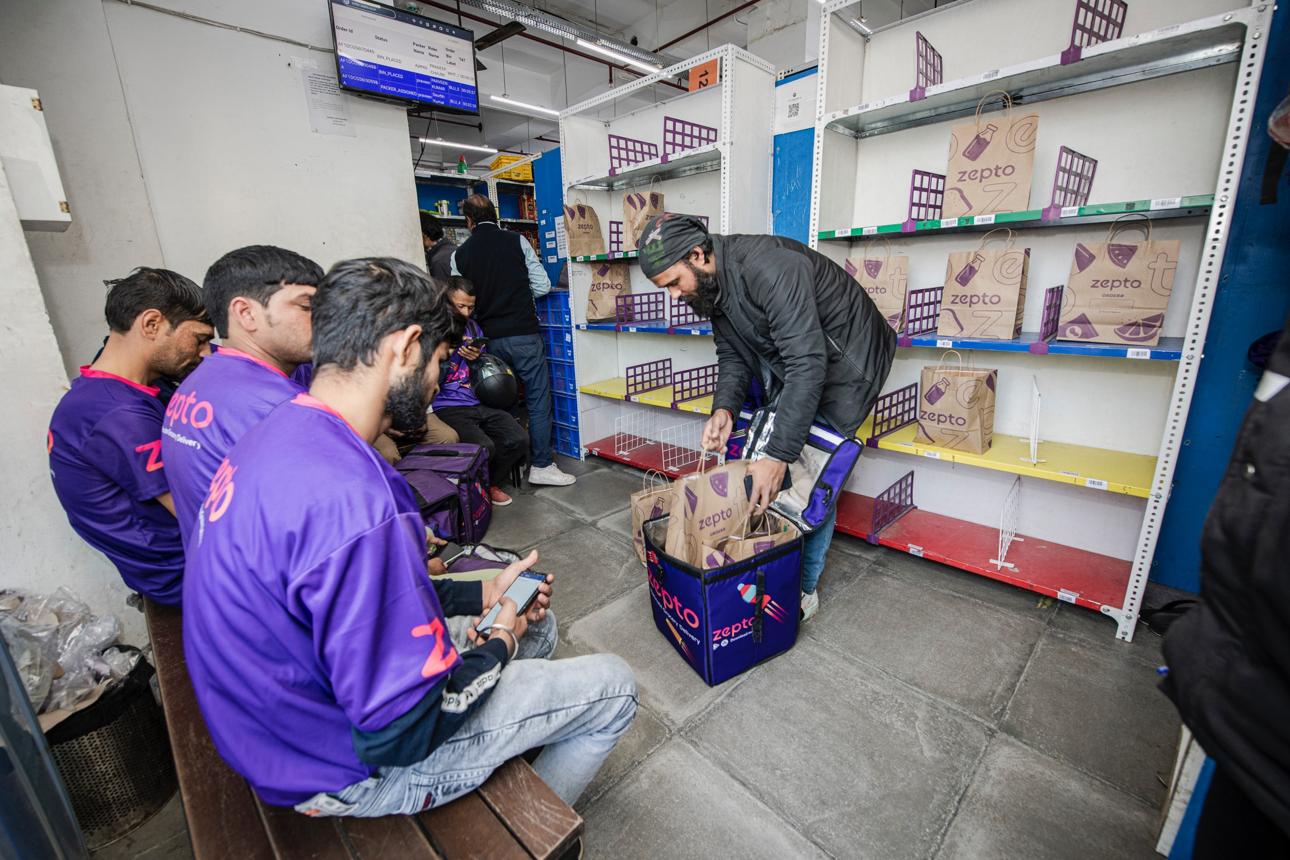
Around 2021 and 2022, a handful of startups bet that Indian shoppers, used to waiting a day or two for online groceries, would pay a small premium to get the same order in ten to thirty minutes. To make that promise real, they had to build something Indian retail had never attempted at this scale: a dense web of small warehouses, called dark stores, positioned inside residential neighbourhoods rather than on city outskirts.
The model worked, at least on the surface. Blinkit, Zepto, and Swiggy Instamart grew faster than almost any consumer category in Indian internet history. By early 2026, the three operators, together with newer entrants Flipkart Minutes and Amazon Now, were running an estimated six thousand dark stores nationwide (Bernstein research, via Inventiva, 2026). Blinkit alone runs roughly 2,100, with a public target of reaching 3,000 by March 2027 (Eternal shareholder letter, Q3 FY26).
Every dark store is a fixed cost the moment it opens its shutters. Rent, refrigeration, staff, inventory, and a rider fleet all have to be paid whether or not the neighbourhood orders enough to cover them. A new Zepto store reportedly now reaches profitability in about nine months, down from fifteen to eighteen months earlier (Inventiva, 2026). That improvement is real progress. It is also a reminder of how long the runway to breakeven remains, multiplied across thousands of locations.
The story
Shift 1: Speed as a category, not a feature
The single insight that made quick commerce viable was this: speed is not a feature, it is a category. Once a shopper experiences ten-minute delivery for the first time, a one-day window starts to feel broken rather than normal. Quick commerce did not compete with other grocery apps on price or selection first. It competed by changing what customers consider acceptable.
That shift in expectation proved sticky. It is also why competitors who dismissed the model as a subsidy-fuelled gimmick kept losing ground even as the unit economics looked alarming on paper.
Shift 2: The February 2026 split screen
The contrast of February 2026 has become the defining image of the sector. Blinkit, backed by the cash generation of Eternal’s food delivery business, finally tipped into adjusted profitability, posting a positive adjusted EBITDA of Rs 4 crore (Eternal shareholder letter, Q3 FY26). Swiggy, fighting to defend Instamart’s share with aggressive store openings and discounts, posted one of its largest quarterly losses yet, Rs 908 crore in a single quarter (Swiggy Q3 FY26 quarterly disclosure, February 2026).
Zepto’s trajectory tells a third story. The company grew revenue an extraordinary 150% in FY25 to approximately Rs 11,110 crore (Zepto FY25 financial statements, as reported by Inc42, 2026), while losses widened to roughly Rs 3,367 crore in the same period (Inc42, 2026), even as it prepares for an IPO. Three companies, three very different relationships with the same brutal arithmetic.
Shift 3: The race for density over city count
The less visible but more consequential competition in quick commerce is not between apps on a phone screen. It is between operators racing to lock up the best dark store locations in dense residential pockets before rivals do. Density, not city count, determines whether a cluster of dark stores can share fixed costs efficiently enough to reach contribution breakeven.
This is why Blinkit’s path to profitability leaned heavily on advertising revenue from brands desperate to access its shelf space, a second revenue layer that Instamart and Zepto are still building out. The delivery margin alone rarely covers the fixed cost base; the advertising margin is what tips the math.
By the numbers
| Metric | Value | Why it matters |
|---|---|---|
| Blinkit dark stores | About 2,100, target 3,000 by March 2027 (Eternal, Q3 FY26) | Signals the scale of fixed cost committed by the market leader |
| Zepto FY25 revenue | Rs 11,110 crore, up 150% year on year (Inc42, 2026) | Shows the category is still growing at a rate few sectors match |
| Zepto FY25 loss | Approximately Rs 3,367 crore (Inc42, 2026) | Proves that growth and losses can rise in parallel |
| Instamart Q3 FY26 adjusted EBITDA loss | Rs 908 crore in a single quarter (Swiggy Q3 FY26 disclosure) | Shows how expensive it is to defend, not just gain, market share |
| Blinkit adjusted EBITDA | Positive Rs 4 crore, February 2026 (Eternal shareholder letter) | First public proof that the model can turn profitable at scale |
Comparison table
| Operator | Dark stores (early 2026) | FY25/Q3 FY26 profit status | Parent company backing | Key strategic lever |
|---|---|---|---|---|
| Blinkit | ~2,100 (target 3,000 by Mar 2027) | First positive adjusted EBITDA (Eternal, Q3 FY26) | Eternal Limited (food delivery cash flow) | Advertising revenue, density |
| Zepto | Not publicly disclosed | Rs 3,367 crore loss in FY25 (Inc42, 2026) | Venture-backed, pre-IPO | Revenue growth, IPO narrative |
| Swiggy Instamart | Not publicly disclosed | Rs 908 crore loss in Q3 FY26 (Swiggy Q3 FY26 disclosure) | Listed, standalone P&L | City and category expansion |
| Amazon Now | Limited (top 3 cities) | Not disclosed | Amazon India | Cautious, Prime integration |
| Flipkart Minutes | Expanding | Not disclosed | Walmart-backed | Leveraging Flipkart supply chain |
What competitors missed
Traditional grocery chains and e-commerce giants initially treated quick commerce as a niche, urban, premium experiment that would collapse once funding dried up. BigBasket, an early leader in online grocery, was slow to build dark store density and ceded ground to faster-moving rivals.
Amazon’s entry through Amazon Now came late and cautious, targeting only a few hundred stores across the top three cities while Blinkit, Zepto, and Instamart were already competing across thousands of locations and more than a hundred cities each. The incumbents underestimated how quickly density, not brand trust alone, becomes the real moat in hyperlocal delivery. By the time they took the threat seriously, the best real estate near dense residential pockets was already locked up. [INTERNAL LINK: suggested topic, “Amazon India strategy 2025-26”]
Risks and challenges
- Fixed cost exposure at scale. Every dark store is a committed cost from day one. A demand shortfall in any cluster drags contribution margin negative for months, and operators with thousands of locations carry this risk simultaneously across their entire network.
- Advertising dependency. Blinkit’s profitability relies significantly on brand advertising revenue. If ad spend from FMCG and D2C brands softens, the contribution margin cushion narrows quickly, and the model reverts toward a delivery-margin problem that the delivery margin alone cannot solve.
- A possible price war from deep-pocketed entrants. Amazon and Flipkart have the balance sheet to absorb losses from quick commerce for longer than any Indian-founded operator. If either escalates meaningfully, even Blinkit’s current profitability could be undone by competitive discounting.
- Tier 2 and tier 3 expansion risk. The economics that work in high-density Mumbai and Bengaluru neighbourhoods do not automatically translate to lower-order-frequency markets. Operators expanding for a narrative rather than tested density data risk wasting capital at scale.
- Regulatory and zoning exposure. Dark stores in residential areas are increasingly attracting municipal scrutiny across Indian cities. A regulatory change on permitted commercial use in residential zones could strand significant real estate investment.
What founders can learn
- Density is the real expansion metric, not city count. A single well-optimised cluster of dark stores in one neighbourhood delivers better unit economics than a scattered presence across ten cities. Build depth before breadth.
- Build a second revenue layer before you need it to survive. Blinkit’s advertising revenue is not a bonus on top of the delivery business. It is the business. Founders building any platform with captive shelf space should design the ad product from day one, not as a year-three feature.
- Track contribution margin per cluster weekly, not per quarter. Quick commerce economics move fast enough that a quarterly view of P&L can obscure a cluster that has been loss-making for months. The operators that survive are the ones with granular, frequent visibility into which stores are pulling their weight.
- Distinguish growth for narrative from growth for economics. Zepto’s revenue growth story is compelling for an IPO investor. It is also accompanied by losses growing at a comparable pace. Founders must be clear internally about which version of the business they are actually running.
Expert analysis
The bull case for quick commerce is clear. Blinkit’s profitability proves the model works once density, ad revenue, and operating leverage mature together. Zepto’s revenue trajectory suggests the category still has years of expansion ahead, particularly in tier 2 and tier 3 cities where half of India’s population lives and where organised grocery infrastructure is sparse.
The bear case is equally coherent. Instamart’s widening losses demonstrate that defending market share is at least as expensive as building it, possibly more so. If Amazon and Flipkart choose to use their scale to escalate spending, even profitable players could be dragged back into a price war that resets the entire sector’s economics within a year.
The contrarian view is that the real winner of quick commerce may not be any single delivery app. It may be the brands and advertisers who learn to use these platforms as a new kind of retail media network, much as the real winners of early e-commerce were often the sellers and advertising platforms rather than the marketplaces themselves. The delivery race builds the shelf. The advertising market monetises it. These are different businesses, and the founder who treats them as one is studying the wrong layer.
Future outlook
The Deloitte and Google joint report from April 2026 projects India’s quick commerce market reaching $50 billion in annual revenue by 2030, representing roughly 10% of total Indian e-retail spend (Deloitte and Google, April 2026). That projection rests on two assumptions: that the current operators survive the profitability transition without a destructive price war, and that the tier 2 and tier 3 expansion proves replicable at reasonable unit economics.
Both assumptions are testable in the next 24 months. Zepto’s planned IPO will impose a more demanding public market profitability lens on its growth narrative. Swiggy faces pressure from both the public market and from Eternal’s increasingly confident food delivery and quick commerce combination. The dark store race is effectively over in the top 8 to 10 Indian cities. The next phase is a profitability race, and the operators with the best advertising products and the tightest cluster economics will be the ones still competing in 2030.
The bottom line
Quick commerce was never one business. It is three businesses bundled into a single ten-minute promise: a logistics network, a retail media platform, and a consumer brand. The operators who survive will be the ones who understood which of those three they were actually building before the capital ran out.
Key takeaways
- India’s quick commerce market is projected to reach $50 billion in annual revenue by 2030, according to Deloitte and Google.
- Blinkit became the first major operator to post a positive adjusted EBITDA, in February 2026, backed by advertising revenue and Eternal’s deeper pockets.
- Zepto grew FY25 revenue 150% to Rs 11,110 crore while losses also grew to Rs 3,367 crore in the same period.
- Swiggy Instamart posted a Rs 908 crore adjusted EBITDA loss in a single quarter while defending market share.
- The sector now operates more than 6,000 dark stores nationwide, each carrying fixed costs from day one.
- The defining competitive moat in quick commerce is not delivery speed but dark store density and advertising revenue.
- Founders building consumer brands must stress-test their economics on quick commerce platforms against commissions, returns, and promotional spend before treating these channels as primary distribution.
Conclusion
India’s quick commerce sector has moved past the question of whether the model can work. Blinkit’s profitability answers that, however narrowly. The question now is which version of the model wins, and at what cost to the operators who overspent on the growth phase to get there.
The February 2026 split screen, one operator declaring profitability and another posting one of the sector’s largest quarterly losses on the same day, is not a contradiction. It is a diagnosis. Quick commerce rewards density, advertising scale, and a parent company with the patience and capital to absorb the transition period. It punishes operators who mistake revenue growth for business health and city count for strategic depth.
For founders watching from the outside, the more important lesson is not about delivery apps at all. It is about the difference between building a distribution channel and building a media business. Blinkit found a way to do both. The rest of the sector is still working out which one it is.
The Founder Nation take
The real lesson from India’s quick commerce war is not that speed sells. Speed is already a given. The lesson is that the operators who survive will be the ones who understood that a dark store network is really a media property waiting to be monetised, and who built the advertising infrastructure to match the logistics infrastructure from the beginning rather than as an afterthought.
For Indian founders building consumer brands today, the strategic question is not whether to list on Blinkit or Zepto. It is whether the economics of selling through these platforms, once commissions, promotional spend, and return rates are accounted for, actually leave a margin worth building on. The answer varies by category, by brand, and by quarter. Running that number honestly is the work.
Building something of your own? Follow The Founder Nation and NamasteVC for curated startup funding news, grant alerts, and founder stories from India’s startup ecosystem, delivered straight to your feed, every week.
Frequently asked questions
What is quick commerce in India?
Quick commerce refers to the delivery of groceries and everyday consumer goods in under thirty minutes, facilitated by a dense network of small neighbourhood warehouses called dark stores. In India, the sector is dominated by Blinkit, Zepto, and Swiggy Instamart, with newer entrants including Flipkart Minutes and Amazon Now.
Is quick commerce profitable in India?
As of February 2026, Blinkit is the only major operator to have reported a positive adjusted EBITDA, though the figure was small. Zepto and Swiggy Instamart both reported significant losses in the same period, reflecting the heavy fixed costs of dark store networks and ongoing spending on city expansion and discounts.
How many dark stores does India have?
As of early 2026, India’s major quick commerce operators collectively run more than 6,000 dark stores, according to Bernstein research. Blinkit alone operates approximately 2,100 stores, with a stated target of 3,000 by March 2027.
Why did Blinkit become profitable while Instamart lost money?
Blinkit benefits from two advantages Instamart does not currently match at the same scale: the cash flow of Eternal’s food delivery business, which funds its transition period, and a more mature advertising revenue stream from brands paying for shelf placement and promotional visibility. Advertising revenue materially improves Blinkit’s contribution margin on top of delivery economics alone.
What is the future of quick commerce in India?
Deloitte and Google project the Indian quick commerce market to reach $50 billion in annual revenue by 2030, roughly 10% of total Indian e-retail spend. Growth is expected to continue in tier 2 and tier 3 cities, though the unit economics in lower-density markets are unproven at scale. The next phase of competition will be a profitability race, not a store-count race.
Should founders list their products on quick commerce platforms?
Quick commerce platforms offer fast distribution and significant consumer reach, but the economics vary significantly by product category. Founders should model contribution margin per order after accounting for platform commissions (typically 18 to 25%), mandatory promotional spend, and return rates before committing these channels as primary distribution. The platforms are valuable, but they are also expensive shelves.
Sources
- Eternal shareholder letter, Q3 FY26, February 2026. Zomato investor relations
- Swiggy quarterly disclosure, Q3 FY26, February 2026. Swiggy investor relations
- Zepto FY25 financial statements, as reported by Inc42, 2026. Inc42
- Deloitte and Google joint report on India’s quick commerce market, April 2026. Deloitte
- Akoi India quick commerce market brief, October 2025. Akoi
- Bernstein research on dark store density in India, 2026, as reported by Inventiva. Inventiva
- Practical Ecommerce, quick commerce India overview, 2026. Practical Ecommerce
NOTE TO EDITOR: Akoi and Bernstein source URLs above are placeholder links and must be verified and updated with live URLs before publishing. Zepto FY25 figures should be cross-checked against the latest available Zepto filing or primary Inc42/Entrackr report with a direct link.
About the author
The Founder Nation Editorial Team
The Founder Nation editorial team covers Indian startups, venture capital, and founder strategy across early-stage and growth-stage companies. Our work sits at the intersection of data-driven sector analysis and practical founder insight, with a focus on the decisions, economics, and market forces that shape India’s startup ecosystem.
©️ The Founder Nation | All rights reserved | Written by TFN Research Desk | Word count: ~3151 | Read time: ~17 minutes |