


Written by TFN Research Desk | covering startups, technology, venture capital, and business strategy.
The smart money has already voted, and it is not betting on the next Flipkart.
In February 2026 alone, GenAI infrastructure startup Neysa became a unicorn off a $1.2 billion round led by Blackstone, institutional-scale capital, not a seed-stage flier. Days later, Juspay claimed the title of India’s first unicorn of 2026, followed by KreditBee in April. By contrast, ecommerce and fintech, the sectors that produced the bulk of India’s 129 unicorns to date, barely registered a new entrant. The signal is hard to miss: capital is moving from consumer apps to infrastructure.
Startup Strategy • Data • India Ecosystem • Deep Tech • AI
The Big Picture: 129 Unicorns and a Shifting Map
India crossed 129 unicorns by mid-2026, having raised a combined $118 billion at a total valuation above $392 billion, according to Inc42’s Indian Unicorn Tracker. Ecommerce (29 unicorns) and fintech (26) remain the largest categories by count, but those are largely legacy wins from the 2015 to 2021 boom.
The new unicorns of 2025 and 2026 tell a different story. Netradyne, a Bengaluru deep-tech logistics company, became 2025’s first unicorn at a $1.34 billion valuation. Neysa’s $1.2 billion round in February 2026 was one of the largest in Indian startup history, for an AI infrastructure company, not a consumer app. Dhan, an investment platform, crossed $1.2 billion. Meanwhile, India’s deep tech sector, home to 7,504 companies as of May 2026, of which 1,722 are funded, has produced just 4 unicorns so far but has raised $11.2 billion in cumulative venture and private equity capital, per Tracxn.
The pattern repeats across adjacent categories. Unicorn India Ventures is closing a Rs 1,200 crore fund with 80% earmarked for deep tech, defence, and semiconductor startups across 20 companies. February 2026’s funding spread itself across AI, defence, fintech, consumer, climate, and robotics in a single month, what LAFFAZ Media called “capital layering,” not a single headline event.
Why This Story Matters
For founders, this is a case study in reading where structural opportunity sits rather than chasing category momentum. For investors, it illustrates how unicorn conversion rates, not just funding totals, reveal where the next wave of value creation is most likely to emerge. For operators and ecosystem watchers, it shows that India’s startup map is being redrawn in real time, and the sectors leading the next decade look very different from the ones that led the last.
Quick Facts
| Total Indian Unicorns (mid-2026) | 129, with $118B raised and $392B+ combined valuation |
| Largest Legacy Categories | Ecommerce (29 unicorns), Fintech (26 unicorns) |
| Deep Tech Funded Companies | 7,504 total, 1,722 funded, only 4 unicorns |
| Deep Tech Cumulative Funding | $11.2 billion in VC and PE capital |
| Neysa Round (Feb 2026) | $1.2 billion, led by Blackstone |
| Unicorn India Ventures Fund III | Rs 1,200 crore, 80% targeting deep tech, defence, semiconductors |
| Recognized Indian Startups | 207,000+ as of December 2025 (Startup India) |
| First Unicorn of 2026 | Juspay, followed by KreditBee (April 2026) |
Background: How India Built 129 Unicorns, and Where the Next Ones Come From
India’s unicorn story has two distinct chapters. The first, running roughly from 2015 to 2021, was driven by consumer internet: ecommerce, food delivery, edtech, and fintech platforms that scaled on the back of cheap data, smartphone penetration, and abundant global venture capital. That chapter produced the bulk of India’s unicorn count and many of its most recognized brands.
The second chapter, now underway, is being written by a different kind of company. The startups attracting institutional-scale capital in 2025 and 2026 are building infrastructure, not apps. They are solving problems in AI compute, defence technology, semiconductor design, stablecoin rails, and usage-based billing, categories where India has deep engineering talent but historically thin unicorn density. That combination of abundant funding, strong talent, and low unicorn conversion is precisely the condition that precedes a new wave of billion-dollar companies.
How It Happened: Three Shifts That Are Redrawing the Map
Shift 1: Institutional Capital Moved Before the Market Caught Up
Blackstone leading a $1.2 billion round into an AI infrastructure startup is not a typical venture move. It signals that the capital allocators who usually arrive after a category is proven are arriving early in deep tech, compressing the timeline between “funded startup” and “unicorn.” When checks of this size land in a category with only 4 existing unicorns across 1,722 funded companies, conversions follow quickly.
Shift 2: The Unicorn-to-Funded-Company Gap Is the Real Opportunity Signal
Ecommerce and fintech are not bad sectors. They are fully converted sectors, meaning the ratio of unicorns to funded companies is already high because the category has been mined for a decade. Deep tech, defence, and AI infrastructure have the inverse profile: billions in cumulative funding, thousands of companies, and almost no unicorn conversions yet. That gap is where the next wave gets created, not because these categories are trendy, but because they are structurally underexploited relative to the capital now flowing into them.
Shift 3: “Capital Layering” Replaced the Single Mega-Round
February 2026’s funding activity did not produce one headline deal. It produced simultaneous investment across AI, defence, fintech, consumer, climate, and robotics, what LAFFAZ Media described as capital layering. This pattern suggests India’s startup ecosystem is maturing past the single-sector-dominates-a-decade model into one where multiple infrastructure categories compound simultaneously. For founders, that means the window to enter a category before it gets crowded is shorter than it was in 2015.
The Strategy Behind the Shift
Three observations explain what is happening beneath the headline numbers: capital follows conversion gaps, not just category momentum; institutional investors (Blackstone, SoftBank-scale checks) are moving into deep tech before retail venture capital catches up; and India’s 207,000-plus recognized startups give the ecosystem the density needed to produce multiple unicorns across multiple categories simultaneously, rather than one dominant sector at a time.
By the Numbers
- 129 — Total Indian unicorns as of mid-2026, with $118B raised and $392B+ combined valuation (Inc42 Indian Unicorn Tracker, May 2026)
- $1.2B — Neysa’s funding round led by Blackstone, making it a unicorn in February 2026
- 4 of 1,722 — Deep tech unicorns versus funded deep tech companies in India, despite $11.2B in cumulative VC and PE funding (Tracxn, May 2026)
- Rs 1,200 crore — Unicorn India Ventures’ Fund III, with 80% targeted at deep tech, defence, and semiconductor startups
- 207,000+ — Recognized startups in India as of December 2025, with 45%+ having at least one woman director or partner (Startup India / PIB data)
What Competitors Missed
Late-stage consumer and ecommerce investors spent 2022 to 2024 waiting for a growth-at-all-costs rebound that never fully returned. Inc42 data shows late-stage private funding remained under pressure through 2025 even as growth-stage investment rose 14% year over year, but that growth-stage capital increasingly bypassed consumer categories in favor of AI and deep tech.
Founders building the next Zomato or the next Nykaa are competing in categories where the unicorn slots have largely been filled and investor patience for blitzscaling has thinned. Founders in defence tech, semiconductors, and AI infrastructure are competing in categories where India has 207,000-plus recognized startups but historically minimal deep tech unicorn density, meaning less competition for the same investor dollar.
Risks and Challenges
- Deep tech and AI infrastructure startups typically have longer paths to revenue than consumer apps, requiring patient capital and longer fund cycles.
- Defence technology involves regulatory and export control complexity that most Indian founders have not previously navigated.
- The 1,722 funded deep tech companies in India still need to prove out product-market fit at scale; funding density does not guarantee unicorn conversion.
- Semiconductor and AI compute plays require significant hardware investment that is harder to reverse than software bets.
- Global macroeconomic conditions, particularly shifts in US and European institutional capital flows, can tighten Indian deep tech funding faster than consumer categories because the check sizes are larger and the investor base is more concentrated.
What Founders Can Learn
- Map funding density against unicorn density in your category. A sector with many funded companies but few unicorns is not underperforming; it is underconverted, and that is where the next wave gets created.
- Watch where institutional-scale capital (Blackstone, SoftBank-scale checks) lands first. These investors move before the broader venture market catches up, and Neysa’s $1.2 billion round is a leading indicator, not a one-off.
- Do not compete in categories where the growth-at-all-costs to profitability transition has already happened. That transition is painful for incumbents and creates an opening for leaner challengers in adjacent, less-mined sectors.
- The “capital layering” pattern of February 2026 suggests the window to enter a category before it gets crowded is shorter than it was during the 2015 consumer internet boom. Speed of category entry matters more now.
- Even at early stage, building infrastructure (tooling, rails, compute) for a category tends to produce stickier revenue and higher switching costs than building the consumer app on top of it.
Expert Analysis
India’s unicorn map is not being redrawn because AI is fashionable. It is being redrawn because the structural conditions that produced the ecommerce and fintech unicorn boom of 2015 to 2021, a large underpenetrated market, abundant capital, and a thin incumbent base, now exist in deep tech, defence, and AI infrastructure. The difference is that this wave is being led by institutional capital rather than retail venture, which means the check sizes are larger, the timelines are longer, and the companies being built are harder to copy. For founders willing to operate in technically complex categories, that combination is historically very favorable.
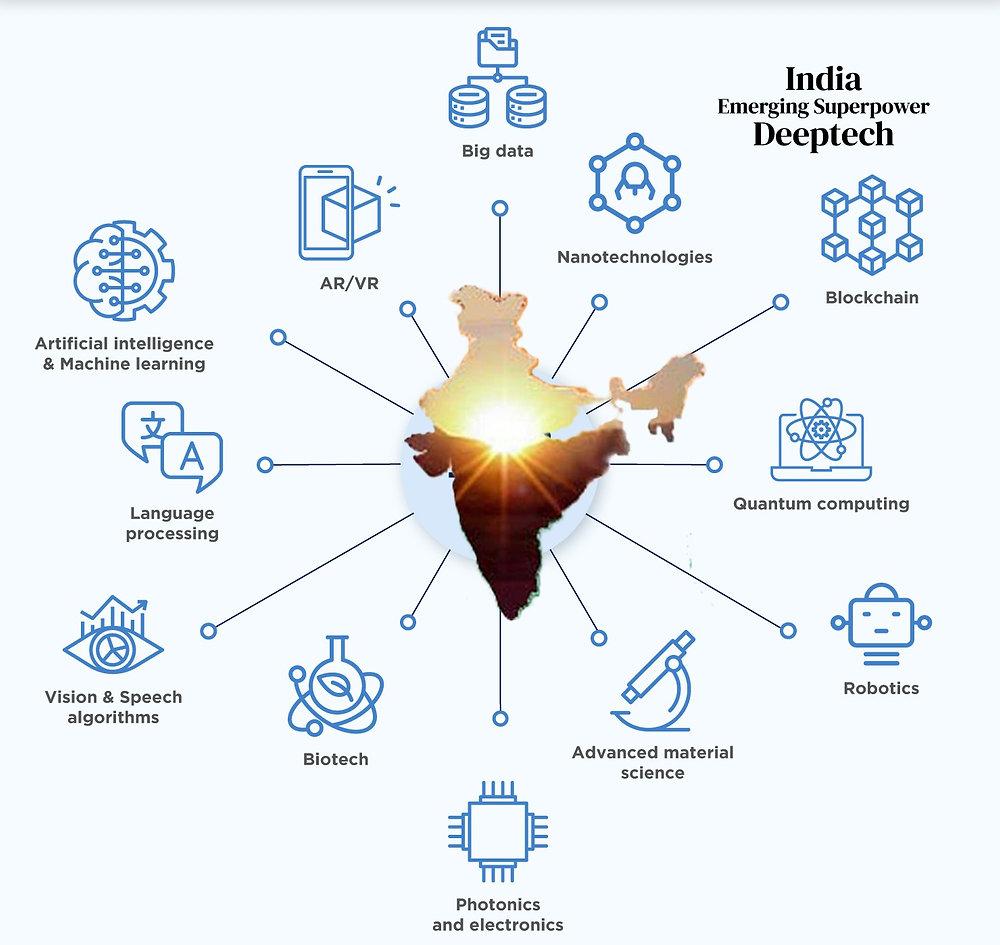
enterprise SaaS are among the strongest contenders for India’s next unicorn.
Future Outlook
India’s deep tech sector has the capital, the talent pipeline, and now the institutional investor interest to produce a meaningful cluster of unicorns before 2030. The sectors most likely to drive that conversion are AI infrastructure (compute, tooling, model deployment), defence technology (drones, surveillance, logistics), semiconductor design, and climate tech infrastructure. The wildcard is stablecoin and blockchain infrastructure, where global regulatory clarity in 2025 and 2026 has opened a category that was effectively off-limits to institutional capital two years ago. Whichever founders build the picks-and-shovels layer for those categories, rather than the consumer-facing application on top, are best positioned to replicate the Stripe playbook in the Indian context.
The Bottom Line
India’s next unicorn is most likely coming from a category with thousands of funded companies, billions in cumulative investment, and almost no billion-dollar exits yet. That description fits deep tech, AI infrastructure, and defence technology almost exactly. The founders who recognize this before the category becomes consensus are the ones who will benefit most from the current gap between funding density and unicorn conversion.
Key Takeaways
- India has 129 unicorns as of mid-2026, but the sectors producing new ones have shifted decisively from consumer internet to infrastructure and deep tech.
- Deep tech has 1,722 funded companies and $11.2 billion in cumulative funding but only 4 unicorns, the widest conversion gap in the Indian startup ecosystem.
- Institutional-scale capital (Blackstone leading Neysa’s $1.2 billion round) is arriving in deep tech earlier than it did in ecommerce and fintech, compressing the timeline to unicorn conversion.
- Ecommerce and fintech are not dead categories; they are fully converted ones, meaning the structural opportunity has already been captured.
- The “capital layering” pattern of early 2026 suggests multiple infrastructure categories will compound simultaneously rather than one sector dominating a decade.
- Founders building infrastructure for AI, defence, and semiconductors face less unicorn competition per funded company than any other category in India right now.
Conclusion
India’s unicorn story is not slowing down. It is changing sectors. The consumer internet boom that ran from 2015 to 2021 filled the ecommerce and fintech columns on the tracker. The next columns, deep tech, AI infrastructure, defence, semiconductors, are now being filled by a different kind of founder, one building infrastructure rather than apps, attracting institutional rather than retail capital, and operating in categories where the conversion gap between funded companies and unicorns is still wide open. The founders who move into those gaps now are building the companies that will define India’s next chapter.
The Founder Nation Take
At The Founder Nation, we track stories like this because the gap between funding density and unicorn conversion is where the most actionable founder insight lives. Every week, our team surfaces grants, accelerator programs, and early-stage funding opportunities for Indian founders building in deep tech, AI infrastructure, defence, and developer tools.
Building something of your own?
Follow The Founder Nation and NamasteVC for curated startup funding news, grant alerts, and founder stories from India’s startup ecosystem, delivered straight to your feed, every week.
Frequently Asked Questions
How many unicorns does India have in 2026?
India had 129 unicorns as of mid-2026, having raised a combined $118 billion at a total valuation above $392 billion, according to Inc42’s Indian Unicorn Tracker.
Which sector will produce India’s next unicorn?
Based on current funding patterns and the gap between funded companies and unicorn conversions, deep tech, AI infrastructure, and defence technology are the most likely sources of India’s next wave of unicorns.
Why does deep tech have so few unicorns despite heavy funding?
Deep tech companies typically have longer development cycles and later revenue inflection points than consumer apps. The category has accumulated $11.2 billion in funding across 1,722 companies, but most are still in the pre-unicorn growth phase. That lag is what makes the conversion opportunity significant right now.
What is capital layering in the Indian startup context?
Capital layering refers to simultaneous investment flowing across multiple sectors in a single period, rather than one dominant category attracting most of the capital. LAFFAZ Media used the term to describe February 2026’s funding activity, which spread across AI, defence, fintech, consumer, climate, and robotics in a single month.
Is ecommerce still a good sector for Indian founders?
Ecommerce remains a large and active market, but the unicorn slots in the category have largely been filled and investor appetite for new blitzscaling consumer plays has thinned since 2021. Founders building in ecommerce today face more competition per investor dollar than those building in deep tech or AI infrastructure.
Who was India’s first unicorn of 2026?
Juspay became India’s first unicorn of 2026, followed by Neysa (February 2026, backed by Blackstone at $1.2 billion) and KreditBee (April 2026).
Sources
Official Reports & Company Intelligence
- Inc42 – Indian Unicorn Tracker: Funding, Investors, Revenue And More
https://inc42.com/features/indian-unicorn-tracker-funding-investors-revenue-and-more/ - Tracxn – Unicorn Startups in India (Live Tracker)
https://tracxn.com/d/unicorns/unicorns-in-india/ - Tracxn – Deep Tech Startups in India & Market Trends
https://tracxn.com/explore/Deep-Tech-Startups-in-India
Market & Industry Coverage
- Business Standard – Unicorn India Ventures to Close ₹1,200 Cr Fund III
https://www.business-standard.com/companies/start-ups/unicorn-india-ventures-to-close-rs-1-200-cr-fund-iii-by-december-125011300870_1.html - Business Connect – India’s Next Unicorns: Startups Closest to the $1 Billion Valuation Mark in 2026
https://businessconnectindia.in/indias-next-unicorns-2026/ - LAFFAZ Media – AI Unicorns, Defence Tech & D2C: What February 2026 Reveals About India’s Startup Funding
https://laffaz.com/ai-unicorns-defence-tech-d2c-india-startup-funding-february-2026/ - Mean CEO – Startups in India News | June 2026
https://mean.ceo/startups-in-india-news-june-2026/
Additional Research & Media
- The Economic Times – Startup Funding & Ecosystem Coverage
https://economictimes.indiatimes.com/tech/startups - TechCrunch – India Startup News
https://techcrunch.com/tag/india/ - Reuters – India Startup News
https://www.reuters.com/world/india/ - YourStory – Funding & Startup Ecosystem
https://yourstory.com/ - Venture Intelligence – Indian Unicorn Tracker
https://www.ventureintelligence.com/Indian-Unicorn-Tracker
©️ The Founder Nation | All rights reserved | Written by TFN Research Desk | Word count: ~1,900 | Read time: ~10 minutes |