

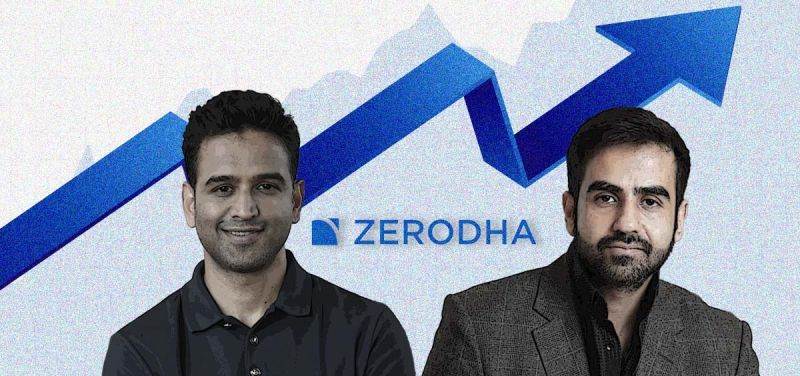
Nithin and Nikhil Kamath built Zerodha into India's most profitable brokerage without raising a single rupee of venture capital.
From full-time traders to fintech pioneers, here’s the inspiring story of how Zerodha transformed India’s investing landscape.
Written by TFN Research Desk | covering startups, technology, venture capital, and business strategy.
Quick Facts
Nithin Kamath: Born in Shivamogga, Karnataka. Alma mater: Bangalore Institute of Technology, Electronics and Telecommunications. Occupation: Co-founder and CEO, Zerodha; former decade-long trader and sub-broker. Years active: 2000 to present. (StartupTalky)
Nikhil Kamath: Born September 5, 1986, in Shimoga, Karnataka. Education: Left formal schooling after the 10th grade to pursue trading and chess. Occupation: Co-founder, Zerodha, heading financial planning; co-founder of True Beacon and Gruhas. Years active: 2010 to present. (StartupTalky)
Table of Contents
- Introduction
- The Zerodha Story
- Business Model
- Growth Without External Funding
- Revenue and Recent Performance
- Zerodha vs Competitors
- Key Takeaways
- FAQs
Introduction
Nithin and Nikhil Kamath built Zerodha from a bootstrapped 2010 startup into India’s most profitable stock brokerage, pioneering the flat-fee discount trading model that reshaped the industry. Fifteen years on, and without ever raising outside capital, Zerodha remains one of India’s rare unicorns built entirely on its own earnings.
The Zerodha Story
Nithin began managing his father’s trading account at 17 and spent nearly a decade as a trader and sub-broker before founding Zerodha in August 2010. (StartupTalky) Nikhil, who left school after the 10th grade to pursue trading and competitive chess, joined his elder brother as co-founder, bringing sharp market instincts despite an unconventional path. (Founderspedia) The name Zerodha combines “zero” with “rodha,” the Sanskrit word for barrier, reflecting the brothers’ goal of removing the cost and complexity that kept ordinary Indians out of the stock market. (Wikipedia)
Business Model
Zerodha replaced percentage-based brokerage commissions with a flat-fee model, a structural shift that made active and long-term trading dramatically cheaper for retail investors. (Founderspedia) Its Kite platform handles trading and Coin offers direct mutual fund investments, while the company has since expanded into asset management, lending through Zerodha Capital, and Rainmatter, its fintech-focused investment initiative.
Growth Without External Funding
Zerodha reached unicorn status in 2020 at a self-disclosed valuation of roughly $1 billion, without taking a single round of venture capital, an unusual feat in India’s typically funding-hungry startup ecosystem. (Founderspedia) That discipline has let the founders retain full ownership and control, funding growth entirely through retained profits even as VC-backed rivals like Groww spent aggressively on customer acquisition.
Revenue and Recent Performance
Zerodha’s revenue grew from Rs 6,875 crore in FY23 to a peak before easing to Rs 8,868.2 crore in FY25, down 11.2 percent year-over-year, with net profit falling 23 percent to Rs 4,236.7 crore. (BW Disrupt) The decline followed SEBI’s tightened derivatives regulations aimed at curbing excessive retail speculation, alongside a broader slowdown in trading activity; Nithin Kamath had flagged the pressure publicly, noting brokerage revenue fell 40 percent in the first quarter of FY26. (Indian Startup News) Active NSE clients fell from 78.88 lakh in FY25 to 68.93 lakh in FY26, continuing a broader industry-wide pullback in retail trading activity. (Business Today)
Zerodha vs Competitors
Groww overtook Zerodha as India’s largest brokerage by active client count in October 2023 and has extended that lead since, backed by venture funding and an aggressive user-acquisition strategy. Despite that, Zerodha remains the more profitable of the two, historically posting far higher margins due to its dominance in futures and options trading, though both firms are now navigating the same regulatory and volume headwinds affecting the wider discount-broking industry.
Key Takeaways
- Nithin and Nikhil Kamath bootstrapped Zerodha in 2010, pioneering India’s flat-fee discount brokerage model.
- The company reached unicorn status in 2020 without ever raising external venture funding.
- FY25 revenue fell 11.2 percent to Rs 8,868.2 crore, with profit down 23 percent, amid tighter derivatives regulation.
- Zerodha lost its lead in active client count to Groww in 2023 but remains India’s most profitable brokerage historically.
- Both founders have expanded into adjacent ventures, including Zerodha Capital, True Beacon, and Rainmatter.
FAQs
Who founded Zerodha?
Brothers Nithin and Nikhil Kamath founded it in August 2010.
Has Zerodha ever raised external funding?
No, it remains fully bootstrapped, reaching unicorn status in 2020 without VC capital.
Is Zerodha profitable?
Yes, though FY25 net profit fell 23 percent to Rs 4,236.7 crore amid regulatory and market headwinds.
Who are Zerodha’s competitors?
Groww, which overtook it in active client count in 2023, along with Angel One and Upstox.
© The Founder Nation | Written by TFN Research Desk