

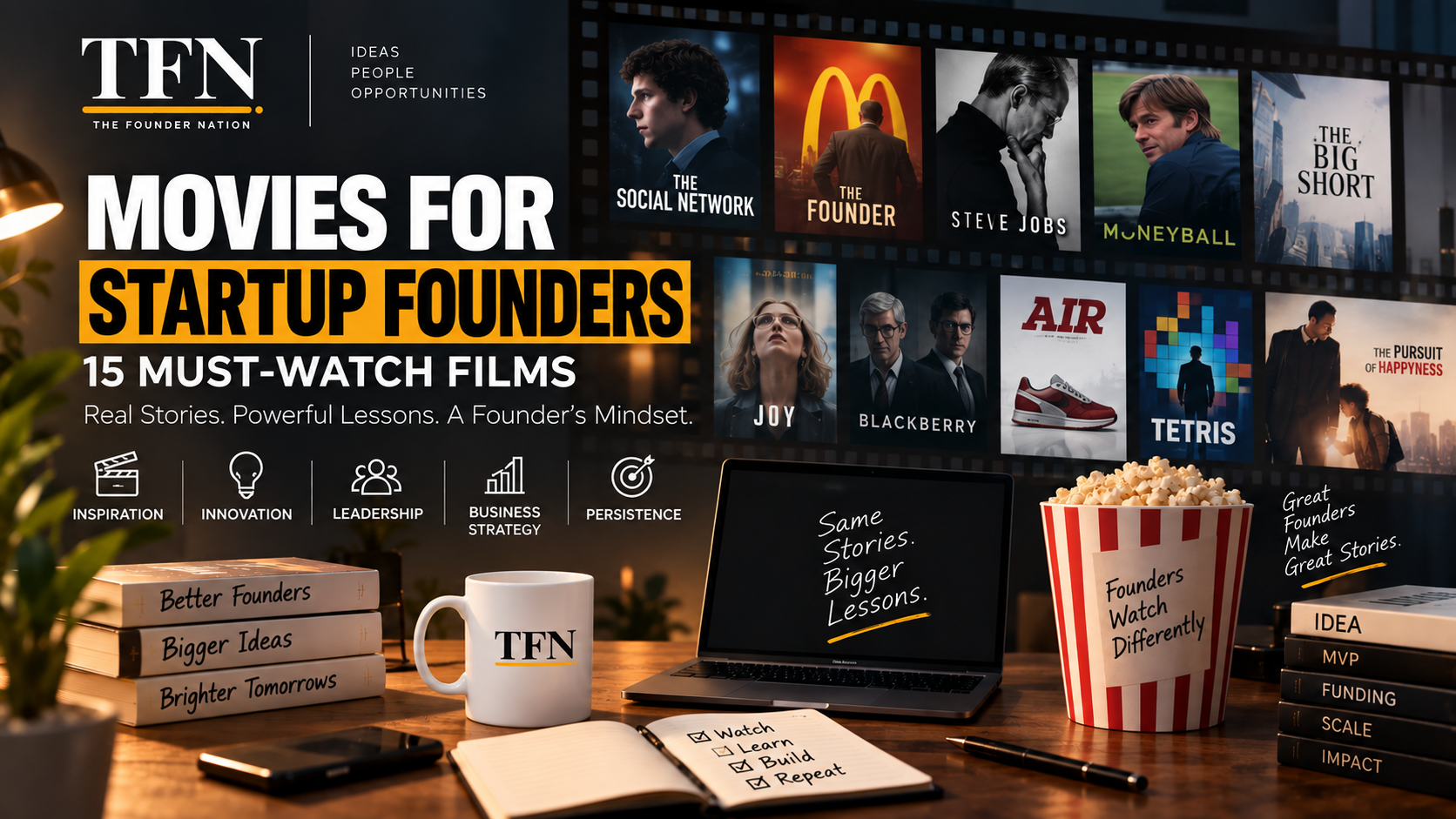
A founder-focused watchlist of 15 films covering entrepreneurship, innovation, leadership, strategy, persistence and startup lessons.
This list of movies for startup founders is designed for entrepreneurs at different stages, from idea validation and MVP development to fundraising, sales and scaling. Each film offers a different perspective on the realities of building a business.
The right movies for startup founders can offer more than entertainment. They can help entrepreneurs understand cofounder relationships, product development, fundraising, sales, customer acquisition, leadership, business ethics and the difficult decisions involved in scaling a company.
Some films dramatise real events, while others are fictional stories inspired by common business challenges. They should not be treated as complete business case studies, but they can provide useful questions for founders to discuss with their teams.
From the early days of Facebook and McDonald’s to the rise of Nike, the struggles of Indian entrepreneurs and the collapse of dot-com businesses, these 15 movies explore different sides of building a company.
Best Movies for Startup Founders: Quick Comparison
| Movie | Year | Main startup theme | Best lesson for founders |
|---|---|---|---|
| The Social Network | 2010 | Cofounders, ownership and growth | Clarify equity, roles and expectations early |
| Startup.com | 2001 | Startup failure and relationships | Business conflict can damage personal relationships |
| The Founder | 2016 | Scaling and franchising | Systems can be as important as the original product |
| Steve Jobs | 2015 | Product vision and leadership | Vision must be balanced with collaboration |
| BlackBerry | 2023 | Product innovation and competition | A successful product can still lose through poor adaptation |
| Joy | 2015 | Invention and persistence | Protect the product and understand distribution |
| Moneyball | 2011 | Data and unconventional strategy | Use evidence instead of blindly following convention |
| Air | 2023 | Partnerships and brand building | A focused partnership can transform a business |
| Tetris | 2023 | Licensing and negotiation | Intellectual property and contracts matter |
| The Pursuit of Happyness | 2006 | Sales and resilience | Persistence must be supported by skill development |
| Rocket Singh: Salesman of the Year | 2009 | Sales and customer trust | Ethical selling can create long-term value |
| Soorarai Pottru | 2020 | Affordable innovation | Solve a real problem for an underserved market |
| Upstarts | 2019 | Indian startup life | Growth can test friendships and founder alignment |
| The Big Short | 2015 | Market research and contrarian thinking | Question assumptions and study incentives |
| The Inventor: Out for Blood in Silicon Valley | 2019 | Startup ethics and fraud | A compelling vision cannot replace evidence |
1. The Social Network
Release year: 2010 Focus: Cofounder relationships, equity, ownership, speed and ambition
The Social Network dramatises the creation and early growth of Facebook. The film explores the tension between technical execution, business development, personal relationships and competing claims over the company’s origin.
The film is especially relevant for founders because it highlights how quickly informal arrangements can become serious disputes once a startup gains traction.
What founders can learn
- Discuss equity before the company becomes valuable.
- Define each cofounder’s responsibilities.
- Record intellectual property ownership clearly.
- Do not rely only on verbal promises.
- Separate personal friendship from business governance.
- Understand that speed of execution does not eliminate the need for legal structure.
Founder question
If your startup became successful tomorrow, would your current cofounder agreement still protect everyone involved?
2. Startup.com
Release year: 2001 Format: Documentary Focus: Fundraising, operational pressure, cofounder conflict and failure
Startup.com follows the rise and decline of govWorks.com during the dot-com era. Unlike fictionalised founder dramas, the documentary observes real entrepreneurs dealing with fundraising, hiring, growth expectations and internal pressure.
The film is valuable because it does not present entrepreneurship as a smooth journey from idea to success. It shows how business stress can affect relationships and decision-making.
What founders can learn
- Fundraising does not automatically create a sustainable business.
- Hiring too quickly can increase pressure on operations.
- Cofounder disagreements should be addressed early.
- Growth projections must be connected to real business performance.
- Personal relationships need boundaries when working together.
Founder question
What would happen to your company if your cofounder relationship suddenly became unstable?
3. The Founder
Release year: 2016 Focus: Scaling, franchising, systems, ownership and ethics
The Founder portrays the expansion of McDonald’s through the business activities of Ray Kroc and the original McDonald brothers.
Although it is not a conventional technology startup movie, it is highly relevant to founders building scalable businesses. The story examines how repeatable processes, distribution and operating systems can transform a local business into a large network.
What founders can learn
- A strong product needs a repeatable operating model.
- Distribution can be as important as product quality.
- Standardisation can improve consistency.
- Contracts and ownership structures deserve careful attention.
- Scaling raises ethical questions about control, credit and value distribution.
Founder question
Is your business dependent on your personal effort, or can it operate through a repeatable system?
4. Steve Jobs
Release year: 2015 Focus: Product vision, leadership, presentation and internal conflict
Steve Jobs is a dramatised film structured around major product launches. Rather than offering a complete biography, it focuses on the relationship between product vision, leadership style, personal conflict and public presentation.
The film shows how a founder’s product philosophy can shape a company’s identity, while also raising questions about communication and management.
What founders can learn
- Product launches are opportunities to communicate a clear vision.
- A strong product narrative can influence customer perception.
- High standards must be balanced with team trust.
- Founder personality can shape company culture.
- Visionary leadership does not remove the need for operational discipline.
Founder question
Does your team understand the product vision, or does the vision exist only in your head?
5. BlackBerry
Release year: 2023 Focus: Product innovation, competition, leadership and adaptation
BlackBerry explores the rise of the BlackBerry smartphone and the internal dynamics behind its growth. The film contrasts technical innovation, business leadership, sales strategy and competitive pressure.
Its central value for founders is the reminder that early success can create new risks. A company that once changes the market may later struggle if it fails to adapt to new customer expectations.
What founders can learn
- Market leadership is temporary.
- Product teams must monitor changing customer behaviour.
- Technical excellence alone may not be enough.
- Business and engineering leaders need shared priorities.
- Companies must respond to competitive threats before they become existential.
Founder question
What market change could make your current product less relevant?
6. Joy
Release year: 2015 Focus: Invention, product development, distribution and persistence
Joy follows the entrepreneurial journey of Joy Mangano, an inventor who develops and commercialises a household product.
The film explores the difference between creating an invention and turning that invention into a business. Manufacturing, distribution, retail relationships, financing and intellectual property all become important.
What founders can learn
- An invention is not automatically a business.
- Product-market fit includes distribution and pricing.
- Protect intellectual property where appropriate.
- Understand manufacturing and supply-chain constraints.
- Build commercial relationships instead of focusing only on the product.
Founder question
How will your product reach customers consistently and profitably?
7. Moneyball
Release year: 2011 Focus: Data, resource constraints and unconventional strategy
Moneyball follows baseball executive Billy Beane as he attempts to compete against wealthier teams by using data and alternative methods of evaluating talent.
Although the film is about baseball rather than a startup, its core business lesson is directly relevant to founders operating with limited resources.
What founders can learn
- Limited budgets require sharper decision-making.
- Data can reveal opportunities overlooked by traditional systems.
- Do not confuse popularity with actual value.
- Identify metrics that connect directly to outcomes.
- Challenge industry assumptions with evidence.
Founder question
Which important business decision are you making based on convention rather than data?
8. Air
Release year: 2023 Focus: Partnerships, branding, negotiation and customer insight
Air tells the story of Nike’s effort to sign basketball player Michael Jordan and build a major product partnership around him.
The film is useful for founders because it demonstrates how a focused partnership can influence brand positioning, distribution and long-term growth.
What founders can learn
- The right partnership can accelerate credibility.
- Understand what your potential partner actually values.
- A clear brand story can support premium positioning.
- Negotiation requires preparation and conviction.
- Partnerships should create value for both sides.
Founder question
Which strategic partnership could help your startup reach customers more effectively?
9. Tetris
Release year: 2023 Focus: Licensing, intellectual property, negotiation and international business
Tetris is a thriller based on the complicated international licensing history of the Tetris video game.
The film demonstrates why founders must understand ownership, licensing rights, contracts, jurisdiction and negotiation before commercialising a product.
What founders can learn
- Confirm who legally owns the product or technology.
- Understand licensing rights before signing agreements.
- Do not assume that access equals ownership.
- Read contracts carefully.
- International expansion can introduce legal and operational complexity.
Founder question
Do you clearly understand who owns your startup’s code, content, brand and intellectual property?
10. The Pursuit of Happyness
Release year: 2006 Focus: Sales, resilience, career transition and persistence
The Pursuit of Happyness follows Chris Gardner as he attempts to build a more stable future through sales and professional development.
The film is often described as motivational, but founders should look beyond the inspirational storyline. Its strongest business lesson is the importance of developing valuable skills while continuing to pursue a long-term goal.
What founders can learn
- Sales is a learnable skill.
- Persistence must be paired with preparation.
- Short-term hardship does not remove the need for planning.
- Professional credibility is built through consistent effort.
- Founders must manage both personal and business risk.
Founder question
Which skill would most improve your startup’s chances if you became significantly better at it?
11. Rocket Singh: Salesman of the Year
Release year: 2009 Focus: Sales, customer trust, ethics and internal entrepreneurship
Rocket Singh: Salesman of the Year follows a young sales professional who creates a business inside a highly competitive sales environment.
The film is particularly relevant for Indian founders because it focuses on customer relationships, sales incentives, workplace politics and the importance of trust.
What founders can learn
- Customer trust is a long-term business asset.
- Sales incentives influence employee behaviour.
- Ethical service can differentiate a company.
- Founders should understand the real needs of customers.
- A strong sales process requires more than aggressive persuasion.
Founder question
Does your sales process create genuine customer value or only short-term conversions?
12. Soorarai Pottru
Release year: 2020 Focus: Affordable innovation, access, regulation and execution
Soorarai Pottru is inspired by the effort to create a low-cost airline model in India. The film follows the challenges involved in making air travel more accessible to ordinary customers.
It is useful for founders building products for underserved markets because it highlights the importance of affordability, distribution and persistence against established systems.
What founders can learn
- Large opportunities can exist in underserved markets.
- Affordability can be a powerful product strategy.
- Regulation and compliance must be taken seriously.
- A mission needs an executable business model.
- Customer access can be a meaningful source of innovation.
Founder question
Which expensive or inaccessible service could your startup make more affordable?
13. Upstarts
Release year: 2019 Focus: Indian startup culture, friendship, funding and founder alignment
Upstarts follows three friends who attempt to build a startup while dealing with funding pressure, personal relationships and growth challenges.
The film is especially relevant to young Indian founders because it presents entrepreneurship through the lens of friendship, ambition and the realities of building a company in India.
What founders can learn
- Cofounder alignment matters as much as the original idea.
- Funding can change relationships and priorities.
- Growth may expose differences in personal ambition.
- Founders need honest conversations about roles and expectations.
- A startup can affect personal relationships beyond working hours.
Founder question
Are you and your cofounders aligned on the company’s ambition, timeline and definition of success?
14. The Big Short
Release year: 2015 Focus: Market research, incentives, risk and contrarian thinking
The Big Short follows investors who identify weaknesses in the housing and financial systems before the 2008 financial crisis.
It is not a startup-origin story, but it is highly relevant to founders working in fintech, financial services, marketplaces and other industries shaped by complex incentives.
What founders can learn
- Understand how a market actually works.
- Question assumptions that everyone accepts.
- Study incentives across the value chain.
- Identify hidden risks before scaling.
- A complex business model requires clear explanations.
Founder question
What assumption about your market have you accepted without independently testing it?
15. The Inventor: Out for Blood in Silicon Valley
Release year: 2019 Format: Documentary Focus: Startup ethics, credibility, governance and evidence
The Inventor: Out for Blood in Silicon Valley examines the rise and collapse of Theranos and the claims surrounding its blood-testing technology.
The documentary is an important cautionary viewing choice for founders, investors and employees. It explores how ambitious narratives, secrecy, pressure and weak verification can create serious consequences.
What founders can learn
- Claims must be supported by evidence.
- Strong branding cannot replace product validation.
- Transparency is essential in high-stakes industries.
- Independent testing and governance matter.
- Founders must distinguish ambition from exaggeration.
Founder question
Can your startup’s most important claims be independently tested and verified?
What These Movies Teach About Building a Startup
Across these films, several themes appear repeatedly.
1. Cofounder alignment matters
The Social Network, Startup.com and Upstarts show how personal relationships and business decisions can become closely connected.
Founders should discuss:
- Equity ownership
- Roles and responsibilities
- Decision-making authority
- Time commitment
- Founder exits
- Conflict resolution
- Long-term goals
2. Product-market fit is not enough
Joy, BlackBerry, Soorarai Pottru and The Founder demonstrate that a product must be supported by distribution, operations, pricing and a scalable model.
3. Sales is a core founder skill
The Pursuit of Happyness and Rocket Singh highlight the importance of customer conversations, trust, persuasion and consistent execution.
4. Data can challenge conventional thinking
Moneyball and The Big Short encourage founders to investigate assumptions instead of accepting industry consensus.
5. Ethics and governance cannot be ignored
Tetris and The Inventor demonstrate the importance of intellectual property, contracts, transparency, validation and accountability.
6. Growth creates new problems
A startup may face different challenges at every stage:
- Idea stage: validation
- MVP stage: product development
- Early revenue: sales and retention
- Growth stage: hiring and systems
- Scaling stage: governance, security and operational control
A Practical Movie-Watching Framework for Founders
Do not simply watch these movies for motivation. Use them as discussion material.
After each film, ask:
- What was the company’s original problem?
- Who was the target customer?
- What was the founder’s biggest assumption?
- Which decision changed the company’s direction?
- What role did distribution play?
- What did the founders misunderstand?
- Was the conflict caused by people, process, capital or market conditions?
- What could have been prevented?
- Which lesson applies to my startup?
- What action should I take after watching the film?
This approach turns passive entertainment into a practical founder learning exercise.
Suggested Viewing Order
If you are still validating your idea
- Moneyball
- Soorarai Pottru
- Joy
- The Big Short
If you are building an MVP
- Steve Jobs
- BlackBerry
- The Social Network
- Tetris
If you are focused on sales and growth
- Rocket Singh: Salesman of the Year
- The Pursuit of Happyness
- Air
- The Founder
If you are dealing with cofounder or team challenges
- Startup.com
- Upstarts
- The Social Network
- The Inventor
Are These Movies Accurate Startup Case Studies?
Not completely.
Films compress timelines, combine characters, dramatise conflicts and sometimes present events through a particular perspective. Documentaries also involve editorial choices and do not necessarily provide every detail.
For this reason, founders should use these movies to generate questions rather than treat every scene as a verified business fact.
For deeper research, compare the film with:
- Company histories
- Founder interviews
- Court documents
- Official company statements
- Investor letters
- Regulatory records
- Reputable business journalism
The difference between a compelling story and a reliable case study is important, especially when making decisions involving money, hiring, legal structure or product claims.
Frequently Asked Questions
What are the best movies for startup founders?
Useful choices include The Social Network, Startup.com, The Founder, Moneyball, BlackBerry, Joy, Rocket Singh, Soorarai Pottru and The Inventor. Each explores a different aspect of company building.
Which movie best explains cofounder conflict?
The Social Network, Startup.com and Upstarts are particularly useful for discussing ownership, personal relationships, trust and founder alignment.
Which startup movie focuses on failure?
Startup.com is a documentary about the rise and decline of govWorks.com. The Inventor also examines failure, but focuses more directly on credibility, governance and ethical breakdown.
Which movie teaches the importance of data?
Moneyball is a strong example of using data to challenge traditional decision-making. The Big Short also demonstrates the importance of questioning accepted assumptions.
Which Indian movies should startup founders watch?
Indian founders can explore Rocket Singh: Salesman of the Year, Soorarai Pottru and Upstarts. These films address sales, affordability, startup culture, founder relationships and business execution.
Are business movies useful for real startup decisions?
They can be useful for identifying questions and discussing scenarios, but they should not replace market research, customer interviews, financial analysis, legal advice or operational planning.
Should founders watch startup documentaries?
Yes. Documentaries such as Startup.com and The Inventor can offer a closer look at real business pressures, although they still reflect editorial choices and may not show the complete picture.
Final Takeaway
The most useful movies for startup founders are not necessarily the ones that show spectacular success. Some of the strongest lessons come from stories about failed partnerships, weak governance, poor adaptation, questionable claims and businesses that could not convert ambition into sustainable execution.
Watch these films with a notebook. Record the decisions, mistakes and strategies that appear relevant to your own company. Then turn one lesson into an action, such as clarifying founder roles, interviewing customers, improving your sales process, reviewing your contracts or tracking a more meaningful business metric.
Cinema cannot build your startup for you, but it can help you ask better questions before making important decisions.