
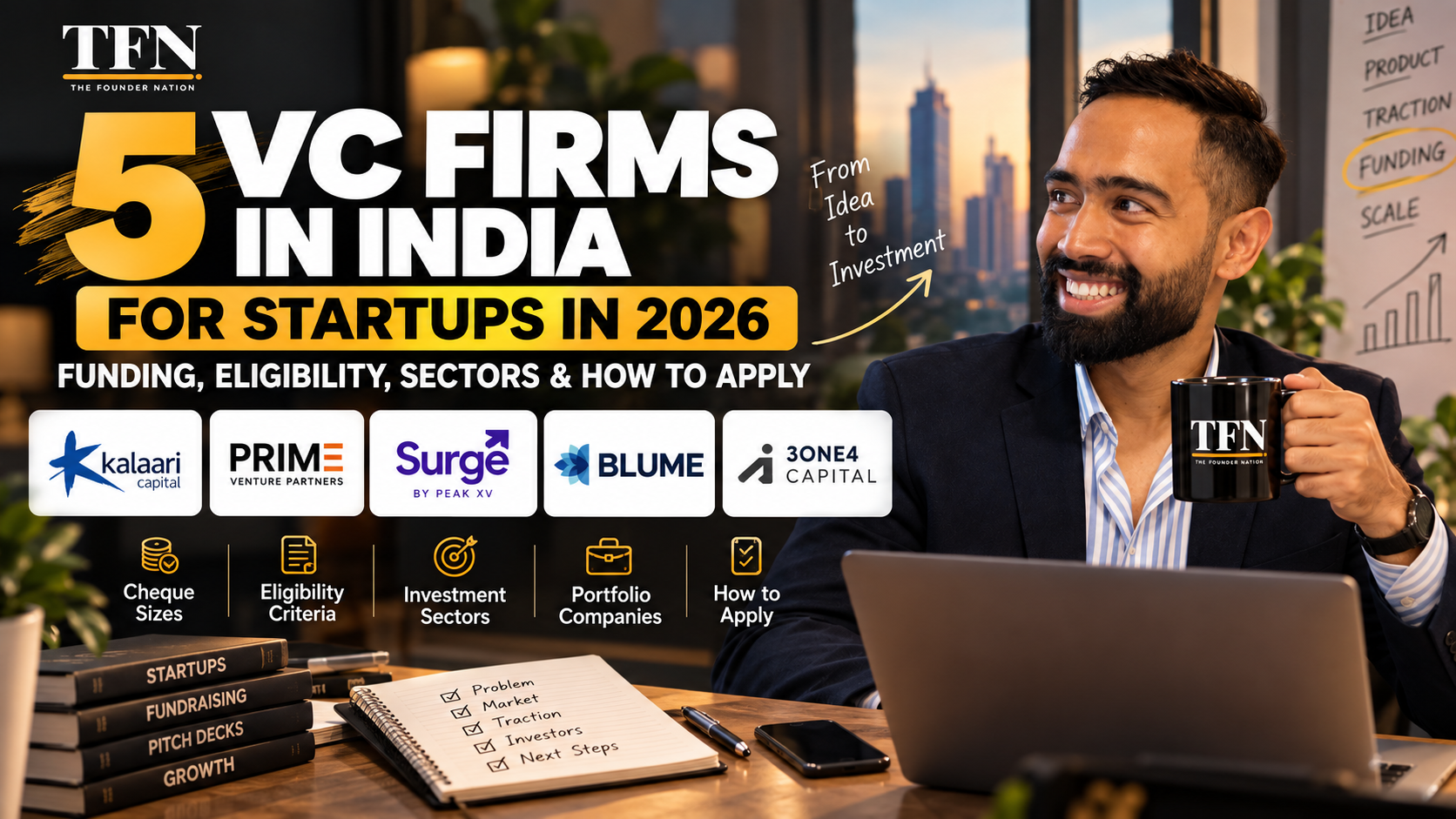
Rajyavardhan Bhandari's guide to 5 VC firms in India for startups, covering funding, eligibility, sectors, portfolio companies and how to apply.
VC firms in India are becoming an increasingly important source of capital for startups across technology, consumer, fintech, SaaS and emerging sectors.
Raising your first institutional funding round can be one of the most challenging phases of building a startup.
You might have a working product, paying customers, promising traction and a capable founding team. But none of that guarantees funding if you are approaching investors who don’t invest at your stage, in your sector or within your required cheque size.
Many founders make the same mistake. They collect hundreds of VC email addresses, send the same pitch deck to everyone and hope that someone responds.
But successful fundraising requires much more than a list of investors.
It requires understanding the fund’s investment thesis, portfolio, decision-making process, cheque size, ownership expectations and preferred approach.
In this guide, The Founder Nation examines five venture capital investors relevant to Indian startups:
- Kalaari Capital
- Prime Venture Partners
- Surge by Peak XV
- Blume Ventures
- 3one4 Capital
We also explain how to identify the appropriate investment partner, secure warm introductions, prepare a pitch deck, approach investors, handle due diligence, negotiate a term sheet and build a structured fundraising strategy.
5 VC Firms in India: Funding and Eligibility Comparison
| VC firm | Investment range | Investment stage | Key sectors |
|---|---|---|---|
| Kalaari Capital | ₹4 crore to ₹40 crore average first cheque | Pre-Seed to Series A | Consumer Tech, Deep Tech, Enterprise AI |
| Prime Venture Partners | $1 million to $4 million first cheque | Seed to Series A, with some earlier investments | Technology-led businesses |
| Surge by Peak XV | $500,000 to $5 million | Idea to Seed | AI, SaaS, Consumer, FinTech, DeepTech and others |
| Blume Ventures | Typically $1.5 million to $3 million | Seed to Pre-Series A | SaaS, Consumer, FinTech, DeepTech, Healthcare |
| 3one4 Capital | Historical early-stage range of approximately $500,000 to $5 million | Early stage | SaaS, Consumer, FinTech, Digital Health, Enterprise |
Note: These figures describe published or historical investment approaches, not guaranteed funding ranges. In particular, 3one4’s current first-cheque policy should be confirmed directly with the fund. Currency conversions also vary with exchange rates.
Official references: Kalaari Capital, Prime Venture Partners, Surge, Blume Ventures and 3one4 Capital.
1. Kalaari Capital: Funding, Eligibility, Portfolio and How to Apply
Kalaari Capital is a technology-focused venture capital firm investing in early-stage businesses.
The firm has backed companies across consumer technology, enterprise software and emerging technologies.
Kalaari Capital cheque size
According to its official funding page, Kalaari’s average first cheque ranges from ₹4 crore to ₹40 crore.
Its stated investment stages include:
- Pre-Seed
- Seed
- Series A
Kalaari says it prefers to lead investment rounds but can also participate alongside other investors.
Source: Kalaari Capital funding criteria
Sectors Kalaari invests in
Kalaari currently identifies three primary investment areas.
Consumer Technology: Technology-led consumer businesses, platforms and services.
Deep Technology: Companies developing differentiated technologies or technical intellectual property.
Enterprise AI: AI products and infrastructure serving business customers.
A startup operating in one of these sectors may be relevant, but sector fit alone does not establish eligibility.
What does Kalaari look for?
Kalaari evaluates several dimensions:
- Market opportunity
- Product differentiation
- Founder-market fit
- Customer evidence
- Traction
- Growth potential
- Execution ability
Its application form also changes the questions based on the startup’s stage.
Pre-Seed eligibility
Founders should explain the problem, proposed solution, target customer and evidence that the problem exists.
Kalaari also asks about the company’s biggest uncertainty and expected progress over the next 12 months.
Seed eligibility
Seed-stage founders should demonstrate customer learning, product improvements, initial traction and evidence of emerging product-market fit.
Series A eligibility
Later-stage founders should be prepared to discuss repeatability, growth, commercial traction and capital allocation.
Source: Kalaari funding application
Kalaari Capital portfolio
Kalaari’s portfolio and historical investments include companies such as:
- Myntra
- BlueStone
- Dream11
- Curefit
- AgNext
- Attero
- Digantara
These examples illustrate its exposure to consumer, technology and deep-tech businesses. Some are historical investments rather than necessarily current holdings.
Source: Kalaari portfolio
Kalaari’s founder support
Beyond capital, Kalaari describes support involving:
- Product-market fit
- Go-to-market strategy
- Customer introductions
- Hiring
- Team building
- Finance
- Legal assistance
- Future fundraising
Founders should identify which of these capabilities would actually matter to their business.
How to approach Kalaari Capital
Step 1: Review Kalaari’s current investment thesis.
Step 2: Compare your startup’s sector, stage and funding requirement with its criteria.
Step 3: Research relevant portfolio companies.
Step 4: Identify current investment team members and their sector interests through the official website.
Step 5: Seek a genuine introduction through a portfolio founder or shared professional contact where possible.
Step 6: Submit the official funding application.
Kalaari publicly describes an investment process involving initial screening, deeper discussions, partner evaluation, Investment Committee consideration and term-sheet discussions.
The firm has described a typical process of approximately four to six weeks from the first call, although individual transactions can take longer.
Application deadline: No fixed deadline is stated on its public funding page.
Official application: https://kalaari.com/seek-funding
2. Prime Venture Partners: Funding, Eligibility, Portfolio and How to Pitch
Prime Venture Partners is an early-stage investor focused on technology-driven startups.
It describes itself as sector agnostic, although its portfolio demonstrates considerable exposure to enterprise software, fintech, consumer technology and other technology-led sectors.
Prime Venture Partners cheque size
Prime currently states that its first cheque generally ranges between $1 million and $4 million.
The firm also describes reserving additional capital for subsequent financing rounds.
Its published materials have indicated a total allocation of approximately $8 million to $10 million per company over the life of the investment, depending on the company’s needs.
Source: Prime investment criteria
Prime Venture Partners investment stages
Prime has invested at:
- Seed
- Pre-Series A
- Series A
It also says it has invested in businesses at the idea stage, including companies that had not generated revenue.
However, Prime emphasizes that evidence of validation can improve the likelihood of investment.
Relevant signals include:
- Revenue
- Active users
- Engagement
- Customer validation
- Exceptional founder-market fit
What does Prime look for?
Strong founding teams
Prime identifies qualities including passion, learning ability, collaboration, ambition and a bias toward execution.
Large market opportunities
The fund encourages founders to calculate market opportunities from the bottom up.
For example, rather than claiming a $10 billion total addressable market, founders should explain how many realistic customers exist, what they spend and what market share the company could plausibly capture.
Meaningful differentiation
Prime emphasizes products or approaches that are substantially better than existing alternatives.
Differentiation may come from technology, distribution, product design, business model or industry insight.
Long-term scalability
The company should have a credible path toward substantial revenue growth.
Prime Venture Partners portfolio
Examples from Prime’s portfolio and investment history include:
- MyGate
- Niyo
- WheelsEye
- Quizizz
- Happay
- Freo
- HackerEarth
Founders should research which companies are relevant to their particular business rather than treating the portfolio as a generic credibility signal.
Source: Prime Venture Partners
How to approach Prime Venture Partners
Prime explicitly identifies introductions through trusted relationships as a preferred approach.
These may come from:
- Portfolio founders
- Angel investors
- Existing investors
- Other founders
- Industry professionals
Recommended approach
First, identify the investment partner associated with your sector.
Then study the partner’s relevant investments, writing and public interviews.
If you know a portfolio founder, ask whether they would be comfortable making an introduction.
If you do not have a warm connection, send a targeted email that explains your company, traction, funding requirement and the specific reason for approaching Prime.
Avoid sending identical messages to multiple partners.
Prime’s investment process
Prime describes a process involving initial discussions, lead partner meetings, wider partnership discussions, reference checks and diligence.
Its diligence can cover:
- Product
- Customers
- Technology
- Market
- Business model
- Founders
- Industry references
Prime states that investment decisions can take approximately three to six weeks, depending on the sector and transaction.
Application deadline: No universal fixed deadline is stated.
Official website: https://www.primevp.in/
3. Surge by Peak XV: Idea-Stage Funding, Programme Details and Applications
Surge by Peak XV is an early-stage investment platform associated with Peak XV Partners.
Surge differs from a conventional VC application model because it combines seed investment with structured founder support, networks and programming.
Surge cheque size
Surge currently states that it invests $500,000 to $5 million in seed capital.
It also welcomes co-investors rather than requiring founders to raise exclusively from Surge.
Source: How Surge invests
Who is eligible for Surge?
Surge explicitly encourages very early-stage founders to apply.
This includes:
- Idea-stage founders
- Pre-launch companies
- Startups building an MVP
- Companies with early customer validation
- Seed-stage businesses
Its application categories cover a wide range of sectors, including:
- AI and machine learning
- SaaS
- Enterprise technology
- Consumer
- FinTech
- HealthTech
- DeepTech
- Robotics
- Gaming
- Climate and energy
- Mobility
- Security
- Space technology
- Marketplaces
Being in one of these sectors does not guarantee an investment.
Surge programme and founder support
Surge describes support across:
- Hiring
- Engineering
- Product
- Go-to-market
- Marketing
- Communications and PR
- Policy
- Fundraising
- Global expansion
It also provides access to a wider community of founders, operators and investors.
What happened to the cohort model?
Surge currently says it accepts applications on a rolling basis, without fixed investment cohort windows.
That is different from older descriptions of Surge that focused heavily on specific cohorts.
However, Surge continues to describe founder programming, including an annual eight-week Immersion.
The important distinction is that the investment application and founder programming are not the same thing.
Source: Surge FAQs
Surge portfolio and track record
Surge’s published platform figures include more than 170 companies and 400 founders.
These are self-reported programme figures.
Founders should use the official Surge website to examine its current company community and relevant examples.
How to apply to Surge
The official application process asks founders to explain their company, market, team and progress.
Before applying, prepare:
- A concise pitch deck
- Founder profiles
- Product explanation
- Market opportunity
- Competition
- Differentiation
- Customer evidence
- Fundraising requirements
- Product demonstration, where relevant
A pre-revenue founder should focus on the quality of the insight, technical progress and evidence of demand.
A revenue-generating founder should also include relevant commercial metrics.
Application deadline: Rolling applications, with no fixed investment cohort window currently stated.
Apply: https://surge.peakxv.com/apply
4. Blume Ventures: Funding, Traction Requirements and Application Strategy
Blume Ventures is an Indian early-stage investor with a broad portfolio across technology-led sectors.
Blume is particularly transparent about its preferences concerning customer validation.
Blume Ventures cheque size
Blume currently describes typical investments of approximately $1.5 million to $3 million.
It also discusses ownership expectations of approximately 12% to 20%, although actual transaction terms vary.
Source: Blume Ventures
What stage does Blume invest in?
Blume generally focuses on:
- Seed
- Pre-Series A
It typically prefers companies that have launched a product and demonstrated some customer validation.
For first-time founders, Blume says it generally does not invest at the idea or pre-MVP stage.
Exceptions may apply, including for experienced operators and repeat founders.
Blume’s published traction guidelines
Blume provides illustrative traction benchmarks.
| Business model | Published guideline |
|---|---|
| B2B or e-commerce | Approximately ₹3 crore annualised revenue |
| Marketplace | Approximately ₹50 lakh monthly GMV |
| Non-monetising consumer app | Approximately 25,000 MAUs or 5,000 DAUs |
These are guidelines, not mandatory eligibility thresholds.
Founders should not assume that crossing a particular metric guarantees funding or that being below it automatically means rejection.
What does Blume evaluate?
Blume has described an evaluation framework built around three areas.
Opportunity: Approximately 40%.
Team: Approximately 40%.
Investability: Approximately 20%.
Opportunity considers the size and attractiveness of the market.
Team considers the founders’ abilities, experience, ambition and execution.
Investability considers whether the company can attract future capital and develop into a scalable business.
Blume Ventures portfolio
Examples of Blume portfolio companies and historical investments include:
- Unacademy
- Slice
- Spinny
- smallcase
- Locus
- Pixxel
These companies operate across different business models and stages.
How to approach Blume
Blume publicly states that introductions from portfolio founders or trusted connections are preferred.
It has also indicated that it receives thousands of pitches annually.
Therefore, the quality of your approach matters.
Recommended process
- Research the Blume portfolio.
- Identify companies operating in your market.
- Find the investment team member covering your sector.
- Check mutual professional connections.
- Ask for a specific introduction.
- If no introduction is available, send a researched cold email.
Blume advises founders to identify a relevant person rather than sending a generic message to the entire firm.
Blume’s portfolio support
Blume has developed a platform function to support portfolio companies.
Its published materials describe areas such as:
- Talent
- Growth
- Business development
- Capital markets
- Strategic partnerships
- Founder networks
- Community
Application deadline: No universal fixed deadline is publicly stated.
Official website: https://blume.vc/
5. 3one4 Capital: Investment Thesis, Portfolio and How to Approach
3one4 Capital is an early-stage investment firm focused on technology-led businesses.
Its investment approach emphasizes market research, founder conviction and long-term company building.
3one4 Capital cheque size
Historical fund announcements have described early-stage investment amounts of approximately $500,000 to $5 million, including post-seed and pre-Series A opportunities.
However, that range should not be treated as a verified current first-cheque policy.
Founders should confirm the current cheque size, available fund capital and investment stage directly with the team.
Reference: 3one4 Capital
3one4 Capital sectors
Its stated investment areas include:
- SaaS
- Consumer Internet
- FinTech
- Digital Health
- Enterprise and SMB digitisation
Its portfolio also reflects exposure to emerging technologies and technology-enabled businesses.
Source: 3one4 investment thesis
3one4 Capital portfolio
Examples from its portfolio and investment history include:
- Darwinbox
- Licious
- Jupiter
- Open
- Hyperface
- CheQ
- Scimplify
- Smallest.ai
Not all of these companies necessarily represent the fund’s current entry-stage preferences.
Founders should examine recent investments and determine which companies best reflect the fund’s present investment thesis.
Source: 3one4 portfolio
How to approach 3one4 Capital
Start with its published investment thesis.
For example, a founder building software for small businesses should explain why the product fits the fund’s interest in enterprise and SMB digitisation.
A fintech founder should identify which part of the financial-services ecosystem the company serves and how its business differs from existing solutions.
Recommended approach
- Research the relevant portfolio companies.
- Identify the current investment team.
- Review recent investments and sector focus.
- Explain the specific investment-thesis overlap.
- Prepare a concise deck and traction summary.
- Use the official pitch/contact route.
- Seek a warm introduction if one exists.
Do not assume that an old portfolio investment means the fund is still pursuing the same opportunities.
Application deadline: No universal fixed deadline has been verified.
Official website: https://www.3one4capital.com/
Do These VCs Have Accelerators, Special Programmes or Faster Application Routes?
One of the biggest misconceptions in fundraising is that every early-stage VC operates an accelerator.
That is not the case.
| Fund | Programme or support model | Important distinction |
|---|---|---|
| Kalaari | Portfolio operating support and investment process | Not a universal accelerator admission route |
| Prime | Hands-on investment and portfolio support | Primarily a VC investment process |
| Surge | Seed investment plus founder community and Immersion | Rolling investment applications, separate founder programming |
| Blume | Portfolio platform and founder support | Portfolio services should not be confused with open accelerator admission |
| 3one4 | Research-led investment and portfolio support | No universal accelerator route verified |
Founders should also be careful with claims about fast-track, gear-down or accelerated turnaround programmes.
A programme should only be described as an active application route if the fund officially confirms its current eligibility, benefits and process.
For these five funds, there is no verified universal shortcut that guarantees faster funding decisions.
A warm introduction, complete application and strong founder-investor fit may improve communication, but they do not bypass investment diligence.
What Else Should You Research Before Approaching a VC?
Cheque size is only one part of investor fit.
1. Fund vintage
A VC may manage multiple funds raised in different years.
The fund vintage can influence the investment strategy and remaining deployment period.
Ask:
- Which fund would make the investment?
- When was that fund raised?
- Is it actively making new investments?
- Does it have capital reserved for follow-on rounds?
Do not confuse total assets under management with capital currently available for new investments.
2. Fund size
A large fund and a small fund may have different ownership and return requirements.
Fund size can influence:
- Initial cheque
- Ownership target
- Reserve allocation
- Follow-on participation
- Portfolio construction
3. Geography
Check whether the fund invests in:
- India-incorporated companies
- India-origin companies
- Indian founders building internationally
- Global companies with Indian operations
A fund’s historical international investments do not automatically establish current eligibility for foreign companies.
4. Lead versus co-investment
Some investors prefer to lead rounds.
Others are comfortable participating alongside a lead investor.
This matters when constructing your fundraising syndicate.
5. Ownership expectations
A VC may have a target ownership range.
For example, a fund targeting meaningful ownership may not be interested in a very small allocation.
Ask about ownership expectations before assuming that a fund’s cheque size fits your round.
6. Follow-on strategy
Determine whether the fund typically supports portfolio companies in subsequent rounds.
Ask:
- Does the fund reserve follow-on capital?
- How does it decide whether to reinvest?
- Does it support introductions to later-stage investors?
- Does it have internal portfolio-support resources?
7. Portfolio conflicts
If the fund has invested in a direct competitor, clarify how it handles confidentiality and potential conflicts.
Do not disclose highly sensitive commercial information before understanding the fund’s process.
How to Find the Right VC Partner
Many founders research the firm but not the person making the investment decision.
That is a mistake.
The relevant partner’s sector expertise, recent investments and current interests can matter considerably.
Step 1: Study the official team page
Find current partners, principals and investment professionals.
Step 2: Examine their investments
Identify companies they have personally worked with.
Step 3: Read their public commentary
Look for:
- Investment theses
- LinkedIn posts
- Interviews
- Podcasts
- Blog articles
- Conference discussions
Step 4: Check recent investments
A company funded several years ago may not represent the partner’s current focus.
Step 5: Identify genuine connections
Potential connectors include:
- Portfolio founders
- Angel investors
- Startup mentors
- Incubators
- Accelerators
- Existing investors
- Industry professionals
Important: Current partner assignments can change. Verify the relevant individual through the fund’s official team page before outreach rather than relying on an outdated directory.
How to Get a Warm Introduction to a VC
A warm introduction means a trusted contact connects you with the investor.
It is not a guarantee of a meeting or funding.
Portfolio founder introductions
Identify a founder who has worked with the fund.
Approach them with a specific request.
Example:
Hi [Name],
I’m [Founder], building [Company], a [one-line description].
We’re currently at [traction] and raising [amount] for our [stage] round.
I noticed your experience with [Fund], and our business appears relevant to its investments in [sector].
Would you be comfortable introducing me to [Partner] if you believe there’s a fit?
Happy to send a short forwardable summary.
Thanks, [Name]
Angel investor introductions
If you have angel investors, ask whether they know investors covering your sector.
Provide them with a concise, forwardable overview.
Incubator introductions
Incubators can provide access to investor networks, demo days and ecosystem contacts.
However, being incubated does not guarantee institutional funding.
Professional networks
Lawyers, accountants, advisors and experienced operators may also know investors.
Use these connections professionally and avoid asking people who do not know your business to provide strong endorsements.
How to Cold Email a VC
Cold outreach is not inherently ineffective.
Poorly researched cold outreach is.
A useful email should answer:
- Who are you?
- What are you building?
- What traction do you have?
- How much are you raising?
- Why are you contacting this investor?
VC cold email template
Subject: [Company] | ₹2Cr ARR | Raising ₹8Cr Seed | Enterprise AI
Hi [Partner Name],
I’m [Name], founder of [Company].
We’re building [one-sentence explanation of the product and customer].
We’ve reached:
- ₹2 crore ARR
- 35 enterprise customers
- 15% monthly growth
- 90% customer retention
We’re raising ₹8 crore to expand enterprise sales, strengthen our product and enter two additional markets.
I’m reaching out specifically because of your investment in [relevant company] and your work around [investment thesis].
I believe there may be a strong fit with what we’re building.
Deck: [Link]
Would be happy to connect if this aligns with your current focus.
Best, [Name]
The metrics above are illustrative. Use your actual verified figures.
How to Approach VCs on LinkedIn
LinkedIn is useful for researching investors and initiating conversations.
However, a LinkedIn DM should be shorter than an email.
LinkedIn DM template
Hi [Name],
I’m [Name], founder of [Company].
We’re building [one sentence] and have reached [key traction].
We’re raising [amount] at [stage].
I noticed your investments in [company/sector] and thought our startup might fit your thesis.
Would be happy to share our deck if relevant.
Thanks.
Avoid sending multiple long messages, tagging investors repeatedly or contacting several employees with identical pitches.
How to Follow Up After Contacting a VC
A follow-up should ideally provide new information.
First follow-up
Hi [Name],
Sharing a quick update since my previous email.
We’ve now reached [new milestone], signed [new customers] and improved [important metric].
I’ve included our updated deck below.
Happy to connect if this is relevant to your current investment focus.
Best, [Name]
Second follow-up
Hi [Name],
One final update from my side.
Since our last note, we’ve achieved [specific milestone].
I’ll close the loop here for now, but would be happy to reconnect when the timing is more suitable.
Thanks, [Name]
Avoid following up every day.
A reasonable cadence depends on the investor’s stated process and whether you have meaningful new information.
What Should Be in Your Startup Pitch Deck?
Your pitch deck should communicate the business clearly without requiring the investor to read a lengthy document.
A practical structure is:
| Slide | Content |
|---|---|
| 1 | Company overview |
| 2 | Problem |
| 3 | Solution |
| 4 | Product |
| 5 | Why now |
| 6 | Market opportunity |
| 7 | Business model |
| 8 | Traction |
| 9 | Growth strategy |
| 10 | Competition |
| 11 | Differentiation |
| 12 | Team |
| 13 | Financials |
| 14 | Fundraising ask |
| 15 | Use of funds |
The deck should reflect the stage.
An idea-stage startup may emphasize customer research, technical differentiation and founder-market fit.
A Series A startup will generally need much stronger evidence of repeatable growth, retention and business economics.
How Much Funding Should You Raise?
Do not select a funding amount simply because a VC is capable of writing that cheque.
Start with the milestones you need to achieve.
For example:
| Metric | Illustrative plan |
|---|---|
| Current ARR | ₹1 crore |
| Target ARR | ₹5 crore |
| Capital required | ₹8 crore |
| Planned runway | 18 months |
| Main objective | Build repeatable enterprise GTM |
| Other milestones | Product expansion and hiring |
Your funding requirement should be based on a financial model that considers hiring, operating costs, capital expenditure, working capital and contingency.
The key question is:
What measurable progress will this funding allow the startup to achieve before its next financing requirement?
Understanding Startup Valuation and Dilution
Founders should understand the difference between pre-money and post-money valuation.
Post-money valuation = Pre-money valuation + New investment
Suppose a startup raises ₹10 crore at a ₹40 crore pre-money valuation.
Its post-money valuation becomes ₹50 crore.
The new investor’s ownership, assuming a straightforward equity transaction without other adjustments, is:
₹10 crore ÷ ₹50 crore = 20%
The existing shareholders collectively retain 80%.
Actual dilution can be affected by option pools, convertible securities and other transaction terms.
What Should Founders Know About Term Sheets?
A term sheet outlines the principal economic and governance terms of an investment.
Important provisions include:
Valuation
The agreed value of the company for financing purposes.
Liquidation preference
The distribution rights investors may receive in an exit or liquidation.
Anti-dilution
Protections that may apply if the company subsequently raises capital at a lower valuation.
Board rights
Rights to appoint directors or observers.
Reserved matters
Company decisions that may require investor approval.
ESOP pool
The employee option pool and its effect on ownership.
Pro-rata rights
Rights allowing investors to participate in future rounds.
Founder vesting
Conditions governing founder equity over time.
Drag-along and tag-along rights
Rights associated with the sale or transfer of shares.
Founders should obtain qualified legal advice before agreeing to investment terms.
A higher headline valuation is not automatically more favourable if other terms create substantial restrictions or economic disadvantages.
Startup Fundraising Data Room Checklist
When an investor begins serious due diligence, prepare a secure data room.
Corporate documents
- Certificate of incorporation
- MOA and AOA
- Shareholding records
- Capitalisation table
- Shareholder agreements
- Board resolutions
- ESOP documents
Financial records
- Profit and loss statements
- Balance sheets
- Cash flow statements
- Revenue breakdown
- Bank statements, where appropriate
- Financial projections
- Tax filings
- Outstanding liabilities
Commercial information
- Customer contracts
- Sales pipeline
- Revenue concentration
- Customer retention
- Cohort data
- Major partnerships
Technology and intellectual property
- Product architecture
- Intellectual property ownership
- Product roadmap
- Relevant security documentation
- Third-party software dependencies
- Material licences
Legal and regulatory
- Employment agreements
- IP assignment agreements
- Material contracts
- Applicable licences
- Regulatory compliance
- Disputes and litigation
Sensitive documents should be shared through controlled access rather than public links.
What Happens After the First VC Meeting?
Although each fund has its own process, a typical investment journey can include:
Initial outreach
↓
Screening
↓
First meeting
↓
Partner discussions
↓
Product and market evaluation
↓
Customer references
↓
Financial and legal diligence
↓
Investment Committee
↓
Term sheet
↓
Definitive agreements
↓
Closing
The sequence is not universal.
Some diligence happens before a term sheet, while additional diligence and legal work may continue afterward.
Founders should ask the investor to clarify its process, decision-makers and expected timeline.
What Do VCs Check During Due Diligence?
Investors may investigate:
- Accuracy of revenue
- Customer concentration
- Growth quality
- Churn
- Retention
- Gross margins
- Unit economics
- Intellectual property
- Technology scalability
- Regulatory exposure
- Legal liabilities
- Founder background
- Market assumptions
- Competitive differentiation
The objective is to validate the company’s claims and understand investment risks.
Never invent revenue, customers, contracts, partnerships or technical capabilities.
The 90-Day Startup Fundraising Plan
A structured fundraising process can reduce wasted outreach.
Days 1 to 15: Preparation
Prepare:
- Pitch deck
- Financial model
- Data room
- Cap table
- Product demo
- Fundraising narrative
- Traction dashboard
Days 16 to 30: Investor research
Build a database covering:
- Investor
- Fund
- Stage
- Sector
- Cheque size
- Partner
- Portfolio
- Introduction source
- Geography
- Thesis fit
Days 31 to 45: Warm introductions
Contact relevant:
- Portfolio founders
- Angels
- Existing investors
- Incubators
- Advisors
Days 46 to 60: Targeted outreach
Send personalised emails to investors with relevant investment mandates.
Days 61 to 75: Investor discussions
Prepare for:
- Product demonstrations
- Market analysis
- Unit economics
- Growth strategy
- Founder references
- Financial questions
Days 76 to 90: Diligence and follow-up
Progress serious discussions, provide requested documentation and manage investor updates.
This is an illustrative planning framework, not a promise that funding can be completed within 90 days.
Create a VC Fundraising CRM
Fundraising should be managed as a structured pipeline.
| Field | Purpose |
|---|---|
| Fund name | Investor organisation |
| Relevant partner | Target contact |
| Sector | Investment focus |
| Stage | Preferred entry stage |
| Cheque size | Typical investment |
| Portfolio | Relevant investments |
| Introduction | Mutual connection |
| Outreach date | First contact |
| Response | Investor feedback |
| Meeting | Scheduled/completed |
| Diligence | Process status |
| Follow-up date | Next action |
| Outcome | Active, passed or closed |
Track the quality of each conversation, not just the number of emails sent.
Common Reasons VCs Reject Startups
An investment rejection can occur for several reasons.
Stage mismatch
The startup may be too early or too mature for the fund.
Sector mismatch
The company may operate outside the fund’s current thesis.
Cheque mismatch
The round size may not align with the fund’s investment model.
Insufficient validation
The investor may want more evidence of customer demand.
Market concerns
The addressable opportunity may be unclear or smaller than expected.
Competition
The company may lack meaningful differentiation.
Valuation
The proposed terms may not align with the investor’s assessment.
Portfolio conflict
The fund may already have exposure to a competing business.
Fund timing
The fund may be prioritising follow-on investments or operating under deployment constraints.
When appropriate, ask for feedback and identify milestones that might justify reconnecting later.
VC Funding Alternatives for Indian Startups
Venture capital is not appropriate for every business.
Founders should also evaluate alternative funding sources.
Angel investors
Individuals investing their own capital in startups.
Incubators
Organisations providing mentorship, infrastructure, ecosystem access and, in some cases, funding.
Accelerators
Structured programmes supporting startup development, often with mentorship, networks and sometimes capital.
Government grants
Funding programmes designed for eligible startups, innovation projects or specific sectors.
Bank financing
Debt financing, subject to lending criteria and repayment obligations.
Venture debt
Debt products designed for qualifying growth companies, often alongside equity financing.
Strategic investors
Companies investing for financial or commercial objectives.
Bootstrapping
Funding growth through founder capital and business cash flows.
For more information, see Startup India’s funding resources.
Startup India Seed Fund Scheme
The Startup India Seed Fund Scheme was designed to support eligible startups with activities such as:
- Proof of concept
- Prototype development
- Product trials
- Market entry
- Commercialisation
The scheme operates through selected incubators and has eligibility conditions covering matters such as DPIIT recognition and incorporation age.
However, the official scheme portal has stated that the last date for startup applications was May 31, 2026, while disbursements continue.
Founders should therefore verify whether any new application window or replacement scheme is available before preparing an application.
Official source: https://seedfund.startupindia.gov.in/
How to Avoid Fake Investors and Funding Scams
Founders should be cautious when receiving unsolicited investment offers.
Potential warning signs include:
- Guaranteed funding promises
- Requests for unexplained upfront fees
- Unofficial email addresses
- Requests for passwords or OTPs
- Pressure to transfer money immediately
- Fake term sheets
- Unverifiable investor identities
- Suspicious document links
Always confirm the investor’s identity through the fund’s official website.
Never disclose account credentials or sensitive financial access information.
Frequently Asked Questions About VC Funding in India
Can I raise VC funding without revenue?
Yes. Some early-stage investors fund companies before meaningful revenue.
Surge explicitly accepts very early-stage applications, while Prime has described investments made before companies generated revenue.
However, founders still need credible evidence supporting the opportunity.
Which VCs invest at the idea stage in India?
Among the funds discussed, Surge explicitly welcomes idea-stage founders. Prime has also made idea-stage investments, and Kalaari considers pre-seed applications.
Actual investment decisions depend on the team, opportunity and evidence.
How do I find VC investors in India?
Start with official VC websites, portfolio pages, investment announcements, founder networks, startup databases and relevant ecosystem organisations.
Then verify the fund’s current criteria directly.
Should I approach multiple VCs simultaneously?
Founders commonly maintain conversations with several relevant investors, but outreach should be targeted and organised.
Avoid misrepresenting competing offers or creating artificial urgency.
How long does it take to raise VC funding?
Timelines vary widely.
Individual funds may describe decision processes lasting several weeks, but the complete fundraising process can take months depending on investor availability, diligence, documentation and market conditions.
How do I get an investor’s attention?
A concise pitch supported by meaningful evidence, clear investor fit and a specific reason for contacting the fund can make outreach more relevant.
What documents do investors need?
Typical requirements include a pitch deck, financial model, cap table, incorporation documents, commercial records and relevant legal documents.
The exact requirements depend on the investor and stage.
Is a warm introduction compulsory?
No.Some funds prefer introductions, but direct applications and targeted outreach are also available.
Can I approach a VC after being rejected?
Yes, particularly if the company has achieved meaningful new milestones or the original reason for rejection has changed.
How much equity should founders give away?
There is no universal percentage.
Dilution depends on the amount raised, valuation, financing structure, existing shareholders, option pools and negotiated terms.
Final Takeaway: Fundraising Is About Investor Fit
Founders should not approach venture capital as a numbers game.
Sending 200 generic emails is not necessarily more effective than approaching a smaller group of carefully researched investors.
Kalaari, Prime, Surge, Blume and 3one4 have different investment mandates, sector interests, cheque sizes and founder expectations.
Some consider companies before revenue.
Others generally prefer customer validation.
Some provide rolling applications.
Others place greater emphasis on trusted introductions.
The correct approach is to understand your own business first.
Define:
Stage × Sector × Capital Requirement × Traction × Geography × Investor Thesis
Then identify investors whose published investment approaches align with those characteristics.
Research the relevant partner, study the portfolio, prepare your materials and communicate a clear reason for the conversation.
Most importantly, remember that raising venture capital is not the ultimate objective of building a startup.
Capital is a tool for reaching business milestones.
The objective is to build a company capable of creating sustainable value, with financing that supports its strategy rather than dictates it.
For additional funding resources and investor research, explore The Founder Nation’s guide to early-stage investors in India.
Official Sources and External References
- Kalaari Capital: Funding Criteria and Application
- Kalaari Capital: Portfolio
- Prime Venture Partners: Investment Approach
- Prime Venture Partners: Official Website
- Surge by Peak XV: How We Invest
- Surge by Peak XV: Application
- Surge by Peak XV: FAQs
- Blume Ventures: Official Website
- 3one4 Capital: Investment Thesis
- 3one4 Capital: Portfolio
- Startup India
- Startup India Seed Fund Scheme