

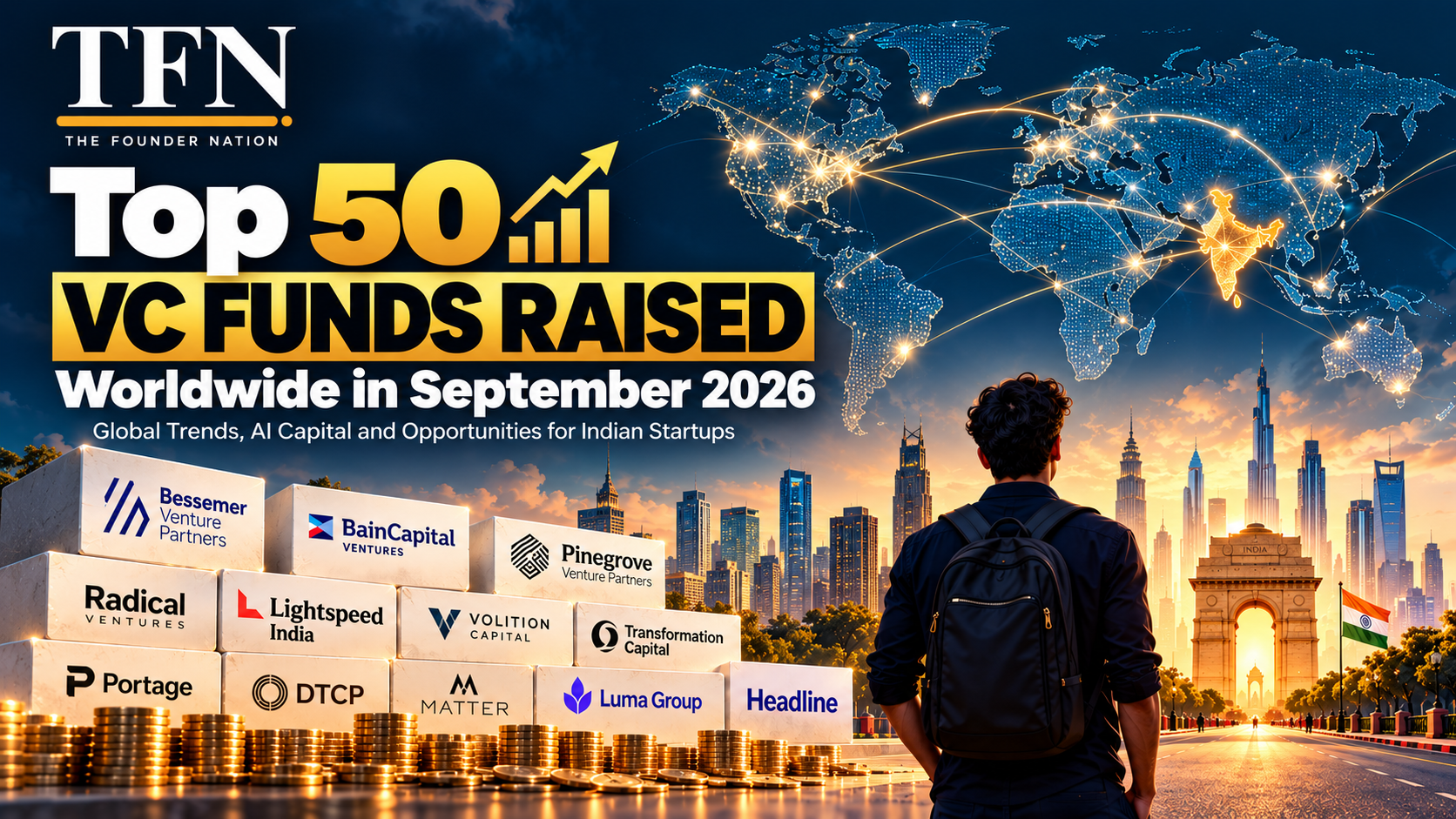
The top 50 VC funds raised worldwide in September 2026, covering global venture capital trends, AI funding and opportunities for Indian startups.
VC funds raised in September 2026 show that institutional investors continue to commit significant capital to technology, AI, healthcare, fintech, deep tech, climate, defence and growth-stage businesses.
The month produced several exceptionally large fundraises. Bessemer Venture Partners announced $5.75 billion, Bain Capital Ventures closed a $1.6 billion fund, Pinegrove Venture Partners closed $1.5 billion, Radical Ventures secured more than $1 billion for its new AI strategy, and Volition Capital closed $950 million. Venture Capital Access Online
However, the most interesting story is not simply the size of these funds.
September’s fundraising activity shows where institutional investors believe the next generation of technology companies could emerge. AI remains central, but capital is also moving toward physical AI, robotics, healthcare, biotech, defence, fintech, climate technology, semiconductors, deep tech and specialised growth strategies.
For Indian founders, the picture is especially relevant.
India is simultaneously developing a deeper domestic venture capital ecosystem, while global investors are creating dedicated strategies for Indian and India-linked startups. Lightspeed, for example, is targeting a $250 million India fund focused on early-stage AI, while the Indian government has operationalised the ₹10,000 crore Startup India Fund of Funds 2.0. TechCrunch
This guide examines the 50 largest and most notable venture and venture-adjacent fundraises announced during September 2026, what each fund is designed to do, the investment themes behind the fundraising activity, and what Indian founders should learn from it.
Important methodology note: This ranking combines traditional VC funds with venture secondaries, growth capital, venture debt and a small number of adjacent private-market vehicles where the September fundraising data is relevant to the broader startup funding ecosystem. These vehicles are clearly identified. The ranking is based on reported fund size, but currencies and fund structures are not perfectly comparable. First closes, final closes, targets and multi-vehicle strategies are also different and should not be treated as identical.
September 2026 VC Fundraising: Key Numbers
A few numbers immediately stand out.
| Metric | September 2026 snapshot |
|---|---|
| Largest raise in this ranking | $5.75B |
| Second largest | $1.6B |
| Third largest | $1.5B |
| Radical Ventures AI strategy | $1B+ |
| Major India-focused AI fund target | $250M |
| Startup India FoF 2.0 | ₹10,000 crore |
| Indian startup funding tracked in September | $1.6B disclosed value |
| Indian startup funding rounds tracked | 95 |
The Indian funding figures come from a September tracker that records 95 Indian startup funding rounds with $1.6 billion in disclosed value. Lapaas Voice
Meanwhile, the official Startup India Fund of Funds 2.0 notification establishes a ₹10,000 crore corpus and specifically targets deep tech, smaller AIFs backing early-growth startups, technology-driven manufacturing and sector or stage agnostic funds. Startup India
Top 50 VC Funds Raised Worldwide in September 2026
1. Bessemer Venture Partners
$5.75 billion
Bessemer Venture Partners recorded the largest fundraise in this September dataset, closing $5.75 billion across seed, early-stage and growth strategies.
The firm said the new capital includes:
- $1.75 billion for seed and early-stage investments
- $4 billion for growth investments
That allocation is particularly significant because it shows that Bessemer is building substantial capacity not only for new startups but also for companies that have already achieved significant scale. Venture Capital Access Online
For founders, Bessemer’s new capital is especially relevant to:
- AI
- Cloud infrastructure
- Cybersecurity
- Fintech
- Healthcare
- Enterprise software
- Deep tech
- Consumer technology
- Growth-stage technology
Bessemer also has an established India investment presence, making it one of the more relevant global funds for Indian technology companies.
Founder takeaway: A large fund with both early-stage and growth capital can potentially support a company across multiple financing stages.
Visit Bessemer Venture Partners
2. Bain Capital Ventures
$1.6 billion
Bain Capital Ventures announced Fund XI at $1.6 billion.
The new fund is targeting technology companies across areas including:
- AI infrastructure
- AI applications
- Physical AI
- Science
- Security
- Technology-enabled services
The fund continues BCV’s early-stage strategy, making it particularly relevant to founders before late-stage growth. Venture Capital Access Online
Founder takeaway: BCV’s new fund demonstrates how AI is increasingly being treated as a broad technology platform rather than a single startup category.
3. Pinegrove Venture Partners
$1.5 billion
Pinegrove closed Strategic Investors Fund XII at $1.5 billion.
This requires an important distinction.
Pinegrove’s vehicle is not simply a conventional startup VC fund. It uses strategies that invest in venture managers, expansion-stage managers and selected co-investments. Venture Capital Access Online
Founder takeaway: Not every large fundraise represents direct startup cheques. Understanding the fund structure matters.
4. Radical Ventures
More than $1 billion
Radical Ventures announced the first close of its Radical Breakouts Fund, securing well over $1 billion in commitments.
The strategy focuses on scaling AI companies into global leaders and provides late-stage capital to companies that have moved beyond the earliest stages. Radical Ventures
Radical’s existing ecosystem includes AI companies such as Cohere, Waabi and World Labs.
Founder takeaway: The AI funding market is increasingly developing dedicated capital for companies that have already demonstrated significant technical and commercial potential.
5. Volition Capital
$950 million
Volition Capital closed Fund VI at $950 million, providing additional growth capital for high-growth businesses.
This is particularly relevant for companies that have moved beyond the earliest venture stages and are looking for institutional growth capital.
6. Transformation Capital
$850 million
Transformation Capital closed Fund IV at $850 million.
The firm’s focus is healthcare technology and digital health.
For healthcare founders, specialised investors can be particularly valuable because healthcare businesses often involve:
- Longer sales cycles
- Regulatory requirements
- Clinical validation
- Complex enterprise procurement
- Large capital requirements
7. Portage Ventures
Approximately $600 million
Portage closed Ventures Fund IV at approximately $600 million, with a focus on fintech.
The strategy covers areas including:
- Banking
- Payments
- Insurance
- Wealth management
- Asset management
The fund invests across stages from Seed through Series C. Portage
Founder takeaway: Fintech remains a significant specialist investment category even as generalist VC attention shifts heavily toward AI.
8. Claret Capital Partners
€575 million
Claret Capital Partners raised €575 million, including Fund IV and affiliated mandates.
This is a growth capital and debt strategy rather than a conventional equity-only VC fund.
That distinction is important for founders because growth debt can provide capital without the same ownership dilution as an equity round, although debt creates repayment obligations and therefore carries different risks.
9. Intrepid Growth Partners
$525 million
Intrepid Growth Partners launched with a $525 million inaugural fund focused on AI.
The strategy targets AI businesses capable of transforming established industries.
This reflects an important change in the AI investment landscape.
Investors are increasingly looking beyond AI wrappers toward:
- AI infrastructure
- Vertical AI
- Enterprise AI
- Physical AI
- Industry-specific AI
- AI-native companies
10. TrueBridge Capital Partners
$508 million
TrueBridge raised capital for its second venture secondaries strategy.
Secondaries differ from traditional VC because the investor can acquire existing stakes rather than only purchasing newly issued shares.
This becomes increasingly relevant as private technology companies remain private for longer.
11. Crane Venture Partners
$484 million
Crane Venture Partners raised approximately $484 million across four investment vehicles.
The firm focuses on enterprise technology and software.
12. DTCP
€455 million
DTCP reached the first close of its Defence Fund I at €455 million.
The fund focuses on:
- Defence
- Security
- Resilience
- European technology
Defence technology has become an increasingly important institutional venture category, particularly where software, AI, robotics and dual-use technology overlap.
13. Matter Venture Partners
$450 million
Matter Venture Partners closed Fund II at $450 million.
Its focus includes:
- Semiconductors
- Robotics
- Physical AI
- Quantum technology
- Advanced manufacturing
- Energy technology
- AI infrastructure
This makes Matter one of the clearest examples of capital moving into hard technology rather than software alone.
14. Luma Group
$410 million
Luma Group closed LumaBio Fund I at $410 million.
The fund focuses on life sciences and biomedical innovation.
This reinforces the continuing importance of specialist capital in industries where development cycles can extend well beyond conventional software timelines.
15. Headline
$400 million
Headline raised $400 million for Headline EU VIII, targeting early-stage European technology companies.
The strategy focuses on Seed and Series A opportunities, with AI playing a significant role in the investment thesis.
16. Sundance Growth
$250 million
Sundance Growth closed Fund II at $250 million, reaching its hard cap.
The fund is focused on growth-stage businesses.
17. Lightspeed India Partners V
$250 million target
This is one of the most important fundraises in this list for Indian founders.
Lightspeed is targeting $250 million for a new India-focused early-stage fund, with AI as the central investment theme.
Approximately 80% of the target had reportedly already been committed when the fund was announced.
Lightspeed plans to invest in early-stage AI companies across India and Southeast Asia. TechCrunch
The firm has already invested in Indian technology companies including Sarvam AI, Zepto, Pocket FM, Snabbit and SolarSquare. TechCrunch
Founder takeaway: India is no longer simply a geographic allocation inside global VC strategies. Major firms are creating dedicated AI capital specifically for the region.
18. Swish Ventures
$250 million
Swish Ventures closed its third fund at $250 million.
The fund intends to invest in approximately 12 high-tech companies, primarily at Seed and Series A, with an average investment of around $20 million. Globes
This is another example of a specialist fund concentrating substantial capital into a relatively small number of technology companies.
19. Bpifrance
€207 million
Bpifrance raised €207 million for InnoBio 3, continuing its investment activity in life sciences and biotechnology.
The fund demonstrates how government-backed investment institutions can play a significant role in sectors where private capital alone may not always provide sufficient long-duration funding.
20. Molten Ventures
£175 million
Molten Ventures reached a £175 million first close for its Growth Fund.
Because this is a first close, the amount should not be interpreted as necessarily representing the fund’s final size.
21. Zero Infinity Partners
$156 million
Zero Infinity Partners announced Fund II, focused on founders building innovative technologies for physical infrastructure.
The strategy reflects the growing overlap between software, infrastructure and industrial technology.
22. Seed Capital
€130 million
Seed Capital closed Fund V at approximately €130 million.
The firm focuses on early-stage technology companies, particularly within the Nordic ecosystem.
23. DIG Ventures
$120 million
DIG Ventures closed Fund III at $120 million, continuing its investment strategy across technology and innovation.
24. Sofinnova Partners
€82 million
Sofinnova Partners raised capital for MD Start IV, focused on medical technology and healthcare innovation.
25. Clean Growth Fund
£81.5 million
Clean Growth Fund reached the second close of Fund II at £81.5 million.
The fund focuses on climate and clean technology.
26. Cosmos Ventures
$77.6 million
Cosmos Ventures closed its inaugural $77.6 million fund.
As a first fund, this is particularly relevant to founders because emerging managers often build highly concentrated investment theses.
27. Brighteye Ventures
$72 million
Brighteye Ventures reached the first close of Fund III at $72 million.
The firm’s thesis covers the future of learning and work, including technology, AI and productivity.
28. Cherubic Ventures
$68.9 million
Cherubic Ventures closed Fund VI at approximately $68.9 million.
The firm has a long-standing focus on early-stage technology businesses across multiple international markets.
29. LAUNCHub Ventures
€65 million
LAUNCHub Ventures reached the first close of Fund III at €65 million.
The firm focuses heavily on early-stage technology companies in Central and Southeast Europe.
30. Pulse Fund
$63 million
Pulse Fund closed its $63 million inaugural fund with a climate technology focus.
The fund targets companies working on climate and sustainability challenges.
31. Connect Ventures
$55 million
Connect Ventures reached the first close of Fund V at $55 million.
The fund continues its early-stage technology investment strategy.
32. Commonweal Ventures
$54 million
Commonweal Ventures raised $54 million across Fund II and a New York co-investment vehicle.
The structure demonstrates another trend in venture capital: managers increasingly use multiple vehicles to address different opportunities and investor requirements.
33. Enable Ventures
$50.3 million
Enable Ventures raised $50.3 million for Fund I.
As an emerging manager, the fund is part of a broader September trend in which new and smaller firms continue to secure institutional capital.
34. Rohati Capital
$50 million
Rohati Capital closed an oversubscribed $50 million inaugural fund.
The fund is particularly notable because it represents a new institutional vehicle rather than another large multi-billion-dollar platform.
35. Dorm Room Fund
$50 million
Dorm Room Fund raised a new $50 million vehicle.
The fund is known for backing student and emerging founders.
For very early-stage entrepreneurs, smaller specialist funds can sometimes be more accessible than large institutional investors.
36. Techshop Capital
€43 million
Techshop Capital reached the first close of Techshop II at €43 million.
The fund focuses on technology and innovation opportunities.
37. VORNvc Management GmbH
€41 million+
VORNvc Management reached a second close of more than €41 million.
Because this is a second close, the amount represents additional committed capital rather than necessarily the ultimate size of the investment vehicle.
38. Primo Capital
Approximately €40 million
Primo Capital raised approximately €40 million for Primo Biotech Lazio, focused on biotechnology and life sciences.
39. Vinyl Capital
$40 million
Vinyl Capital closed Fund II at $40 million.
The fund continues its investment strategy with a relatively focused capital base.
40. Auxxo Female Catalyst Fund
€33.3 million
Auxxo closed Female Catalyst Fund II at €33.3 million.
The fund focuses on female-led companies and represents a growing category of gender-focused venture capital.
41. Captain Ventures
Approximately $33 million
Captain Ventures raised approximately $33 million for Fund I.
As a first fund, the vehicle adds to the growing number of emerging managers entering the venture ecosystem.
42. Forty.5 Ventures
$30 million
Forty.5 Ventures launched Fund I at $30 million.
The fund represents another example of smaller specialised managers raising institutional capital.
43. Eureka! Venture
Approximately €20 million
Eureka! Venture raised approximately €20 million for Fund II / Deep Tech Lazio.
The strategy is connected to deep technology and innovation.
44. Breed VC
$15 million
Breed VC closed Fund II at $15 million.
The fund operates at the smaller end of the venture capital market and demonstrates that specialist capital continues to emerge even outside large institutional platforms.
45. BAG Ventures
$11.3 million
BAG Ventures closed its inaugural fund at approximately $11.3 million.
The fund is focused on enterprise AI founders and has built an operator-heavy ecosystem around its investment strategy.
46. NewSchool.vc
€10 million
NewSchool.vc raised €10 million for its inaugural fund, focusing on early-stage B2B technology companies.
The fund is another example of an emerging manager building a specialised investment platform rather than competing directly with mega-funds.
47. Project Ventures
£1.2 million first close
Project Ventures reached a £1.2 million first close for its debut fund.
The fund is associated with the Imperial College London ecosystem and focuses on deep tech and AI-related opportunities.
48. Rising Point Capital Management
$325 million
Rising Point Capital Management closed its inaugural institutional fund at $325 million on September 29.
However, this is an adjacent private equity/growth vehicle rather than a conventional VC fund. It invests in founder- and family-led field-based services companies in the lower middle market. FinancialContent
It is included here because the September private-market fundraising landscape overlaps with venture and growth capital, but founders should not treat it as a traditional startup VC.
49. PSG Equity
More than €4.4 billion
PSG Equity held the final close of its third European fund at more than €4.4 billion in September.
This is another growth and private equity vehicle rather than a traditional early-stage VC fund.
It is relevant to the broader private-capital environment because it demonstrates how significant institutional capital continues to be available for established technology businesses.
50. Princeton Equity Group
$1.3 billion
Princeton Equity Group raised $1.3 billion for Fund III, reaching its hard cap.
Like PSG Equity and Rising Point, Princeton Equity Group is better classified as private equity rather than traditional startup VC.
Its inclusion therefore belongs in the broader September private-market fundraising picture, rather than being interpreted as an early-stage venture fund.
Why the Top 50 Is Not a Perfectly Like-for-Like VC Ranking
This distinction is important.
A founder reading a list of fund sizes could easily assume that:
“$5.75 billion VC fund > $50 million VC fund.”
But the comparison is not that simple.
The September fundraising landscape includes:
- Traditional venture capital
- Early-stage VC
- Growth equity
- Venture debt
- Venture secondaries
- Fund-of-funds strategies
- Co-investment vehicles
- Private equity
- First closes
- Second closes
- Final closes
For example, Pinegrove’s $1.5 billion vehicle is structurally different from an early-stage startup fund, while Claret’s €575 million strategy includes growth debt. TrueBridge is a secondaries investor. Rising Point and Princeton Equity Group operate in private equity.
Therefore, the most useful way to read this ranking is:
Which investment vehicles raised significant capital in September, and what does that capital tell us about the direction of private-market investing?
That is more meaningful than treating every number as an equivalent startup cheque pool.
What September 2026’s VC Fundraising Tells Us
The numbers reveal several major trends.
1. AI Remains the Biggest Capital Magnet
AI appears repeatedly among the largest September fundraises.
Bessemer is deploying new capital across the AI ecosystem. Bain Capital Ventures is targeting AI infrastructure and applications. Radical Ventures has raised more than $1 billion specifically for its AI growth strategy. Intrepid has launched a $525 million AI fund. Lightspeed is building a dedicated $250 million India and Southeast Asia AI vehicle. Radical Ventures
This suggests that investors increasingly view AI as an entire investment ecosystem rather than a single category.
The AI investment stack
The opportunity can be divided into:
- Foundation-model infrastructure
- Compute
- Data infrastructure
- AI security
- AI agents
- Enterprise AI
- Vertical AI
- AI applications
- Physical AI
- AI-enabled scientific discovery
For founders, this means simply calling a company an “AI startup” is no longer enough.
Investors increasingly need to understand:
What technical advantage does the company have?
What problem is AI actually solving?
Why is this business difficult to replicate?
What happens to the company’s economics as model costs fall?
2. Physical AI Is Becoming a Major Investment Theme
Physical AI combines artificial intelligence with the physical world.
It includes:
- Robotics
- Autonomous machines
- Industrial automation
- Drones
- Manufacturing
- Warehouse technology
- Sensors
- Autonomous vehicles
- Energy systems
Matter Venture Partners and Bain Capital Ventures both highlight physical AI in their strategies.
This is especially important for India.
India has significant engineering talent, manufacturing capabilities, automotive ecosystems and an expanding deep-tech sector.
That creates an interesting intersection:
Indian engineering + AI + manufacturing + global capital.
3. Defence Technology Is Becoming Institutional Venture Capital
DTCP’s Defence Fund I is one of the strongest signals.
Defence technology increasingly overlaps with:
- AI
- Cybersecurity
- Drones
- Autonomous systems
- Space technology
- Communications
- Simulation
- Robotics
- Dual-use infrastructure
The opportunity is therefore broader than traditional defence equipment.
For Indian founders, the dual-use category can be particularly interesting because technologies developed for government and defence applications can sometimes have commercial applications as well.
4. Healthcare and Biotech Continue to Attract Specialist Capital
Transformation Capital and Luma Group demonstrate that healthcare remains an important destination for institutional capital.
Healthcare investing requires specialised expertise because startups may need:
- Clinical validation
- Regulatory approvals
- Long development timelines
- Specialist talent
- Large R&D budgets
That is why a healthcare founder should generally prioritise healthcare-specialist investors over simply choosing the largest generalist VC.
5. Growth Capital Is Becoming More Important
Bessemer’s new allocation is particularly revealing.
The firm allocated $4 billion to growth compared with $1.75 billion for seed and early-stage strategies. Venture Capital Access Online
This reflects a broader market reality.
Technology companies are staying private longer.
As a result, startups increasingly need investors that can support:
- Series B
- Series C
- Series D
- Pre-IPO growth
- Secondary transactions
For founders, the implication is straightforward.
When selecting an early investor, think about whether that investor can support the company beyond the first round.
6. Venture Debt and Alternative Capital Are Becoming More Relevant
Claret’s €575 million raise highlights the importance of growth debt.
Debt can potentially help a company extend runway without immediately issuing new equity.
However, debt is not free capital.
Founders must consider:
- Interest
- Repayment
- Covenants
- Security
- Revenue predictability
- Default risk
- Dilution versus repayment economics
A startup should therefore evaluate venture debt as a financing instrument, not simply as an alternative to VC.
7. Emerging Managers Are Still Raising Capital
The lower half of the list contains numerous first and second funds.
That matters.
The venture market is not controlled exclusively by mega-funds.
New managers can sometimes offer:
- Narrower sector expertise
- More partner attention
- Smaller portfolios
- Strong founder networks
- Geographic specialisation
- Greater willingness to invest early
Therefore, founders should not automatically rank investors by fund size.
What September’s VC Fundraising Means for Indian Startups
This is perhaps the most important section for The Founder Nation’s audience.
India is becoming increasingly relevant to global venture capital.
Lightspeed’s new India fund is a direct example.
The firm is targeting $250 million for Lightspeed India Partners V, with an early-stage AI focus covering India and Southeast Asia. Approximately 80% of the target had reportedly been committed at the time of the September announcement. TechCrunch
Lightspeed also has existing exposure to Indian technology companies including Sarvam AI, Zepto, Pocket FM, Snabbit and SolarSquare. TechCrunch
That tells Indian founders something important:
Global investors increasingly see India not only as a large startup market, but also as a source of globally relevant technology companies.
Indian Startup Funding in September 2026
The domestic market was active as well.
A September 2026 Indian startup funding tracker recorded:
- 95 funding rounds
- $1.6 billion in disclosed funding value
- 95 startups funded during the month
The database tracks funding rounds across Indian startups and cites a source for individual transactions. Lapaas Voice
That provides an important contrast.
Global VCs were raising large pools of capital, while Indian startups were simultaneously raising fresh equity and debt.
This creates an ecosystem where:
Global LP capital → VC funds → startup investments
and
Indian institutional capital → AIFs → Indian startups
can operate in parallel.
Startup India Fund of Funds 2.0: Why Indian Founders Should Know About It
India’s government notified Startup India Fund of Funds 2.0 with a ₹10,000 crore corpus in April 2026.
The objective is to mobilise venture capital for India’s startup ecosystem through eligible Alternative Investment Funds. Startup India
The scheme specifically identifies four broad areas:
Deep tech
Startups with longer R&D cycles, higher costs and technically complex products.
Smaller AIFs
Funds supporting early-growth startups and emerging venture managers.
Technology-driven manufacturing
Startups working on innovative manufacturing and technology-intensive industrial opportunities.
Sector and stage agnostic startups
Broader startup strategies that can invest across sectors and stages. Startup India
The operational guidelines also establish a structured AIF selection process and identify SIDBI as the implementation agency. Press Information Bureau
This is important because Startup India FoF 2.0 is not simply a government grant handed directly to founders.
Instead, the fund of funds commits capital to eligible AIFs.
Those AIFs then evaluate and invest in startups.
What This Means for Indian Founders
An Indian founder should therefore think about fundraising across multiple layers.
Layer 1: Angels
Useful for:
- Pre-seed
- Idea validation
- Early product development
Layer 2: Indian Seed Funds
Useful for:
- MVP
- Initial traction
- Product-market fit
Layer 3: Indian VC Funds
Useful for:
- Seed
- Series A
- Series B
Layer 4: Global Specialist Funds
Useful for:
- AI
- Deep tech
- Healthcare
- Defence
- Climate
- Global SaaS
Layer 5: Global Growth Investors
Useful for:
- International expansion
- Large growth rounds
- Late-stage capital
Layer 6: Venture Debt
Useful for selected companies with sufficient revenue, traction or institutional backing.
Which Global VC Themes Are Most Relevant to Indian Startups?
AI Startups
This is probably the strongest intersection.
Indian founders can build in:
- AI agents
- Enterprise AI
- Voice AI
- Indian-language AI
- AI cybersecurity
- AI infrastructure
- AI healthcare
- AI for financial services
- AI for manufacturing
The opportunity does not necessarily require building a frontier foundation model.
The application layer may be equally important.
Lightspeed’s new India fund explicitly focuses on early-stage AI companies in India and Southeast Asia. TechCrunch
Deep-Tech Startups
The rise of specialist funds such as Matter Venture Partners is relevant to Indian companies working on:
- Semiconductors
- Robotics
- Quantum
- Industrial automation
- Advanced materials
- Energy technology
- Sensors
- Manufacturing technology
The Indian government’s Startup India FoF 2.0 also explicitly identifies deep tech and technology-driven manufacturing as priority segments. Startup India
That creates a potentially powerful combination of:
Government ecosystem support + domestic AIF capital + global specialist VC.
Defence and Dual-Use Startups
Indian founders building:
- Drones
- Autonomous systems
- Cybersecurity
- Satellite technologies
- Communications
- Defence logistics
- Simulation
- Surveillance infrastructure
should monitor the growing global defence investment ecosystem.
The emergence of dedicated defence funds such as DTCP’s strategy demonstrates that institutional investors are becoming more comfortable with this category.
Healthcare and Biotech Startups
Indian healthcare startups can potentially benefit from the continuing growth of specialist healthcare capital.
Relevant categories include:
- Healthtech
- Diagnostics
- Medical devices
- AI diagnostics
- Drug discovery
- Biotechnology
- Clinical technology
- Healthcare infrastructure
However, founders should expect specialist investors to examine regulatory and scientific risk much more deeply than a conventional SaaS investor.
Climate and Clean Technology
Clean Growth Fund and Pulse Fund demonstrate continuing institutional interest in climate-focused capital.
For Indian founders, this could be relevant to:
- Renewable energy
- Battery technology
- Energy storage
- Carbon reduction
- Industrial efficiency
- Water technology
- Climate adaptation
- Sustainable manufacturing
Fintech
Portage’s $600 million fintech fund is another strong signal that specialist fintech capital remains available. Portage
Indian fintech founders can potentially benefit from global interest in:
- Payments
- Banking infrastructure
- Wealth management
- Insurance technology
- Financial compliance
- Risk technology
- Cross-border finance
India’s existing digital public infrastructure can also create a strong foundation for new financial technology businesses.
Top VC Funds and Strategies by Theme
| Theme | Funds to Watch | Why |
|---|---|---|
| AI | Bessemer, Radical, Bain, Intrepid | AI infrastructure, applications and growth |
| AI in India | Lightspeed India | Early-stage India and Southeast Asia AI |
| Fintech | Portage | Banking, payments, insurance and wealth |
| Deep tech | Matter, Eureka! | Hard technology and advanced systems |
| Defence | DTCP | Defence and security |
| Healthcare | Transformation, Luma, Sofinnova | Digital health and life sciences |
| Climate | Pulse, Clean Growth | Climate and clean technology |
| Growth | Bessemer, Volition | Later-stage technology |
| Venture debt | Claret | Growth debt |
| Secondaries | TrueBridge | Existing private-company stakes |
| Early stage | Bain, Headline, Seed Capital | Seed and early-stage technology |
| Emerging managers | Cosmos, Captain, Forty.5, NewSchool | Newer specialist funds |
How Indian Founders Should Use This List
Do not simply copy these 50 names into a spreadsheet and email all of them.
Instead, create an investor scoring system.
Investor Fit Score
Score each investor from 1 to 5 on:
| Factor | Score |
|---|---|
| Stage fit | /5 |
| Sector fit | /5 |
| Geography fit | /5 |
| Cheque-size fit | /5 |
| Portfolio fit | /5 |
| Partner fit | /5 |
| Follow-on capacity | /5 |
| Warm introduction | /5 |
A fund with a 35/40 score should generally be prioritised over a famous fund with a 15/40 score.
Fund Size vs Cheque Size: A Critical Difference
One of the biggest mistakes founders make is assuming:
Big fund = big cheque for my startup.
That is not how venture capital works.
A $5 billion fund may make dozens of investments.
It may also reserve substantial capital for follow-on rounds.
For example, a fund may have:
- $1 billion total capital
- $400 million initial investments
- $600 million follow-on reserves
The exact structure differs by fund.
Therefore, founders should always research:
- Initial cheque
- Ownership target
- Number of investments
- Follow-on reserves
- Stage
- Geography
- Lead versus follow
- Investment period
First Close vs Final Close: What Founders Need to Know
Several funds in this list reached a first close rather than a final close.
These terms are not interchangeable.
| Term | Meaning |
|---|---|
| Target | Amount the manager hopes to raise |
| First close | Initial committed capital |
| Second close | Additional capital raised later |
| Final close | Fundraising completed |
| Hard cap | Maximum amount the fund intends to accept |
For example, Lightspeed’s new India fund is currently described as a $250 million target, with approximately 80% committed at the time of reporting. It should not be described as a final $250 million close unless the fund later confirms that. TechCrunch
Similarly, a first close can eventually become substantially larger.
How to Approach a Newly Raised VC Fund
A newly raised fund can be attractive because the manager has fresh capital to deploy.
But timing alone is not enough.
Step 1: Find the investment thesis
Read the fund announcement.
Look for:
- Sector
- Stage
- Geography
- Founder profile
- Investment size
Step 2: Research the partners
Do not email a generic VC inbox if you can identify the partner who invests in your category.
Step 3: Study the portfolio
Look for companies that resemble yours.
Step 4: Check conflicts
If the fund already backs your direct competitor, your outreach strategy may need to change.
Step 5: Find a warm introduction
A referral from:
- Founder
- LP
- Portfolio company
- Accelerator
- Industry expert
- Existing investor
can be more valuable than a cold email.
Step 6: Personalise the pitch
Explain why the fund specifically makes sense for your company.
What Your VC Pitch Deck Should Cover
Before approaching global investors, Indian founders should have:
1. Problem
What painful problem are you solving?
2. Solution
What exactly have you built?
3. Market
How large is the opportunity?
4. Product
How does it work?
5. Traction
What evidence shows that customers want it?
6. Business Model
How do you make money?
7. Competition
Who else is solving the problem?
8. Moat
Why will you win?
9. Go-to-Market
How will you acquire customers?
10. Team
Why are you uniquely capable of building this company?
11. Financials
What are your revenue, burn, runway and projections?
12. Fundraise
How much are you raising?
13. Use of Funds
What will the capital achieve?
What Global VCs May Expect From Indian Startups
An Indian founder approaching a global fund should be prepared for questions around:
- International market size
- US or European expansion
- Currency exposure
- Corporate structure
- IP ownership
- Regulatory compliance
- Data protection
- Cross-border taxation
- Customer concentration
- Founder ownership
- Cap table
- ESOP pool
- Future fundraising
- Exit potential
This does not mean every startup needs to incorporate outside India.
It means founders should understand the legal and commercial structure of their company before entering international fundraising conversations.
For legal, tax and structuring decisions, founders should obtain professional advice rather than relying on a general startup article.
Global VC vs Indian VC: What Should Founders Choose?
There is no universal answer.
| Factor | Indian VC | Global VC |
|---|---|---|
| Indian market expertise | Usually strong | Varies |
| Local regulatory knowledge | Strong | Varies |
| India hiring network | Strong | Depends |
| International network | Varies | Often strong |
| US market access | Depends | Potentially strong |
| Global expansion | Varies | Often strong |
| Local founder ecosystem | Strong | Depends |
| Large global rounds | Increasing | Often strong |
| Sector specialisation | Depends | Often strong |
| India-specific capital | Strong | Increasing |
For many startups, the strongest strategy can be a combination.
An Indian lead investor can provide local ecosystem support while a global specialist can help with international expansion.
The New Indian Founder Playbook for 2026
Indian founders should build fundraising pipelines across three dimensions.
Domestic capital
Target:
- Indian angels
- Seed funds
- Indian VCs
- Family offices
- AIFs
- Strategic investors
Global capital
Target:
- Global AI funds
- Deep-tech funds
- Healthcare funds
- Climate funds
- Fintech specialists
- Growth funds
Non-dilutive and alternative capital
Explore:
- Grants
- Government programmes
- Venture debt
- Credit guarantees
- Corporate partnerships
- Strategic capital
The objective is not to replace VC.
It is to avoid becoming dependent on one type of capital.
Why September 2026 Could Be Important for AI Founders in India
The combination of global and domestic developments is particularly interesting.
On one side:
Radical Ventures: $1B+ AI strategy. Radical Ventures
Bessemer: $5.75B across seed through growth. Venture Capital Access Online
Bain Capital Ventures: $1.6B new fund with AI and physical AI exposure. Venture Capital Access Online
Intrepid: $525M AI-focused fund.
Lightspeed India: $250M target focused on early-stage AI in India and Southeast Asia. TechCrunch
On the other side:
Startup India FoF 2.0: ₹10,000 crore aimed at mobilising venture capital, including deep tech, early growth and innovative manufacturing. Press Information Bureau
That creates an unusually interesting environment for Indian technology founders.
What Indian Founders Should Build for the Next VC Cycle
The data does not mean every founder should suddenly build an AI startup.
Instead, founders should identify where technology creates a genuine advantage.
Some potentially important categories include:
AI + Enterprise
Automate expensive business processes.
AI + Healthcare
Improve diagnostics, workflows or drug development.
AI + Manufacturing
Make factories more intelligent.
AI + Defence
Build dual-use technologies with real-world applications.
AI + Fintech
Improve underwriting, fraud detection and financial operations.
AI + Climate
Improve energy efficiency and resource utilisation.
AI + Agriculture
Improve productivity, logistics and supply chains.
AI + Indian Languages
Build technology around India’s linguistic diversity.
AI + Robotics
Move beyond software into physical systems.
The 50 Fundraises Show a Broader Shift in Venture Capital
It would be easy to look at September’s numbers and conclude:
“Venture capital is back.”
The reality is more nuanced.
Capital is available, but investors are increasingly selective.
The market is moving toward:
specialisation
technical defensibility
AI
deep technology
growth-stage companies
sector expertise
capital efficiency
long-term company building
That is particularly important for founders who assume that raising a large VC fund automatically means investors are willing to fund anything.
They are not.
The competition for high-quality companies remains significant.
What Founders Should Learn From the Biggest Fundraises
Lesson 1: Follow the capital
If an investor just raised a new fund, understand where it intends to deploy it.
Lesson 2: Follow the thesis
A fund’s strategy matters more than its headline size.
Lesson 3: Find specialists
The right specialist can be more useful than the biggest generalist.
Lesson 4: Think beyond your current round
Your first investor may become your Series B or Series C partner.
Lesson 5: Build globally where appropriate
Indian startups can increasingly build from India while targeting global markets.
Lesson 6: Do not confuse a fund with a cheque
Fund size and individual investment size are very different.
Lesson 7: Understand fund structure
First close, final close, secondaries, debt and growth equity all work differently.
A Practical VC Research Template for Founders
Before adding a fund to your fundraising pipeline, record:
| Information | What to Research |
|---|---|
| Fund | Exact name |
| Size | Latest fund |
| Fund status | Target, first, second or final close |
| Stage | Pre-seed to growth |
| Sector | Investment thesis |
| Geography | Countries covered |
| Initial cheque | Typical range |
| Ownership | Target stake |
| Follow-on | Reserve strategy |
| Partner | Relevant investor |
| Portfolio | Similar companies |
| Competitors | Portfolio conflicts |
| Warm intro | Potential connection |
| Application | Website/contact route |
| Last fund | Previous vintage |
| Dry powder | If disclosed |
| Status | Prospect, contacted, meeting, DD |
This can become the foundation of a proper fundraising CRM.
Frequently Asked Questions About VC Funds Raised in September 2026
Which VC fund raised the most money in September 2026?
Bessemer Venture Partners announced $5.75 billion in new capital across seed, early-stage and growth strategies. Venture Capital Access Online
Which was the second-largest VC fundraise?
Bain Capital Ventures announced a $1.6 billion fund. Venture Capital Access Online
Which fund raised $1.5 billion?
Pinegrove Venture Partners closed Strategic Investors Fund XII at $1.5 billion. Venture Capital Access Online
Did Radical Ventures raise more than $1 billion?
Yes. Radical Ventures announced the first close of its Radical Breakouts Fund with well over $1 billion committed, focused on scaling AI companies. Radical Ventures
Which VC raised a new fund specifically for AI in India?
Lightspeed is targeting $250 million for Lightspeed India Partners V, focused on early-stage AI companies across India and Southeast Asia. Approximately 80% of the target had reportedly been committed at announcement. TechCrunch
Which fund focused on fintech?
Portage closed Ventures Fund IV at approximately $600 million, targeting fintech companies across banking, payments, insurance, wealth and asset management. Portage
Which funds focused on deep tech?
Matter Venture Partners is one of the strongest examples, with its $450 million Fund II targeting areas including semiconductors, robotics, physical AI, quantum technology and advanced manufacturing.
Which fund focused on defence?
DTCP’s Defence Fund I reached a €455 million first close and focuses on defence, security and resilience technologies.
Is the $250 million Lightspeed India fund already fully closed?
No. It was reported as a $250 million target, with approximately 80% committed at the time of the September announcement. It should not be described as a final close unless Lightspeed subsequently confirms one. TechCrunch
Is Startup India Fund of Funds 2.0 a VC fund that founders can directly apply to?
No.
Startup India FoF 2.0 is a fund-of-funds structure. It commits capital to eligible AIFs, which then invest in startups. The scheme has a ₹10,000 crore corpus and specifically targets areas including deep tech, early-growth startups and technology-driven manufacturing. Startup India
Does a bigger VC fund mean a startup has a better chance of getting funded?
No.
Stage, sector, geography, cheque size, partner fit and investment thesis can matter more than the headline fund size.
Should Indian founders approach all 50 funds?
No.
Founders should shortlist investors based on stage, sector, geography, cheque size, portfolio fit and partner expertise.
Are all 50 entries traditional VC funds?
No.
The list includes venture capital, growth, venture debt, secondaries and a few adjacent private equity vehicles because September’s private-market fundraising landscape includes several different forms of capital.
Final Takeaway: What September 2026 Means for Founders
The VC funds raised in September 2026 show that enormous amounts of institutional capital are still being committed to private markets.
But the capital is increasingly specialised.
AI is attracting some of the largest pools.
Physical AI and robotics are becoming increasingly important.
Healthcare and biotech continue to attract specialist capital.
Defence and security are emerging as major investment categories.
Fintech continues to attract dedicated funds.
Climate technology remains an institutional theme.
Growth capital is becoming increasingly important as companies stay private longer.
At the same time, emerging managers continue to raise smaller specialist funds.
For Indian founders, the opportunity is particularly significant.
India now has:
- A large domestic startup ecosystem
- A growing AIF ecosystem
- A ₹10,000 crore Startup India Fund of Funds 2.0
- Increasing global VC interest
- Dedicated India-focused funds
- Growing AI investment
- Deep-tech policy support
- Expanding opportunities in manufacturing, defence, healthcare and climate technology
The most important lesson is therefore not:
“VCs raised billions, so funding is easy.”
The real lesson is:
Capital is available, but the best founders need to know exactly which capital is designed for their company.
If you are an Indian AI founder, the Lightspeed India fund is worth watching.
If you are building deep tech, funds such as Matter and India’s growing deep-tech ecosystem may be relevant.
If you are building fintech, specialist investors such as Portage can be more relevant than a generalist mega-fund.
If you are building healthcare, specialist healthcare and life-sciences investors may offer more than capital.
If you are building defence or dual-use technology, the rise of dedicated defence funds should be on your radar.
And if you are raising a growth round, funds with significant later-stage capacity may matter more than traditional seed investors.
The smartest fundraising strategy is therefore not to chase the biggest VC.
It is to find the right investor, with the right thesis, at the right stage, with the right cheque size and the right ability to support the company over time.
For founders, that is the real signal hidden inside September 2026’s massive VC fundraising numbers.
Methodology and Data Notes
This article uses the September 2026 fundraise dataset supplied for this report and supplements it with independently reported and primary-source information where available.
For major fund announcements, primary or high-quality sources were prioritised. Venture Capital Access Online’s September fund-news archive, for example, lists major September closes including Bessemer’s $5.75 billion raise, Bain’s $1.6 billion fund, Pinegrove’s $1.5 billion vehicle, Transformation Capital’s $850 million fund, Matter’s $450 million fund and Luma’s $410 million fund. Venture Capital Access Online
Radical Ventures independently confirmed that its Radical Breakouts Fund secured more than $1 billion at first close. Radical Ventures
Lightspeed’s India fund has been treated as a target, not a final close, because the September reporting described a $250 million target with approximately 80% already committed. TechCrunch
The Indian startup funding figure comes from a September tracker that records 95 rounds and $1.6 billion in disclosed value. Lapaas Voice
The Startup India Fund of Funds 2.0 information comes from the Government of India’s notification and DPIIT/PIB operational guidance. Startup India
Important: Fund sizes are reported in different currencies. This article does not attempt to create a false precision by converting every amount into USD at an arbitrary exchange rate. Also, first closes, final closes, targets, secondaries, debt funds and private equity vehicles are not directly comparable.
Fund sizes and investment mandates can change. Founders should verify the latest information directly with the relevant fund before making fundraising decisions.
This article is for informational purposes only and is not investment, legal, tax or financial advice.