

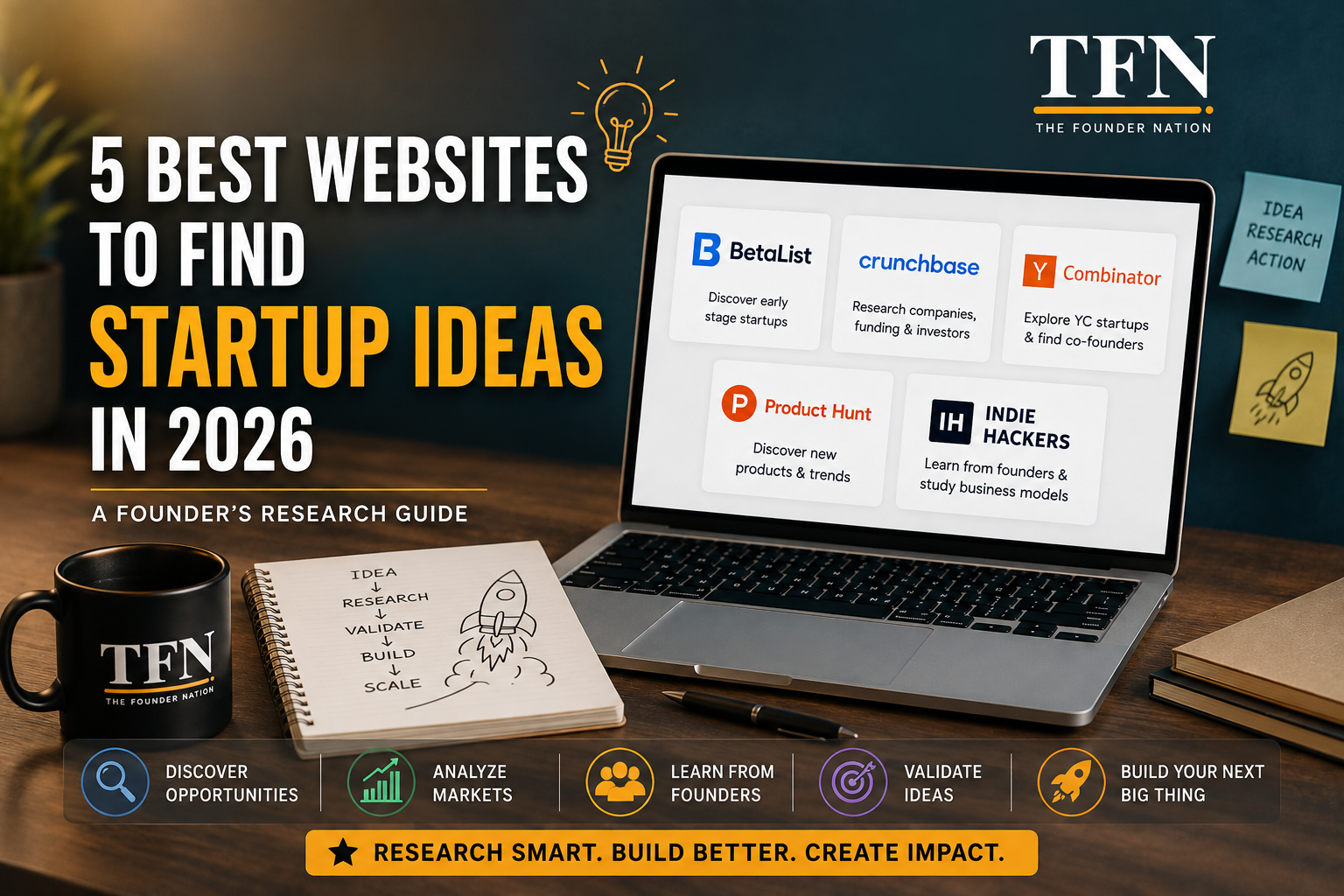
Five startup research websites founders can use to discover startup ideas, emerging trends and business opportunities.
Startup idea websites can help aspiring founders discover emerging startups, new products, business models, market opportunities and problems that entrepreneurs are already solving around the world. Instead of waiting for a completely original idea to appear, founders can study what is being built in different markets and identify opportunities that could potentially be adapted for their own customers and region.
Finding a good startup idea does not always mean waiting for a completely original idea to appear out of nowhere.
Some of the best startup opportunities can be discovered by studying what entrepreneurs are already building, which problems are attracting customers, what products are launching, where investors are putting capital and which business models are generating revenue.
That is why knowing the right websites to find startup ideas can give aspiring founders a significant advantage.
Platforms such as BetaList, Crunchbase, Y Combinator, Product Hunt and Indie Hackers allow founders to research companies, products, markets, business models and emerging trends from different angles.
But there is an important distinction.
The objective is not to blindly copy another startup.
The objective is to identify a problem, understand why a particular solution works, study the market and then determine whether you can build a better or differently positioned solution for a specific customer.
In this guide, The Founder Nation breaks down five of the most useful startup research platforms and explains exactly how founders can use them to discover, evaluate and validate potential startup opportunities.
Quick Answer: What Are the Best Websites to Find Startup Ideas?
If you are looking for a quick starting point, these five platforms are worth bookmarking:
| Website | Best for | What founders can research |
|---|---|---|
| BetaList | Early startup discovery | New startups, emerging categories and early products |
| Crunchbase | Company and funding research | Companies, investors, funding and market activity |
| Y Combinator | Startup and founder research | YC companies, founder resources and co-founder opportunities |
| Product Hunt | New product discovery | Recently launched products and emerging trends |
| Indie Hackers | Business model research | Founder stories, revenue, products and profitable online businesses |
Each platform answers a different question.
BetaList: What are people building early?
Product Hunt: What are people launching right now?
Crunchbase: Which companies and markets are attracting capital?
Y Combinator: What problems are ambitious founders building around?
Indie Hackers: How are founders actually turning products into businesses?
Using all five together gives you a much stronger startup research process than relying on a single website.
Why Use Websites to Find Startup Ideas?
The internet already contains an enormous amount of information about startups.
Founders are publicly launching products, sharing their experiences, discussing problems, documenting revenue and talking about the markets they are entering.
The opportunity is to turn that information into structured research.
Instead of asking:
“What startup should I build?”
ask:
“What problems are repeatedly being solved by startups across different markets?”
Then investigate those problems.
This approach can reveal:
- Emerging startup categories
- New SaaS opportunities
- AI business ideas
- B2B opportunities
- Consumer trends
- Underserved customer segments
- New distribution models
- International business models
- Potential opportunities for India
The five websites below are particularly useful because they give you different types of evidence.
The 5 Best Websites to Find Startup Ideas
1. BetaList: Find Early Stage Startup Ideas
BetaList is useful for discovering startups while they are still relatively early.
The platform focuses on early stage startups and allows users to explore startups across different categories and regions. Its current India section lists more than 1,800 startups, making it particularly interesting for founders researching the Indian ecosystem.
Why BetaList is useful for startup research ?
The biggest advantage is timing.
You can discover products before they become widely recognized companies.
That makes BetaList useful for researching:
- AI startups
- SaaS businesses
- Productivity tools
- Fintech products
- Developer tools
- Marketing software
- Analytics companies
- Consumer applications
Rather than looking for one company to copy, look for patterns.
If you notice several startups appearing around the same problem, category or customer, investigate why.
How to use BetaList to find startup ideas
Start with one category.
For example:
AI → Healthcare → Fintech → SaaS → Education → Productivity
Then collect 20 companies.
For each company, record:
| Research question | What to record |
|---|---|
| What is the company? | Name |
| What problem does it solve? | Problem |
| Who is the customer? | ICP |
| What does the product do? | Product |
| How does it make money? | Business model |
| Where is it based? | Geography |
| What category does it belong to? | Market |
| Could the problem exist in India? | India opportunity |
After studying enough companies, you will begin to see recurring problems.
Those recurring problems are often more interesting than individual startup names.
BetaList’s India angle
BetaList’s India directory is especially useful if you want to compare global startup ideas with companies already being built in India. The current directory includes startups across areas such as AI, SEO, customer service, analytics and other technology categories.
That creates an interesting research exercise:
Global startup → Indian equivalent → Existing Indian competitors → Unsolved customer problem
2. Crunchbase: Research Startups, Funding and Investors
Finding an interesting startup is only the first step.
The next question is whether the broader market appears to be attracting meaningful activity.
That is where Crunchbase becomes useful.
Crunchbase provides company and private-market intelligence that can be used to research companies, investors, funding activity and market information.
What can founders research on Crunchbase?
Depending on the company and available information, founders can investigate:
- Funding rounds
- Investors
- Company information
- Industry
- Funding history
- Acquisitions
- Competitors
- Market activity
The important thing is to research categories rather than individual companies.
Suppose you discover an AI recruitment startup.
Do not stop there.
Search for similar companies.
Then ask:
How many companies are solving this problem?
Who has raised funding?
Which investors are active?
What stage are these companies at?
Is the category growing?
You are trying to determine whether you have found an isolated product or a broader market trend.
Funding is a signal, not proof
One important warning for founders is that funding should not be treated as proof that a business is good.
A company can raise significant capital and still fail.
A bootstrapped business can become highly profitable without raising venture capital.
Use funding as one research signal among many.
3. Y Combinator: Research Startups, Founders and Emerging Markets
Y Combinator is another valuable resource for startup idea research.
Instead of simply looking at which companies were accepted into the accelerator, study the problems those companies are attempting to solve.
Look for patterns across:
- Artificial intelligence
- Fintech
- Healthcare
- Education
- SaaS
- Developer tools
- Robotics
- Climate technology
- Consumer technology
How to research YC startups
When you discover an interesting company, ask:
What problem did the founders identify?
Who experiences that problem?
What did customers use before the company existed?
Why might the timing be right?
What technology enabled the product?
What market could the company eventually serve?
This transforms a startup directory into a research database.
Y Combinator can also help you find a co-founder
One particularly useful YC resource is its Co-Founder Matching platform.
YC states that the platform can be used whether you already have a startup idea or are still exploring. It is also free and does not take equity for the service.
Explore Y Combinator Co-Founder Matching
That means someone who says:
“I want to build a startup but I don’t know exactly what to build.”
does not necessarily have to wait until the idea is perfect.
You can meet potential co-founders, understand their interests and potentially discover problems worth exploring together.
4. Product Hunt: Discover New Products and Startup Trends
Product Hunt is particularly useful for discovering products as they launch.
Product Hunt describes itself as a platform for discovering new products, with products ranked daily by its community. Users can browse categories and topics and see products that are gaining traction.
Why Product Hunt is useful for startup ideas
Product Hunt gives founders something that a traditional startup database cannot always provide:
fresh product discovery.
You can research new products across categories including:
- AI
- Productivity
- Developer tools
- Finance
- Marketing
- Design
- SaaS
- Consumer technology
The right way to use Product Hunt
Do not ask:
“Which product can I copy?”
Ask:
“Which customer problems keep appearing?”
Suppose you notice multiple products addressing AI sales automation.
That repeated appearance is more interesting than any individual product.
You can investigate:
- Why is this category growing?
- Who is paying for these products?
- What workflow is being automated?
- What alternatives exist?
- What are customers complaining about?
- Could the product be specialised for another market?
- Is the existing solution too expensive?
- Is there a distribution opportunity?
The trend is the insight.
The individual product is the evidence.
5. Indie Hackers: Study Revenue, Business Models and Founder Stories
Indie Hackers is particularly useful for understanding what happens after a product is built.
The platform describes itself as a place where founders of profitable businesses and side projects share their stories transparently so other entrepreneurs can learn from them.
Its current resources include founder stories, product databases and case studies covering businesses at different stages.
Why Indie Hackers is different
A product directory might tell you:
“This company built an AI tool for marketers.”
A founder story can potentially tell you:
- Why the founder built it
- How the idea was discovered
- How the first customers were acquired
- What pricing model was used
- What went wrong
- What worked
- How revenue changed
- How the business evolved
That makes Indie Hackers particularly useful for business model research.
Its product database also allows research by business model and revenue-related information where available.
What should you study?
Focus on:
Problem → Customer → Product → Distribution → Pricing → Revenue → Growth
That sequence can tell you much more about a business than its homepage.
Which Website Should You Use for Startup Research?
The answer depends on what you are trying to discover.
| Your objective | Best platform | Why |
|---|---|---|
| Find early startups | BetaList | Early stage discovery |
| Research Indian startups | BetaList | Dedicated India directory |
| Research funding | Crunchbase | Company and funding intelligence |
| Research investors | Crunchbase | Investor and company research |
| Study YC companies | Y Combinator | Startup and founder ecosystem |
| Find a co-founder | Y Combinator | Dedicated co-founder matching |
| Discover new products | Product Hunt | Daily product discovery |
| Identify emerging product trends | Product Hunt | Community driven rankings and discussion |
| Study founder journeys | Indie Hackers | Founder stories and case studies |
| Research business models | Indie Hackers | Products, revenue and founder experiences |
The Best Startup Research Workflow
Using one website is useful.
Using all five in a structured process is much better.
A practical workflow is:
BetaList → Product Hunt → Crunchbase → Y Combinator → Indie Hackers → Customer validation
Each platform contributes a different piece of information.
Stage 1: Discovery
Use BetaList and Product Hunt.
Find companies and products.
Stage 2: Market research
Use Crunchbase.
Investigate companies, funding and investors.
Stage 3: Problem research
Use Y Combinator.
Study similar startups and the problems founders are tackling.
Stage 4: Business model research
Use Indie Hackers.
Understand pricing, revenue and founder experiences.
Stage 5: Localisation
Bring the idea into your target market.
For Indian founders, this means researching the Indian customer, competitors, pricing and distribution.
Stage 6: Validation
Speak to real potential customers.
Only then decide whether the opportunity deserves a product.
How to Find Startup Ideas for India
This is where global startup research becomes particularly interesting.
A startup working in the United States may have validated a customer problem without necessarily solving it well for Indian customers.
But the correct formula is not:
US startup + Indian logo = Indian startup
Instead, think:
Global problem → Indian customer → Indian insight → Original solution
Consider the differences that may matter:
Pricing
Can the target customer afford the original product?
Distribution
Would the product need WhatsApp, partnerships, field sales or another channel?
Payments
Does Indian payment behaviour change the product?
Language
Would regional language support create an advantage?
Regulation
Are there Indian compliance requirements?
Customer behaviour
Does the Indian customer solve the problem differently?
Competition
Who already serves this customer?
Infrastructure
Does the product depend on infrastructure that works differently in India?
These differences can create genuine opportunities.
Do Not Copy the Startup. Copy the Research Process.
The word “copy” gets attention on social media.
But founders should be much more precise when turning that idea into a real business.
Do not copy:
- Branding
- Logos
- Code
- Proprietary technology
- Copyrighted content
- Trade secrets
- Patented inventions without appropriate rights
- Another company’s exact product implementation
Instead, study:
- The problem
- The customer
- The market
- The business model
- The distribution strategy
- The customer complaints
- The gap in the market
Then build something original.
This is particularly important if you are planning to raise venture capital or build a long-term company.
The Startup Idea Research Template
Instead of saving random startup links, create a research database.
| Company | Problem | Customer | Product | Pricing | Business model | Funding | Competitors | Country | India opportunity |
|---|---|---|---|---|---|---|---|---|---|
| Startup 1 | |||||||||
| Startup 2 | |||||||||
| Startup 3 | |||||||||
| Startup 4 | |||||||||
| Startup 5 |
After 20 companies, look for patterns.
Then ask:
Which problems appear repeatedly but remain poorly solved for the customers I understand?
That is where research starts turning into opportunity discovery.
How to Evaluate a Startup Idea Before Building It
Finding a startup idea is not the same as validating it.
Before investing months of development time, answer these questions.
Who has the problem?
Define a specific customer.
“Everyone” is rarely a useful customer definition.
How painful is the problem?
A minor inconvenience may not be strong enough to create a business.
What do customers use today?
Existing alternatives reveal how people currently solve the problem.
Are customers already spending money?
Existing spending can be useful evidence that the problem has economic value.
Why would someone switch?
Your product needs a reason to exist.
How will you acquire customers?
Distribution is part of the startup, not an afterthought.
Why are you the right founder?
Founder expertise, access, network, distribution or personal experience can create an advantage.
Idea vs Opportunity: Know the Difference
An idea might be:
“An AI tool for restaurants.”
An opportunity is much more specific:
“Independent restaurants with small teams spend significant time handling customer communication and repeat-order workflows manually. Existing software may be expensive or designed for larger restaurant chains. A lightweight solution focused on a specific workflow could potentially serve this segment at a different price point.”
The second version gives you:
Customer + Problem + Existing behaviour + Potential gap + Product hypothesis
That is something you can actually test.
A 7 Day Startup Idea Research Challenge
Want to turn these five websites into an actual research process?
Try this seven-day challenge.
Day 1: Explore BetaList
Find 20 early stage startups.
Record the problem, customer and category.
Day 2: Explore Product Hunt
Find 20 recently launched products.
Look for repeated themes.
Day 3: Shortlist
Choose the 10 most interesting problems.
Ignore the products for a moment.
Focus on the problems.
Day 4: Research on Crunchbase
Investigate the companies and broader categories.
Look at funding and investor activity where available.
Day 5: Research Y Combinator
Find companies addressing similar problems.
Study how they approach the market.
Day 6: Study Indie Hackers
Find founder stories and business models related to your shortlisted ideas.
Pay particular attention to distribution and monetisation.
Day 7: Validate
Choose your three strongest opportunities.
Speak with potential customers.
Do not build anything significant until you understand whether the problem actually exists.
What Types of Startup Ideas Can You Discover?
These platforms can help you research almost every major startup category.
SaaS startup ideas
Look at:
- CRM
- HR software
- Accounting
- Sales
- Marketing
- Analytics
- Customer support
- Workflow automation
AI startup ideas
Rather than building another general-purpose chatbot, research specific workflows.
For example:
- AI sales
- AI research
- AI customer support
- AI coding
- AI healthcare
- AI legal technology
- AI education
- AI finance
B2B startup ideas
Look for industries where businesses still rely heavily on:
- Spreadsheets
- Manual data entry
- Paperwork
- Phone calls
- Repetitive administrative tasks
- Fragmented software
Then ask:
Is this process painful enough for someone to pay to improve it?
Why You Should Research More Than One Startup
One company can be an outlier.
Ten companies addressing a similar problem may indicate something more interesting.
For example, imagine your research produces:
7 AI sales companies
5 AI customer support companies
4 AI research companies
3 AI finance companies
The goal is not automatically to choose the category with the most startups.
Instead ask:
Why are founders entering these categories?
What changed recently?
What technology made this possible?
What customers are paying?
What remains unsolved?
This turns startup discovery into market research.
More Founder Resources From The Founder Nation
Finding a startup idea is only the beginning.
Once you have identified an opportunity, you will eventually need to answer questions about:
Validation
Co-founders
Funding
Investors
Government schemes
DPIIT recognition
Pitch decks
Startup grants
Business strategy
That is where the wider The Founder Nation resource ecosystem comes in.
Explore The Founder Nation startup resources
As TFN’s resource library expands, this article should internally link to dedicated guides on each of these topics.
For example:
- Startup funding in India
- Best VCs and angel investors in India
- DPIIT recognition and startup benefits
- Startup grants in India
- How to create a startup pitch deck
- How to find a co-founder
- Startup opportunities and founder resources
This is important for TFN’s long-term SEO strategy because individual articles should not exist as isolated pages.
They should form interconnected topic clusters.
Frequently Asked Questions
What are the best websites to find startup ideas?
BetaList, Crunchbase, Y Combinator, Product Hunt and Indie Hackers are five useful platforms for startup research. Each serves a different purpose, from discovering early stage companies to researching funding, products, founders and business models.
Where can I find startup ideas for India?
You can research international startups on BetaList, Product Hunt, Crunchbase, Y Combinator and Indie Hackers and then investigate whether similar customer problems exist in India. BetaList also maintains an India startup directory.
Where can I find US startup ideas?
BetaList, Crunchbase, Y Combinator and Product Hunt are useful starting points for researching startups and products from the United States and other markets.
Which website is best for early stage startups?
BetaList is particularly useful for discovering early stage startups and emerging companies. Its regional directories also allow founders to explore startups by geography.
Which website is best for startup funding research?
Crunchbase is useful for researching companies, investors and funding activity.
Which website is best for discovering new products?
Product Hunt is designed around discovering new products and ranks products daily through its community.
Where can I study startup business models?
Indie Hackers is particularly useful because its community and databases focus on founders, businesses, products, revenue and lessons from building companies.
Can I find a co-founder without having an idea?
Yes. Y Combinator’s Co-Founder Matching platform explicitly supports people who are still exploring and do not yet have an idea.
Should I copy a successful startup?
You should study successful startups, but you should not blindly reproduce another company’s product, branding, code or proprietary assets. Instead, identify the underlying customer problem and develop an original solution.
Does funding mean a startup idea is good?
No. Funding is only one signal. Customer demand, retention, revenue, distribution, competition and economics should also be evaluated.
How do I validate a startup idea?
Start by speaking to potential customers and understanding their existing behaviour. Then test the problem with a landing page, prototype, manual service, waitlist or other appropriate experiment before investing heavily in development.
Final Takeaway
You do not need to wait for a magical startup idea. You can research your way toward better ideas.
Use BetaList to discover early companies.
Use Product Hunt to watch new products launch.
Use Crunchbase to investigate companies, investors and funding activity.
Use Y Combinator to study ambitious founders and emerging problems.
Use Indie Hackers to understand how entrepreneurs turn products into businesses.
Then bring those insights back to the market you understand.
For Indian founders, that means asking:
What has already been proven somewhere else, what is still underserved here, and what can I build that is genuinely better for this customer?
That is a much more powerful question than simply asking:
“What startup should I copy?”
The best startup idea may already exist somewhere in the world.
Your job is to discover the problem, understand the opportunity and build the right solution for your market.
Official Startup Research Resources
| Platform | Official resource | Best use |
|---|---|---|
| BetaList | BetaList | Discover early stage startups |
| Crunchbase | Crunchbase | Research companies, funding and investors |
| Y Combinator | Y Combinator | Research startups and founders |
| YC Co-Founder Matching | Co-Founder Matching | Find potential co-founders |
| Product Hunt | Product Hunt | Discover new products and trends |
| Indie Hackers | Indie Hackers | Study founders and business models |
| The Founder Nation | The Founder Nation | Founder resources and startup ecosystem information |
These are official platform links, rather than low-quality directory links. Google’s guidance specifically recommends linking when it adds context and using descriptive anchor text so users and search engines can understand the destination.