
PM Modi's six major Independence Day 2026 announcements on AI, sports, semiconductors, nuclear energy, competitive exams and offshore exploration.
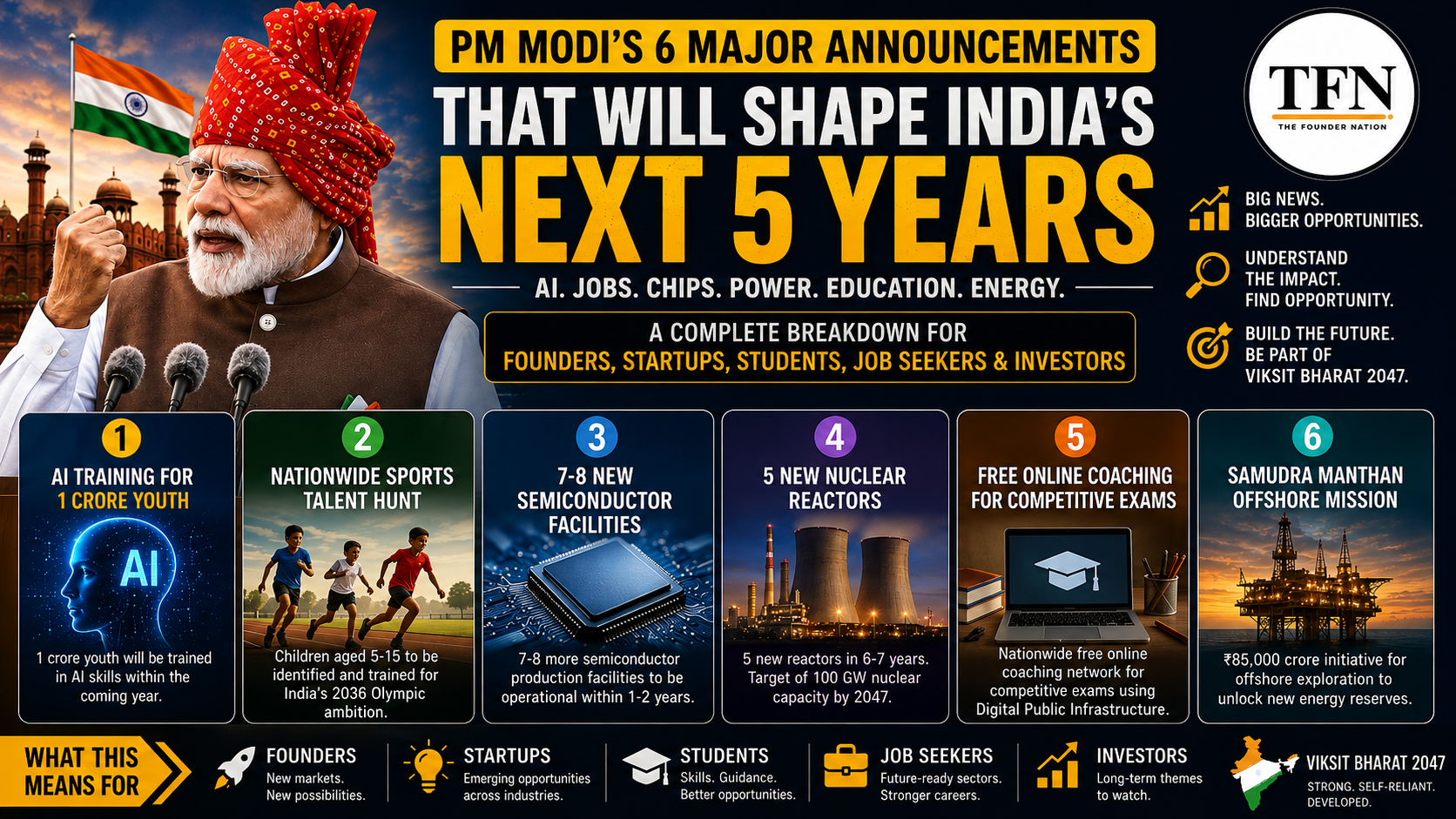
PM Modi Independence Day 2026 brought six major announcements that could have significant implications for India’s jobs, startups, technology, education and energy sectors. From training 1 crore youth in Artificial Intelligence to expanding semiconductor manufacturing, nuclear power, competitive-exam coaching and offshore exploration, Prime Minister Narendra Modi’s 80th Independence Day address outlined several initiatives connected to India’s broader Viksit Bharat 2047 vision.
The announcements span some of the most important areas of India’s future economy — AI, human capital, sports, semiconductors, nuclear energy, education and energy security.
For students, the announcements could influence the skills they need to develop. For job seekers, they offer clues about emerging industries. For founders and MSMEs, they could create new markets and supply-chain opportunities. And for investors, they provide several long-term themes worth watching.
Official PM India Independence Day 2026 Address
Here’s what was announced, what is confirmed, what still needs implementation, and what it could mean for India’s next decade.
AI. Jobs. Sports. Semiconductors. Nuclear Energy. Oil.
If you’re looking for a job, building a startup, studying for competitive exams, working in technology, running a business, or investing in India’s growth story, Prime Minister Narendra Modi’s 80th Independence Day speech from the Red Fort had several announcements worth paying attention to.
On 15 August 2026, PM Modi addressed the nation from the Red Fort and outlined a broad roadmap toward Viksit Bharat 2047, with major emphasis on youth, technology, manufacturing, energy security, education, sports and self-reliance.
Among the announcements were plans to:
- Train 1 crore Indian youth in Artificial Intelligence
- Launch a nationwide sports talent hunt for children aged 5–15
- Operationalise 7–8 more semiconductor production facilities within 1–2 years
- Bring 5 new nuclear reactors online within 6–7 years and target 100 GW of nuclear capacity by 2047
- Build a nationwide free online coaching network for competitive examinations
- Expand offshore oil and gas exploration through the ₹85,000 crore Samudra Manthan initiative
But the more important question isn’t simply:
“What did Modi announce?”
It’s:
“What could these announcements mean for your career, startup, business and investment decisions over the next 5–10 years?”
That’s what this resource breaks down.
Last Updated: 16 August 2026
The Big Picture: India Is Betting on Six Engines
Taken together, these announcements reveal a broader strategy.
The government is trying to build capabilities across:
🧠 Human Capital
AI skills + competitive exam preparation
🏅 Sports Capital
Grassroots talent identification
💻 Technology Infrastructure
Semiconductor manufacturing
⚡ Energy Security
Nuclear power + offshore oil and gas
These aren’t six completely separate announcements.
They connect to a much larger objective:
Viksit Bharat 2047
PM Modi reiterated the goal of making India a developed nation by 2047, the 100th year of independence, while emphasizing self-reliance and domestic capabilities.
The government’s stated direction is increasingly about moving from:
Consumer → Creator
Importer → Manufacturer
Talent → Skilled Talent
Technology User → Technology Developer
Energy Importer → Energy-Secure Economy
The real impact will depend on implementation.
1. 1 Crore Indian Youth to Be Trained in AI
India’s AI race just got a massive human-capital push.
One of the biggest announcements from the Red Fort was the government’s plan to train 1 crore youth in Artificial Intelligence skills within the coming year.
PM Modi explicitly said the objective is to equip Indian youth with the capability to lead in the global AI economy.
This is particularly significant because India isn’t only competing to build AI models.
It is competing to build the people who will use, deploy, commercialise and build AI systems.
What Does “1 Crore AI-Skilled Youth” Mean?
1 crore means:
10,000,000 people.
That’s an enormous potential talent pool.
For context, the government has already been expanding AI skilling efforts. A PIB publication in late 2025 said the IndiaAI Mission was designed to train one crore youth in AI while also developing national compute infrastructure, indigenous AI models and responsible AI capabilities.
The Independence Day announcement now puts a much sharper timeline around the youth-skilling objective.
What Could This Mean for Students?
If you’re a student, AI is increasingly moving from:
“Nice skill to have”
to
“Baseline career skill.”
You don’t necessarily need to become an AI researcher.
You may need to understand how AI applies to your field.
Engineering
AI + software development
Law
AI + legal research
Finance
AI + financial analysis
Marketing
AI + content + analytics
Design
AI + creative workflows
Healthcare
AI + diagnostics + health systems
Manufacturing
AI + robotics + automation
Entrepreneurship
AI + product development + distribution
The biggest opportunity may therefore not be:
AI replacing every job.
It may be:
People who know how to work with AI becoming significantly more productive than people who don’t.
What Could This Mean for Startups?
A large AI-trained workforce creates several potential opportunities.
AI Education
Platforms teaching practical AI skills.
AI Productivity
Tools that help professionals use AI in their existing jobs.
AI Agents
Vertical AI agents for specific industries.
AI Infrastructure
Data, compute, security, evaluation and deployment.
AI Adoption
Businesses helping traditional SMEs implement AI.
AI Assessment
Tools that evaluate AI literacy and workplace readiness.
AI Recruitment
Platforms connecting AI-skilled talent with employers.
Founder Opportunity
Imagine a country with:
1 crore newly AI-skilled people
and millions of businesses that still haven’t figured out how to implement AI.
The opportunity isn’t just building another chatbot.
The bigger opportunity could be:
Helping Indian businesses actually use AI.
That means:
AI + MSMEs
AI + Healthcare
AI + Education
AI + Legal
AI + Finance
AI + Manufacturing
AI + Agriculture
AI + Government
⚠️ Important: Is the AI Training Free?
This distinction matters.
The Prime Minister’s official speech announced the target of training 1 crore youth in AI skills, but the speech itself does not explicitly state that every participant will receive free AI training.
Therefore, don’t interpret the announcement as:
“Every Indian can immediately sign up for a completely free AI course.”
The actual delivery mechanism, curriculum, eligibility and participating institutions will need to be clarified through implementing programmes.
2. Nationwide Sports Talent Hunt for Children Aged 5–15
India’s 2036 Olympic ambition starts much earlier than 2036.
PM Modi also announced a nationwide sports talent hunt targeting children aged 5 to 15.
The stated objective is to identify sporting talent at the grassroots level and provide special training so that promising children can develop into athletes capable of competing at the highest levels.
This is connected to India’s ambition to host the 2036 Olympics.
Important:
India is currently a strong contender / candidate to host the 2036 Olympics.
Hosting has not yet been confirmed.
The Prime Minister’s speech referred to India’s strong candidacy and the country’s efforts to prepare for the opportunity.
Why Start at 5 Years Old?
Because elite sports development takes time.
A world-class athlete isn’t created in six months.
The pathway can involve:
Talent identification
↓
Training
↓
District-level competition
↓
State-level competition
↓
National competition
↓
International exposure
↓
Elite performance
↓
Olympics
That means the children identified today could potentially become the athletes representing India a decade or more from now.
What Could This Mean for the Sports Industry?
A nationwide talent-identification system could create opportunities beyond athletes.
Think:
Sports Technology
- Performance analytics
- Wearables
- AI scouting
- Video analysis
- Biomechanics
Sports Education
- Coaching platforms
- Online training
- Athlete development
Sports Infrastructure
- Training centres
- Academies
- Sports facilities
Sports Nutrition
- Performance nutrition
- Recovery
Sports Medicine
- Physiotherapy
- Injury prevention
- Rehabilitation
Sports Data
- Athlete tracking
- Performance databases
- Scouting platforms
Sports Media
- Youth sports content
- Grassroots competitions
- Athlete storytelling
Founder Opportunity
India has historically had a massive sporting population but a relatively limited elite athlete pipeline.
A systematic national talent hunt creates a potentially large ecosystem around:
Discover → Measure → Train → Track → Develop
That could become an interesting startup opportunity.
3. 7–8 New Semiconductor Production Facilities in 1–2 Years
India’s semiconductor ambitions just got another timeline.
PM Modi announced that:
7–8 additional semiconductor production facilities
are expected to become operational within:
1–2 years.
He also stated that three domestic semiconductor plants are already operational and exporting chips to global markets.
This is one of the most strategically important announcements for India’s technology and manufacturing ecosystem.
India Semiconductor Mission – Official Website
Why Do Semiconductors Matter?
Almost every modern industry depends on chips.
Think:
📱 Smartphones
🚗 Automobiles
✈️ Aerospace
🛰️ Satellites
🛡️ Defence
🏭 Industrial machinery
🏥 Medical equipment
💳 Payment systems
📡 Telecommunications
🤖 Artificial intelligence
Semiconductors are essentially the building blocks of modern digital infrastructure.
India’s Semiconductor Mission
India has been building a semiconductor ecosystem through the India Semiconductor Mission, which was approved with a ₹76,000 crore outlay.
Government material has highlighted the growth of semiconductor manufacturing and design facilities and said that approved projects under the mission had reached 10 projects with cumulative investments of around ₹1.60 lakh crore across six states by 2025.
The 2026 Independence Day announcement now points toward another significant expansion in production capacity.
What Does This Mean for Indian Businesses?
The obvious answer is:
More chip manufacturing.
But the bigger opportunity is the ecosystem around the factories.
A semiconductor ecosystem requires:
- Equipment
- Materials
- Chemicals
- Testing
- Packaging
- Design
- Software
- Logistics
- Clean-room technology
- Power
- Water management
- Industrial automation
- Quality control
- Talent
- Supply-chain management
This is where startups could potentially benefit.
Semiconductor Startup Opportunities
Chip Design
India already has significant chip-design talent.
Potential opportunities include:
- ASIC design
- Verification
- EDA tools
- IP
- RISC-V
- Embedded systems
Semiconductor Testing
As manufacturing expands, testing and validation become increasingly important.
Packaging
Advanced packaging is becoming strategically important globally.
Industrial Automation
Semiconductor plants require highly automated production systems.
Supply Chain
Domestic manufacturing creates demand for:
- Logistics
- Procurement
- Inventory
- Vendor management
- Quality systems
What Could This Mean for Jobs?
The semiconductor industry doesn’t only create jobs inside semiconductor factories.
It creates an ecosystem of:
Engineers + technicians + operators + researchers + designers + supply-chain professionals + software developers + business professionals.
The result could be a much broader technology-manufacturing employment ecosystem.
4. 100 GW Nuclear Energy by 2047
India’s energy demand is going to explode.
And AI, manufacturing, data centres, EVs and digital infrastructure will only increase electricity demand.
That’s why nuclear energy is becoming a much bigger part of India’s long-term energy strategy.
PM Modi announced from the Red Fort:
100 GW nuclear capacity by 2047
and:
5 new reactors operational within 6–7 years.
He also linked the expansion to indigenous fast-breeder technology and energy self-reliance.
This Isn’t a Completely New Target
India’s Department of Atomic Energy says the Nuclear Energy Mission for Viksit Bharat, launched in January 2025, targets 100 GW of nuclear capacity by 2047.
So the Independence Day announcement reinforces and accelerates an already established strategic direction.
Why Does Nuclear Energy Matter for Startups?
Because electricity isn’t just a household issue.
It’s an economic input.
Modern industries require enormous amounts of reliable power.
Especially:
AI Data Centres
AI workloads require massive computing power.
Semiconductor Manufacturing
Chip fabs require highly reliable electricity.
Manufacturing
Factories need continuous power.
EV Infrastructure
Charging infrastructure increases electricity demand.
Green Hydrogen
Electrolysis requires large amounts of electricity.
Digital Infrastructure
Data centres and cloud infrastructure are energy intensive.
The Nuclear Ecosystem Opportunity
The opportunity isn’t simply:
“Build nuclear reactors.”
That’s obviously a highly regulated and specialised domain.
The broader ecosystem includes:
- Engineering
- Components
- Industrial automation
- Safety systems
- Materials
- Sensors
- Monitoring
- Maintenance
- Simulation
- Robotics
- Cybersecurity
- Waste management
- Infrastructure
- Construction technology
The government has also been working to increase industry participation in the nuclear ecosystem.
The Department of Atomic Energy held an Industry Consultation on the Nuclear Energy Roadmap in May 2026, specifically discussing industry participation, the SHANTI Act and collaboration between government and industry.
Department of Atomic Energy – Government of India
Could Nuclear Power Make Electricity Cheaper?
Potentially — but don’t treat this announcement as a promise that electricity bills will immediately fall.
Nuclear power can provide reliable, large-scale electricity, but the eventual effect on consumer and industrial electricity prices depends on:
- Construction cost
- Financing
- Project timelines
- Capacity utilisation
- Transmission
- Regulation
- Fuel availability
- Power-market structure
- State-level tariffs
So the correct interpretation is:
India is trying to build a much larger reliable domestic power base.
The economic effects will depend on execution.
DAE Nuclear Energy Roadmap Industry Consultation
5. Free Online Coaching for Competitive Exams
This could be one of the biggest announcements for students and middle-class families.
Competitive exam preparation can become extremely expensive.
Students preparing for:
- UPSC
- SSC
- Banking
- JEE
- NEET
- Other government and professional examinations
often spend significant amounts on:
- Coaching
- Accommodation
- Travel
- Test series
- Study material
- Mentorship
PM Modi announced a nationwide Free Online Coaching network that will use Digital Public Infrastructure and teachers to provide free coaching resources to youth preparing for competitive examinations.
Why This Matters
The announcement is essentially about reducing the:
“Cost of opportunity”
for students.
A student shouldn’t necessarily need to move to:
Delhi
Kota
Hyderabad
Pune
or another coaching hub
just to access high-quality preparation.
Online infrastructure can potentially bring preparation closer to the student.
What Could This Mean for EdTech?
This is an interesting development.
The Government isn’t simply saying:
“Education should be free.”
It’s talking about building a national digital coaching network using teachers and Digital Public Infrastructure.
That could create opportunities for private companies around the edges.
EdTech Infrastructure
- LMS platforms
- Assessment systems
- AI tutors
- Test platforms
Content
- Question banks
- Simulations
- Adaptive learning
AI
- Personalised tutoring
- Doubt resolution
- Performance analysis
Accessibility
- Indian-language education
- Speech-based learning
- Offline-first education
But What About Existing EdTech Companies?
This could be both:
An opportunity
and
A disruption.
Free government-supported educational infrastructure can increase access but also create competition for private players.
Companies may need to differentiate through:
- Better personalisation
- Premium mentorship
- Outcomes
- Specialised courses
- Advanced analytics
- Community
- International opportunities
6. Deep Water Mission: Exploring Oil & Gas Offshore
India’s energy independence isn’t only about nuclear power.
The sixth announcement focuses on something much older:
Oil and gas.
But this time:
Under the sea.
PM Modi announced a major expansion of offshore exploration through the Samudra Manthan initiative.
The government plans to open up large offshore areas for exploration and has announced an initiative involving approximately:
₹85,000 crore
to explore new energy reserves.
PM Modi said that 99% of India’s coastline previously classified as a “No-Go Area” had been moved toward a “Go Ahead Area” for exploration.
Why Does Offshore Oil Matter?
India remains heavily dependent on imported crude oil.
Therefore, discovering and developing commercially viable domestic reserves could potentially:
- Reduce import dependence
- Improve energy security
- Reduce exposure to global oil shocks
- Strengthen the domestic energy ecosystem
- Create demand for offshore services
- Generate industrial activity
But:
Exploration ≠ guaranteed oil discovery.
And:
Discovery ≠ immediate production.
There are several steps between:
Exploration
↓
Discovery
↓
Appraisal
↓
Commercial viability
↓
Development
↓
Production
So don’t interpret the announcement as:
“India has discovered enough oil to eliminate imports.”
It is an aggressive exploration and energy-security push.
What Could This Mean for Businesses?
Offshore exploration can create demand for:
- Marine technology
- Offshore engineering
- Robotics
- Sensors
- Geospatial technology
- AI-based exploration
- Data analytics
- Environmental monitoring
- Logistics
- Shipbuilding
- Underwater inspection
- Safety systems
This is another example of how a large government infrastructure programme can create opportunities beyond the obvious headline sector.
🧩 The Bigger Connection: These Six Announcements Are Linked
At first glance:
AI
Sports
Semiconductors
Nuclear
Education
Oil
look completely unrelated.
They’re not.
They represent six different layers of economic development.
| Announcement | What It Builds |
|---|---|
| AI training | Human capital |
| Sports talent hunt | Human potential |
| Semiconductor manufacturing | Technology infrastructure |
| Nuclear expansion | Reliable energy |
| Free online coaching | Education access |
| Deep Water Mission | Energy security |
Together, they support a larger goal:
Build India’s capabilities domestically.
What Does This Mean for Startups?
This is probably the most important section for founders.
Government announcements of this scale can create what investors call:
“Second-order opportunities.”
The government may build the infrastructure.
Startups build on top of it.
AI
Government:
Train 1 crore people.
Startup opportunity:
Build tools for those people.
Potential sectors:
- AI education
- AI recruitment
- AI productivity
- AI agents
- AI assessment
- AI implementation
- AI infrastructure
Semiconductors
Government:
Build manufacturing capacity.
Startup opportunity:
- Chip design
- Testing
- Packaging
- Industrial automation
- Supply-chain software
- Semiconductor equipment
- Materials
- Workforce training
Nuclear
Government:
Expand nuclear capacity.
Startup opportunity:
- Sensors
- Robotics
- Inspection
- Cybersecurity
- Industrial software
- Predictive maintenance
- Engineering
- Components
Sports
Government:
Identify millions of young athletes.
Startup opportunity:
- Sports analytics
- Athlete tracking
- Coaching
- Performance monitoring
- Sports medicine
- Talent scouting
- Sports infrastructure
Education
Government:
Free online competitive-exam coaching.
Startup opportunity:
- AI tutors
- Assessment
- Personalisation
- Regional languages
- Test analytics
- Learning management systems
Deep Water
Government:
Expand offshore exploration.
Startup opportunity:
- Ocean technology
- Underwater robotics
- Sensors
- Geospatial analytics
- Marine logistics
- Exploration software
- Environmental monitoring
💰 What Does This Mean for Investors?
If you’re an investor, don’t simply look at the headline.
Look at the:
Supply Chain.
For every major government-led sector, ask:
Who supplies the infrastructure?
Who supplies the technology?
Who provides services?
Who maintains it?
Who digitises it?
Who trains the workforce?
Who creates the software layer?
Who becomes the private-sector platform?
This is where many venture-scale opportunities emerge.
Six Potential Investment Themes to Watch
1. AI & Human Capital
Watch:
- AI education
- AI-native SaaS
- AI agents
- AI infrastructure
- AI cybersecurity
2. Semiconductor Ecosystem
Watch:
- Chip design
- Semiconductor equipment
- Testing
- Packaging
- EDA
- Industrial automation
3. Energy Technology
Watch:
- Nuclear supply chains
- Energy storage
- Grid technology
- Power electronics
- Industrial energy efficiency
4. SportsTech
Watch:
- Talent identification
- Athlete analytics
- Wearables
- Coaching
- Sports medicine
5. Education Technology
Watch:
- AI tutoring
- Assessment
- Indian-language learning
- Competitive-exam technology
- Personalised education
6. Ocean & Energy Technology
Watch:
- Offshore exploration
- Underwater robotics
- Marine technology
- Geospatial intelligence
- Energy services
What Does This Mean for Job Seekers?
If you’re looking for a job, don’t just search:
“Which companies are hiring?”
Search:
“Which industries are about to receive massive capital, infrastructure and policy attention?”
That’s a much more powerful question.
Based on the six announcements, some areas worth watching include:
AI
Learn:
- AI tools
- Machine learning
- Data
- AI agents
- Prompt engineering
- AI implementation
Semiconductor
Learn:
- VLSI
- Chip design
- Embedded systems
- Electronics
- Semiconductor manufacturing
Energy
Learn:
- Power systems
- Nuclear engineering
- Renewable energy
- Energy storage
- Grid technology
Sports
Learn:
- Sports science
- Analytics
- Coaching
- Sports technology
Education
Learn:
- EdTech
- AI tutoring
- Instructional design
- Learning analytics
Ocean Technology
Learn:
- Marine engineering
- Geospatial technology
- Robotics
- Remote sensing
What Does This Mean for Students?
The strongest signal from this Independence Day speech is:
Skills are becoming strategic infrastructure.
The government isn’t only talking about jobs.
It’s talking about creating the talent required for future industries.
If you’re a student today, the question isn’t:
“Which degree guarantees a job?”
It’s increasingly:
“Which skills will be valuable when I graduate?”
That could mean combining your existing degree with:
AI + Law
AI + Finance
AI + Marketing
AI + Healthcare
AI + Engineering
AI + Manufacturing
AI + Design
The combination can become more valuable than either skill alone.
What Does This Mean for MSMEs?
This is another important angle.
Large national programmes eventually create demand for thousands of smaller businesses.
For example:
Semiconductor ecosystem
→ Suppliers
→ Logistics
→ Maintenance
→ Components
→ Software
→ Technical staffing
Nuclear ecosystem
→ Engineering
→ Components
→ Maintenance
→ Safety
→ Monitoring
Sports ecosystem
→ Equipment
→ Training
→ Facilities
→ Analytics
AI ecosystem
→ Implementation
→ Training
→ SaaS
→ Automation
This means MSMEs shouldn’t only watch government schemes.
They should watch:
Government spending + emerging supply chains.
What This Means for India’s Startup Ecosystem
India already has a large startup ecosystem.
PM Modi said during the speech that India now has around 2.5 lakh registered startup entities, while highlighting resources including the ₹1 lakh crore Research and Innovation Fund and programmes such as Startup India, Skill India, Khelo India and the National Drone Policy.
The next phase could increasingly be about startups building around:
DeepTech
AI
Semiconductor
Defence
Space
Energy
Climate
Manufacturing
Robotics
Ocean technology
This is a very different startup environment from the previous decade’s dominant consumer-internet narrative.
🔍 Announcement vs Implementation
This is perhaps the most important section of the entire article.
A government announcement is:
A policy signal.
It is not automatically a completed project.
There are multiple steps between:
Announcement
↓
Policy / Budget
↓
Scheme / Programme
↓
Implementation mechanism
↓
Tender / Allocation
↓
Execution
↓
Outcomes
Therefore, founders and investors should treat these announcements as:
Signals of direction.
Not guaranteed returns.
What We Know vs What We Don’t Know Yet
| Announcement | What Is Clearly Announced | What Needs Further Details |
|---|---|---|
| AI | 1 crore youth to be trained in AI within coming year | Exact curriculum, eligibility, delivery and implementation |
| Sports | Nationwide talent hunt for ages 5–15 | Exact selection structure, sports covered and rollout |
| Semiconductors | 7–8 facilities targeted within 1–2 years | Individual facilities, timelines and production details |
| Nuclear | 5 reactors in 6–7 years; 100 GW by 2047 | Project-level timelines, financing and execution |
| Free Coaching | Nationwide free online competitive-exam coaching network | Platforms, exams, eligibility and rollout |
| Deep Water | ₹85,000 crore Samudra Manthan initiative and expanded offshore exploration | Specific discoveries, production timelines and commercial outcomes |
This distinction is important for responsible reporting.
The Founder Takeaway
If you’re a founder, don’t read these six announcements as:
“The government is doing six things.”
Read them as:
“Six large markets may be changing.”
Your job is to ask:
What new demand will this create?
What infrastructure will be required?
What problems will emerge?
Which businesses will need solutions?
What can startups build?
Where will talent shortages appear?
What will become cheaper?
What will become more accessible?
Which industries will grow?
That’s where the founder opportunity is.
The Six Announcements in One Chart
🧠 AI
1 crore youth
↓
AI-skilled workforce
🏅 Sports
5–15 age group
↓
Talent identification
↓
2036 Olympic ambition
💻 Semiconductors
7–8 facilities
↓
Domestic chip ecosystem
⚛️ Nuclear
5 reactors in 6–7 years
↓
100 GW by 2047
📚 Education
Free online coaching
↓
Lower access barriers
🌊 Deep Water
₹85,000 crore initiative
↓
Offshore exploration
↓
Energy security
What Could the Next 5 Years Look Like?
If these initiatives are implemented effectively, India could see simultaneous growth in:
AI
Manufacturing
Semiconductors
Energy
Education
Sports
DeepTech
Defence
Infrastructure
Ocean economy
And that is why these announcements matter beyond the headlines.
They aren’t six isolated news stories.
They potentially represent six directions of India’s economic and technological transition.
Frequently Asked Questions
What did PM Modi announce on Independence Day 2026?
Among the major announcements were AI training for 1 crore youth, a nationwide sports talent hunt for children aged 5–15, 7–8 new semiconductor production facilities within 1–2 years, five new nuclear reactors within 6–7 years with a 100 GW nuclear-capacity target by 2047, free online coaching for competitive examinations, and the Samudra Manthan offshore exploration initiative.
How many youth will be trained in AI?
PM Modi announced that the government will work to train 1 crore youth in AI skills within the coming year.
Is the AI training completely free?
The Prime Minister announced the target of training 1 crore youth in AI, but the official Independence Day speech does not itself specify that every participant will receive free training. Details on the implementation mechanism, eligibility and delivery are expected to clarify how the programme will work.
What age group is covered by the sports talent hunt?
The nationwide sports talent hunt announced by PM Modi targets children aged 5 to 15 years.
Is India hosting the 2036 Olympics?
India is pursuing a bid to host the 2036 Olympics and PM Modi described India as a strong contender, but hosting has not been confirmed.
How many semiconductor plants will India add?
PM Modi announced that 7 to 8 new semiconductor production facilities are expected to become operational within the next 1 to 2 years. He also stated that three domestic plants are already operational and exporting chips.
What is India’s nuclear energy target for 2047?
India has set a target of 100 GW of nuclear power capacity by 2047. PM Modi also announced that five new reactors are expected to become operational within six to seven years.
What is the Samudra Manthan initiative?
Samudra Manthan is the offshore oil and gas exploration push announced by PM Modi, backed by an approximately ₹85,000 crore initiative aimed at exploring India’s offshore energy resources.
What is the free online coaching announcement?
PM Modi announced the creation of a nationwide network providing free online coaching for competitive examinations, using Digital Public Infrastructure and teachers to expand access to preparation resources.
Which industries could benefit from these announcements?
Potentially affected sectors include:
- Artificial intelligence
- Semiconductors
- Electronics
- Manufacturing
- Nuclear energy
- Power infrastructure
- Education technology
- Sports technology
- Defence technology
- Ocean technology
- Robotics
- Logistics
- DeepTech
The actual commercial impact will depend on implementation and private-sector participation.
What does this mean for startups?
These announcements could create opportunities in the supply chains and technology ecosystems around AI, semiconductors, energy, sports, education and offshore exploration.
Founders should look beyond the headline programme and identify the second-order problems created by large-scale infrastructure and policy changes.
What does this mean for job seekers?
Job seekers should watch sectors receiving increased policy attention and build relevant skills in areas such as AI, semiconductor technology, electronics, energy, robotics, data, education technology and industrial technology.
Should investors invest based on these announcements?
No investment decision should be based solely on a government announcement.
Investors should evaluate:
- Company fundamentals
- Valuation
- Revenue
- Growth
- Unit economics
- Competitive advantage
- Policy execution
- Market size
- Regulatory risk
- Project timelines
These announcements are best viewed as long-term policy and market signals, not guaranteed investment returns.
The Bottom Line
The six announcements can be summarised in six words:
AI. Talent. Chips. Power. Education. Energy.
And behind each one is a potential economic ecosystem.
For students:
Skills.
For job seekers:
New industries.
For founders:
New markets.
For MSMEs:
New supply chains.
For investors:
New themes to research.
For India:
A push toward greater technological, industrial and energy self-reliance.
But announcements are only the beginning.
The real story will be implementation.
And that’s what we should be watching next.
What Founders Should Do Next
Don’t just save this article.
Use it.
Pick one of these six themes and ask:
1. What problem is being created?
2. Who will pay to solve it?
3. How large is the market?
4. What infrastructure already exists?
5. What is still missing?
6. Can a startup solve that gap?
Because the biggest startup opportunities often don’t come from the announcement itself.
They come from:
Everything the announcement makes necessary.
📲 Follow Rajyavardhan
I regularly break down:
AI tools • Startup opportunities • Government initiatives • VC funding • Business trends • Founder resources
Follow @rajyavardhanbhandari for more.
And if you know a founder, student or job seeker who should understand these announcements:
Share this resource with them.
🇮🇳 More Resources from The Founder Nation
Explore more practical resources for founders, students and entrepreneurs:
- Government Schemes for Startups
- Startup Funding Opportunities
- Early-Stage VCs in India
- AI Tools for Founders
- Founder Content Ideas
- Startup Resources
- Business Opportunities
- Student Resources
Explore The Founder Nation
Sources & Further Reading
The primary source for this resource is the official Prime Minister’s Independence Day address from the Red Fort on 15 August 2026.
For additional context on India’s nuclear roadmap, the Department of Atomic Energy has stated that the Nuclear Energy Mission for Viksit Bharat targets 100 GW of nuclear capacity by 2047.
For context on India’s AI skilling ecosystem, PIB has previously described the IndiaAI Mission as including a target to train one crore youth in AI alongside compute infrastructure and indigenous AI development.
For semiconductor context, government material has described the India Semiconductor Mission’s ₹76,000 crore outlay and the expansion of approved semiconductor projects.
Disclaimer
This resource is intended for informational and educational purposes.
The article distinguishes between announced targets, existing government programmes and potential economic implications. An announcement or target does not guarantee implementation, commercial success, job creation, investment returns or lower consumer prices.
Statements about potential startup, career or investment opportunities are analytical interpretations and should not be treated as financial or investment advice.
Readers should verify the latest official scheme guidelines, eligibility criteria, implementation details and timelines before making financial, career or business decisions.
The Founder Nation is an independent media and resource platform and is not a government agency.