

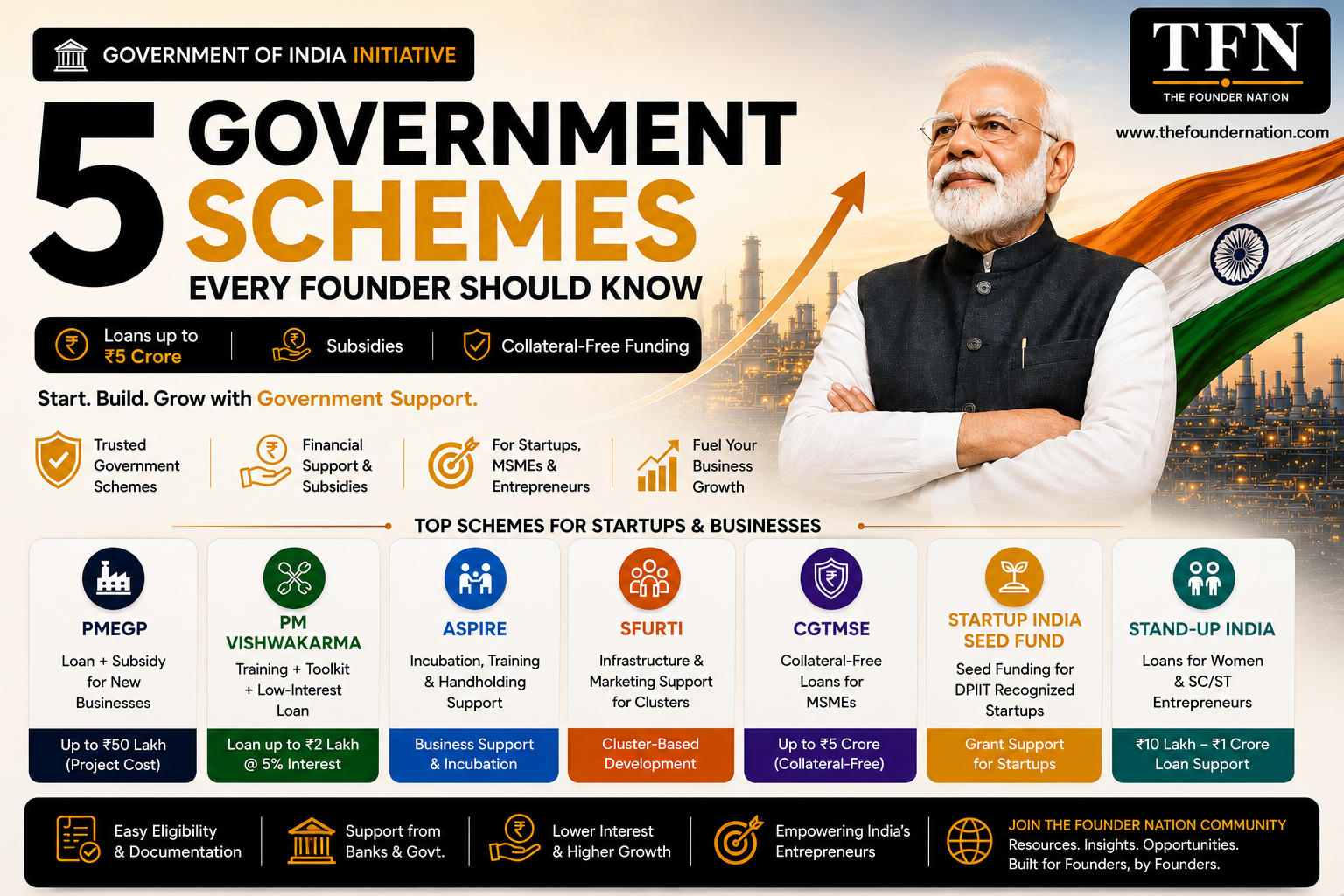
An infographic explaining the top Government of India schemes for startups, MSMEs, and entrepreneurs, including PMEGP, PM Vishwakarma, ASPIRE, SFURTI, CGTMSE, Startup India Seed Fund, and Stand-Up India.
Looking to start a business but worried about funding?
Sometimes, your first investor can be the Government of India.
What if we told you that the Government of India offers collateral-free loans, subsidies, incubation support, training, infrastructure, and even funding of up to ₹5 crore through various schemes?
The problem is that most aspiring entrepreneurs never hear about these opportunities. Banks rarely explain them in detail, and many founders assume they’re only meant for large companies.
That’s simply not true.
Whether you’re a first-time entrepreneur, MSME owner, artisan, or startup founder, this guide will help you understand some of the most valuable government schemes available today.
In this guide, we’ve broken down five of the most useful government schemes every founder should know—explained in simple language.
From collateral-free loans and subsidies to incubation support and startup grants, these government-backed schemes can help you launch and scale your business with significantly lower financial risk.
1. PMEGP (Prime Minister’s Employment Generation Programme)
What is PMEGP?
PMEGP is one of the Government of India’s flagship employment generation programmes that supports first-generation entrepreneurs in setting up new micro-enterprises in manufacturing and service sectors. It is implemented through the Khadi and Village Industries Commission (KVIC), State KVIBs, District Industries Centres (DICs), and participating banks.
Key Highlights
- Manufacturing projects up to ₹50 lakh
- Service projects up to ₹20 lakh
- Government subsidy ranging from 15% to 35%
- Available across urban and rural India
- Suitable for first-time entrepreneurs
Official Portal : PMEGP Portal
2. PM Vishwakarma
PM Vishwakarma supports traditional artisans and craftspeople by combining skill development, toolkit incentives, marketing support, and affordable credit. Eligible beneficiaries can receive enterprise development loans up to ₹2 lakh at concessional rates alongside training and digital incentives.
Ideal For
- Carpenter
- Tailor
- Potter
- Blacksmith
- Goldsmith
- Mason
- Cobbler
- Sculptor
- Traditional artisans
Official Portal : PM Vishwakarma Portal
3. ASPIRE Scheme
ASPIRE (A Scheme for Promotion of Innovation, Rural Industry and Entrepreneurship) focuses on creating entrepreneurship through incubation, innovation, training, and rural enterprise development. It has supported numerous Livelihood Business Incubators and skilled over one lakh beneficiaries.
Best For
- Rural entrepreneurs
- Food processing
- Agriculture
- AgriTech
- Village industries
Official Portal : ASPIRE Portal
4. SFURTI
SFURTI (Scheme of Fund for Regeneration of Traditional Industries) develops entire clusters rather than supporting only one business. It focuses on improving infrastructure, common facilities, branding, packaging, and market access for traditional industries such as khadi, bamboo, coir, and handicrafts.
Best For
- Khadi
- Bamboo
- Coir
- Handicrafts
- Honey
- Village industries
5. CGTMSE
One of the most useful schemes for startups and MSMEs.
CGTMSE enables eligible businesses to obtain collateral-free loans up to ₹5 crore, with the government-backed trust providing a credit guarantee to lending institutions. This reduces the need for borrowers to pledge personal assets.
Best For
- Manufacturing
- Service Businesses
- Existing MSMEs
- Business Expansion
Official Website : CGTMSE
🎁Bonus Scheme 1 — Startup India Seed Fund Scheme (SISFS)
If you’re building an innovative startup rather than a traditional business, this scheme deserves your attention.
The Startup India Seed Fund Scheme provides financial assistance for proof of concept, prototype development, product trials, market entry, and commercialization. It is intended for eligible DPIIT-recognized startups.
Best For
- Tech startups
- SaaS
- AI startups
- DeepTech
- HealthTech
- FinTech
- ClimateTech
Official Portal : Startup India Seed Fund Scheme
🎁Bonus Scheme 2 — Stand-Up India
Stand-Up India encourages entrepreneurship among women entrepreneurs and SC/ST entrepreneurs by facilitating bank loans ranging from ₹10 lakh to ₹1 crore for setting up greenfield enterprises in manufacturing, services, trading, and agriculture-allied activities.
Best For
- Women founders
- SC entrepreneurs
- ST entrepreneurs
Official Website : Stand-Up India
Some of the most popular Government schemes for startups and entrepreneurs in India include PMEGP, PM Vishwakarma, ASPIRE, SFURTI, CGTMSE, Startup India Seed Fund Scheme (SISFS), and Stand-Up India. These schemes provide financial assistance, collateral-free loans, subsidies, incubation support, training, and mentoring depending on your business type and eligibility.
Yes. Under the CGTMSE (Credit Guarantee Fund Trust for Micro and Small Enterprises) scheme, eligible MSMEs can avail collateral-free loans of up to ₹5 crore from participating financial institutions. Approval depends on the lender’s assessment and scheme guidelines.
PMEGP (Prime Minister’s Employment Generation Programme) is one of the best schemes for first-time entrepreneurs. It provides financial assistance for setting up manufacturing and service businesses along with a Government subsidy on eligible project costs.
PMEGP (Prime Minister’s Employment Generation Programme) is a flagship Government scheme that supports new entrepreneurs through bank loans combined with Government subsidies. It aims to generate self-employment opportunities across manufacturing and service sectors.
Eligible MSMEs can obtain collateral-free credit facilities with support under the CGTMSE framework, subject to the prevailing scheme limits and lending institution policies. Always verify the latest limit and eligibility criteria on the official CGTMSE website before applying.
The Startup India Seed Fund Scheme (SISFS) helps eligible DPIIT-recognized startups with financial support for proof of concept, prototype development, product trials, market entry, and commercialization through selected incubators.
PM Vishwakarma is designed for traditional artisans and craftspeople such as carpenters, tailors, potters, blacksmiths, goldsmiths, cobblers, masons, sculptors, and several other notified trades. Eligible applicants can receive skill training, toolkit support, and concessional loans.
The required documents vary by scheme but commonly include:
Aadhaar Card
PAN Card
Address Proof
Passport-size Photograph
Bank Account Details
Business Plan or Project Report
Udyam Registration (where applicable)
Business Registration Documents
Category Certificate (if applicable)
Always check the official scheme guidelines before applying.
Yes. Many Government schemes support both manufacturing and service-sector businesses, provided the applicant satisfies the respective eligibility criteria.
Yes. The Stand-Up India Scheme is specifically designed to encourage entrepreneurship among women as well as SC/ST entrepreneurs by facilitating bank loans for eligible greenfield enterprises.
No. Government schemes cover a wide range of sectors including manufacturing, services, agriculture, handicrafts, food processing, rural enterprises, traditional industries, and technology startups. Different schemes are designed for different business categories.
Yes. Certain schemes provide grants, subsidies, incubation support, or seed funding rather than traditional loans. The Startup India Seed Fund Scheme and several innovation-focused programs offer grant-based assistance to eligible startups.
To improve your chances:
Prepare a detailed business plan.
Maintain accurate financial records.
Submit complete documentation.
Apply through official Government portals or authorized banks.
Ensure you meet the eligibility requirements before applying.
In some cases, businesses may be eligible for multiple Government schemes depending on the objectives, eligibility criteria, and applicable guidelines. However, the availability of combined benefits varies by scheme, so applicants should review the official rules carefully.
Always apply through the official Government portals, participating banks, recognized incubators, or authorized implementing agencies. Avoid relying on unofficial intermediaries or websites that promise guaranteed approvals.
Most flagship schemes operate across India, although implementation, incentives, and eligibility may vary by state, district, category, or implementing agency.
Yes. Depending on the scheme and eligibility criteria, DPIIT-recognized startups may also be eligible to apply for other Government initiatives, including seed funding, incubation, MSME support, and sector-specific programs.
Government schemes are periodically revised to reflect policy changes, budget allocations, and updated eligibility conditions. Always refer to the official Government websites for the latest information before applying.
💡 Still Have Questions?
If you couldn’t find the answer you’re looking for, explore our other founder resources on The Founder Nation. We regularly publish practical guides on startup funding, Government schemes, AI tools, branding, marketing, legal compliance, and entrepreneurship to help founders build smarter.