
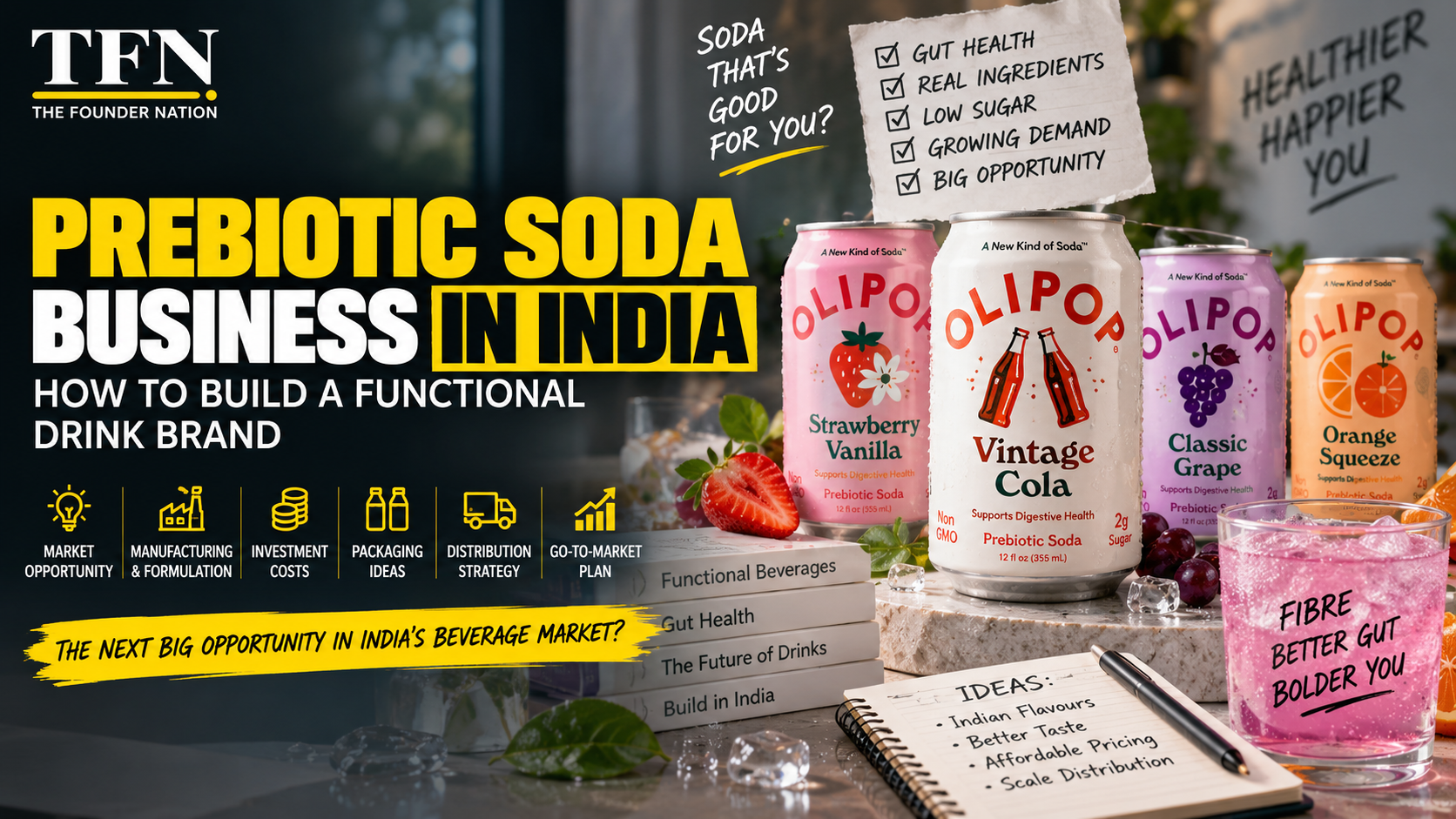
Prebiotic soda business in India: building a functional beverage brand with the right product, packaging and distribution.
Prebiotic Soda Business in India: How to Build a Functional Drink Brand
Prebiotic Soda Business in India: The OLIPOP Opportunity
The prebiotic soda business is becoming one of the most interesting opportunities in the functional beverage market. In the US, brands such as OLIPOP have shown that consumers can be sold a product that combines the familiarity of soda with functional ingredients such as prebiotic fibre.
OLIPOP raised $50 million in February 2025 at a $1.85 billion valuation, making it one of the most prominent examples of the functional soda category.
And the product itself is very different from a conventional soft drink. OLIPOP currently sells 6g and 9g fibre lines, with its formulations using ingredients such as cassava-root fibre, acacia fibre, guar fibre, chicory-root inulin and Jerusalem artichoke inulin depending on the product.
This creates an interesting question for Indian entrepreneurs:
Can the functional soda playbook be adapted for India?
The answer is potentially yes, but the opportunity is no longer about simply copying OLIPOP.
India already has emerging prebiotic soda brands, including Misfits, Enlite, SWICHH, EKOS and others.
The real opportunity is to build a product that combines Indian consumer preferences, local flavours, affordable pricing and credible functional positioning.
What Is a Prebiotic Soda?
A prebiotic soda is essentially a carbonated beverage that contains prebiotic ingredients, typically dietary fibres intended to serve as substrates for beneficial microorganisms in the gut.
OLIPOP describes its products as functional sodas containing plant fibres and prebiotics. Its current products contain between 6g and 9g of prebiotic fibre depending on the line.
This is different from a conventional soft drink.
A traditional soda might primarily sell:
Taste + refreshment + brand
A functional soda attempts to combine:
Taste + refreshment + functional nutrition + lifestyle positioning
That difference is where the business opportunity comes from.
Why Is the Functional Beverage Market Interesting in India?
India’s beverage market is changing.
Consumers are increasingly exposed to products positioned around:
- Protein
- Electrolytes
- Vitamins
- Probiotics
- Prebiotics
- Low sugar
- Zero added sugar
- Gut health
- Hydration
- Functional nutrition
Mintel’s 2026 India beverage research highlights the growing importance of wellbeing in non-alcoholic beverages and specifically identifies pro- and prebiotic claims as part of the “better-for-you” beverage trend.
Mintel’s 2025 functional food and drinks research similarly points to preventive healthcare and functional nutrition as important forces shaping the Indian market.
So the opportunity isn’t simply: “Indians want healthier Coke.”
The broader shift is: Consumers are increasingly looking for products that provide a reason to choose them beyond taste.
That creates room for functional beverages.
OLIPOP’s Business Model
The interesting part about OLIPOP isn’t only the recipe.
It’s the positioning.
Instead of selling a traditional health drink, OLIPOP essentially asks: What if soda could become a functional everyday beverage?
Its current product range combines familiar soda flavours with fibre and other functional ingredients. Its official site currently lists flavours such as Vintage Cola, Cream Soda, Ginger Ale, Lemon Lime, Root Beer and several fruit-forward variants.
The company also has different product formats.
Its current 9g fibre line is refrigerated, while its 6g fibre line is designed to be shelf-stable.
That is an important lesson for an Indian startup.
The business is not only about ingredients.
It is also about:
- Flavour
- Packaging
- Shelf life
- Distribution
- Pricing
- Refrigeration
- Brand identity
- Consumer education
The Biggest Opportunity for an Indian Founder
Do not copy OLIPOP’s can and put an Indian logo on it.
Instead, study the underlying consumer proposition.
OLIPOP effectively combines:
Familiar product category
Functional benefit
Modern branding
Premium positioning
Direct-to-consumer discovery
Retail distribution
That framework can be localized.
For India, a founder could experiment with flavours such as:
- Nimbu
- Masala cola
- Kokum
- Aam panna
- Jamun
- Ginger lime
- Orange
- Guava
- Kala khatta
- Mint
- Spiced lemon
The objective would be to make the product feel Indian without making it look medicinal.
But India Already Has Prebiotic Soda Brands
This is where the opportunity becomes more interesting.
Indian brands are already entering the category.
For example, Misfits markets a prebiotic soda with 7g of prebiotic fibre and 4g of sugar.
SWICHH markets a prebiotic soda containing 5g of prebiotic fibre, zero added sugar and added vitamins.
EKOS positions itself as an ACV-powered prebiotic “gut-reset” soda.
Enlite markets a prebiotic soda with 6g+ fibre and zero added sugar.
And recent launches continue to expand the category. Indian Retailer reported in August 2026 that Hadō launched a prebiotic soda range with 10g of plant-based prebiotic fibre and zero added sugar.
Therefore, the question is no longer:
“Can someone launch prebiotic soda in India?”
The question is:
“Can someone build the category-leading Indian functional soda brand?”
That is a much better business thesis.
What Would Make a New Brand Different?
A new founder needs a clear wedge.
There are several possibilities.
1. Indian flavours
Build around flavours that international brands don’t naturally own.
2. Lower price
Make functional soda affordable enough for regular consumption.
3. Better taste
This may sound obvious, but it is critical.
If the product tastes like a supplement, repeat purchase becomes difficult.
4. Higher fibre
Compete on a meaningful functional proposition, subject to regulatory and formulation requirements.
5. Clean-label positioning
Focus on ingredient transparency.
6. Youth culture
Position the product as a lifestyle beverage rather than a health supplement.
7. D2C-first distribution
Build an online community before investing heavily in offline distribution.
8. B2B distribution
Target:
- Gyms
- Cafés
- Premium grocery stores
- Corporate offices
- Restaurants
- Health stores
- Modern retail
How to Start a Prebiotic Soda Business in India
The first mistake would be starting with:
“Let’s find a factory.”
Start with:
Consumer → Product → Formula → Unit economics → Manufacturing → Distribution
Step 1: Choose Your Consumer
Don’t target “everyone.”
Choose a beachhead.
For example:
Urban Gen Z
People looking for interesting beverages and new flavours.
Fitness consumers
Consumers already purchasing protein, electrolytes and supplements.
Health-conscious professionals
People replacing conventional soft drinks.
Premium beverage consumers
Consumers already comfortable paying more for functional products.
Families
A broader low-sugar beverage proposition.
Each audience requires different pricing, flavour and communication.
Step 2: Decide What the Product Actually Does
A functional beverage should have a clear proposition.
For example:
Prebiotic fibre
or
Low sugar + prebiotic fibre
or
Electrolytes + fibre
or
Functional soda + Indian flavours
Don’t put 15 claims on the front of the can.
The consumer should understand the product in seconds.
Step 3: Formulate the Beverage
This is where beverage formulation becomes serious.
You need to determine:
- Water base
- Carbonation
- Sweetener system
- Fibre source
- Acidulants
- Flavour
- Preservative system where applicable
- Stabilizers
- Colour
- Shelf-life requirements
- pH
- Packaging compatibility
OLIPOP’s formulation demonstrates how complex this can become. Its fibre systems use different plant-based ingredients depending on the product line.
A founder should work with a qualified beverage technologist rather than trying to formulate a commercial product from internet recipes.
Step 4: Select the Prebiotic Fibre
Potential ingredients can include:
- Inulin
- Resistant dextrin
- Acacia fibre
- Guar fibre
- Other permitted prebiotic ingredients
But the cheapest fibre isn’t necessarily the best fibre.
You need to evaluate:
Solubility + taste + stability + digestive tolerance + cost + regulatory status
OLIPOP says its fibre selection considers properties such as solubility, colour, taste and stability.
That is an excellent product-development lesson.
Step 5: Get the Regulatory Classification Right
This is one area where founders should be particularly careful.
FSSAI has specific regulatory frameworks covering health supplements, nutraceuticals, functional foods and prebiotic foods.
At the same time, carbonated water-based flavoured drinks are separately recognized under India’s food-category framework.
Therefore, the exact classification of your product depends on its formulation, claims, ingredients and intended positioning.
Do not simply call a beverage “prebiotic” because the ingredient is present.
Your formulation, claims, labelling and regulatory category need to be reviewed before commercial launch.
Step 6: FSSAI Compliance
Before selling the product, a founder needs to address the applicable FSSAI requirements.
This can include:
- FSSAI licensing
- Product standards
- Ingredient permissions
- Labelling
- Nutrition information
- Claims
- Manufacturing requirements
- Packaging requirements
- Food safety systems
FSSAI’s current website maintains separate standards for product standards and health supplements, nutraceuticals, functional foods and prebiotic foods.
The regulatory process should be handled with a food regulatory professional when developing a novel functional beverage.
Step 7: Decide Between Your Own Factory and Contract Manufacturing
This is one of the biggest decisions.
Option A: Build your own plant
Advantages
- Greater production control
- Long-term manufacturing capability
- Potentially better economics at scale
- Ability to develop proprietary processes
Disadvantages
- High upfront investment
- Machinery
- Factory
- Quality systems
- Staff
- Compliance
- Working capital
- Production risk
Option B: Contract Manufacturing
This is often more practical for an early-stage beverage brand.
A third-party manufacturer can potentially handle:
- Production
- Filling
- Carbonation
- Packaging
- Batch manufacturing
- Sometimes procurement
The startup can focus on:
Brand + product + distribution + marketing
This can dramatically reduce initial capital requirements.
But the founder needs to carefully negotiate:
- Minimum order quantity
- Formula ownership
- Exclusivity
- Quality standards
- Lead times
- Rejection policy
- Packaging procurement
- Testing
- Shelf life
- Confidentiality
How Much Investment Is Required?
There is no single number.
A beverage startup can be launched with very different capital requirements depending on the model.
Lean D2C launch
Potential expenses:
| Category | What you need |
|---|---|
| Product formulation | R&D + trials |
| Testing | Lab + shelf life |
| Packaging | Can/bottle + artwork |
| Initial production | Contract manufacturer |
| Inventory | Finished goods |
| Branding | Identity + packaging |
| Website | D2C store |
| Marketing | Content + sampling |
| Logistics | Warehousing + shipping |
| Working capital | Reorders |
A founder could therefore test the concept without immediately building a factory.
Full manufacturing
A factory requires substantially more capital because you may need:
- Land/rent
- Processing equipment
- Water treatment
- Mixing systems
- Carbonation
- Filling
- Labelling
- Packaging
- Cold storage where applicable
- Utilities
- Quality-control infrastructure
- Staff
- Working capital
Do not choose the factory first.
Validate demand first.
Packaging Strategy
Packaging is one of the most important components of a functional beverage brand.
The customer usually sees:
Can → colour → logo → claim → flavour
before they see the ingredient list.
Your front-of-pack communication should answer:
What is it?
Prebiotic soda
Why should I care?
X grams of prebiotic fibre
What does it taste like?
Lemon Lime / Cola / Kokum / etc.
Why is it different?
Low sugar / zero added sugar / functional positioning, provided these claims comply with applicable regulations.
Can vs PET Bottle
Aluminium can
Pros
- Premium appearance
- Strong shelf presence
- Good for modern beverage branding
- Convenient
- Recyclable
Cons
- Higher packaging costs
- Minimum order quantities
- Printing/label constraints
- Can availability
PET
Pros
- Familiar Indian beverage format
- Potentially lower packaging cost
- Strong distribution familiarity
Cons
- Can feel less premium
- Different brand perception
- Packaging design limitations
The choice should be based on the intended price point and distribution strategy.
The Unit Economics Matter More Than the Recipe
Let’s imagine:
MRP = ₹100
That does not mean the brand makes ₹100.
You need to account for:
- GST
- Distributor margin
- Retailer margin
- Manufacturing
- Packaging
- Ingredients
- Freight
- Warehousing
- Marketing
- Returns
- Discounts
- Marketplace commissions
The actual equation is:
MRP → Net realization → Gross margin → Contribution margin → Operating profit
A founder should model the entire chain before launch.
D2C vs Retail
D2C
You sell through:
- Website
- Marketplaces
- Quick commerce
- Social media
Advantages
- Customer data
- Higher control
- Direct relationship
- Easier testing
Disadvantages
- Shipping economics
- Customer acquisition cost
- Lower impulse discovery compared with physical retail
Modern Retail
Potential channels:
- Premium supermarkets
- Health stores
- Gyms
- Cafés
- Restaurants
- Corporate stores
This provides physical visibility but usually requires distributor and retailer margins.
Quick Commerce
For a beverage brand, quick commerce can be particularly interesting because the consumer already uses these platforms for immediate food and beverage purchases.
But the founder needs to calculate:
Platform margin + promotions + listing/visibility costs + fulfilment economics
before assuming that quick commerce automatically creates profitable growth.
The Best Go-To-Market Strategy
I would use a three-stage approach.
Phase 1: D2C Validation
Launch:
1 to 3 flavours
in:
1 to 2 cities
Test:
- Taste
- Price
- Packaging
- Repeat purchase
- Reviews
- Conversion
Phase 2: Community + Retail
Once repeat purchase is proven:
Enter:
- Gyms
- Cafés
- Premium grocery
- Corporate offices
- Health stores
Use sampling aggressively.
A functional beverage is difficult to sell purely through static advertising.
People need to taste it.
Phase 3: Scale Distribution
Only after product-market fit:
- Quick commerce
- Modern trade
- Distributors
- General trade
- Multiple cities
- National distribution
This reduces the risk of spending huge amounts on distribution before knowing whether people actually want the product.
Marketing Strategy
The strongest content angle is not:
“This drink has fibre.”
It is:
“What if your soda could actually fit into your daily wellness routine?”
Then demonstrate the product.
Content can include:
Educational content
“What is prebiotic fibre?”
Comparison
“Regular soda vs functional soda”
Taste
Blind taste tests.
Founder story
Why the company exists.
Ingredient story
Where the ingredients come from.
Lifestyle
Gym, work, travel, food occasions.
Influencer Strategy
Don’t start with celebrities.
Start with:
- Fitness creators
- Nutrition creators
- Lifestyle creators
- Food creators
- Startup creators
- College creators
Give them the product and let them actually consume it.
For a new beverage, taste validation is more valuable than generic reach.
The Biggest Opportunity May Be Flavour
International functional beverages often have a Western flavour vocabulary.
India has an enormous flavour culture.
Imagine:
Kokum + lime
Aam panna + fizz
Jamun + mint
Nimbu masala
Guava chilli
Kashmiri apple
Ginger lemon
This is where localization can become a genuine competitive advantage.
What Indian Founders Can Learn From OLIPOP
The biggest lesson isn’t:
“Make a prebiotic soda.”
It’s:
Take a familiar category.
Soda.
Add a functional reason to buy.
Prebiotic fibre.
Make the product enjoyable.
Taste first.
Build a distinctive brand.
Not a medicinal supplement.
Create a premium consumer experience.
Packaging + flavour + storytelling.
Scale distribution.
D2C → retail → broader distribution.
That playbook is much more valuable than copying the product itself.
What Could Kill the Business?
1. Bad taste
The number-one problem.
2. Too expensive
Consumers may try it once but never repurchase.
3. Overclaiming health benefits
This creates regulatory and trust problems.
4. Poor shelf life
A beverage that changes taste or appearance will destroy repeat purchase.
5. Excessive fibre
More fibre is not automatically better for every consumer.
6. No distribution
A great beverage nobody can find will not become a large brand.
7. Copying OLIPOP too closely
The opportunity is to learn from the model, not replicate its identity.
Can an Indian Prebiotic Soda Become a ₹100 Crore Brand?
Potentially, yes.
But the calculation is straightforward.
Suppose the brand eventually reaches: 1 million cans/month
at an average net realization of: ₹40/can
That represents: ₹4 crore monthly revenue
or approximately: ₹48 crore annual revenue
At: 2 million cans/month
the same realization would imply: ₹96 crore annual revenue
The important point is that beverage businesses are volume businesses.
You don’t build a large beverage company by selling a few expensive cans.
You build it by creating: repeat consumption + distribution + high enough contribution per unit.
Should You Build a Prebiotic Soda Brand in India?
The opportunity is real, but it is no longer an empty category.
The market already has Indian players and global brands are pushing functional soda internationally. Pepsi launched its Prebiotic Cola nationally in the US in February 2026 with 3g of prebiotic fibre, while Indian startups are simultaneously building their own propositions.
That actually makes the category more interesting.
It means consumers are being educated from multiple directions.
The winning Indian brand will probably not be the company that simply arrives first.
It will be the company that gets the combination right:
Taste + price + function + branding + distribution + repeat purchase.
Final Verdict
OLIPOP proves that a soda does not have to compete only on sugar, taste and nostalgia.
It can become a functional consumer product.
But the Indian opportunity is different.
India already has early players in prebiotic soda, and the category is evolving quickly.
So instead of asking: “How do I bring OLIPOP to India?”
an entrepreneur should ask: “What would OLIPOP look like if it were built specifically for Indian consumers?”
That question opens up much more interesting possibilities around Indian flavours, accessible pricing, functional ingredients, modern packaging and distribution through quick commerce, gyms, cafés and retail.
Frequently Asked Questions
What is a prebiotic soda?
A prebiotic soda is a carbonated beverage formulated with prebiotic ingredients, commonly certain dietary fibres, alongside flavour and other beverage ingredients.
Is OLIPOP available in India?
OLIPOP’s official website currently operates as a US-focused consumer brand. Its current product range includes 6g and 9g fibre products.
How much is OLIPOP worth?
OLIPOP was valued at $1.85 billion in a February 2025 funding round, when it raised $50 million. This is a valuation, not ₹15,000 crore of annual revenue.
Can I start a prebiotic soda brand in India?
Yes, but the product needs appropriate formulation, manufacturing, regulatory review, packaging, testing and distribution.
Do I need my own factory?
Not necessarily. A startup can explore contract manufacturing before investing in its own production facility.
Is there competition in India’s prebiotic soda market?
Yes. Several Indian brands are already positioning themselves around prebiotic and functional soda, including Misfits, Enlite, SWICHH and EKOS.
What is the biggest challenge?
Taste and repeat purchase. Consumers may try a functional beverage because of its health proposition, but they need to enjoy the product enough to buy it repeatedly.