
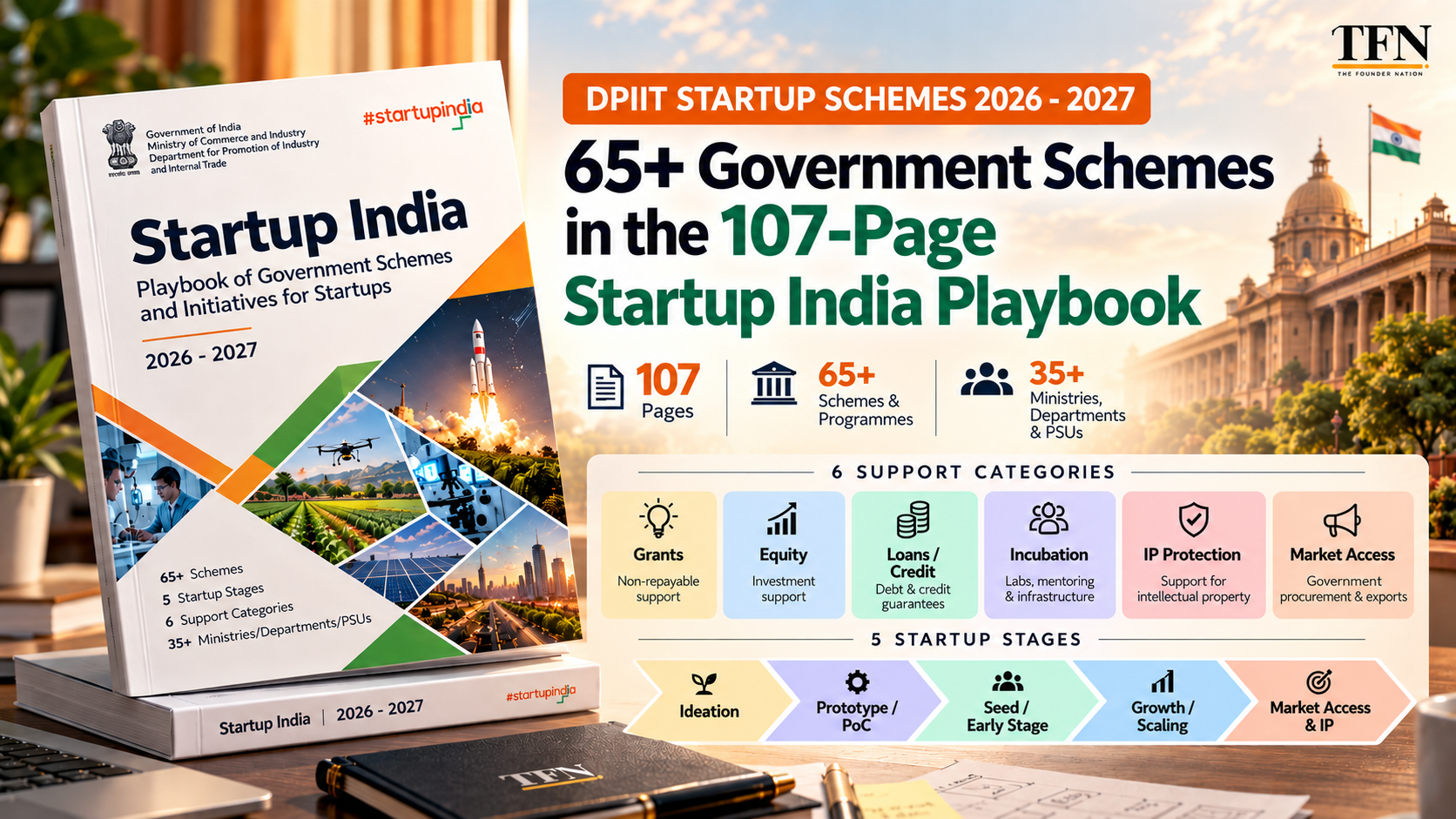
DPIIT Startup India Playbook featuring 65+ government schemes and programmes across 35+ Ministries, Departments and PSUs.
DPIIT startup schemes are now easier to discover with the latest Startup India Playbook, a 107-page government guide covering 65+ schemes and programmes across 35+ Ministries, Departments and PSUs. The playbook brings together funding, grants, loans, incubation, market access, intellectual property support and other government initiatives for startups at different stages of their journey.
If you are an Indian founder looking for government funding, startup grants, loans, incubation, intellectual property support or market access, there is one document you should know about.
The Startup India/DPIIT June 2026 Playbook of Government Schemes and Initiatives for Startups is a 107-page government resource covering 65+ schemes and programmes across 35+ Ministries, Departments and PSUs. It maps support across the startup lifecycle, from ideation and prototype development to seed funding, growth, scaling, market access and intellectual property.
But there is an important point: this is not simply a PDF containing a long list of schemes.
The playbook gives founders a five-question decision tree, a need-based index, a startup lifecycle map, a master summary table, individual scheme profiles, sector-specific pathways and information on PSU, regulator and State/UT initiatives.
And because navigating 107 pages can still take time, this guide turns that information into a founder-friendly web resource.
📥 MAIN DOWNLOAD: Official 107-Page Startup India Playbook
The most important resource in this article
PLAYBOOK OF GOVERNMENT SCHEMES AND INITIATIVES FOR STARTUPS
June 2026 | 107 Pages | 65+ Schemes & Programmes | 35+ Ministries / Departments / PSUs
👉 DOWNLOAD THE OFFICIAL STARTUP INDIA PLAYBOOK
This is the primary document this article is based on. It is hosted by the official Startup India portal.
Save this PDF. Bookmark this article. And before applying to any scheme, verify the latest official guidelines and application status.
📚 BONUS STARTUP INDIA RESOURCES
Bonus 1: DPIIT Recognised Startup Benefits Playbook
This additional Startup India resource focuses on benefits available to DPIIT-recognised startups and related startup ecosystem support.
📘 Download the DPIIT Recognised Startups Benefits Playbook
Bonus 2: April 2026 DPIIT Startup Benefits Playbook
📗 Download the April 2026 DPIIT Startup Benefits Playbook
Important: The June 2026 107-page playbook is the main resource for government schemes and initiatives. The other two are bonus resources focused more specifically on DPIIT-recognised startup benefits.
Quick Facts About the June 2026 Startup India Playbook
| Detail | Information |
|---|---|
| Document | Playbook of Government Schemes and Initiatives for Startups |
| Edition | June 2026 |
| Length | 107 pages |
| Schemes/programmes | 65+ |
| Government bodies | 35+ Ministries, Departments and PSUs |
| Startup stages | Ideation, Prototype/PoC, Seed/Early Stage, Growth/Scaling, Market Access & IP |
| Support categories | 6 |
| Primary audience | Founders, entrepreneurs, students, investors, incubators and intermediaries |
| Main purpose | Help founders identify schemes relevant to their stage and sector |
The playbook describes itself as a consolidated reference for Central Government schemes and incentives relevant to India’s startup ecosystem.
What Is the Startup India 107-Page Playbook?
The Startup India Playbook June 2026 is a consolidated guide to government schemes and initiatives that can be relevant to Indian startups.
It is designed for:
- Entrepreneurs and founders
- Students and aspiring entrepreneurs
- Investors and incubators
- Policymakers and intermediaries
The playbook is particularly useful because startup support is distributed across different government ministries, departments, agencies, PSUs and programmes.
Instead of searching individually for:
- startup grants,
- government loans,
- seed funding,
- deeptech support,
- defence startup funding,
- space startup funding,
- biotech grants,
- agriculture startup schemes,
- semiconductor programmes,
- incubation support,
- IP protection,
the playbook brings these categories into one reference document.
Startup India’s official portal also maintains a Central Government Schemes section that aggregates government schemes intended to support Indian startups and notes that scheme information can change, so founders should verify the latest information with the relevant official sources.
What Does the 107-Page Startup India Playbook Cover?
The playbook is organised around several ways of finding support.
1. Startup stage
- Ideation
- Prototype / Proof of Concept
- Seed / Early Stage
- Growth / Scaling
- Market Access & IP
2. Type of support
- Grant
- Equity
- Loan / Credit
- Incubation
- Market Access
- Mixed
3. Sector
The playbook includes pathways covering areas such as:
- Defence
- Space
- Biotechnology
- Agriculture and Food
- Semiconductors and Electronics
- Quantum Technology
- Telecom
- Technical Textiles
- Mining and Recycling
- Energy
- Livestock
- Rural entrepreneurship
The playbook explicitly maps these lifecycle and sector categories.
How to Find the Right DPIIT Startup Schemes in 5 Questions
One of the most useful parts of the playbook is its Decision Tree.
Instead of starting with 65+ scheme names, you start with five questions.
Question 1: Are you a student, researcher or aspiring entrepreneur?
If you have an idea but are not yet operating as a registered startup, the playbook points towards programmes such as:
- NIDHI-EIR
- E-YUVA
- SITARE
- Atal Tinkering Labs
Question 2: What stage is your startup at?
Are you at:
- Ideation?
- Prototype?
- PoC?
- Seed?
- Early traction?
- Growth?
- Scaling?
- Market access?
Your stage can significantly affect which schemes are relevant.
Question 3: What type of support do you need?
Do you need:
- A grant?
- Equity?
- A loan?
- Credit support?
- Incubation?
- IP protection?
- Market access?
Question 4: Do you need credit, IP or market-access support?
This takes you towards programmes such as:
- CGSS
- CGTMSE
- PMMY
- Stand-Up India
- SIPP
- GeM Startup Runway
Question 5: Are you operating in a strategic or deeptech sector?
For example:
- Defence
- Space
- Biotech
- Agriculture
- Semiconductors
- Quantum
- Telecom
The playbook then directs you towards sector-specific programmes.
Government Startup Schemes by Startup Stage
The playbook divides the startup journey into five major stages.
| Startup Stage | Examples of Schemes / Programmes to Explore |
|---|---|
| Ideation | NIDHI-EIR, BIG, PRAYAS 2.0, PRISM, RKVY, SPARSH, GENESIS, E-YUVA, SITARE |
| Prototype / PoC | SISFS, PRAYAS 2.0, iDEX SPARK, IN-SPACe Seed Fund, DCIS, TDF, C2S, GREAT, S&T-PRISM |
| Seed / Early Stage | SISFS, NIDHI-SSP, LEAP Fund, SAMRIDH, AgriSURE, iDEX Prime, ADITI |
| Growth / Scaling | FFS, Startup India FoF 2.0, AcE, AgriSURE, Antariksh VCF, NQM, RDI, CGSS |
| Market Access & IP | GeM Startup Runway, SIPP, BHARATI |
This does not mean every startup at a particular stage automatically qualifies for every programme in that row. Eligibility, sector, incorporation date, turnover, application windows and other conditions vary by scheme.
Government Startup Schemes by Type of Support
The playbook identifies six support categories.
1. Grants
A grant is funding that generally does not need to be repaid and does not require giving up equity, subject to the particular scheme’s terms.
Examples in the playbook include:
- SISFS
- BIG
- PRAYAS 2.0
- iDEX
- ADITI
- DCIS
- IN-SPACe Seed Fund
- RKVY
- SPARSH
- GREAT
- NQM
2. Equity
Equity support involves investment in exchange for a stake in a startup.
Examples include:
- Fund of Funds for Startups
- Startup India FoF 2.0
- AcE
- AgriSURE
- BIRAC SEED
- LEAP Fund
3. Loans / Credit
Debt or credit support has to be understood differently from a grant.
Examples include:
- CGSS
- CGTMSE
- PMMY
- Stand-Up India
4. Incubation
This can include access to:
- Labs
- Infrastructure
- Workspace
- Mentoring
- Technical support
- Ecosystem networks
Examples include:
- NIDHI-TBI
- i-TBI
- BioNEST
- AICs
- ACICs
- EICs
- TIDE 2.0
5. IP Protection
For startups looking to protect intellectual property, the playbook includes:
- SIPP
6. Market Access
Examples include:
- GeM Startup Runway
- BHARATI
- International Cooperation Scheme
The need-based index in the playbook maps schemes against these categories.
Government Funding Is Not Always “Free Money”
This is one of the most important things founders should understand.
When someone says:
“The government is giving startups funding.”
That can mean very different things.
Grant
Potentially non-repayable funding under the scheme’s conditions.
Equity
Investment in exchange for ownership.
Debt
Money that must be repaid.
Credit Guarantee
A mechanism that can support eligible borrowing through lenders. It is not the same as receiving a government grant.
Incubation
Infrastructure, labs, mentoring or other ecosystem support.
Market Access
Support that can help startups access procurement, markets or other commercial pathways.
Understanding this difference is essential before applying.
How Much Government Funding Can Startups Get?
There is no single “Startup India funding amount.”
Different schemes operate differently.
Startup India Seed Fund Scheme
The June 2026 playbook lists:
- Up to ₹20 lakh as a grant for proof of concept, prototype development or product trials.
- Up to ₹50 lakh for market entry, commercialisation or scaling through convertible debentures, debt or debt-linked instruments.
The scheme is implemented through eligible incubators.
The official SISFS portal also confirms these two funding components and states that eligible DPIIT-recognised startups can apply subject to the scheme’s detailed eligibility conditions.
NIDHI PRAYAS 2.0
The June 2026 playbook describes:
- Up to ₹20 lakh through Level 1 PRAYAS Centres
- Up to ₹40 lakh through Level 2 Advance PRAYAS Centres
for prototyping support, subject to scheme conditions.
Fund of Funds for Startups
This is different from a direct startup grant.
The playbook describes FFS as a government-backed fund-of-funds structure that commits capital to SEBI-registered Alternative Investment Funds, which then invest in startups. The startup-level investment therefore varies by the supported fund and investment process.
Credit Guarantee Scheme for Startups
CGSS is a credit-support mechanism rather than a grant.
The playbook lists guarantee cover up to ₹20 crore per eligible borrower, subject to the applicable framework and lender eligibility.
Always check the latest official guidelines before relying on a funding amount.
15 Important DPIIT and Startup India Schemes to Know
The following are among the major schemes and programmes covered in the June 2026 playbook.
1. Startup India Seed Fund Scheme, SISFS
Designed to support startups with proof of concept, prototype development, product trials, market entry and commercialisation.
The official SISFS portal states that eligible DPIIT-recognised startups can receive up to ₹20 lakh as grant support and up to ₹50 lakh through debt/convertible instruments, subject to the scheme’s requirements.
2. Fund of Funds for Startups, FFS
A fund-of-funds model where government-backed capital is committed to supported AIFs that invest in startups.
3. Startup India Fund of Funds 2.0
A newer fund-of-funds mechanism included in the June 2026 playbook, with emphasis on areas including deeptech, manufacturing and growth-stage startups.
4. Credit Guarantee Scheme for Startups, CGSS
Designed to provide guarantee support to lenders extending eligible credit to DPIIT-recognised startups.
5. SIPP
The Scheme for Facilitating Startups Intellectual Property Protection supports DPIIT-recognised startups with access to IP facilitators and related intellectual property assistance.
Startup India’s portal also lists IP protection among the benefits associated with DPIIT recognition.
6. GeM Startup Runway
A market-access mechanism connected with government procurement.
7. NIDHI-SSP
The NIDHI Seed Support Program is included in the playbook for startup seed support.
8. NIDHI PRAYAS 2.0
An early-stage prototyping programme supporting innovators and startups working on technology-based products. The playbook describes Level 1 and Level 2 support structures.
9. SAMRIDH
Startup Accelerators of MeitY for Product Innovation, Development & Growth.
10. GENESIS
Gen-Next Support for Innovative Startups.
11. iDEX
Innovations for Defence Excellence, aimed at supporting innovation relevant to the defence ecosystem.
12. ADITI
Acing Development of Innovative Technologies with iDEX.
13. IN-SPACe Seed Fund
A dedicated pathway for startups operating in the space ecosystem.
14. National Quantum Mission
The playbook includes NQM within its quantum technology support landscape.
15. PRISM
Promoting Innovations in Individuals, Start-ups and MSMEs.
These are only highlighted examples. The playbook contains a much larger directory.
Government Schemes for Startups by Sector
One of the strongest parts of the June 2026 playbook is its sector-specific mapping.
Defence Startups
Relevant programmes include:
- iDEX
- ADITI
- TDF
Space Startups
Relevant programmes include:
- IN-SPACe Seed Fund
- Antariksh VCF
- Space Technology Adoption Fund
Biotech Startups
The playbook includes:
- BIG
- BIRAC SEED
- AcE
- LEAP Fund
- SPARSH
- SBIRI
- PACE
- BioNEST
Agriculture and Agritech Startups
Examples include:
- RKVY
- AgriSURE
- BHARATI
Semiconductor and Electronics Startups
Examples include:
- Design Linked Incentive, DLI
- Chips to Startup, C2S
- GENESIS
Quantum Technology
The playbook maps:
- National Quantum Mission
Telecom
The playbook includes:
- Digital Communication Innovation Square, DCIS
Technical Textiles
The playbook includes:
- GREAT
Mining, Minerals and Recycling
The playbook includes:
- S&T-PRISM
Energy
The playbook includes:
- MAHIR
Livestock
The playbook includes:
- National Livestock Mission
Rural Entrepreneurship
The playbook includes:
- Start-up Village Entrepreneurship Programme, SVEP
Startup-Specific vs Startup-Relevant Schemes
This distinction is easy to miss but extremely important.
The playbook separates programmes into two broad categories.
Startup-Specific
Startups are explicitly named as the primary or sole eligible beneficiaries under the relevant eligibility framework.
Startup-Relevant
The eligibility can extend beyond startups to categories such as MSMEs, companies, institutions or other organisations, while startups may still benefit.
Why does this matter?
Because being mentioned in the Startup India playbook does not automatically mean that every startup qualifies for every programme.
Always read the individual scheme’s:
- Eligibility
- Incorporation requirements
- Turnover requirements
- Sector requirements
- Stage requirements
- Funding restrictions
- Application window
- Implementing agency
Complete List of Schemes and Programmes Covered in the Playbook
The June 2026 playbook contains a large scheme one-pager directory divided into Startup-Specific and Startup-Relevant sections. The following list reproduces the scheme/programme names from its contents.
Startup-Specific Schemes and Programmes
- Startup India Seed Fund Scheme, SISFS
- Fund of Funds for Startups, FFS
- Startup India Fund of Funds 2.0
- Credit Guarantee Scheme for Startups, CGSS
- Scheme for Facilitating Startups Intellectual Property Protection, SIPP
- GeM Startup Runway
- NIDHI Seed Support Program, SSP
- NIDHI Promotion and Acceleration of Young and Aspiring Technology Entrepreneurs, PRAYAS 2.0
- Research, Development & Innovation, RDI Scheme
- National Quantum Mission, NQM
- Promoting Innovations in Individuals, Start-ups and MSMEs, PRISM
- Biotechnology Ignition Grant Scheme, BIG
- Biotechnology Innovation Fund, Accelerating Entrepreneurs, AcE
- BIRAC Incubator SEED Fund
- LEAP Fund, Launching Entrepreneurial Driven Affordable Products
- SPARSH, Social Innovation Programme for Products Affordable & Relevant to Social Health
- AgriSURE, Agri Fund for Startups & Rural Enterprises
- Innovation & Agri-Entrepreneurship Program, RKVY
- SAMRIDH, Startup Accelerators of MeitY for Product Innovation, Development & Growth
- GENESIS, Gen-Next Support for Innovative Startups
- STPI Next Generation Incubation Scheme, NGIS
- Chips to Startup, C2S Programme
- Innovations for Defence Excellence, iDEX
- Acing Development of Innovative Technologies with iDEX, ADITI
- Technology Development Fund, TDF
- IN-SPACe Seed Fund Scheme
- Digital Communication Innovation Square, DCIS
- GREAT, Grant for Research & Entrepreneurship across Aspiring Innovators in Technical Textiles
- BHARATI, Bharat’s Hub for Agritech, Resilience, Advancement & Incubation for Export Innovation
- S&T-PRISM, Promotion of Research & Innovation in Mining, Minerals & Recycling Sector
The playbook’s contents list these as Part A of its scheme one-pagers.
Startup-Relevant Schemes and Programmes
- NIDHI Entrepreneur in Residence, EIR
- National Mission on Interdisciplinary Cyber-Physical Systems, NM-ICPS, Technology Innovation Hubs
- NIDHI Technology Business Incubator, NIDHI-TBI
- NIDHI Inclusive-Technology Business Incubator, i-TBI
- NIDHI Accelerator
- NIDHI Centres of Excellence, CoE
- BioAngels
- BioNEST Programme
- Biotechnology Industry Partnership Programme, BIPP
- E-YUVA, Empowering Youth for Undertaking Value Added Innovative Translational Research
- SITARE, Students Innovations for Translation & Advancement of Research Explorations
- PACE, Promoting Academic Research Conversion to Enterprise
- SBIRI, Small Business Innovation Research Initiative
- TIDE 2.0, Technology Incubation & Development of Entrepreneurs
- Design Linked Incentive, DLI Scheme
- Antariksh Venture Capital Fund / Space VCF
- Space Technology Adoption Fund, TAF
- Credit Guarantee Trust Fund for Micro & Small Enterprises, CGTMSE
- Self-Reliant India Fund, SRI Fund
- MSME Champions Scheme
- International Cooperation Scheme
- National SC-ST Hub Scheme
- Atal Innovation Mission, Atal Tinkering Labs
- Atal Incubation Centres, AICs
- Atal Community Innovation Centres, ACIC
- Scheme for Scale-up Support to Established Incubation Centres, EICs
- Agriculture Infrastructure Financing Facility
- Pradhan Mantri Mudra Yojana, PMMY
- Stand-Up India
- Pradhan Mantri Formalisation of Micro Food Processing Enterprises, PMFME Scheme
- IFSCA Fintech Incentive Scheme
- Technology Development-cum-Incubation Centers
- Start-up Village Entrepreneurship Programme, SVEP
- Venture Capital Fund for Scheduled Castes, VCF-SC
- Science Technology and Innovation Hubs for Development of Scheduled Caste and Scheduled Tribe Communities
- National Livestock Mission, NLM
- Mission on Advanced and High-Impact Research, MAHIR
- Yuva Sahakar, Cooperative Enterprise Support and Innovation Scheme
- Entrepreneurship and Skill Development Programme, ESDP
These programmes appear in the playbook’s Part B one-pager directory.
Important: The document describes its overall coverage as 65+ schemes and programmes, while its one-pager contents contain the above broader set of named programmes. The categories should not be interpreted as a claim that every listed programme is a direct cash-funding scheme.
DPIIT Startup Recognition: What Founders Should Know
Government schemes and DPIIT recognition are related, but they are not the same thing.
DPIIT recognition is a formal recognition process under Startup India for eligible entities.
The current Startup India recognition page states that eligible entities can include:
- Private Limited Companies
- Registered Partnership Firms
- Limited Liability Partnerships
- Cooperative Societies
The current recognition framework also contains separate provisions for DeepTech startups.
Current recognition framework
Startup India currently states that a non-DeepTech startup can be recognised for up to 10 years from incorporation/registration, while the DeepTech framework extends this to 20 years, subject to the applicable conditions. The current portal also lists turnover thresholds of ₹200 crore for non-DeepTech startups and ₹300 crore for DeepTech startups under the recognition framework.
Do not confuse these recognition criteria with the eligibility criteria of an individual government scheme.
A scheme can impose additional requirements.
DPIIT vs Startup India vs Government Schemes
These terms are often used interchangeably online, but they are not identical.
Startup India
The broader Government of India initiative for building and supporting the startup ecosystem.
DPIIT
The Department for Promotion of Industry and Internal Trade, under the Ministry of Commerce and Industry.
DPIIT Recognition
An official startup recognition status for eligible entities.
Government Scheme
An individual programme operated by a ministry, department, agency, PSU, regulator or other implementing body.
A startup can therefore be DPIIT-recognised without automatically qualifying for every government funding programme.
What Are the Benefits of DPIIT Recognition?
The Startup India portal lists benefits associated with DPIIT recognition that can include areas such as:
- Funding support
- Fund-of-funds ecosystem
- Public procurement support
- Intellectual property support
- Tax-related benefits subject to separate eligibility
- Self-certification
- Regulatory support
- Mentorship and ecosystem access
However, recognition does not mean automatic access to every benefit.
For example, Startup India’s current recognition page explains that recognised startups may separately apply for Section 80-IAC tax exemption if they meet the applicable conditions.
How to Apply for DPIIT Startup Recognition
The current Startup India portal directs eligible startups to the National Single Window System, NSWS, for the recognition application.
The basic process is:
- Create/login to your NSWS account.
- Go to Add Approvals.
- Select Central Approvals.
- Find Registration as a Startup.
- Complete the application.
- Provide the required information and supporting documents.
- Submit the application.
Startup India also states that the government has not appointed private agencies or franchises to obtain DPIIT recognition on its behalf and that startups should file the recognition application themselves.
Official Startup India DPIIT Recognition Page
Official Startup India Portal
Government Startup Schemes Beyond Central Government Programmes
The 107-page playbook does not stop with central government schemes.
It also contains a dedicated section covering:
- Public Sector Undertakings
- Regulators
- State startup initiatives
- Union Territory startup initiatives
This is important because startup support in India is not limited to one national funding programme.
Startup India’s portal separately provides a Know Your State/UT section covering state and UT startup policies.
TFN’s state-policy coverage
For founders researching state-specific support, also read:
State Startup Policies in India: Which State Is Actually Worth It for Founders?
How to Apply for Government Startup Schemes
There is no single application process for all 65+ programmes.
Depending on the scheme, you may apply through:
- Startup India
- An approved incubator
- A ministry or department
- A dedicated programme portal
- A lender
- A fund/AIF
- An implementing agency
- A state or UT agency
- Another designated institution
For example, SISFS funding is routed through eligible incubators, while a fund-of-funds structure operates through supported investment funds.
That is why simply searching “Startup India application form” is not enough.
You need to identify the specific scheme and its current implementing agency.
Documents to Prepare Before Applying
There is no universal document checklist because requirements differ by scheme.
However, founders should generally be prepared to provide some combination of:
- Incorporation/registration documents
- DPIIT recognition details, where required
- Founder/promoter information
- Pitch deck
- Business plan
- Product or prototype information
- Financial information
- Funding requirement
- Use-of-funds plan
- Technical proposal
- Research information
- IP information
- Sector-specific documents
- Bank/account details
- Previous funding details
Always use the individual scheme’s latest guidelines as the final document checklist.
How to Check Whether a Government Startup Scheme Is Currently Open
A scheme being listed in the June 2026 playbook does not necessarily mean its application window is open today.
Startup India’s own Central Government Schemes page warns that information can change and advises founders to refer to official websites for the latest updates.
Before applying, check:
1. Is the scheme currently accepting applications?
2. Has the application deadline changed?
3. Is the current guideline newer than the playbook?
4. Do you meet the current eligibility criteria?
5. Is DPIIT recognition required?
6. Is the application direct or through an incubator/lender/fund?
7. Is the funding actually a grant, or is it debt/equity?
8. Is the official application portal still active?
This is particularly important for government schemes because application windows and operating guidelines can change.
A Note on SISFS Applications
The official SISFS portal currently states that the scheme supports proof of concept, prototype development, product trials, market entry and commercialisation, and that eligible DPIIT-recognised startups apply through the Startup India system with disbursement through eligible incubators.
The June 2026 playbook records the startup application deadline as 31 May 2026 and notes that disbursals were ongoing at the time of the playbook’s preparation.
Because application status can change, founders should verify the current portal before taking action.
Common Mistakes Founders Make With Government Schemes
1. Assuming every scheme is a grant
Many programmes involve equity, debt, credit guarantees, incubation or market access.
2. Applying without checking eligibility
A scheme can have requirements around:
- Incorporation date
- Turnover
- Sector
- Technology
- DPIIT recognition
- Founder category
- Geography
- Stage
3. Looking only for large funding amounts
Sometimes incubation, IP protection, procurement access or technical infrastructure can be as relevant as direct funding.
4. Confusing credit guarantees with grants
A guarantee can facilitate eligible borrowing. It does not mean the startup receives the guaranteed amount as free capital.
5. Using outdated information
Government schemes change.
6. Applying through unofficial intermediaries
Use the official portal or implementing agency.
7. Not checking the implementing agency
Some schemes operate through incubators, lenders, AIFs or other institutions.
8. Treating the maximum amount as guaranteed funding
“Up to ₹X” does not mean every eligible applicant receives ₹X.
9. Ignoring sector-specific schemes
A deeptech, defence, space, biotech or agritech startup may have sector-specific pathways that a generic funding search misses.
10. Applying without understanding the objective
Your application should actually fit the purpose of the programme.
How to Use ChatGPT With the 107-Page Startup India Playbook
This is where the playbook becomes even more useful.
You can upload the official PDF to an AI assistant and provide your startup information.
Copy and paste this prompt:
I am uploading the June 2026 Startup India/DPIIT Government Schemes Playbook.
My startup is: [describe startup]
Startup stage: [ideation/prototype/PoC/seed/growth/scaling]
Sector: [sector]
Location: [state/city]
DPIIT recognised: [yes/no]
Funding/support required: [grant/equity/loan/incubation/IP/market access]
Approximate requirement: ₹[amount]
Analyse the uploaded playbook and identify the government schemes and programmes that may be relevant to my startup.
For every potentially relevant scheme, provide:
- Scheme name
- Ministry/implementing agency
- Startup stage
- Support type
- Funding/benefit
- Eligibility
- Sector requirements
- DPIIT recognition requirement
- Application route
- Official website
Do not assume that I am eligible. Clearly separate confirmed information from points that require verification against the latest official guidelines.
Why this works
The playbook itself is structured around:
Decision Tree → Need Index → Lifecycle Map → Summary Table → Scheme One-Pagers.
So instead of asking AI a vague question like:
“Which government scheme is best for me?”
give it your stage + sector + requirement + eligibility information and ask it to identify schemes that may be relevant.
Always verify the final eligibility and application status against the official scheme source.
The Complete Founder Workflow
If you want to use the playbook properly, follow this sequence:
STEP 1
Download the official 107-page PDF.
STEP 2
Identify your startup stage.
STEP 3
Identify what you actually need.
STEP 4
Identify your sector.
STEP 5
Check whether DPIIT recognition is required.
STEP 6
Shortlist potentially relevant programmes.
STEP 7
Read the individual scheme one-pager.
STEP 8
Open the official scheme website.
STEP 9
Check the latest eligibility and guidelines.
STEP 10
Check whether applications are currently open.
STEP 11
Prepare the required documents.
STEP 12
Apply through the official implementing agency.
Government Schemes for Early-Stage Startups
If you’re still building your first product, don’t immediately jump to growth-stage funding.
The playbook’s lifecycle map includes early-stage programmes such as:
- NIDHI-EIR
- BIG
- PRAYAS 2.0
- PRISM
- RKVY
- SPARSH
- GENESIS
- E-YUVA
- SITARE
- SISFS
- iDEX
- IN-SPACe Seed Fund
- DCIS
- TDF
- C2S
- GREAT
depending on the startup’s stage, sector and eligibility.
For more funding-related context, see:
Early-Stage Investors in India
Government Schemes for Deeptech Startups
Deeptech founders should pay particular attention to the sector and technology-specific programmes rather than treating government funding as one generic category.
The June 2026 playbook maps support around areas such as:
- Quantum technology
- Space
- Defence
- Semiconductors
- Cyber-physical systems
- Biotechnology
- Advanced research
- Technical textiles
- Mining and minerals
Examples include:
- National Quantum Mission
- IN-SPACe Seed Fund
- iDEX
- ADITI
- TDF
- C2S
- DLI
- NM-ICPS
- BIG
- BIRAC SEED
- PACE
- SBIRI
- GREAT
- S&T-PRISM
The appropriate programme depends on the technology, stage and specific eligibility criteria.
Government Schemes for Women, SC/ST and Other Founder Categories
The playbook also includes programmes with specific beneficiary or ecosystem considerations, including:
- National SC-ST Hub Scheme
- Venture Capital Fund for Scheduled Castes
- Science Technology and Innovation Hubs for SC/ST communities
- Stand-Up India
- Other broader entrepreneurship programmes
The existence of a scheme in this list does not by itself establish eligibility. Founders should check the individual programme’s current requirements.
Government Schemes for Rural and Agriculture Startups
Agriculture and rural entrepreneurship receive substantial attention in the playbook.
Relevant programmes include:
- RKVY
- AgriSURE
- BHARATI
- Agriculture Infrastructure Financing Facility
- PMFME
- National Livestock Mission
- SVEP
- Yuva Sahakar
The playbook specifically identifies agriculture, food, livestock and rural entrepreneurship among its sector areas.
Government Schemes for Incubators and Innovation Infrastructure
Not every programme is designed for a startup to directly receive cash.
Some focus on building the infrastructure through which founders receive support.
Examples include:
- NIDHI-TBI
- i-TBI
- NIDHI Accelerator
- NIDHI Centres of Excellence
- BioNEST
- AICs
- ACICs
- EICs
- TIDE 2.0
- NM-ICPS Technology Innovation Hubs
This distinction is important when searching for startup incubation schemes.
Government Startup Support for Intellectual Property
For founders developing a patentable or otherwise protectable innovation, the playbook includes SIPP, the Scheme for Facilitating Startups Intellectual Property Protection.
Startup India’s current portal also lists IP protection as one of the benefits available to DPIIT-recognised startups, including access to facilitators and support around IP filings.
Government Startup Support for Market Access
Funding isn’t the only way a government programme can help a startup.
Market-access programmes can help founders explore:
- Government procurement
- Public-sector opportunities
- Export pathways
- Institutional buyers
- Commercialisation
Examples in the playbook include:
- GeM Startup Runway
- BHARATI
- International Cooperation Scheme
This is particularly relevant for startups that already have a product and are looking for customers rather than just capital.
What Makes This 107-Page Playbook Different?
The biggest value isn’t simply the number of schemes.
It is the way the information is organised.
The playbook lets a founder approach government support through:
Stage
↓
Need
↓
Sector
↓
Scheme
↓
Eligibility
↓
Application
That is far more useful than searching through a random list of government schemes.
The Startup India Playbook Is Not a Guarantee of Funding
This point deserves repeating.
Being:
- a startup,
- an Indian company,
- a DPIIT-recognised startup,
- or a founder in a particular sector
does not automatically guarantee funding.
Each programme has its own eligibility criteria and operating rules.
The playbook itself advises readers to consult the relevant ministries, departments and implementing agencies for the latest information, including eligibility, application processes and timelines.
Official Resources
⭐ MAIN RESOURCE
📥 DOWNLOAD THE 107-PAGE STARTUP INDIA GOVERNMENT SCHEMES PLAYBOOK, JUNE 2026
This is the primary PDF covered in this article.
Bonus Resources
📘 DPIIT Recognised Startups Benefits Playbook
📗 April 2026 DPIIT Startup Benefits Playbook
🌐 Official Startup India Portal
🏛️ Official Central Government Schemes for Startups
🪪 Official DPIIT Startup Recognition Page
💰 Official Startup India Seed Fund Portal
Frequently Asked Questions
What are DPIIT startup schemes?
DPIIT startup schemes are government programmes and initiatives relevant to startups through DPIIT and other Central Government ministries, departments, agencies and implementing institutions. The June 2026 Startup India playbook consolidates 65+ schemes and programmes across 35+ Ministries, Departments and PSUs.
What is the 107-page Startup India Playbook?
It is the June 2026 Playbook of Government Schemes and Initiatives for Startups, a government resource designed to help founders identify programmes according to startup stage, need and sector.
How many government schemes are in the Startup India Playbook?
The playbook states that it covers 65+ schemes and programmes across 35+ Ministries, Departments and PSUs.
What startup stages does the playbook cover?
The playbook covers:
- Ideation
- Prototype / PoC
- Seed / Early Stage
- Growth / Scaling
- Market Access & IP
What types of support are included?
The six support categories are:
- Grant
- Equity
- Loan/Credit
- Incubation
- Market Access
- Mixed
What is the Startup India Seed Fund Scheme?
SISFS provides financial assistance for areas including proof of concept, prototype development, product trials, market entry and commercialisation. Eligible startups apply through the Startup India system and selected startups receive support through eligible incubators.
How much funding can SISFS provide?
The official SISFS FAQ states that eligible startups can receive up to ₹20 lakh as a grant for validation/PoC/prototype/product trials and up to ₹50 lakh through convertible debentures, debt or debt-linked instruments for market entry, commercialisation or scaling, subject to the scheme conditions.
What is CGSS?
The Credit Guarantee Scheme for Startups is a credit-support mechanism that provides guarantee coverage to eligible lenders for qualifying loans to DPIIT-recognised startups. The June 2026 playbook lists guarantee cover up to ₹20 crore per eligible borrower.
Is government startup funding free?
Not necessarily. Government startup support can take the form of grants, equity investment, loans, credit guarantees, incubation, IP support or market access. The specific financial structure depends on the scheme.
Do I need DPIIT recognition for government funding?
Not for every programme. Some schemes specifically require DPIIT recognition, while others have broader eligibility. Always check the individual scheme.
How do I get DPIIT recognition?
Eligible entities can apply through the National Single Window System. Startup India provides the current application process and eligibility requirements on its official recognition page.
Can a startup apply for multiple government schemes?
Potentially, depending on the individual schemes’ rules. Some programmes may restrict duplicate or overlapping government support, so founders should check the applicable guidelines before applying.
Which government schemes support deeptech startups?
The playbook includes programmes covering areas such as quantum technology, space, defence, semiconductors, biotechnology, cyber-physical systems and advanced research. Examples include NQM, IN-SPACe Seed Fund, iDEX, ADITI, TDF, C2S, DLI, BIG and NM-ICPS.
Which schemes support defence startups?
Examples include iDEX, ADITI and TDF. The specific route depends on the startup’s technology, stage and programme requirements.
Which schemes support space startups?
Examples include IN-SPACe Seed Fund, Antariksh Venture Capital Fund and Space Technology Adoption Fund.
Which schemes support biotech startups?
The playbook includes BIG, AcE, BIRAC SEED, LEAP Fund, SPARSH, SBIRI, PACE and BioNEST among its biotechnology-related programmes.
Where can I download the Startup India schemes PDF?
The primary official document is the 107-page June 2026 Startup India Playbook.
📥 Download the Official 107-Page Startup India Playbook
Final Takeaway
The biggest mistake a founder can make is to search for “one government scheme for my startup”.
The June 2026 Startup India Playbook shows why that approach can be limiting.
There are programmes mapped across:
Ideation → Prototype → Seed → Growth → Scaling → Market Access & IP
and across different forms of support:
Grants → Equity → Loans/Credit → Incubation → IP → Market Access.
It also goes beyond generic startup funding by mapping support for areas such as defence, space, biotech, agriculture, semiconductors, quantum technology, telecom, technical textiles, mining, energy and rural entrepreneurship.
So if you’re building a startup in India in 2026, the most useful starting point is not guessing which scheme might work.
Start with your:
stage + sector + requirement + eligibility
and then work backwards to the programmes that may fit.
⭐ Download the main resource here:
📥 DOWNLOAD THE OFFICIAL STARTUP INDIA PLAYBOOK, 2026
Then verify every eligibility condition, application window and guideline on the official scheme website before applying.