


Written by TFN Research Desk | covering startups, technology, venture capital, and business strategy.
In 2016, millions of Indians wanted to invest.
There was just one problem.
Nobody knew where to begin.
Mutual funds sounded complicated. Stock brokers looked intimidating. The entire industry felt like it had been designed for people who already knew the rules.
Most people gave up before they even started.
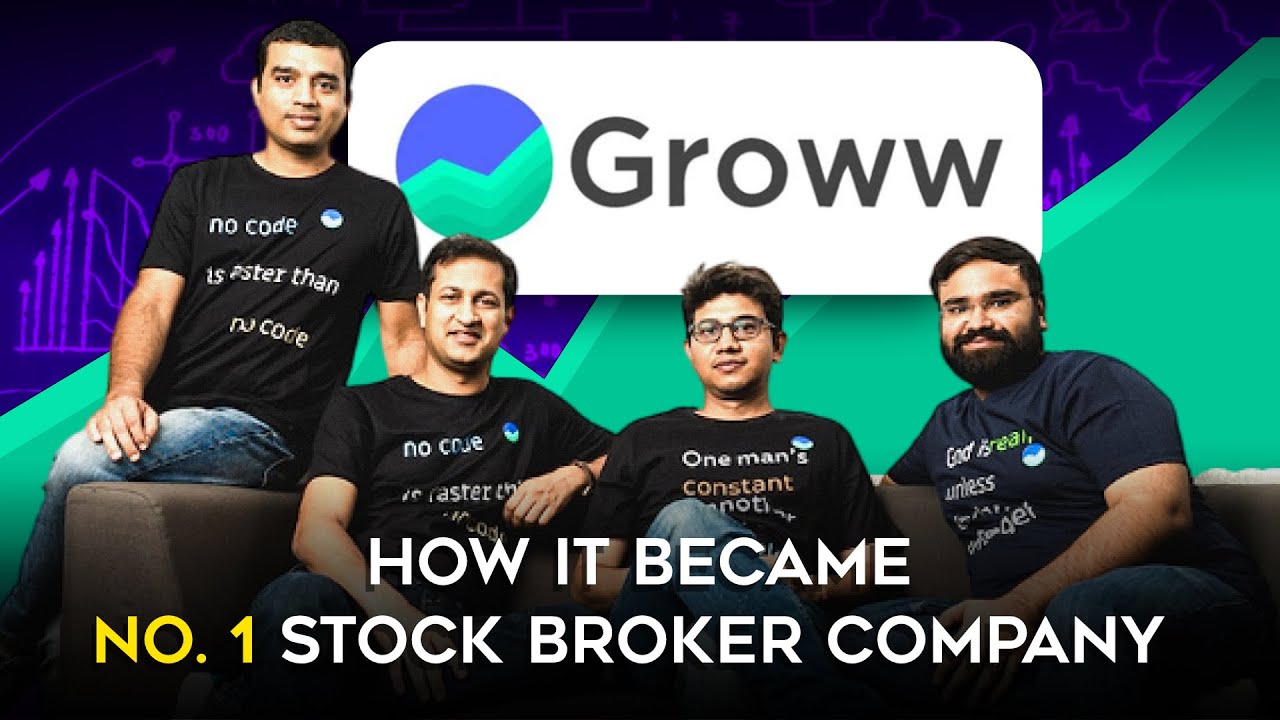
Four ex-Flipkart employees saw that confusion and built a company around removing it.
Lalit Keshre, Harsh Jain, Neeraj Singh, and Ishan Bansal understood product. They understood scale. And they understood that the same person who would confidently order shoes online at midnight would freeze up the moment someone mentioned mutual funds.1
They built Groww to fix that.
What happened next was not just a business success story. It was a quiet financial revolution that nobody in the traditional broking industry saw coming.
How Did Groww Build India’s Largest Investing Community?
Groww became India’s largest stock broking platform by making investing feel as simple as shopping online. By offering a clean app, zero commission on mutual funds, flat fee brokerage on stocks, and a content strategy that educated rather than sold, Groww attracted 15 million active users by FY2025, capturing over 26% of India’s active broking market and overtaking Zerodha, a platform that had dominated for years.2 3
What India’s Investing Problem Actually Looked Like
Before Groww, investing in India was a process designed to make you give up.
To buy a mutual fund, you needed a distributor who earned a commission on every rupee you invested. That commission came out of your returns, invisibly, year after year. Most distributors had no incentive to put you in the best fund. They had every incentive to put you in the fund that paid them the most.
To open a demat account, you had to physically visit a broker, fill out forms, submit documents, wait days for verification, and pay annual fees before you had made a single trade.
And if you wanted to understand what any of it meant, there was almost no plain-language content available. The financial media talked to people who already knew. Everyone else was left to figure it out alone.
India had over 400 million internet users by 2016.1 Fewer than 2% of them were investing in equity markets.4
That gap was not an accident. It was what happened when an entire industry decided that complexity was a feature, not a bug.
What Groww Did Differently
Groww launched in 2017 as a direct mutual fund platform.5
Direct funds cut out the distributor. No commission. No hidden fees. Every rupee you invested went to work for you, not for a middleman. It sounds obvious. The entire industry had spent years making sure it was not obvious.
But the product was only half the story.
The other half was content.
Groww’s team made a decision early on that most fintech startups never make. They decided not to sell. Instead they taught.
Their blog became one of the most widely read personal finance resources in India, with articles explaining what a SIP is, how index funds work, why diversification matters, and what someone with ₹500 a month should actually do with their money.2
This was not a marketing strategy. It was a philosophy. Build trust before you ask for anything.
And it worked in a way that no performance marketing campaign could have replicated.
Co-founder Neeraj Singh said it directly: “We focused on building the right product and knew growth would follow. We never had a marketing team in the beginning.”2
The Numbers That Tell the Story
| Metric | Figure |
|---|---|
| Active users FY2025 | 15 million3 |
| Market share (active clients) | 26.59%2 |
| FY24 Revenue | ₹3,145 crore6 |
| FY24 Revenue growth | 119% year on year6 |
| FY24 Operational profit | ₹535 crore6 |
| Customer assets on platform (June 2025) | ₹2.6 trillion3 |
| New users added in 2024 | 6 million+7 |
| Target IPO valuation | $7 to $8 billion7 |
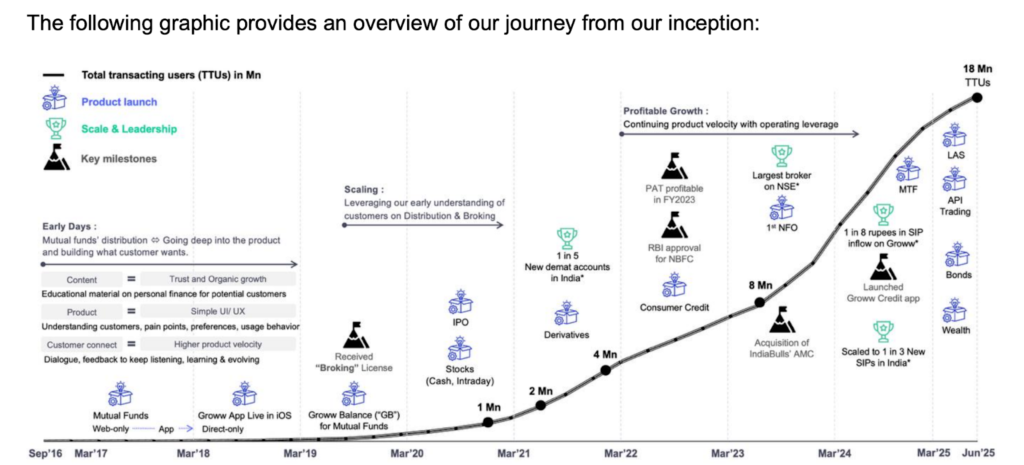
In September 2023, Groww overtook Zerodha in active clients.5 That was not just a milestone. It was a statement. Zerodha had spent fifteen years building a devoted user base of traders and investors who swore by the platform. Groww quietly passed them in under seven years.
March 2020: The Moment Everything Changed
Groww was growing steadily. And then the world stopped.
When the COVID-19 pandemic hit and markets crashed in March 2020, something unexpected happened. Instead of running away from investing, millions of Indians ran toward it.
They were stuck at home. They had time. They had savings they were not spending. And for the first time, they were genuinely worried about their financial future.
Groww was ready for them.
The app was simple enough that someone who had never invested before could open an account and make their first SIP in under ten minutes. The content was good enough that they could understand what they were doing. And the market was low enough that even a small investment felt meaningful.
Groww went from 1 million users to crossing significant scale milestones in the months that followed.4
The pandemic was not their break. It was confirmation that what they had built worked exactly as intended.
How Groww Actually Makes Money
This is the part most people do not bother to understand.
Groww charges zero commission on mutual funds. So how does a zero-commission platform become a ₹3,145 crore revenue business?
Three ways:
Flat fee brokerage on stocks. Every equity or F&O trade costs a flat fee, not a percentage. For small trades this is more expensive than traditional brokers. For large trades it is dramatically cheaper. It attracted exactly the kind of active retail trader Groww was building for.5
Groww AMC. Groww launched its own Asset Management Company, allowing it to create and sell its own mutual fund products. This is high margin, recurring revenue that grows with every rupee under management.5
Financial products. Groww Pay, lending, fixed deposits, and US stocks have all been added to the platform, increasing the revenue per user without increasing acquisition costs.6
In May 2025, Groww raised its minimum brokerage from ₹2 to ₹5 per order, a 150% increase. Users complained on social media. Almost none of them left.4
That is what brand trust looks like when you have actually earned it.
Why the Old Guard Never Saw It Coming
Traditional brokers dismissed Groww for years. And it is easy to understand why.
The incumbents, ICICI Direct, HDFC Securities, Kotak Securities, had built their businesses around relationship banking. A broker. A phone call. A trusted advisor.
They looked at Groww and saw a cheap app targeting millennials who did not know what they were doing.
They were right about one thing. Most of Groww’s early users did not know what they were doing.
That was the entire point.
Groww was not competing for the experienced investor who already had a broker and was happy with them. It was going after the person who had never invested at all. The person who had ₹500 a month, a smartphone, and zero confidence that investing was something people like them were allowed to do.
By the time the incumbents realised that segment was enormous, Groww had already built 15 million relationships inside it.
The Founder Nobody Talks About
Every Groww profile leads with Lalit Keshre. That is fair. He is the CEO.
But the detail that tends to get buried is where he came from.
Lalit Keshre grew up as a farmer’s son.8 He was not from a family that talked about mutual funds at the dinner table. He was not raised in a household where investing was assumed. He understood, viscerally, what it meant to be on the outside of a system that was built for someone else.
That background is not incidental to what Groww became. It is central to it.
The product was built by someone who genuinely remembered what it felt like to not understand any of this. And that empathy, more than any feature or algorithm, is what made Groww feel different to the millions of first-time investors who found it.
The Take Nobody In The Industry Wants To Say Out Loud
Our editors weigh in.
Here is the thing that the Indian financial services industry does not want to acknowledge.
Groww did not win because it had better technology than the incumbents. ICICI Direct had more engineers. Zerodha had a better trading platform for serious traders.
Groww won because the incumbents had spent decades treating retail investors like they were not worth the trouble.
The minimum investment amounts. The paperwork. The commissions that were never explained. The advisors who sold you what was good for them, not what was good for you. The entire system was built to serve people who already had money and already knew what to do with it.
Everyone else was an afterthought.
Groww decided that everyone else was the market.
And here is the uncomfortable takeaway for every startup founder reading this. The most defensible businesses in India are almost never built by being better than the competition. They are built by going somewhere the competition decided was not worth their time.
Traditional brokers looked at a first-time investor with ₹500 a month and saw a customer who was not worth acquiring.
Groww looked at 400 million people like that and saw the largest untapped financial market in the world.
One of those perspectives built a $7 to $8 billion company.7
The other is still wondering what happened.
Frequently Asked Questions
Who founded Groww?
Four ex-Flipkart employees: Lalit Keshre, Harsh Jain, Neeraj Singh, and Ishan Bansal, in 2016.1
How many users does Groww have?
15 million active users as of FY2025, making it India’s largest stock broker by active clients.3
Is Groww profitable?
The core business is operationally profitable. FY24 showed ₹535 crore in operational profit. A ₹805 crore net loss was due to a one-time tax expense from repatriating the parent entity to India, not from business operations.6
How does Groww make money without charging commission on mutual funds?
Through flat fee brokerage on stocks and F&O trades, its own AMC, and financial products like lending and fixed deposits.
Is Groww going public?
Groww is in talks to raise $700 million through an IPO targeting a valuation of $7 to $8 billion.7
How did Groww beat Zerodha?
By targeting first-time investors that Zerodha was not focused on. Groww overtook Zerodha in active clients in September 2023.5
Is Groww safe?
Groww is SEBI registered and holds AMFI certification. Customer assets on the platform crossed ₹2.6 trillion by June 2025.3
Stay in the Loop
For more stories, breakdowns, and unfiltered takes on what is really happening in Indian business and tech, follow TheFounder Nation.
[Instagram handle to be added]
We cover what the mainstream business press won’t.
© TheFounder Nation | All rights reservedWord count: ~1,700 | Read time: ~7 minutesPrimary keyword: How Groww built India’s largest investing community | Secondary: Groww success story, Groww vs Zerodha, Groww business model, Groww IPO, Groww users, fintech India, mutual fund app IndiaFeatured image alt text: Groww app growth from zero to India’s largest stock broking platformSuggested image filename: groww-india-largest-investing-community.jpg