



A founder built the product before the company existed. The code lived on a personal laptop. The algorithm was refined over weekends. The brand name was chosen in a café over coffee.
Then a term sheet arrived. Then the lawyers arrived. Then someone asked a question nobody had thought about: who actually owns this?
Intellectual property is not a legal formality for startups. It is often the only thing investors are actually buying. For a pre-revenue SaaS company or a deeptech startup with no customers yet, the IP is the asset. If ownership is unclear, ambiguous, or simply not documented, the deal either dies or prices in the risk with a valuation cut.
This is a guide to understanding IP protection across every seat at the table, from the first-time founder to the angel writing a cheque.
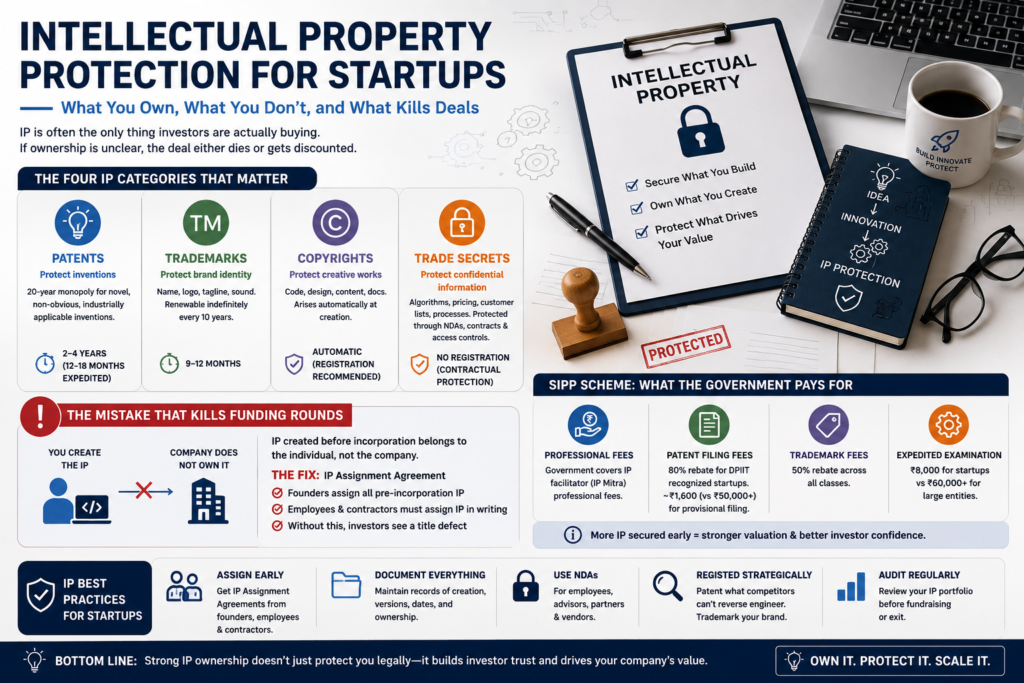
The Four IP Categories That Matter for Startups
Not all intellectual property works the same way. Each type protects something different, costs different amounts to secure, and takes a different amount of time to register.
Patents protect inventions. In India under the Patents Act, 1970, a patent grants a twenty-year monopoly on a novel, non-obvious, and industrially applicable invention. For startups in deeptech, pharma, hardware, or software with a process innovation, patents are the strongest form of protection. The tradeoff is time. Normal examination takes two to four years. Expedited examination under Rule 24C, available to DPIIT-recognised startups, compresses that to twelve to eighteen months.
Trademarks protect brand identity. The name, the logo, the tagline, the sound. Registered under the Trade Marks Act, 1999, a trademark gives the holder the exclusive right to use that mark in the specified class of goods or services. Registration takes nine to twelve months without objections. Unlike patents, trademarks are renewable indefinitely at ten-year intervals, meaning a strong brand built today is protectable forever.
Copyrights protect original creative works. Code, design assets, written content, marketing copy, product documentation. Under the Copyright Act, 1957, copyright arises automatically at the point of creation. You do not need to register it. But registration creates a public record and significantly strengthens your position in enforcement proceedings.
Trade secrets protect proprietary information that derives value from remaining confidential. Algorithms, pricing models, customer lists, manufacturing processes. There is no formal registration. Protection comes through non-disclosure agreements, confidentiality clauses in employment contracts, and internal access controls. The moment a trade secret is exposed without a contractual framework in place, protection is largely gone.
Most startups need more than one of these. A consumer tech company might trademark its brand, copyright its codebase, and treat its recommendation algorithm as a trade secret. A biotech startup might patent the molecule, copyright the clinical documentation, and trademark the product name.
The Mistake That Kills Funding Rounds
Here is the issue that surfaces in almost every tech startup’s due diligence and that founders almost never anticipate.
IP created before a company is incorporated belongs to the individual who created it, not to the company. This is not a technicality. It is how Indian law works under the Copyright Act and the Patents Act. Work created by an author in the course of employment belongs to the employer under Section 17 of the Copyright Act. But founders are not employees before the company exists. The product they built in the months before incorporation, the code they wrote, the designs they refined, the algorithm they developed, belongs to them personally.
When investors conduct due diligence, IP ownership is one of the first things they verify. If the company cannot demonstrate that it owns the technology it was built around, the investor faces a straightforward problem: they are being asked to invest in a company that does not own its core asset.
The solution is an IP Assignment Agreement, executed at or shortly after incorporation. Every founder must formally transfer all IP created for the company, including pre-incorporation work, to the company through a written assignment. This applies to freelancers and contractors too. Under Indian law, a contractor who builds a feature or a designer who creates the visual identity retains ownership unless an explicit written assignment exists.
Investors see the absence of IP Assignment Agreements as a title defect. Deals have been delayed, restructured, and walked away from over this issue. It is among the cheapest problems to fix early and among the most expensive to fix under deal pressure.
The SIPP Scheme: What the Government Actually Pays For
DPIIT-recognised startups have access to the Startup Intellectual Property Protection scheme, known as SIPP. The scheme has been extended into 2026 and is one of the more useful and underused benefits available to Indian startups.
Under SIPP, the government covers the fees of IP facilitators, called IP Mitras, a network of over 2,200 empanelled patent and trademark attorneys. The startup pays only the statutory government filing fees, not the professional fees, for any number of patents, trademarks, or design registrations.
On top of that, DPIIT-recognised startups receive an 80% rebate on patent filing fees. Standard patent filing fees for large entities run to ₹50,000 or more. For a recognised startup filing electronically, that drops to around ₹1,600 for a provisional application. The expedited examination fee under Form 18A is ₹8,000 for startups, versus ₹60,000 for large entities.
For trademark filings, the rebate is 50% across all classes. For a startup building a product with a distinct brand across multiple categories, this adds up quickly.
The practical takeaway: if you are DPIIT-recognised, your cost to file a patent with professional support is a small fraction of what a non-recognised company pays. There is no valid reason to delay filing while you are building, particularly given that novelty is destroyed the moment your invention is publicly disclosed, including in a pitch, at a demo day, or in a published article.
What Each Stage of Startup Growth Demands from IP
| Stage | Priority IP Action | Why It Matters |
| Pre-incorporation | None to file, but document everything | Timestamped records establish creation dates |
| Incorporation | IP Assignment Agreements for all founders and contractors | Clears ownership before any investor enters |
| Pre-seed / seed | Trademark the brand, provisional patent on core innovation | Establishes priority date; signals seriousness to angels |
| Series A | File complete patent, register copyright in codebase | Due diligence readiness; valuation uplift |
| Growth / Series B+ | PCT filing for international coverage, trade secret policies | Protects expansion into new markets |
How IP Protection Affects Valuation
Investors in deeptech and pharma startups routinely assign significant weight to the IP portfolio during valuation. A granted patent, or even a pending application with a strong filing date, signals that the core innovation has been independently assessed as novel and non-obvious. That changes the risk calculus.
For consumer tech or SaaS, the weight on patents is lower but not absent. What matters more is clean ownership, a registered trademark, and documented copyright in the codebase. These signal governance quality. An investor looking at two broadly comparable SaaS companies, one with clean IP documentation and one without, prices the difference.
Startups with granted patents in deeptech and pharma sectors have seen valuation premiums compared to those without IP protection, according to practitioners who work on funding rounds in these sectors. The mechanism is straightforward. A patent grants a legally defensible monopoly. That monopoly is worth money in the hands of an acquirer or a public market investor.
The inverse is also true. A startup that raises a Series A and then discovers mid-due-diligence that a former contractor built the core feature without signing an IP assignment agreement is in a difficult position. The fix, buying the rights back from the contractor or resolving the ambiguity through legal proceedings, is time-consuming, expensive, and makes the cap table and deal structure more complicated.
Trade Secrets: The Often Overlooked Option
Not every innovation should be patented. Patents require public disclosure of the invention. Twenty years of protection is valuable, but the moment a patent application is published, competitors can read exactly how the innovation works and start building around it.
For innovations where the value lies in the specific implementation rather than the underlying principle, trade secret protection is often the better choice. The most famous example globally is Coca-Cola’s formula, kept secret for over a century rather than patented. In the Indian startup context, a recommendation algorithm, a proprietary credit scoring model, or a unique logistics routing system might derive more value from remaining confidential than from a twenty-year monopoly with public disclosure.
Trade secret protection in India has no formal registration mechanism. It is built entirely through contracts and operational controls. Every employee, contractor, advisor, and investor who has access to the proprietary information should have a signed NDA and confidentiality clause. Internal access should be limited to those who need it. Departing employees should go through a structured offboarding that includes reminders of their ongoing confidentiality obligations.
The risk is that if the information leaks without a contractual framework, you have very limited legal recourse under Indian law compared to jurisdictions with dedicated trade secret statutes.
The Take Nobody Will Say Out Loud
Most Indian founders treat IP as something they will sort out before the Series A. That is the wrong mental model.
IP protection is not a funding-round checkbox. It is a founding decision. The moment a founder publicly demos a product, presents at a pitch competition, or publishes a blog post about how their technology works, they have potentially destroyed novelty on a patent they have not yet filed. The moment a contractor delivers working code without a signed IP assignment, the company has a gap in its chain of title that will surface at the worst possible time.
The SIPP scheme exists. The 80% rebate on patents exists. The IP Mitra network exists. Government support for startup IP protection is more accessible in 2026 than at any point in India’s startup history.
The bottleneck is not money or access. It is the assumption that IP can be handled later. It almost always cannot.
Frequently Asked Questions
Do I need to register copyright in India for my code to be protected? No. Copyright arises automatically at the point of creation under the Copyright Act, 1957. However, registration creates a public record and significantly strengthens your legal standing in infringement proceedings. For a startup whose core product is software, registering copyright in the codebase is inexpensive and worth doing.
What happens if a freelancer built part of my product without signing an IP assignment? Under Indian law, the freelancer retains ownership of the work they created unless a written assignment was executed. This is a title defect that investors will identify in due diligence. The fix is to approach the freelancer and get a retroactive assignment in writing. If the relationship has soured, this becomes a legal matter. Fix it before you enter a funding process.
Can I file a patent on software in India? Software as such is not patentable under the Patents Act, 1970. However, software that produces a technical effect, including a novel algorithm implemented in a system, a computer-implemented process with a specific industrial application, or a method that solves a technical problem, can be patented if framed correctly. Work with a patent attorney experienced in software patents to determine whether your innovation qualifies and how to frame the claim.
What is the SIPP scheme and how do I access it? The Startup Intellectual Property Protection scheme is a DPIIT initiative that covers the professional fees of empanelled IP attorneys for recognised startups. The startup pays only statutory filing fees, not the attorney’s professional fees. Access the scheme through the Startup India portal at startupindia.gov.in after obtaining DPIIT recognition. The scheme also provides an 80% rebate on patent filing fees and a 50% rebate on trademark filing fees for recognised startups.
Should I file a provisional or complete patent application first? A provisional application is typically the right starting point. It costs significantly less, establishes your priority date, and gives you twelve months to develop the invention further before filing the complete specification. The priority date is critical: it determines who filed first in the event of a dispute. File the provisional before any public disclosure, including pitches, conferences, or product launches.
When should a startup consider international patent protection? If you plan to expand internationally or raise capital from foreign VCs, file a PCT application within twelve months of your Indian provisional filing. A PCT application preserves your right to pursue patent protection in over 150 countries and gives you up to thirty months from the priority date to decide in which countries to proceed. Filing only in India and attempting to add international coverage later is costly and, in some cases, impossible.
How does IP protection affect what investors look for in due diligence? Investors look for clean IP ownership above all else. The company must demonstrably own its core technology, brand, and creative assets through executed assignment agreements and, where applicable, registrations. Beyond ownership, a filed or granted patent signals innovation quality. A registered trademark signals brand seriousness. Clean IP documentation signals governance maturity. All three affect both the probability of closing a round and the valuation at which it closes.
Stay in the Loop
For more stories, breakdowns, and unfiltered takes on what is really happening in Indian and global business and tech, follow TheFounder Nation.
Instagram Handle : https://www.instagram.com/thefoundernation?igsh=MTZobDUwc2xqZWdhOA==
We cover what the mainstream business press won’t.
© TheFounder Nation | All rights reserved Word count: ~1,500 | Read time: ~6 minutes Primary keyword: intellectual property protection for startups | Secondary: IP protection startups India, SIPP scheme India 2026, patent filing startup India, IP assignment agreement founder, trademark registration startup India, trade secrets startup, copyright software India, DPIIT IP rebate