


By TFN Editorial Team, The Founder Nation Editorial Team
While Western markets are still debating whether social commerce is a trend or a category, India has already built an $8.4 billion industry on WhatsApp groups and Instagram reels.
Somewhere in Indore, a woman who was selling handmade dupattas in her neighbourhood ten years ago now runs a Rs 40 lakh annual business. Her storefront is a WhatsApp catalogue. Her marketing is a network of resellers in eight states. Her logistics partner is someone she found through a Facebook group. She has never used Shopify. She doesn’t need to. She is doing social commerce, and she is part of the fastest-growing retail category in the third-largest consumer market in the world.
Sector Analysis • Social Commerce • D2C • Indian Ecosystem
Social commerce is not a feature. It is a retail model.
Social commerce is the practice of buying and selling goods directly through social media platforms, peer networks, and messaging apps, completing the transaction without leaving the social environment. It is distinct from e-commerce in one important way: the trust signal is social, not transactional. In a traditional marketplace, a buyer trusts a rating or a return policy. In social commerce, a buyer trusts a person: a friend who recommended the product, a reseller who has been selling in their WhatsApp group for two years, an influencer whose taste they follow on Instagram.
This distinction is not academic. It is why India, with its dense social networks, high trust in peer recommendations, and deep mobile-first consumer culture, has become the world’s most consequential social commerce market.
Why this story matters
India’s social commerce market reached $8.42 billion in 2025 and is projected to reach $54.3 billion by 2033, growing at a CAGR of 22.4% (IMARC Group, 2025). These numbers matter for three distinct groups. For founders in D2C, consumer internet, or marketplace categories, social commerce represents the fastest channel to Tier 2 and Tier 3 customers without the distribution cost of physical retail. For investors, it is the sector that produced Meesho, one of India’s most capital-efficient unicorns, and will produce several more. For operators at large platforms, it is the category that is quietly threatening the dominance of traditional e-commerce marketplaces.
Quick facts
| Metric | Figure | Source |
|---|---|---|
| India social commerce market size (2025) | $8.42 billion | ResearchAndMarkets/Businesswire, May 2025 |
| Projected market size by 2033 | $54.3 billion | IMARC Group, 2025 |
| CAGR (2025-2033) | 22.4% | IMARC Group, 2025 |
| India social media users (2025) | 491 million | Data Reportal via Digital Showroom, May 2025 |
| Meesho monthly active users | 120 million | Merchantspring, April 2026 |
| Meesho GMV run-rate | $5 billion+ | Merchantspring, April 2026 |
| Share of e-commerce from Tier 2 and 3 cities | 60%+ | Deloitte, cited by Entrepreneur India, November 2025 |
| Key platforms | WhatsApp, Instagram, Facebook, Meesho, Shopsy | Multiple sources |
Background
Social commerce as a formal category emerged in India around 2015, when platforms like Meesho began enabling individual entrepreneurs, primarily women in smaller cities, to resell products from supplier catalogues through their WhatsApp and Facebook networks. The model worked because it solved two problems simultaneously: suppliers in Tier 1 cities could access customers they couldn’t reach through retail or even conventional e-commerce, and resellers in Tier 2 and Tier 3 cities could earn income without capital investment or logistics infrastructure.
Between 2019 and 2022, the category formalised rapidly. Instagram’s native shopping features, WhatsApp Business API integrations, and the rise of short-form video on YouTube Shorts and Instagram Reels created new surfaces for product discovery. UPI made mobile payments frictionless. The result was a structural shift: social media evolved from a discovery channel to a complete transaction channel, with no mandatory exit to a third-party website or app.
The COVID-19 pandemic accelerated this trajectory sharply. With physical retail closed and a new cohort of first-time online buyers entering the market, social commerce became the primary entry point to e-commerce for millions of Indian consumers who found the trust signals of a known reseller more legible than a marketplace review.
Timeline
| Year | Milestone |
|---|---|
| 2015-2018 | Early adoption via reselling apps like Meesho; social selling through WhatsApp and Facebook establishes itself in Tier 2 and 3 cities |
| 2019 | Meesho raises funding from Facebook; social commerce gets formal venture backing |
| 2020 | Pandemic drives first-time digital shoppers to trust-based social channels |
| 2021 | Instagram Shops, WhatsApp Business API, and Facebook Marketplace reach mass penetration in India |
| 2021 | Flipkart launches Shopsy as a social commerce competitor to Meesho |
| 2022 | Meesho processes 910 million orders; adds support for 8 Indian languages |
| 2023 | Full-stack social commerce matures: discovery to checkout within WhatsApp and Instagram |
| 2024 | India social commerce market valued at $7.18 billion (IMARC); Tier 2 and 3 cities account for majority of transactions |
| 2025 | Market reaches $8.42 billion; live commerce, influencer-led selling, and AI-personalised social feeds become dominant channels |
How it works: the mechanics of Indian social commerce
Shift 1: The reselling model that created millions of micro-entrepreneurs
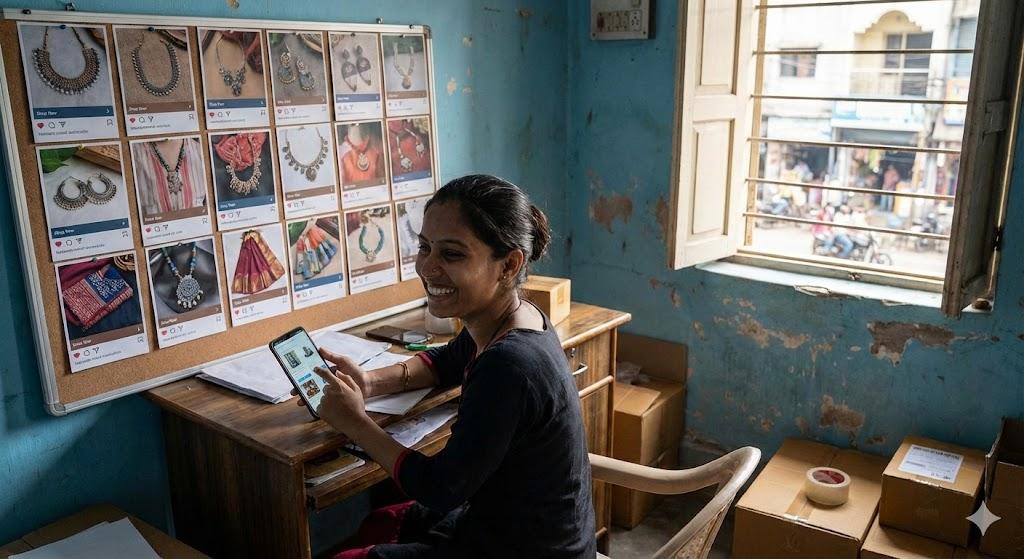
The foundational layer of Indian social commerce is the reseller network. Meesho pioneered this at scale: suppliers list their catalogue on the platform, and individual entrepreneurs, most of them women in smaller cities with existing WhatsApp groups and Facebook networks, select products, add their margin, and sell to their networks without holding inventory (IBEF, March 2021).
The model is structurally different from a conventional marketplace. The reseller is not a logistics intermediary. She is a trust intermediary. Her customers buy because they trust her judgement, not because they trust a platform rating system. This is why social commerce penetrates markets where conventional e-commerce fails: in communities where platform trust is low or digital literacy is limited, peer trust is the more legible buying signal.
Meesho’s growth to 120 million monthly active users and a $5 billion-plus GMV run-rate (Merchantspring, April 2026) is the clearest evidence that the reselling model scales. The company’s zero-commission model, serving largely unbranded products to price-conscious buyers in Tier 2 and smaller cities, created a segment that the major marketplaces, Amazon and Flipkart, had not served effectively.
or managing logistics.
Shift 2: Platform-native commerce comes to Instagram and WhatsApp
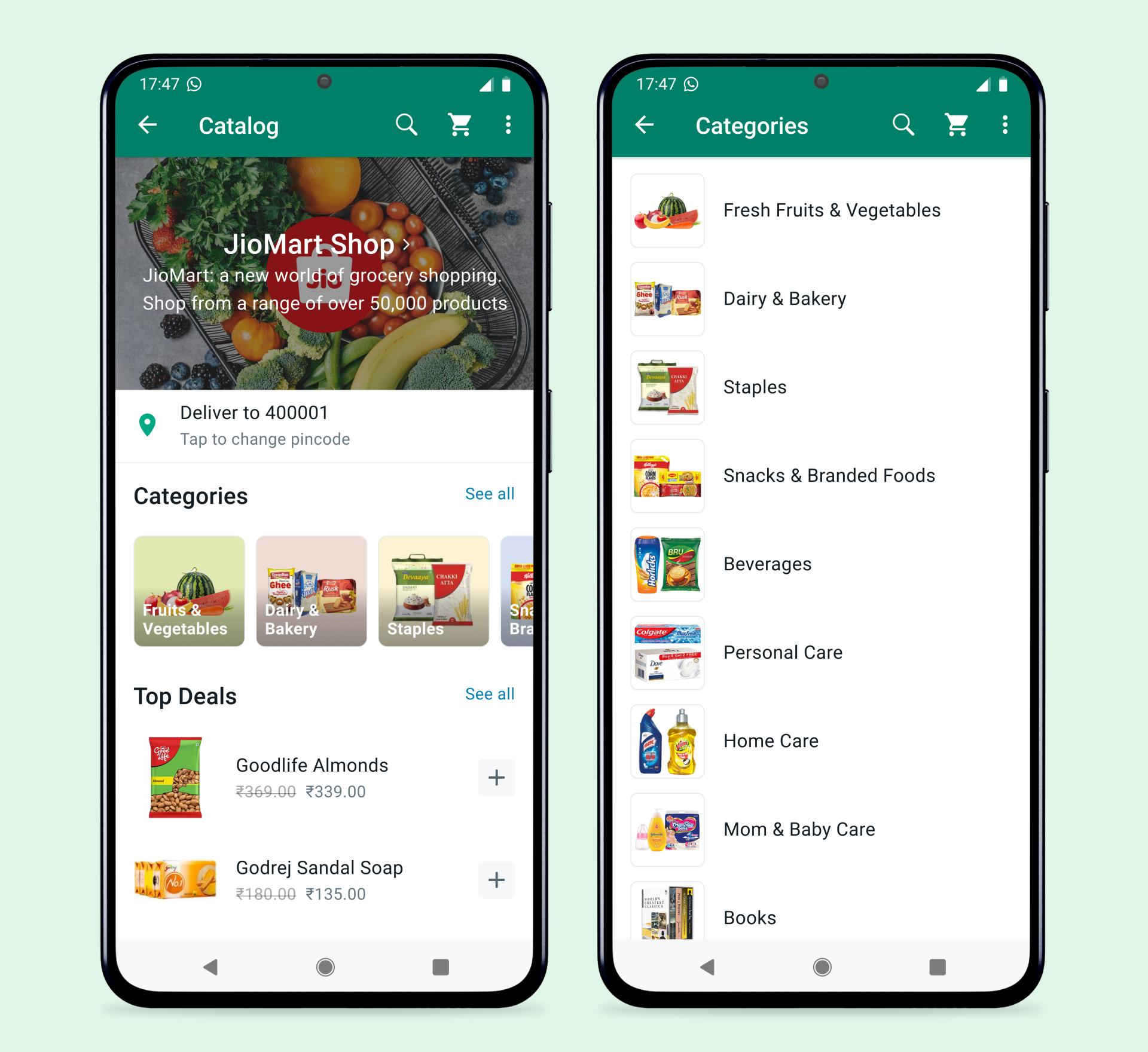
The second layer is the shift from app-based social commerce to platform-native social commerce. Instagram Shops, WhatsApp Business catalogues, and Facebook Marketplace evolved from discovery tools to complete transaction environments. Brands and individual sellers can now take a customer from first impression to payment confirmation without leaving the social app.
This matters for a specific reason: the friction between discovery and purchase is where e-commerce conversion rates collapse. Every redirect from a social post to a website costs conversion. Social commerce eliminates the redirect. Brands that leverage Instagram’s shoppable posts and WhatsApp checkout features report materially higher conversion rates than those driving social traffic to external sites.
The integration of UPI into social payment flows is the critical enabler. India’s UPI infrastructure is the only mass-market payment system in the world that makes in-app social payments both frictionless and trusted. Without it, the social-to-payment journey would require credit card entry or OTP flows that would break the social context. UPI preserves it.
Shift 3: Live commerce, video selling, and influencer networks
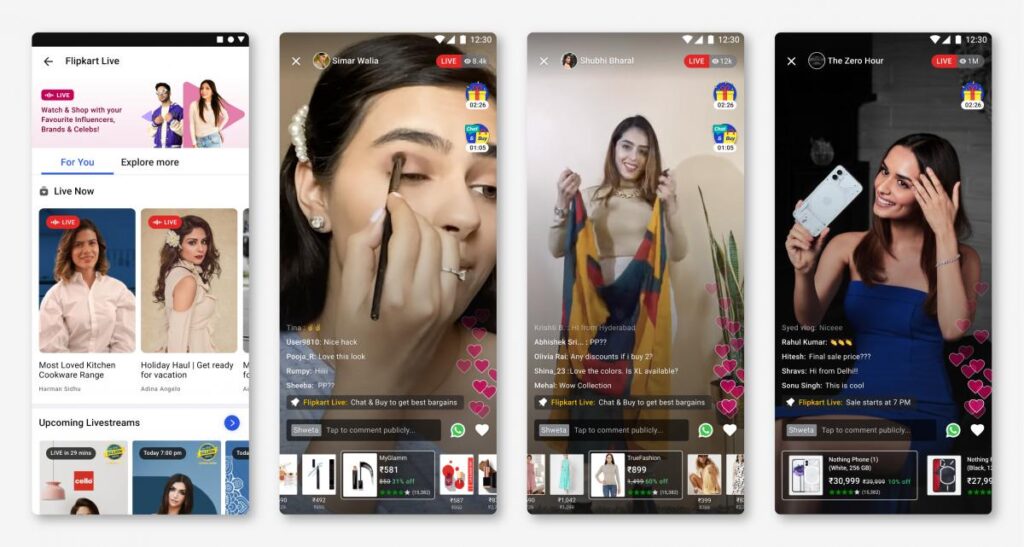
The most recent and fastest-growing channel within Indian social commerce is live commerce: real-time video selling where a host demonstrates products and viewers purchase immediately within the stream. Meesho’s interactive live sessions, YouTube Shorts selling integrations, and Instagram Live product drops have established a model that combines entertainment and retail in a format that Tier 2 and 3 consumers have adopted faster than most platform analysts predicted (IMARC Group, 2025).
The creator economy is the distribution network that makes this possible. India’s creator-influenced consumer spend is estimated at $400 billion (Entrepreneur India, November 2025), driven by 800-900 million Indians online who are deeply engaged with local-language content creators across YouTube, Instagram, and Moj. When a creator in Patna recommends a skincare product to 200,000 followers in Bihar, the trust dynamic is fundamentally different from a banner ad. The purchase signal travels through a social relationship, not an advertising algorithm.
By the numbers
- India’s social commerce market was valued at $8.42 billion in 2025 and is projected to reach $54.3 billion by 2033 at a CAGR of 22.4% (IMARC Group, 2025).
- Over 60% of India’s e-commerce transactions now originate from Tier 2 and Tier 3 markets, with social commerce as the primary acquisition channel (Deloitte, cited by Entrepreneur India, November 2025).
- Meesho, the category-defining platform, has 120 million monthly active users and a GMV run-rate exceeding $5 billion (Merchantspring, April 2026), operating a zero-commission model targeting value shoppers in smaller cities.
- India has 491 million social media users as of 2025 (Data Reportal, 2025), the second-largest social media user base globally, creating the surface area for social commerce at a scale unmatched by any other market.
- The Mordor Intelligence estimate places India’s social commerce market at $29.27 billion by 2025 on a higher CAGR basis of 37.5%, with growth projected to $143.86 billion by 2030 (Mordor Intelligence, December 2025), reflecting significant variance in how analysts define social commerce scope.
Comparison: social commerce models in India
| Model | Mechanism | Primary platform | Key player | Best for |
|---|---|---|---|---|
| Reselling | Resellers share supplier catalogues to personal networks | WhatsApp, Facebook | Meesho, GlowRoad | Unbranded goods, Tier 2-3 penetration |
| Platform-native commerce | Buy within social app, no redirect | Instagram, Facebook | Meta-enabled brands | Urban branded D2C |
| Live commerce | Real-time video selling with in-stream checkout | Instagram Live, Meesho Live, YouTube | Meesho, D2C brands | High-engagement categories (fashion, beauty) |
| Influencer-led D2C | Creator recommends; follower buys via link or DM | Instagram, YouTube Shorts | D2C brands across categories | Trust-driven category entry |
| Group buying | Community purchases at volume discount | WhatsApp groups | DealShare (pre-shutdown), CityMall | FMCG, grocery |
What competitors missed
Traditional e-commerce marketplaces, Amazon and Flipkart specifically, built their trust infrastructure on platform-level signals: seller ratings, return policies, delivery guarantees, and customer reviews. This model works well for urban, digitally confident buyers who are comfortable evaluating unknown sellers.
It does not work as well for the 400 million Indians who became internet users between 2016 and 2022, many of whom shop in vernacular languages, have limited prior experience with online retail, and rely primarily on personal networks for product recommendations. Social commerce platforms understood this. They built trust into the person rather than the platform.
The implication is structural: social commerce is not a feature that Amazon or Flipkart can simply add. It requires a different relationship with the buyer, one built on peer networks rather than algorithmic curation. Flipkart’s Shopsy, launched in 2021 as a social commerce response to Meesho, has gained traction but has not replicated Meesho’s network density in Tier 2 and 3 cities, because Meesho had a four-year head start in building reseller relationships at the community level.
Risks and challenges
- Platform dependency is structural risk. Social commerce businesses built entirely on WhatsApp or Instagram are exposed to unilateral changes in platform policy, algorithm, or commerce fees. Meta has moved WhatsApp Business from free to paid tiers before, and can do so again.
- Trust is personal, not scalable. The core advantage of social commerce, peer trust, is also its scaling constraint. The reseller network that makes Meesho work requires continuous recruitment and retention of individual sellers, each of whom is a micro-business that could churn.
- Returns and quality control are harder to manage. In a reseller model with unbranded products, quality consistency is difficult to enforce. Consumer disputes in social commerce are harder to mediate than marketplace disputes, where the platform is the formal counterparty.
- Logistics infrastructure in Tier 3 and below remains a constraint. The demand side of social commerce has reached districts that the logistics side has not. Last-mile delivery to small towns and rural areas is expensive and unreliable, creating a ceiling on order volume from these markets.
- Regulatory uncertainty around social media commerce is rising. The Consumer Protection (E-commerce) Rules and the Digital Personal Data Protection Act create compliance requirements that small resellers cannot easily navigate, potentially concentrating the market in platforms that can absorb compliance cost.
What founders can learn
- Trust is a distribution mechanism. Social commerce works because peer trust converts better than platform trust in new-to-digital markets. Any founder building for India’s next 200 million internet users should design their trust architecture before their product architecture.
- The reseller network is an asset class. Meesho’s 120 million MAU base did not come from advertising spend. It came from building a reseller network that each individually recruited her own customers. Founders who can identify and activate existing social network effects in their category have a distribution advantage that capital cannot easily replicate.
- Vernacular is not a feature. It is a market. Platforms that added regional language support, Meesho (8 languages in 2022), Shopsy (Tamil and Telugu), consistently outperformed in markets they entered with language-first positioning. Building for English-only is building for a fraction of the available market.
- UPI is the infrastructure that makes social commerce viable. Any commerce product that doesn’t integrate UPI payments natively is adding friction in the most conversion-sensitive part of the customer journey. UPI integration is not an enhancement; it is a prerequisite.
- Live commerce is the next reseller network. The shift from catalogue reselling to live selling is happening faster than most founders expect. Founders in categories with high visual appeal or demonstration value should be building live commerce capabilities now, not after the channel has been commoditised.
Expert analysis
The reason India is social commerce’s biggest market is not because Indians are inherently more social than other consumers. It is because India has the specific combination of conditions that makes social commerce the rational format: a large first-time-online consumer base with low platform trust, deep penetration of messaging apps (specifically WhatsApp with its 500-million-plus Indian users), the most frictionless mobile payment infrastructure in the world via UPI, and a creator economy that generates trust at scale across hundreds of local languages and communities.
China was the first large market to demonstrate social commerce at scale, primarily through WeChat and Pinduoduo’s group-buying model. But China’s social commerce is built on a super-app infrastructure that India has not yet produced, despite Jio’s ambitions. India’s social commerce is more distributed: it runs across WhatsApp, Instagram, Facebook, YouTube, and Meesho simultaneously, which creates resilience but also makes it harder to consolidate into a single platform. For the Indian consumer, this distributed structure is a feature; for the platform operator trying to own social commerce, it is the central competitive challenge.
Future outlook
The next phase of Indian social commerce will be determined by three developments. First, the integration of AI-driven product recommendation into social feeds will accelerate the discovery-to-purchase journey for categories where the buyer does not know exactly what they want. Second, live commerce infrastructure will mature: dedicated live-selling apps, better logistics for live-order fulfillment, and creator monetisation tools will make live selling viable for a much broader set of category types beyond fashion and beauty. Third, the B2B layer of social commerce, MSMEs using WhatsApp and Instagram to acquire business customers and take payments, will grow as the GST e-invoice infrastructure aligns with social commerce transaction data.
The constraint that will determine how quickly these developments compound is logistics. Until last-mile delivery reliability reaches the districts where social commerce demand already exists, the market will be limited by fulfillment rather than by demand. Founders building in logistics for Tier 3 and rural India are solving the binding constraint in the country’s most important new retail channel.
The bottom line
India is social commerce’s biggest market not by accident but by architecture: the right payment infrastructure, the right trust dynamics, the right language diversity, and the right demographic profile converged at the same moment that mobile internet became ubiquitous. The category is $8.4 billion today and tracking toward $54 billion by 2033. The founders who build for this market understand that the product is the trust, and the distribution is the person.
Key takeaways
- Social commerce is the practice of selling directly through social platforms and peer networks, where the trust signal is personal rather than transactional.
- India’s social commerce market reached $8.42 billion in 2025 and is projected to reach $54.3 billion by 2033, growing at a CAGR of 22.4%.
- Meesho’s reseller model, enabling individuals to sell through WhatsApp and Facebook without inventory, created the category’s foundational playbook in India and produced 120 million monthly active users and $5 billion-plus in GMV.
- India is the global leader in social commerce because of a specific combination: 491 million social media users, UPI’s frictionless mobile payments, deep WhatsApp penetration, and a first-time-online consumer base that trusts people more than platforms.
- Over 60% of Indian e-commerce transactions now originate from Tier 2 and Tier 3 markets, with social commerce as the primary acquisition channel for these consumers.
- Live commerce is the fastest-growing social commerce format, combining entertainment with real-time purchasing and matching the consumption habits of India’s creator-economy audience.
- Platform dependency, trust scalability, and last-mile logistics are the structural constraints limiting the category’s ceiling.
Conclusion
Social commerce is the category that proves India’s consumer internet does not have to follow the Western playbook. The model that works here, peer trust networks, reseller economics, vernacular content, WhatsApp-first transactions, is a product of India’s specific market conditions rather than an import from Silicon Valley or Shenzhen. The founders who understood this earliest built Meesho. The founders who understand it now are building the next wave of social commerce infrastructure: live selling tools, reseller CRMs, vernacular creator monetisation platforms, and logistics for the districts that platform-based e-commerce hasn’t reached. The market is large enough for several of them to succeed.
TFN LENS
Indian social commerce is one of those categories where the most important business insights came not from MBA case studies but from observing how women in Tier 2 cities run micro-businesses in WhatsApp groups. The founders and VCs who paid attention to those users, rather than benchmarking India to Western e-commerce models, built the most valuable companies in the category. The next generation of social commerce opportunity is in the infrastructure behind these networks: the tools, logistics, payments, and AI that make the existing trust networks faster, more reliable, and more profitable for the people running them.
Building something of your own? Follow The Founder Nation and NamasteVC for curated startup funding news, grant alerts, and founder stories from India’s startup ecosystem, delivered straight to your feed, every week.
Frequently asked questions
What is social commerce?
Social commerce is the practice of buying and selling goods directly through social media platforms, messaging apps, and peer networks, completing the transaction without leaving the social environment. Unlike traditional e-commerce, where a buyer evaluates a product on a marketplace, social commerce transactions are triggered by peer recommendations, influencer endorsements, or reseller relationships. The trust signal is personal rather than transactional.
Why is India the biggest market for social commerce?
India leads in social commerce because of a specific combination of structural conditions: 491 million social media users, deep WhatsApp penetration, the UPI payment infrastructure that makes in-app mobile payments frictionless, a large first-time-online consumer base that trusts peer recommendations more than platform ratings, and a creator economy that influences an estimated $400 billion in consumer spending. No other market has all five of these conditions at comparable scale simultaneously.
What is the social commerce market size in India?
India’s social commerce market reached $8.42 billion in 2025 and is projected to reach $54.3 billion by 2033, growing at a CAGR of 22.4%, according to IMARC Group. Mordor Intelligence uses a broader market definition and estimates $29.27 billion by 2025, reflecting different scope boundaries around what constitutes a social commerce transaction.
How does Meesho’s social commerce model work?
Meesho operates as a platform connecting suppliers with individual resellers. Suppliers list their product catalogues on Meesho; resellers, typically individuals with WhatsApp groups and Facebook networks, browse the catalogue, select products, add their margin, and share to their personal networks. The customer orders through the reseller, who fulfills through Meesho’s logistics and supplier network. The reseller earns the margin without holding inventory or managing logistics. This model has scaled to 120 million monthly active users and a $5 billion-plus GMV run-rate.
What is live commerce?
Live commerce is a form of social commerce where a seller or creator demonstrates products in a real-time video stream and viewers can purchase immediately within the stream, without leaving the app. Platforms like Meesho Live, Instagram Live, and YouTube enable this format. It combines the trust of a real-time demonstration with the convenience of in-app purchase, and has been adopted rapidly in India’s fashion, beauty, and home goods categories.
How can founders build a social commerce business in India?
Founders entering Indian social commerce should prioritise three decisions: trust architecture (who the buyer will trust and how to operationalise that trust at scale), vernacular access (which regional languages and platforms matter for their target consumer), and UPI integration (mobile payment must be in-app and frictionless). The distribution model, whether reseller networks, creator partnerships, or platform-native listings, should follow from the trust architecture, not precede it.
© 2026 The Founder Nation. All rights reserved.