
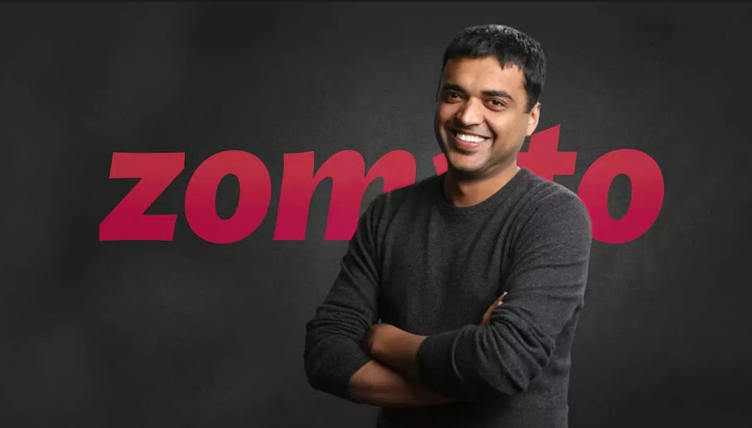
Deepinder Goyal founded Zomato in 2008, transforming a simple restaurant discovery platform into one of India's largest food-tech companies.
Discover how Deepinder Goyal transformed a simple restaurant menu directory into Zomato, one of India’s largest listed internet companies, reshaping food delivery and quick commerce.
Written by TFN Research Desk | covering startups, technology, venture capital, and business strategy.
Table of Contents
- Who is Deepinder Goyal?
- Early Life and Education
- Career Before Zomato
- How Zomato Started
- Funding History
- Revenue Growth and Recent Challenges
- Public Recognition
- Zomato vs Competitors
- Investor Perspective
- Founder Timeline
- Key Takeaways
- FAQs
- Sources
Who is Deepinder Goyal?
Deepinder Goyal is the founder of Zomato, now Eternal Limited, India’s largest listed food-delivery and quick-commerce company. An IIT Delhi graduate in Mathematics and Computing, he built the business out of a simple frustration, long lunch queues at his first job, and led it for eighteen years before stepping down as Group CEO in February 2026 to pursue new ventures, remaining on the board as Vice Chairman. He can be reached via Zomato, LinkedIn, and X.
Early Life and Education
Goyal was born on 26 January 1983 in Muktsar, Punjab, into a middle-class family; his father worked as a teacher. He studied at DAV College, Chandigarh, before joining IIT Delhi in 2001, where he pursued an Integrated M.Tech in Mathematics and Computing, graduating in 2005. Not publicly disclosed is any specific childhood venture, though he has spoken of an early lapse in judgement, an admitted attempt to cheat in school, as a formative lesson.
Career Before Zomato
After graduating, Goyal joined Bain & Company as a Senior Associate Consultant in January 2006. While waiting in long lunch queues with colleagues, he and fellow Bain analyst Pankaj Chaddah built an internal website listing restaurant menus on the company intranet to save time. The tool caught on faster than expected inside Bain’s Delhi office, convincing Goyal there was a real business in digitising restaurant discovery.
How Zomato Started
In 2008, Goyal and Chaddah launched Foodiebay, an online directory of scanned restaurant menus for Delhi NCR. Within nine months it had become the region’s largest restaurant directory, proof that consumers wanted searchable menus rather than phone calls and guesswork. In 2010, the company rebranded as Zomato to reflect broader ambitions, and it soon expanded internationally into markets including the UAE, South Africa, and Canada, before adding food delivery in 2015.
Funding History
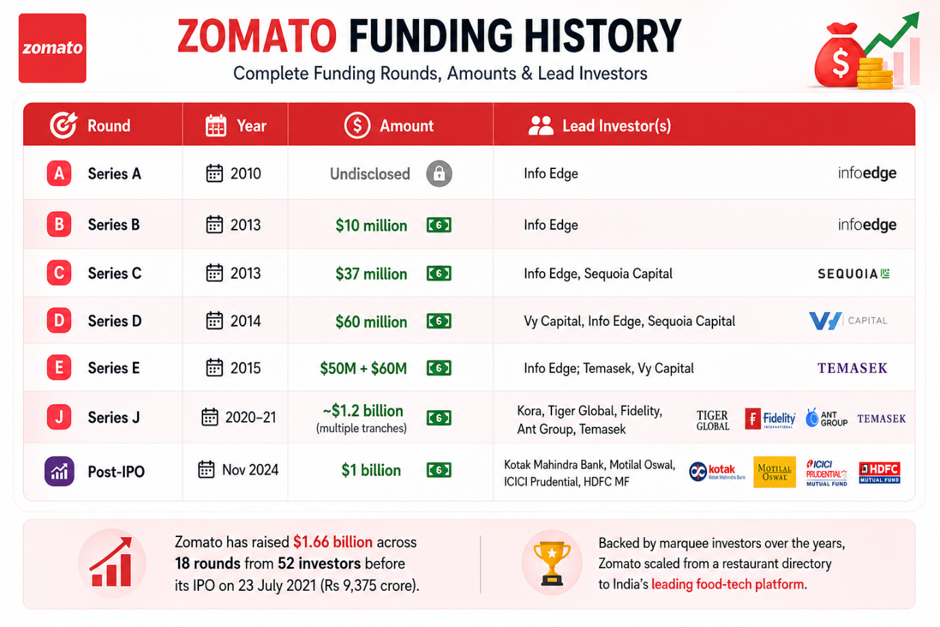
Zomato has raised $1.66 billion across 18 rounds from 52 investors, per Tracxn, before going public on the NSE and BSE on 23 July 2021 through a Rs 9,375 crore IPO.
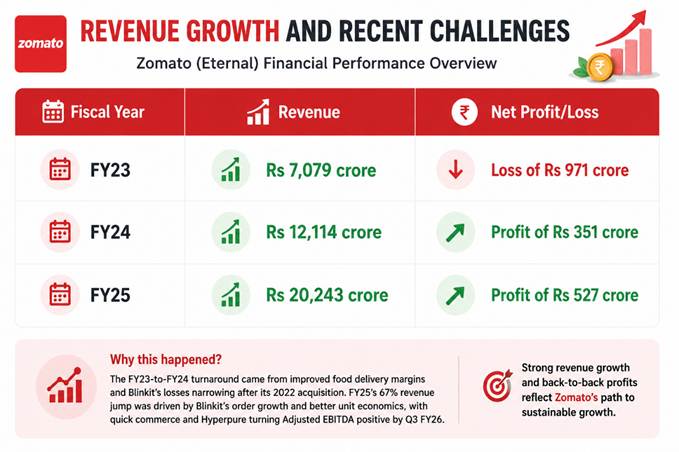
Why this happened:
The FY23-to-FY24 turnaround came largely from food delivery reaching healthier margins and Blinkit’s losses narrowing after its 2022 acquisition. FY25’s 67% revenue jump was driven by continued growth in Blinkit’s order volumes and improving food delivery economics, with quick commerce and Hyperpure both turning Adjusted EBITDA positive by Q3 FY26, according to the company’s own disclosures.
Public Recognition
Goyal won The Economic Times Startup of the Year Award in 2011, the Business Today Young Business Leader Award in 2012, IIT Delhi’s Distinguished Alumni Award in 2018, and the GQ Men of the Year Award in 2019. He featured in Fortune India’s 40 Under 40 list in 2020 and joined Shark Tank India as a judge from its third season in 2024.
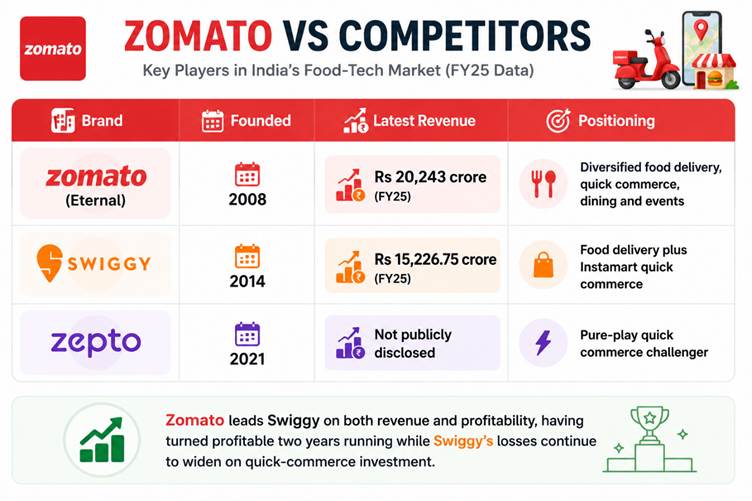
years running while Swiggy’s losses continue to widen on quick-commerce investment.
Investor Perspective
Goyal’s qualification rested on spotting a real, felt inefficiency and building a durable business around it. His strengths include first-mover advantage in Indian food-tech, a diversified revenue base after the Blinkit acquisition, and rare profitability among Indian internet companies at this scale. The risks include thin food delivery margins and Blinkit’s continuing cash needs, though both areas have shown improving unit economics. His February 2026 exit as CEO introduces a fresh variable: whether Albinder Dhindsa, promoted from running Blinkit, can sustain the group’s momentum without Goyal in the operating seat, even as Goyal himself stays on as Vice Chairman focused on long-term strategy and governance.
Founder Timeline
- 2005 — Graduates IIT Delhi, Mathematics and Computing
- 2006 — Joins Bain & Company
- 2008 — Co-founds Foodiebay with Pankaj Chaddah
- 2010 — Rebrands company as Zomato
- 2021 — Lists on NSE and BSE via Rs 9,375 crore IPO
- 2022 — Acquires Blinkit; company later rebranded Eternal Limited
- 2025 — Reports Rs 527 crore net profit on Rs 20,243 crore revenue
- 2026 (Feb) — Steps down as Group CEO, becomes Vice Chairman; Albinder Dhindsa takes over
- 2026 — Backs LAT Aerospace (regional air mobility) and launches wearable brain-tech startup Temple
Key Takeaways
- Zomato began as an internal tool solving a problem Goyal experienced personally at work, a reminder that founder-market fit often starts small.
- Acquiring Blinkit diversified revenue beyond food delivery at a time when growth in that core segment was slowing.
- Zomato’s return to profitability in FY24 and FY25 stands out in an Indian internet sector still dominated by losses.
- Goyal’s 2026 exit from the CEO role, after eighteen years, shows a founder deliberately choosing to pursue higher-risk ventures outside a listed company rather than staying indefinitely.
- His post-Zomato bets, LAT Aerospace and Temple, suggest an appetite for frontier technology far removed from food delivery.
FAQs
Who founded Zomato?
Deepinder Goyal and Pankaj Chaddah, in 2008, originally as Foodiebay.
Is Deepinder Goyal still CEO of Zomato?
No. He stepped down as Group CEO of Eternal (Zomato’s parent) effective 1 February 2026 and now serves as Vice Chairman, with Blinkit founder Albinder Dhindsa as the new Group CEO.
How much funding did Zomato raise?
$1.66 billion across 18 rounds, per Tracxn, before its 2021 IPO.
Is Zomato profitable?
Yes, as of FY25, with a consolidated net profit of Rs 527 crore.
What is Deepinder Goyal’s net worth?
Estimated at over Rs 8,300 crore as of 2025, based on his stake in the company.
Who are Zomato’s main investors?
Info Edge, Sequoia Capital (Peak XV Partners), Tiger Global, Fidelity, Temasek, and Ant Group.
What did Zomato acquire to expand beyond food delivery?
Blinkit, the quick-commerce platform, acquired in an all-stock deal in 2022.
What is Deepinder Goyal working on now?
LAT Aerospace, a regional air-mobility startup he co-founded with Surobhi Das, and Temple, a wearable brain-tech company that raised $54 million in early 2026.
What makes Zomato different from Swiggy?
Zomato has reached sustained profitability across two fiscal years while Swiggy continues to post widening losses, largely from heavier quick-commerce investment.
Sources
- https://alumni.iitd.ac.in/distinguished-alum-award/388
- https://tracxn.com/d/companies/zomato/__p0YjM7Dg5D5Q7x0V9rM4I8i8M6v6t6k6Y4Q5v0lA6c
- https://entrackr.com/?s=Zomato
- https://www.medianama.com/?s=Eternal+FY25
- https://www.indmoney.com/blog/stocks/swiggy-q4-results
https://www.indianretailer.com/ - https://www.business-standard.com/companies/people/deepinder-goyal-eternal-zomato-ceo-126012100845_1.html
- https://www.entrepreneur.com/en-in
- https://inc42.com/?s=LAT+Aerospace
- https://techfundingnews.com/?s=Temple+Deepinder+Goyal
© The Founder Nation | All rights reserved | Written by TFN Research Desk