

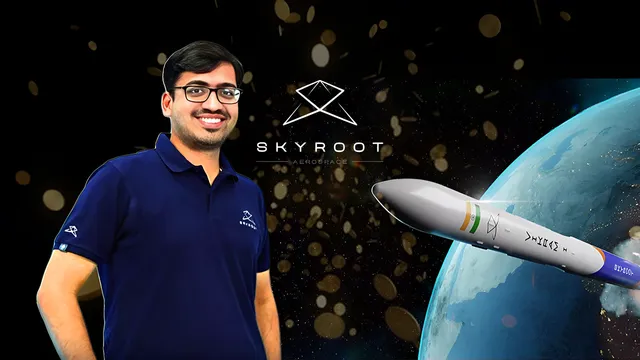
Pawan Kumar Chandana and Naga Bharath Daka founded Skyroot Aerospace in 2018, building India's first private rocket company and the country's first SpaceTech unicorn.
Written by TFN Research Desk | covering startups, technology, venture capital, and business strategy.
Table of Contents
- Quick Facts
- Introduction
- The Skyroot Story
- Business Model
- How Skyroot Makes Money
- Funding History
- Revenue and Performance
- Key Takeaways
- FAQs
- Sources
Quick Facts
Pawan Kumar Chandana: Co-founder and CEO, former ISRO scientist. Naga Bharath Daka: Co-founder. Founded: 2018. Company type: Commercial space launch vehicle manufacturer. Valuation: $1.1 billion (May 2026). Status: India’s first space-tech unicorn. Headquarters: Hyderabad, Telangana.
Introduction
Pawan Kumar Chandana and Naga Bharath Daka founded Skyroot Aerospace in 2018, creating India’s first commercial space launch company. Starting with ten ISRO scientists and academics, Skyroot developed the Vikram-S suborbital rocket and Vikram-1 orbital launch vehicle. The company raised $160 million across 11 funding rounds, achieving unicorn status in May 2026 with $1.1 billion valuation. Skyroot became India’s first space-tech unicorn and most-funded private space firm. The company launched India’s first privately built rocket (Vikram-S, November 2022) and prepared Vikram-1 orbital mission (July 2026). Skyroot targets Rs 977 crore revenue by FY27 serving global small-satellite market. This profile covers Chandana’s journey from ISRO scientist to space entrepreneur and Skyroot’s rocket development trajectory.
The Skyroot Story
Pawan Kumar Chandana worked as ISRO scientist recognizing fundamental gap: small satellite operators lacked affordable, dedicated launch options. International providers like Rocket Lab dominated this segment, but no Indian company offered comparable capabilities. In 2018, Chandana and Naga Bharath Daka founded Skyroot Aerospace with mission to democratize space access.
Starting with ten individuals, Skyroot assembled team combining ISRO experience with startup agility. The company was incubated in T-Hub and supported by government initiatives fostering emerging technology entrepreneurship. Skyroot’s first milestone came with successful Vikram-S launch in November 2022, making history as India’s first privately built rocket reaching space. The achievement validated Skyroot’s technology and engineering prowess.
Following Vikram-S success, Skyroot accelerated Vikram-1 development—orbital launch vehicle carrying 350 kg payloads to low Earth orbit. Teknologibroker breakthrough came through proprietary Dhawan engines. In February 2026, Skyroot completed successful Dhawan-III engine testing demonstrating advanced additive manufacturing. By 2024, Skyroot employed 500+ people and established itself as India’s leading private space firm.
In April 2025, Telangana government signed MOU establishing private rocket manufacturing facility with Rs 500 crore investment. Government backing eliminated hardware constraints. In May 2026, Skyroot raised $60 million at $1.1 billion valuation achieving unicorn status. Ram Shriram (Sherpalo Ventures founder, Alphabet board member) joined Skyroot’s board signaling global tech leadership confidence.
Business Model
- Orbital launch services (dedicated and rideshare)
- Vikram-1 orbital launch vehicle
- Customized orbital injection capabilities
- Indigenous Dhawan-series cryogenic engines
- Advanced guidance and flight control systems
- Global customer base (Southeast Asia, Japan, USA, Europe)
How Skyroot Makes Money
- Per-launch pricing for satellite missions
- Rideshare launch participation fees
- Customized orbital requirement pricing
- Long-term launch contracts
- Mission planning services
- Launch pad and facility utilization
Funding History
| Round | Year | Amount | Lead Investors |
|---|---|---|---|
| Seed/Angel | 2018-2020 | Undisclosed | Space-focused angels |
| Series A | 2021 | Undisclosed | Early VC investors |
| Series B | 2023-2024 | Multiple tranches | Various VCs |
| Series B Final | 2026 | $60M | GIC, Sherpalo Ventures |
Skyroot raised $160 million across 11 rounds from 27 institutional and 8 angel investors achieving unicorn status.
Revenue and Performance
- Team: 912 employees (April 2026)
- Planned scale: 5,749 employees by FY32
- Revenue target: Rs 977 crore by FY27
- EBITDA target: Rs 285 crore by FY29
- Launch frequency: 4-6 missions for FY26-27
- Vikram-1 maiden flight: July-August 2026 (Mission Aagaman)
Key Takeaways
- Pawan Kumar Chandana and Naga Bharath Daka founded Skyroot in 2018
- Achieved India’s first space-tech unicorn status (May 2026, $1.1B)
- Raised $160 million from tier-1 global investors
- Launched Vikram-S in November 2022—India’s first private rocket
- Developed proprietary Dhawan-series cryogenic engines
- Targets Rs 977 crore revenue by FY27
- Operating across India, USA, Europe, Middle East, and Southeast Asia
- 912 employees with plans to scale to 5,749 by FY32
- Strategic partnerships with Axiom Space and Telangana government
FAQs
Who founded Skyroot Aerospace?
Pawan Kumar Chandana (CEO) and Naga Bharath Daka (Co-founder) founded Skyroot in 2018.
When was Skyroot founded?
Skyroot was founded in 2018 by former ISRO scientists.
What is Skyroot’s current valuation?
$1.1 billion (Rs 10,600 crore) as of May 2026.
How much funding has Skyroot raised?
$160 million across 11 funding rounds achieving unicorn status.
When will Vikram-1 launch?
Vikram-1 maiden flight scheduled for July-August 2026 (Mission Aagaman).
What is Vikram-1?
Orbital launch vehicle carrying 350 kg payloads to low Earth orbit using advanced cryogenic engines.
How many employees does Skyroot have?
912 employees (April 2026) with plans to reach 5,749 by FY32.
What are Dhawan engines?
Proprietary cryogenic engines using advanced additive manufacturing for cost-effective reliable propulsion.
Why is Skyroot significant?
Skyroot became India’s first space-tech unicorn validating India’s commercial space capability.
Does Skyroot serve international customers?
Yes. One-third domestic demand, two-thirds international across Southeast Asia, Japan, USA, and Europe.
Sources
- Business Standard: https://www.business-standard.com/companies/news/skyroot-unicorn-2026/
- Wikipedia: https://en.wikipedia.org/wiki/Skyroot_Aerospace
- Tracxn: https://tracxn.com/d/companies/skyroot/
©️ The Founder Nation | Written by TFN Research Desk