

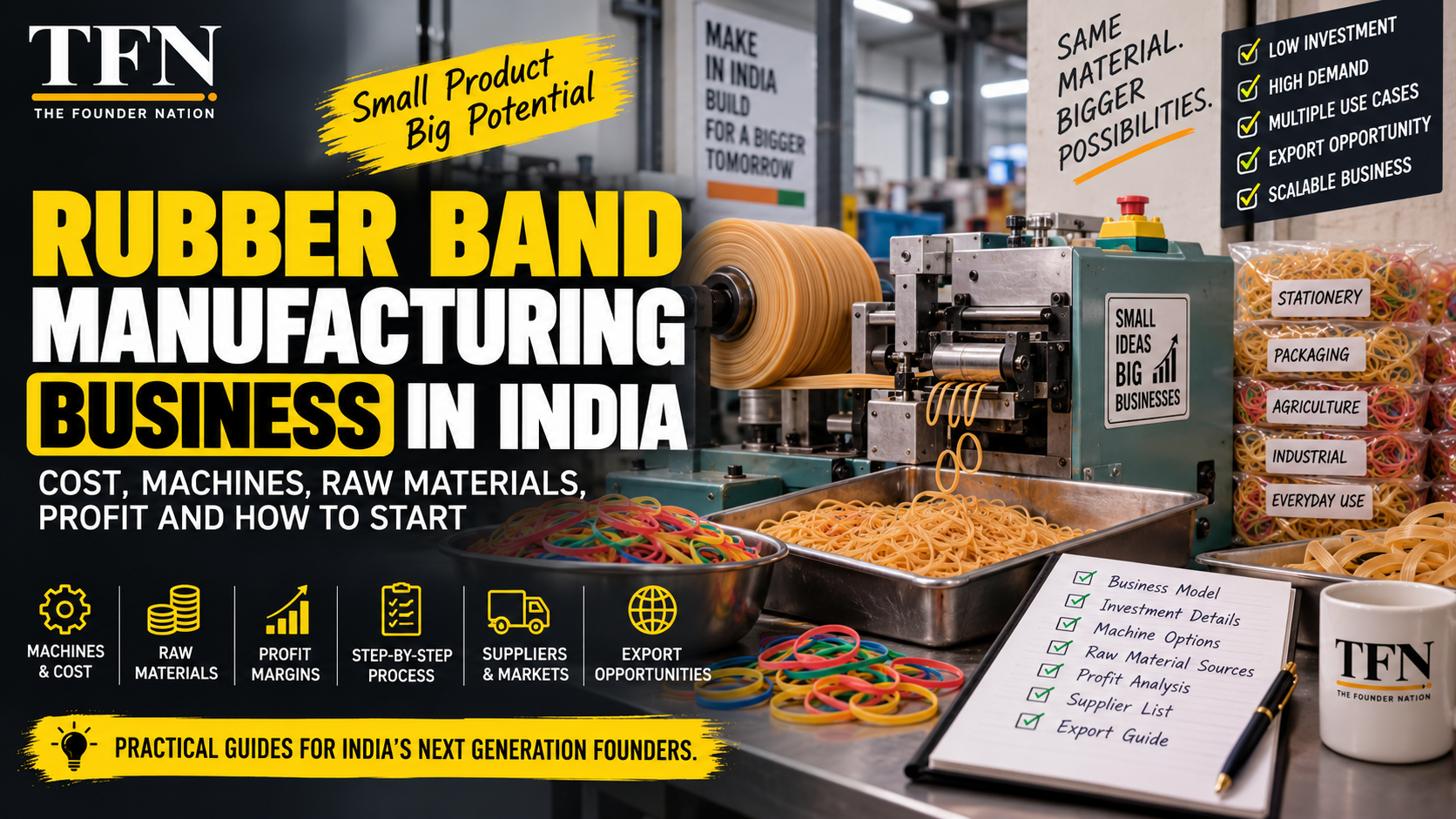
Rubber band manufacturing business in India: machine cost, raw materials, production process and profit potential.
A rubber band manufacturing business can look deceptively simple. The finished product is tiny, inexpensive and found everywhere, but producing it consistently requires the right raw material, machinery, formulation, curing process, quality control and distribution network.
Rubber bands are used in packaging, stationery, agriculture, logistics, retail, office supplies and several industrial applications. The global rubber bands market has been estimated to grow at roughly 4% to 5% annually in recent market research, although estimates vary depending on how the market is defined.
That makes this an interesting small-manufacturing opportunity, but there is an important catch.
A small rubber-band cutting unit and a complete rubber-band manufacturing plant are not the same business.
This guide breaks down both models, including machinery, raw materials, investment, manufacturing process, pricing, margins, suppliers, compliance and the mistakes a new entrepreneur should avoid.
Is Rubber Band Manufacturing a Good Business?
The first attraction is simple: rubber bands are a repeat-use consumable product.
A single customer may buy them repeatedly because businesses use them for:
- Packaging
- Bundling
- Stationery
- Agriculture
- Newspapers and postal handling
- Retail packaging
- Textile applications
- Office supplies
- Industrial bundling
- Household use
The product is also available in different diameters, widths, thicknesses, colours and formulations.
This creates an opportunity to sell different SKUs rather than relying on one commodity product.
However, rubber bands are also a price-sensitive product.
That means your competitive advantage cannot simply be:
“I will make rubber bands.”
You need to compete on at least one of these:
Price + quality + consistency + packaging + delivery + specialization.
The Biggest Misconception About This Business
A viral business reel may make it sound like the process is:
Buy cheap rubber tube → cut it → sell it at a much higher price.
That model does exist.
But it is essentially a conversion and cutting business, not a complete rubber manufacturing plant.
A full manufacturing operation can involve:
Rubber/latex → compounding → extrusion or sheet formation → vulcanization → cutting → sorting → packaging
Industry project material describes rubber-band manufacturing as involving processes such as compounding, extrusion, vulcanization and cutting.
The distinction matters because the machinery, capital requirement, technical expertise and operating costs are completely different.
Two Ways to Start a Rubber Band Business
Model 1: Rubber Tube Cutting Unit
This is the lower-capital model.
You purchase already-processed rubber tubes or suitable rubber tubing and use a cutting machine to produce bands of the required width.
The workflow can be:
Ready rubber tube → feeding → calibrated cutting → sorting → weighing → packaging → dispatch
A current Indian machine listing from ARS Engineering shows a semi-automatic rubber band cutting machine priced at around ₹75,000, with a stated capacity of up to 40 kg/hour. The manufacturer lists 2 kW power consumption and tube/ring cutting applications.
Another Indian marketplace listing shows rubber-band cutting machines in the approximate ₹65,000 to ₹75,000 range.
This is where the reel’s ₹75,000 machine figure has some support.
But there is a major difference between:
Machine price = ₹75,000 and Business setup = ₹75,000.
You still need working capital, raw material, packaging, electricity, rent, labour, transport, maintenance, rejected stock and customer acquisition.
Model 2: Full Rubber Band Manufacturing Plant
The second model starts much earlier in the production chain.
Instead of purchasing finished rubber tubes, the entrepreneur processes rubber or latex into the required material.
A typical industrial process can involve:
- Raw material preparation
- Compounding
- Mixing
- Milling
- Extrusion or sheet formation
- Vulcanization
- Cooling
- Cutting
- Sorting
- Quality inspection
- Packaging
A current 2026 IMARC industry project report identifies compounding, extrusion, vulcanization and cutting as core processes and notes that machinery can include mixers, calenders, extruders, vulcanization presses, curing ovens, slitting machines and packaging equipment.
This is a completely different investment category.
A PMEGP common project profile for rubber bands lists equipment including a ball mill, PVC pipe moulds, automatic dipping machine, vulcanization tank, cutting machine and polythene packing machine. It puts the machinery cost for that project profile at approximately ₹10 lakh, with the actual figure varying according to capacity.
Another project report for a 120 kg/day rubber-band plant estimates:
| Component | Indicative cost |
|---|---|
| Land & building | ₹6.54 lakh |
| Plant & machinery | ₹1.57 lakh |
| One month working capital | ₹4.62 lakh |
| Total capital investment | ₹13.02 lakh |
These are project-report estimates rather than guaranteed 2026 market prices, so an entrepreneur should obtain fresh quotations before investing.
Rubber Band Manufacturing Machine Price
The answer depends entirely on which business model you choose.
| Machine / Setup | Indicative figure |
|---|---|
| Small rubber-band cutting machine | ₹65,000 to ₹80,000+ |
| Small cutting setup | ₹1.5 lakh+ after adding basic working capital and accessories |
| Complete manufacturing machinery | Can run into several lakhs |
| Project-level manufacturing setup | Around ₹10 lakh+ in some project profiles |
| Larger automated production lines | Significantly higher |
Current machine listings show a ₹75,000 semi-automatic cutting machine with up to 40 kg/hour stated capacity.
Do not treat machine-listing prices as turnkey factory costs.
Installation, electrical work, tooling, transportation, GST, auxiliary equipment and working capital can materially change the final investment.
How Much Does It Cost to Start a Rubber Band Business?
For a tube-cutting micro unit, a practical initial budget could be structured approximately like this:
| Expense | Illustrative budget |
|---|---|
| Cutting machine | ₹65,000 to ₹80,000 |
| Basic tools/accessories | ₹10,000 to ₹20,000 |
| Initial raw material | ₹25,000 to ₹50,000 |
| Packaging | ₹10,000 to ₹20,000 |
| Weighing/sorting equipment | ₹5,000 to ₹10,000 |
| Electrical/setup expenses | ₹10,000 to ₹20,000 |
| Initial working capital | ₹25,000 to ₹50,000 |
| Indicative lean setup | ₹1.5 lakh to ₹2.5 lakh+ |
This should be treated as an illustrative micro-unit budget, not a guaranteed cost.
Rent, location, electricity connection, GST, labour and inventory requirements can push the number higher.
For a full manufacturing operation, the investment can be considerably higher.
Rubber Band Raw Material
The raw material depends on your manufacturing model.
Common inputs can include:
- Natural rubber or latex
- Synthetic rubber or elastomers
- Vulcanizing agents
- Sulfur
- Zinc oxide
- Processing chemicals
- Pigments or colourants
- Fillers
- Packaging material
A PMEGP rubber-band project profile lists latex, whitener, chalk powder, titanium, rubber chemicals and packing material among its raw materials.
The formulation will depend on the desired:
- Elasticity
- Tensile strength
- Thickness
- Colour
- Hardness
- Stretch
- Shelf life
- Application
What Does Rubber Cost in India?
This is where the original reel’s ₹150 to ₹250/kg claim needs to be handled carefully.
The Rubber Board’s current reference prices on 5 September 2026 showed RSS4 at approximately ₹272/kg and RSS5 at approximately ₹268/kg in the domestic market, excluding 5% GST, transportation, warehousing and other incidental costs. Latex 60% was listed around ₹199.70/kg on the referenced domestic market page.
These are reference prices for rubber commodities, not the final cost of processed rubber tube suitable for every rubber-band application.
So a blanket statement such as:
“Rubber tube costs ₹150/kg”
should not be presented as a universal current market fact.
Your actual input cost depends on:
- Natural vs synthetic rubber
- Tube specification
- Grade
- Diameter
- Thickness
- Colour
- Quantity
- Supplier
- Location
- Freight
- Quality
- Recycled/reclaimed content
Rubber Band Wholesale Price in India
Current supplier listings show a wide range of prices.
For example, ExportersIndia’s June 2026 price data showed listings ranging from approximately ₹150 to ₹450/kg, depending on the type and specification.
A current manufacturer listing from DVM Industries quotes approximately ₹450/kg for a 2-inch multicolour natural-rubber band.
Another manufacturer listing quotes natural latex rubber bands at approximately ₹250 to ₹450/kg depending on quality and volume.
This illustrates an important point:
There is no single “rubber band price per kg.”
The price depends heavily on product specifications and sales channel.
Is ₹1,500 Per Kg Realistic?
For ordinary commodity rubber bands, ₹1,500/kg should not be treated as a standard wholesale selling price.
Current Indian supplier listings show many conventional rubber bands around ₹150 to ₹450/kg, although specialized products, branded consumer packs, unusual specifications and retail packaging can command different effective prices.
So the reel’s:
₹150/kg input → ₹1,500/kg output
claim needs qualification.
It may refer to a specific product, pack size, retail economics, specialty band or a different calculation.
It should not be used as the basis for a business plan without supplier quotations and actual customer purchase orders.
What Is the Profit Margin in Rubber Band Manufacturing?
This is another area where we should avoid presenting a fixed “20 to 30% profit” as a fact.
Suppose, purely for illustration:
Raw material + conversion cost = ₹220/kg
and
Selling price = ₹350/kg
Then the gross spread is:
₹350 − ₹220 = ₹130/kg
But ₹130 is not net profit.
You still have:
- Electricity
- Labour
- Rent
- Packaging
- Transport
- Machine maintenance
- Rejections
- Wastage
- Sales commissions
- Administrative costs
- Financing costs
- Taxes
So:
Gross margin ≠ net profit.
An industrial project report from IMARC describes potential gross margins of around 30% to 40% and net margins of around 15% to 22% for its modeled rubber-band manufacturing project, but those are project assumptions and not a guaranteed margin for a small Indian unit.
For a new entrepreneur, actual profitability should be calculated from real supplier quotes + actual customer selling prices + actual monthly production.
Rubber Band Manufacturing Profit Calculator
A simple way to estimate profitability is:
Monthly Revenue = Monthly Sales Volume × Selling Price/kg
Then:
Gross Contribution = Revenue − Variable Production Cost
And finally:
Net Profit = Gross Contribution − Fixed Operating Costs
Example
Assume:
- Production: 1,000 kg/month
- Selling price: ₹350/kg
- Variable cost: ₹240/kg
Revenue:
1,000 × ₹350 = ₹3,50,000
Variable production cost:
1,000 × ₹240 = ₹2,40,000
Gross contribution:
₹1,10,000
If fixed monthly expenses are ₹60,000:
Estimated operating surplus:
₹50,000/month
This is only an example.
It is not a projected return for a real factory.
Rubber Band Manufacturing Process
The process varies by technology, but a simplified manufacturing chain is:
Step 1: Raw material preparation
Rubber or latex is prepared according to the required formulation.
Step 2: Compounding
Rubber is mixed with chemicals and additives to achieve the required properties.
Step 3: Milling
The compound is processed to achieve consistency.
Step 4: Extrusion or forming
The rubber is formed into tubes, strips or other required shapes.
Step 5: Vulcanization
Heat is used to cure the rubber and improve elasticity, strength and durability.
Step 6: Cooling
The material is cooled under controlled conditions.
Step 7: Cutting
Precision cutting equipment converts the cured material into individual bands.
Step 8: Sorting
Bands are checked for:
- Diameter
- Width
- Thickness
- Colour
- Defects
- Elasticity
- Breakage
Step 9: Packaging
Products are packed according to customer requirements.
The manufacturing sequence of compounding, extrusion, vulcanization and cutting is also reflected in current industry project material.
What Sizes of Rubber Bands Can You Sell?
Instead of producing only one generic product, a manufacturer can build a product portfolio around:
- Small stationery bands
- Large packaging bands
- Thick industrial bands
- Coloured bands
- Agriculture bands
- Produce-bundling bands
- Postal and logistics bands
- Custom-size bands
- High-elasticity bands
- Specialty industrial bands
This is important because SKU specialization can improve pricing power.
A commodity product sold only on price is usually harder to defend.
Who Buys Rubber Bands?
Potential B2B customers include:
Stationery distributors
Schools, offices, wholesalers and stationery retailers.
Packaging companies
Businesses that bundle products or use rubber bands as part of packaging workflows.
Agricultural businesses
Rubber bands can be used for bundling and produce handling.
Logistics businesses
Packaging and sorting applications create recurring demand.
Textile businesses
Certain bundling and handling applications use elastic products.
Retailers
Supermarkets and general stores can sell consumer packs.
Export distributors
International buyers may purchase bulk products if the manufacturer can meet their specifications, packaging and documentation requirements.
How to Sell Rubber Bands
For a small manufacturing business, I would prioritize B2B distribution before spending heavily on consumer branding.
A possible sales structure:
Factory
↓
Distributor
↓
Wholesaler
↓
Retailer
↓
End customer
You can also sell directly to:
Packaging companies + agriculture businesses + stationery distributors + exporters
The advantage of B2B is repeat orders.
The disadvantage is that buyers can negotiate aggressively on price.
Packaging Can Increase the Value of the Product
One of the easiest ways to move away from commodity pricing is packaging.
Instead of selling:
50 kg loose rubber bands
you can create:
- 100 g packs
- 250 g packs
- 500 g packs
- 1 kg packs
- 5 kg industrial packs
- Custom B2B cartons
Packaging can also include:
- Brand
- Size
- Quantity/weight
- Application
- Manufacturing details
- Batch information
- Contact information
However, packaging costs need to be included in your actual margin calculation.
Rubber Band Supplier and Machine Sourcing
There are several ways to source equipment and materials.
1. Direct machine manufacturers
Indian manufacturers list cutting machines, including semi-automatic models in the ₹65,000 to ₹75,000 range.
2. B2B marketplaces
Platforms such as TradeIndia and ExportersIndia contain listings for:
- Rubber bands
- Rubber tubing
- Rubber machinery
- Raw materials
- Packaging
- Industrial suppliers
Current supplier listings also show substantial variation in rubber-band prices, which is exactly why you should request multiple quotations.
3. Rubber industry sources
The Rubber Board provides current reference pricing for major rubber categories, which can help manufacturers track the underlying commodity market.
TFN recommendation: Never select a supplier solely on the lowest listed price. Ask for samples first.
What Should You Ask a Machine Supplier?
Before buying a rubber-band machine, ask:
- What is the actual production capacity?
- Is the capacity measured in kg/hour?
- What tube diameter can it accept?
- What band widths can it produce?
- What thickness range is supported?
- What is the motor rating?
- Is it single-phase or three-phase?
- What is the blade life?
- What spare parts are included?
- Is installation included?
- Is operator training included?
- What is the warranty?
- What is the expected maintenance cost?
- Can you see a live production demo?
- Can the supplier provide references from existing customers?
This can prevent a common mistake: buying a cheap machine that cannot produce the specifications your buyers actually want.
Government Support and MSME Registration
A rubber-band manufacturing unit may fit within the MSME ecosystem depending on its investment and turnover.
The official Udyam portal currently classifies:
| Enterprise | Investment limit | Turnover limit |
|---|---|---|
| Micro | ₹2.5 crore | ₹10 crore |
| Small | ₹25 crore | ₹100 crore |
| Medium | ₹125 crore | ₹500 crore |
These limits are based on the current Udyam classification framework.
Udyam registration is officially described as free, paperless and based on self-declaration.
Entrepreneurs should use the official government portal rather than paying third parties for basic MSME registration.
Do You Need a Factory Licence?
The exact approvals depend on:
- State
- Factory size
- Number of workers
- Power usage
- Manufacturing process
- Chemicals used
- Building
- Local authority
- Pollution category
- Fire-safety requirements
So a responsible business plan should not simply state:
“You only need GST and Udyam.”
The entrepreneur should check the applicable state and local requirements before starting production.
For a larger manufacturing setup, environmental and factory-related compliance should be assessed during site selection and project planning.
Quality Control Is Where the Real Business Is
A rubber band that breaks easily may be cheap to produce, but it is difficult to build a repeat B2B business around it.
You need consistency in:
Thickness
A variation can affect strength and appearance.
Elasticity
The band must stretch without failing prematurely.
Tensile strength
Important for packaging and industrial customers.
Curing
Under-cured or over-cured rubber can create quality problems.
Colour
For coloured bands, consistency matters.
Surface quality
Customers expect clean and uniform products.
Shelf life
Poor formulation or storage can lead to degradation.
How to Build a Competitive Advantage
If I were building this business from scratch, I would not try to become the cheapest manufacturer immediately.
I would choose one niche.
For example:
Option 1: Premium stationery rubber bands
Option 2: Heavy-duty packaging bands
Option 3: Agricultural bundling bands
Option 4: Custom-size B2B rubber bands
Option 5: Export-focused natural rubber bands
Then build the machinery, product specifications and sales strategy around that niche.
Export Opportunity
Exporting can become attractive when a manufacturer has:
- Consistent quality
- Competitive pricing
- Standardized sizes
- Reliable production
- Proper packaging
- Documentation
- Repeat production capability
- International buyer relationships
But export should not be treated as an automatic high-margin opportunity.
Before targeting an overseas market, research:
- HS classification
- Import regulations
- Product requirements
- Packaging requirements
- Buyer specifications
- Duties
- Freight
- Payment terms
- Incoterms
- Certifications where applicable
For an actual export operation, obtain the appropriate documentation and check current DGFT requirements before shipping.
Why India’s Rubber Consumption Story Is Interesting
The reel’s broader demand-gap argument comes from older industry data and should be presented carefully.
A government-hosted economic report cited India’s per-capita rubber consumption at around 1.2 kg per year, compared with approximately 9 to 16 kg in the US, Japan, China and the European Union at the time of that report.
A West Bengal government industry overview similarly cites India’s per-capita rubber consumption at about 1.2 kg, versus a global average of around 3.2 kg and approximately 13 kg in developed countries, based on the figures it references.
The commonly repeated 800 gram versus 12 to 14 kg comparison does exist in older industry material, but it is not a reliable current 2026 statistic.
So for a 2026 TFN article, I would not present 800 grams versus 12 to 14 kg as current data.
The stronger argument is:
India’s rubber consumption per capita has historically been lower than several developed markets, while India’s broader rubber industry has a large base of applications and room for value-added manufacturing.
That is defensible without turning an old statistic into a current one.
The Economics of the Business
The most important number isn’t:
“How much does one kg cost?”
It is:
Contribution per kg × monthly volume
For example:
If your contribution after variable production costs is ₹80/kg:
| Monthly sales | Contribution |
|---|---|
| 500 kg | ₹40,000 |
| 1,000 kg | ₹80,000 |
| 2,000 kg | ₹1,60,000 |
| 5,000 kg | ₹4,00,000 |
| 10,000 kg | ₹8,00,000 |
Then fixed costs must be deducted.
This is why distribution and volume matter as much as manufacturing.
Break-Even Calculation
Use: Break-even volume = Fixed monthly costs ÷ Contribution per kg
Suppose:
Fixed costs = ₹80,000/month
Contribution = ₹80/kg
Then: ₹80,000 ÷ ₹80 = 1,000 kg/month
So you would need approximately 1,000 kg of monthly contribution-generating sales to cover those fixed costs under this simplified model.
This is much more useful than simply saying:
“Rubber bands give 30% profit.”
Biggest Risks in Rubber Band Manufacturing
1. Commodity pricing
Rubber prices can change.
The Rubber Board’s daily reference prices demonstrate that underlying rubber prices move over time.
2. Poor-quality raw material
Cheap inputs can result in:
- Breakage
- Poor elasticity
- Customer complaints
- Returns
3. Buying the wrong machine
A machine’s headline capacity may not match your required product specifications.
4. No distribution
Manufacturing 5,000 kg of product is meaningless if you cannot sell it.
5. Working-capital pressure
B2B buyers may demand credit while suppliers want cash.
6. Price competition
Commodity rubber bands can be difficult to differentiate.
7. Quality inconsistency
One bad batch can cost a customer relationship.
Is a ₹2 Lakh Rubber Band Business Actually Possible?
Yes, but with an important qualification.
A small tube-cutting/conversion unit can potentially start around this level depending on machine, premises and working capital.
Current machine listings show cutting equipment around ₹65,000 to ₹75,000.
But:
₹2 lakh is not a universal budget for a complete rubber-band manufacturing factory.
A full manufacturing operation involving rubber processing, vulcanization and extrusion can require substantially more capital.
Government and project-report material supports much larger investment figures for more complete production setups.
Who Should Start This Business?
This business may suit someone who has:
- Access to B2B customers
- Manufacturing discipline
- Basic mechanical understanding
- Working-capital capacity
- Interest in distribution
- Ability to manage quality
- Access to a suitable workspace
It is less attractive for someone who thinks:
“I will buy a machine and customers will automatically come.”
The machine is only one part of the business.
Final Verdict
Rubber bands are a classic example of a small product supporting a surprisingly broad supply chain.
But the real opportunity is not simply buying a ₹75,000 machine and expecting a huge markup.
The smarter approach is:
Choose the business model → identify customers → validate selling price → source raw material → test machine → calculate contribution per kg → build distribution → scale production.
For someone with limited capital, a rubber tube cutting and conversion unit may be the more realistic starting point.
For someone looking to build a larger manufacturing operation, the opportunity becomes much more technical and capital-intensive, involving formulation, extrusion, vulcanization, quality control and industrial distribution.
The biggest lesson is simple:
Do not start with the machine. Start with the customer and the unit economics.
Frequently Asked Questions
How much does a rubber band making machine cost in India?
Small rubber-band cutting machines are currently listed around ₹65,000 to ₹75,000 or more depending on specifications and capacity. One Indian manufacturer currently lists a semi-automatic machine at ₹75,000 with a stated capacity of up to 40 kg/hour.
Can I start a rubber band business with ₹2 lakh?
A small tube-cutting/conversion business may be possible around this level, but a complete rubber manufacturing plant generally requires substantially more capital.
What is the raw material for rubber bands?
Depending on the product, manufacturers can use natural rubber or latex, synthetic elastomers and various processing chemicals.
How much does rubber cost in India?
Rubber prices vary by grade. The Rubber Board’s 5 September 2026 reference prices showed RSS4 around ₹272/kg and RSS5 around ₹268/kg domestically, excluding GST and other costs.
How much can a rubber band manufacturer earn?
There is no fixed profit figure. Earnings depend on product selling price, raw-material cost, production efficiency, volume, labour, packaging, distribution and overheads.
Is rubber band manufacturing profitable?
It can be, but profitability depends heavily on volume, quality, procurement and distribution. Project reports show potentially attractive margins, but those figures should not be treated as guaranteed returns for a new unit.
Who buys rubber bands?
Potential customers include stationery distributors, packaging businesses, agriculture-related businesses, retailers, logistics companies and industrial buyers.
Can rubber bands be exported?
Yes, manufacturers can target international buyers, but export requirements, HS classification, buyer specifications, duties and documentation need to be checked for each market.
Official and Useful Resources
- Rubber Board of India for current rubber reference prices.
- Official Udyam Registration Portal for MSME registration.
- BIS Know Your Standard for checking applicable Indian Standards.
- PMEGP Rubber Band Project Profile for a government-hosted project profile and machinery reference.
- ARS Engineering Rubber Band Cutting Machine for an example of current Indian machine specifications and pricing.
- ExportersIndia Rubber Band Suppliers for market supplier listings and indicative product prices.