

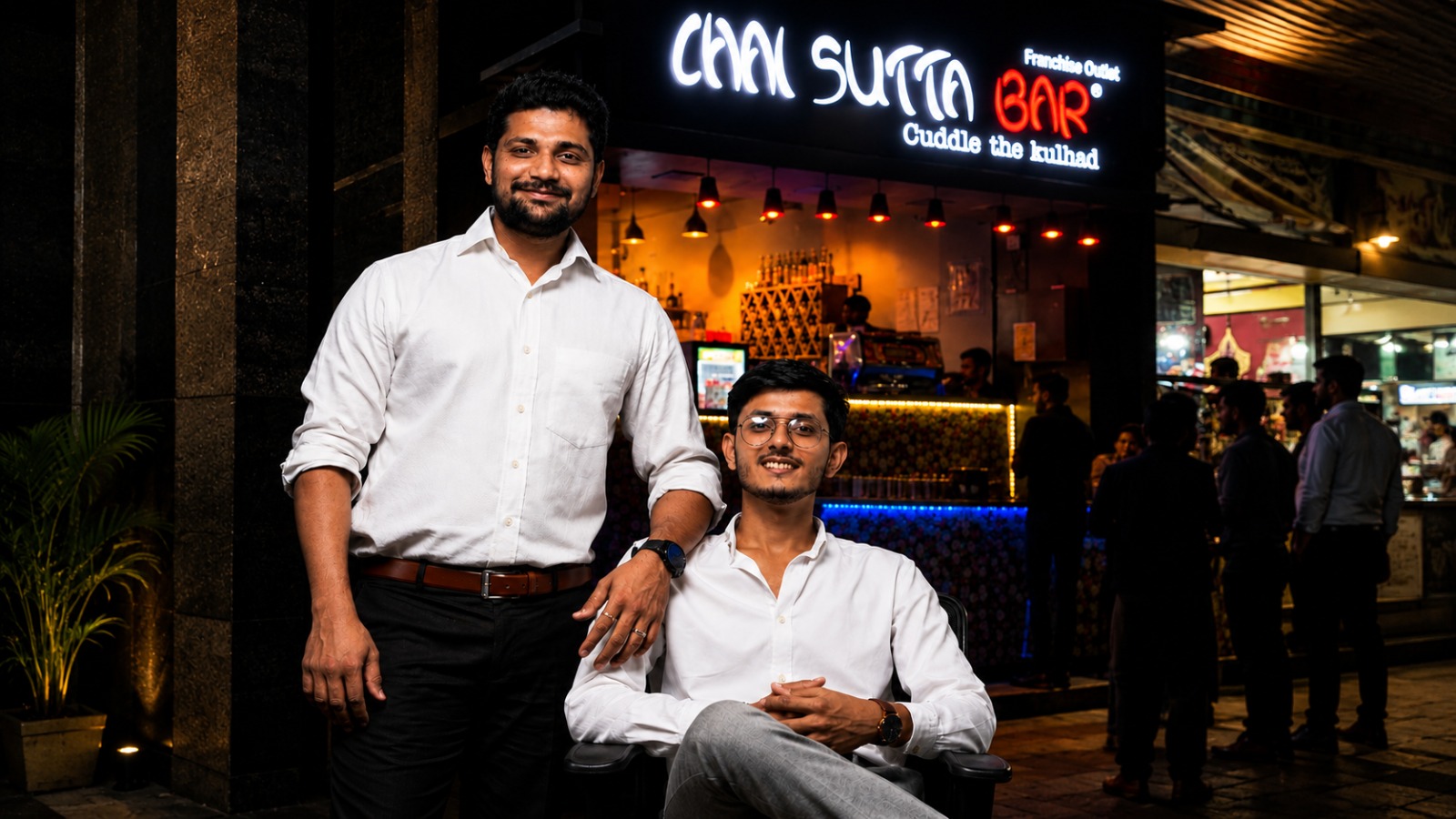
Chai Sutta Bar grew from a ₹3 lakh tea stall in Indore into a franchise network of 550+ outlets across 320+ cities, generating approximately ₹220 crore in annual system-wide turnover.
The Story: Two friends failed the CA exam and gave up on UPSC. With Rs 3 lakh, borrowed furniture, and a hand painted wooden sign, they opened a tea stall opposite a girls hostel in Indore. Ten years later, Chai Sutta Bar runs more than 550 outlets, sells over 4 lakh kulhads of chai daily, and turns over Rs 220 crore a year. No venture capital. No celebrity founder. Just a desi chai idea that scaled through franchising.
Written by TFN Research Desk | covering startups, technology, venture capital, and business strategy.
People Also Ask
- Who founded Chai Sutta Bar? Anubhav Dubey and Anand Nayak founded Chai Sutta Bar in 2016 in Indore, Madhya Pradesh, later joined by Rahul Patidar as a co-founder.
- What is the Chai Sutta Bar franchise cost? Between Rs 16 lakh and Rs 25 lakh depending on outlet format, city tier, and location, according to multiple franchise directories.
- How much revenue does Chai Sutta Bar make? Franchise turnover across the network was reported at approximately Rs 220 crore in 2024, with projections toward Rs 350 crore.
- Is Chai Sutta Bar profitable? Franchise stores typically report 35 to 40 percent margins, though the parent private limited company’s own operating income is comparatively small since most revenue sits with individual franchisees.
- How many outlets does Chai Sutta Bar have? Over 550 outlets across 320 plus Indian cities as of 2026, with additional stores in Dubai and Oman.
Timeline: From One Stall to a National Chain
| Year | Milestone |
|---|---|
| 2016 | First outlet opens in Indore with Rs 3 lakh investment |
| 2018 | Chai Sutta Bar Private Limited incorporated |
| 2019 to 2021 | Franchise model scales to 140 plus outlets across 70 cities |
| 2022 | International entry with outlets in Dubai and Muscat |
| 2023 | Network crosses 300 outlets; kulhad chai becomes signature format |
| 2024 | Annual turnover reaches approximately Rs 220 crore |
| 2026 | Over 550 outlets in 320 plus cities; brand value estimated at Rs 150 to 300 crore |
Quick Facts
| Metric | Value |
|---|---|
| Founded | 2016, Indore |
| Founders | Anubhav Dubey, Anand Nayak, Rahul Patidar |
| Initial Investment | Rs 3 lakh (first outlet) |
| Total Outlets (2026) | 550 plus |
| Cities Covered | 320 plus in India |
| International Presence | Dubai, Oman |
| Daily Chai Sales | 4.5 to 6 lakh kulhads |
| Annual Turnover (2024) | Approximately Rs 220 crore |
| Franchise Investment | Rs 16 to 25 lakh |
| Franchise Royalty | 4 percent of monthly gross revenue |
| Franchise ROI Timeline | 12 to 18 months |
| Estimated Brand Value (2026) | Rs 150 to 300 crore |
How Chai Sutta Bar Built a National Franchise Without Outside Funding
The Origin Story
- Anubhav Dubey grew up in Rewa, Madhya Pradesh, in a middle class family that wanted him to become a CA or an IAS officer. He failed the CA exam. He moved to Delhi to prepare for UPSC and that did not work out either. Back in Indore, he and childhood friend Anand Nayak noticed something simple: chai was everywhere in India, but nobody had built a modern, youth focused brand around it.
- With Rs 3 lakh between them, they opened the first outlet opposite a girls hostel in Indore. There was no money for a printed sign, so they hand painted “Chai Sutta Bar” on a wooden board. On opening day, they gave away free chai and walked around town talking to people about the new spot. The name itself, provocative but not literal since the brand does not sell alcohol or cigarettes, was part of the hook that pulled in a young crowd.
Why the Kulhad Model Worked
- The founders switched from paper cups to kulhads, the traditional clay cups used across North India. This single decision became the brand’s signature differentiator. It tied Chai Sutta Bar to authentic Indian chai culture while giving customers a tactile, Instagrammable experience that mass market coffee chains could not replicate.
- The menu stayed simple: masala chai, adrak chai, chocolate chai, kesar chai, and a handful of light snacks. Low SKU complexity meant faster training for franchise staff and consistent quality across hundreds of outlets, a critical requirement for any franchise model trying to scale quickly.
The Franchise Engine
Rather than raising venture capital, the founders scaled through franchising almost from day one. The current structure looks like this:
| Franchise Component | Detail |
|---|---|
| Investment Range | Rs 16 to 25 lakh |
| Monthly Royalty | 4 percent of gross revenue |
| Average Staff Cost | Rs 30,000 to 60,000 per month |
| Monthly Rent (location dependent) | Rs 50,000 to 1.5 lakh |
| Net Profit Margin | 35 to 40 percent |
| Break Even Period | 12 to 18 months |
This model let Chai Sutta Bar expand into Tier 1, Tier 2, and Tier 3 cities without the founders carrying the capital burden themselves. Franchisees supply the capital and local market knowledge. The parent company supplies the brand, training, supply chain, and marketing support in exchange for the royalty fee.
What the Financial Data Actually Shows
Public filings paint a more layered picture than franchise marketing pages suggest. According to Tracxn, Chai Sutta Bar Private Limited itself generated under Rs 10 crore in revenue for the year ending March 2025, with a negative one year revenue CAGR. This is not a contradiction of the Rs 220 crore franchise turnover figure. It reflects how franchise businesses work: most sales revenue sits with individual franchise owners, while the parent entity earns primarily from royalties, franchise fees, and its own company owned outlets.
This distinction matters for anyone evaluating the brand. The Rs 220 crore figure represents system wide sales across the network. The parent company’s own books are a fraction of that, which is normal for an asset light franchise model but worth understanding before assuming the number represents corporate revenue.
The TFN Lens: Bootstrap Discipline Over Funding Hype
Chai Sutta Bar did not raise institutional capital to reach 550 outlets. It grew through a self funded first store, an early willingness to franchise, and a product simple enough to standardize across hundreds of locations. This is a different playbook from venture backed D2C brands that spend heavily on customer acquisition before proving unit economics.
The lesson for founders: a low cost, high repeat product category like chai has structural advantages that beauty or skincare brands do not. Daily consumption habits, low price points, and cultural familiarity reduce the marketing spend needed to win a first time customer. Chai Sutta Bar’s growth came from operational replication, not brand campaigns.
Key Takeaways
- Chai Sutta Bar started in 2016 with Rs 3 lakh and one outlet in Indore
- The brand now runs 550 plus outlets across 320 plus Indian cities plus Dubai and Oman
- System wide franchise turnover reached approximately Rs 220 crore in 2024
- The parent company’s own revenue is smaller since most sales sit with individual franchisees
- Franchise investment ranges from Rs 16 to 25 lakh with 35 to 40 percent margins
- The brand scaled entirely through franchising without venture capital funding
- Estimated brand value in 2026 ranges from Rs 150 to 300 crore
Sources
- The Weekend Leader: “Anubhav Dubey and Anand Nayak Success Story” – https://www.theweekendleader.com/Success/2974/a-tea-storm.html
- YourStory: “The Story of Chai Sutta Bar” – https://yourstory.com/smbstory/fmcg-india-tea-brands-indore-chai-sutta-bar-business-entrepreneurs
- Wikipedia: “Anubhav Dubey” – https://en.wikipedia.org/wiki/Anubhav_Dubey
- EarnYatra: “Chai Sutta Bar Franchise Cost, Profit and Monthly Income 2026” – https://earnyatra.com/chai-sutta-bar-franchise-cost-in-india/
- AskDaman: “Chai Sutta Bar Net Worth 2026, Revenue, Profit, Franchise” – https://askdaman.com/chai-sutta-bar-net-worth/
Stay in the Loop
For more stories, breakdowns, and unfiltered takes on what is really happening in business and tech, follow TheFounder Nation.
Instagram Handle : https://www.instagram.com/thefoundernation?igsh=MTZobDUwc2xqZWdhOA==
We cover what the mainstream business press won’t.
© The Founder Nation | All rights reserved |