


AI agents are transforming how startups automate operations, customer support, sales, and software development.
Written by TFN Research Desk | covering startups, technology, venture capital, and business strategy.
The chatbot era is over. The autonomous agent era has started. Here is why the next thousand-crore companies will be agents, not apps.
Sierra, an AI customer service agent startup, hit $100 million in ARR in seven quarters faster than almost any enterprise software company in history. Harvey, an AI legal assistant, raised $600 million in H1 2025 and is now embedded in top-tier law firms. Anysphere, the company behind the Cursor coding assistant, is scaling from zero to unicorn status. The pattern across every company on this list is the same: deep vertical focus, production-grade reliability, sticky data integrations that make switching costly, and pricing tied to outcomes, not seats.
This is the AI agent opportunity. It is not a feature cycle. It is a structural shift in what software is capable of and that shift creates the kind of category-defining startup opportunity that appears once every decade.
Startup Strategy • Explainer • AI Agents • Agentic AI • Founder Opportunity
The short answer
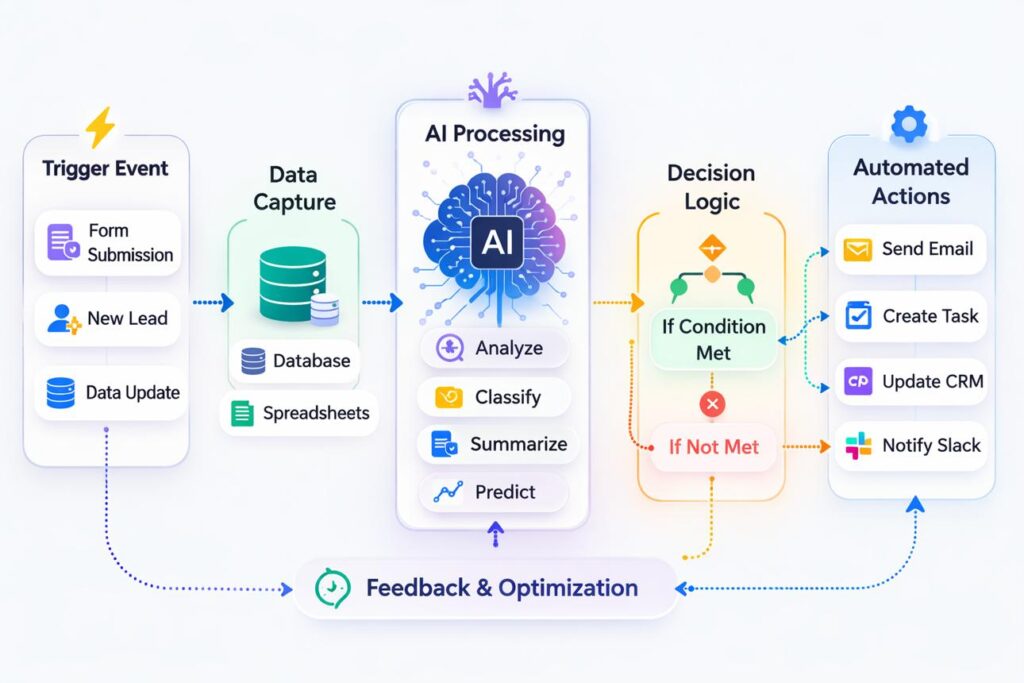
AI agents are autonomous software systems that execute multi-step tasks, take actions in real systems, and operate without constant human supervision. The distinction from a chatbot is critical: agents are on the write path, not just the read path. They do not just answer questions. They book jobs, draft contracts, follow up on insurance claims, and write and deploy code. The market they are attacking human labour doing repetitive multi-step cognitive tasks is enormous. And the early companies that win a vertical own it, because the data integrations and workflow embeddings become switching costs that protect the moat.
Quick facts
| Metric | Detail |
|---|---|
| AI agents market size 2025 | $7.84 billion (AI Funding Tracker, May 2026) |
| Projected market size 2030 | $52.62 billion (AI Funding Tracker, May 2026) |
| CAGR 2025 to 2030 | 41% (AI Funding Tracker, May 2026) |
| Capital deployed into agentic AI (2025) | $6.42 billion (Preuve AI, June 2026) |
| Average round size for agentic AI (Q4 2025) | $155 million, up from $82M in H1 2025 (Unicorn Screener, May 2026) |
| AI agent startups shut down in 2025 | 3,800+ (Preuve AI, June 2026) |
| Enterprise adoption (Sep 2025) | 52% of global enterprises actively using AI agents (Unicorn Screener, May 2026) |
| Sierra AI ARR | $100 million in 7 quarters (AI Funding Tracker, May 2026) |
| Harvey AI total raised | $600 million across two rounds in H1 2025 (AI Funding Tracker, May 2026) |
| Vertical AI agents share of agentic AI capital | 72% of all agentic AI capital in 2025 (New Market Pitch, May 2026) |
Background
The first wave of the AI product cycle, from 2022 through 2024, was about AI that generated content: text, images, code, audio. The model was a chat interface with a large language model on the other end. The business model was subscription access to the interface.
That wave produced real revenue but limited defensibility. Because the underlying models were accessible to anyone via API, the product layer was thin. What one company could build, another could copy. The companies that endured were the ones that embedded the model into a specific workflow, a specific user’s daily routine, or a specific industry’s data which is exactly the pattern that defines the agent wave.
The shift from content generation to autonomous action is the shift from AI as a tool to AI as a worker. A tool answers. A worker acts. The economic value of a worker is fundamentally different from the economic value of a tool, because workers produce outputs that organisations measure in headcount, not software licences.
Why AI agents represent a genuine gold rush
1. The market they attack is priced in human labour, not software licences
Every AI agent is replacing a human task. The economic benchmark is not what enterprise software costs. It is what a human employee costs. A voice AI agent that replaces 10 customer service representatives at Rs 4 lakh per year each is solving a Rs 40 lakh annual problem. If it charges Rs 10 lakh per year, the value proposition is immediate. Enterprise AI agents priced at $2,000 to $5,000 per month per seat can deliver 70–80% cost savings while maintaining or improving output quality (Presta, February 2026). That is not a software pricing conversation. It is a labour economics conversation, and it is far easier to close.
2. Vertical specialisation wins, and the moats are real
Over 70% of horizontal agents agents built for every industry and every use case never convert from a demo to real production use, because real customer data is messy and a general agent has no domain knowledge to handle it (Preuve AI, June 2026). This failure rate is why 3,800 AI agent startups shut down in 2025. They built horizontal tools and could not reach production.
The agents that survive own a vertical. Industry-specific AI agents in legal, healthcare, and finance command premium pricing and face lower competition than horizontal solutions, with specialised agents showing 3–5x higher retention rates than horizontal alternatives (Presta, February 2026). Harvey wins in legal because it knows how law firms work, how case files are structured, and what an Allen & Overy partner needs. Sierra wins in customer service because it understands support ticket taxonomies, escalation logic, and tone requirements at production grade.
Vertical AI agents captured approximately 72% of all agentic AI capital in 2025 (New Market Pitch, May 2026). That concentration is not accidental. Investors have learned the lesson from the horizontal shutdowns: specialisation is the moat, not the model.
3. Capital is concentrating at historically large check sizes
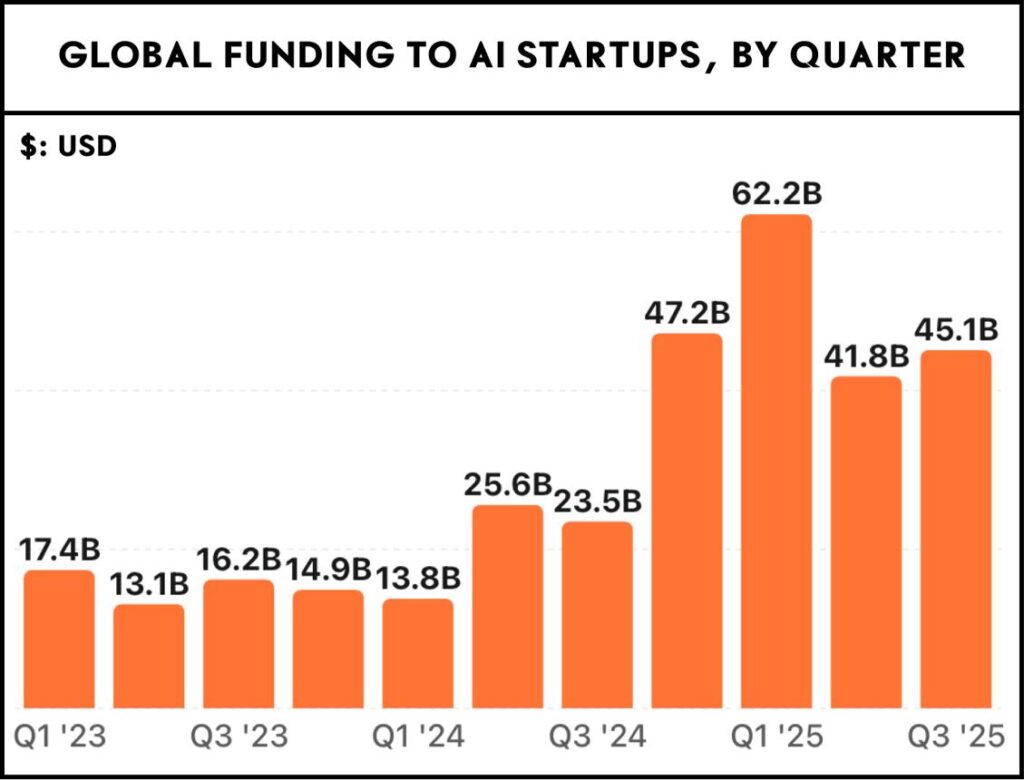
The average round size for agentic AI startups that closed deals in Q4 2025 or early 2026 reached $155 million, nearly double the $82 million average from H1 2025 (Unicorn Screener, May 2026). Autonomous AI agents are moving toward 41% CAGR growth and consuming 40%+ of enterprise AI budgets. This is the phase of a technology cycle where large capital is used to establish market positions before the category consolidates.
For founders, this means the window to enter a vertical with a focused agent product is open now. In 24 to 36 months, the dominant players in each vertical will have raised enough capital to build distribution and integration advantages that make entry significantly harder.
4. Enterprise adoption has crossed the tipping point
In September 2025, 52% of executives at global enterprises with generative AI deployments said their organisations were actively using AI agents (Unicorn Screener, May 2026). This is not pilots and experiments. This is production deployment. The demand is real and accelerating.
The critical distinction: horizontal versus vertical
The single most important framework for any founder considering the AI agent space is the distinction between horizontal and vertical agents.
A horizontal agent attempts to do one task write emails, book meetings, process invoices for every industry. The problem is that every industry’s version of that task is different. A legal invoice is structured differently from a construction invoice. An insurance claim follow-up requires different language and logic from a software support escalation. An agent trained on generic data handles neither case well enough to reach production, where errors have real consequences.
A vertical agent is built for one industry and one buyer, wired into that industry’s system of record. It knows the vocabulary, the workflow, the data structures, and the failure modes. Because it is trained on domain-specific data and integrated with domain-specific tools, it reaches the production-grade reliability threshold 99%+ accuracy that enterprise deployment requires. Getting to production-grade is exponentially harder than demos, which is why the vertical focus is both a competitive moat and a necessary product constraint.
Y Combinator partners have stated directly: vertical AI agents could be 10x bigger than the SaaS they replace. The reason is that vertical AI agents do not just automate tasks. They capture institutional knowledge, surface patterns in domain-specific data, and enable organisations to do things they could not do with human workers at the same cost. That is not an efficiency gain. It is a capability expansion, and capability expansions command different pricing than efficiency tools.
Where the opportunity is largest
The categories attracting the most capital and the most founder attention in 2025 and 2026 share common characteristics: they involve high-volume, repetitive multi-step tasks; they have a clear economic benchmark in human labour cost; and the output is verifiable enough that the agent can reach production-grade reliability.
Customer service (Sierra), legal work (Harvey), coding (Anysphere/Cursor, Cognition AI), healthcare administration, financial compliance, insurance claims, and enterprise cybersecurity (Exaforce, Dropzone AI, Prophet Security) are all receiving significant capital. The investor thesis in each case is the same: these are human tasks priced at human labour rates that can be automated at a fraction of the cost with a vertical agent that understands the domain deeply.
What the 2025 shutdowns teach us
More than 3,800 AI agent startups shut down in 2025, followed by another 1,800 in early 2026 (Preuve AI, June 2026). The cause was almost always horizontal positioning: a general-purpose agent that could not reach production reliability for any specific customer. The lessons are direct.
Demos are not products. An agent that works on clean, curated data in a demo environment will fail on real production data. The investment required to reach production reliability in a specific domain — ingesting real data, handling edge cases, integrating with legacy systems, training on domain-specific feedback is the actual startup. The demo is only the beginning.
The market is not the problem. The agentic AI market reached $7.84 billion in 2025 with 41% CAGR projected to 2030. The startups that shut down were not killed by lack of demand. They were killed by horizontal positioning that prevented them from ever delivering value in a specific production environment. Founders who pick a vertical and go deep enough to reach production will find real demand waiting.
Opportunity for Indian founders
The AI agent opportunity is geography-agnostic in a way that most startup categories are not. An AI agent serving legal professionals does not need to be in San Francisco. It needs to understand legal data, integrate with legal software, and produce reliable outputs at production grade. Indian founders building vertical agents for the $2 billion Indian legal services market, the Rs 70 lakh crore BFSI sector, or the large healthcare administration category have defensible local data and workflow advantages that global competitors cannot easily replicate.
The Indian BPO and KPO industries, which collectively employ millions of people in exactly the kinds of repetitive multi-step cognitive tasks that AI agents automate, represent both the competitive threat and the opportunity. The founders who understand both sides of that equation are positioned to build the vertical agents that will define India’s next startup category.
The TFN lens: Agents replace labour, not software
The conceptual error most founders make when approaching the AI agent market is treating it as a software market. It is not. It is a labour market. The pricing benchmark is human employee cost, not software licence cost. The evaluation criterion is whether the agent does the job reliably enough that a manager would trust it with real work, not whether it has a good demo.
This reframe has practical implications. An Indian founder building an AI agent for a specific vertical should calculate the labour cost of the task their agent replaces, set their price at 30–50% of that cost, and design their product roadmap around reaching the production reliability threshold that makes that value proposition credible. That is a fundamentally different product strategy than building a software feature and charging a SaaS multiple for it. And it is the strategy that is producing the category-defining outcomes in 2025 and 2026.
Key takeaways
- The AI agents market reached $7.84 billion in 2025 and is projected to grow to $52.62 billion by 2030 at a 41% CAGR.
- 52% of global enterprises with generative AI deployments were actively using AI agents as of September 2025.
- Vertical AI agents built for one industry and one buyer captured 72% of all agentic AI capital in 2025. Horizontal agents are failing at a 70%+ rate before production deployment.
- The correct pricing benchmark for AI agents is human labour cost, not software licence cost. This is why the economics are fundamentally better than traditional SaaS.
- 3,800+ AI agent startups shut down in 2025, almost entirely because of horizontal positioning that prevented production-grade reliability.
- Indian founders are structurally well-positioned for the agent opportunity given labour market domain knowledge, strong engineering talent, and large domestic sectors with clear automation use cases.
Frequently asked questions
What is an AI agent and how is it different from a chatbot?
A chatbot answers questions. An AI agent takes autonomous actions across multiple steps in real systems without constant human supervision. A chatbot reads the path; an agent is on the write path. Examples: an AI agent that books a service appointment, drafts and sends a follow-up email, and logs the outcome in a CRM is doing something a chatbot cannot.
What is a vertical AI agent?
A vertical AI agent is built for one industry and one specific buyer within that industry. It is wired into that industry’s system of record — the EHR in healthcare, the case management system in legal, the claims platform in insurance. Because it is trained on domain-specific data and handles domain-specific edge cases, it can reach the production-grade reliability (99%+ accuracy) that enterprise deployment requires. Horizontal agents, built for all industries, typically fail to reach that threshold.
How big is the AI agent market?
The standalone AI agent market reached approximately $7.84 billion in 2025 and is forecast to reach $52.62 billion by 2030, representing a 41% compound annual growth rate (AI Funding Tracker, May 2026). In 2025, $6.42 billion in capital was deployed into agentic AI startups.
What are the best AI agent startup ideas for 2026?
The categories with the strongest founder-market-capital alignment in 2026 are: legal AI (Harvey-style), customer service AI (Sierra-style), coding agents (Cursor/Cognition-style), healthcare administration automation, financial compliance and audit automation, insurance claims processing, and enterprise cybersecurity. All share common characteristics: high-volume repetitive tasks, a clear human labour cost benchmark, and verifiable outputs that enable production reliability.
Why did so many AI agent startups fail in 2025?
Over 3,800 AI agent startups shut down in 2025 primarily due to horizontal positioning: they built agents that attempted to serve all industries for a generic task, could not reach production-grade reliability for any specific customer because real production data is messy and domain-specific, and could not convert from demos to paid production deployments. The market failure was a positioning failure, not a demand failure.
How can Indian founders approach the AI agent opportunity?
By starting with a specific Indian vertical where they have domain knowledge — legal services, BFSI compliance, healthcare administration, or BPO automation and building an agent that reaches production-grade reliability in that vertical before expanding. The labour cost advantage that defines Indian BPO is the exact economic benchmark that makes AI agent pricing attractive. Founders who understand both sides of that equation are starting from the right place.
Sources
- AI Funding Tracker, “Top AI Agent Startups 2026,” May 2026. aifundingtracker.com
- Preuve AI, “AI Agent Startup Ideas 2026: 27 Ranked, 15 Worth Building,” June 2026. preuve.ai
- Unicorn Screener, “7 AI Agent Startups Funded by Top VCs in 2026,” May 2026. unicornscreener.vc
- Presta, “15 AI Agent Startup Ideas That Made $1M+ in 2026,” February 2026. wearepresta.com
- New Market Pitch, “Agentic AI Market Funding Trends 2026,” May 2026. newmarketpitch.com
©️ The Founder Nation | All rights reserved | Written by TFN Research Desk |