


Enterprise spending on artificial intelligence has moved from experimentation to production in 2026, but the data shows a wide gap between AI adoption and AI impact. Microsoft, Google, Amazon and Meta are guiding to a combined 725 billion dollars in AI infrastructure capital expenditure this year, up 77 percent from 410 billion dollars in 2025, according to first-quarter earnings compiled by the Financial Times. At the same time, research from MIT’s Project NANDA found that 95 percent of generative AI pilots inside companies still fail to deliver a measurable return.
That contradiction defines where AI stands midway through 2026. Capital is flowing in at a record pace. Cloud backlogs are climbing. Agentic AI, the term for systems that can plan and execute multi-step tasks rather than just respond to prompts, has become the industry’s primary growth pitch. But Gartner’s own 2026 CIO survey found that only 17 percent of organisations have actually deployed AI agents, even though more than 60 percent expect to do so within two years.
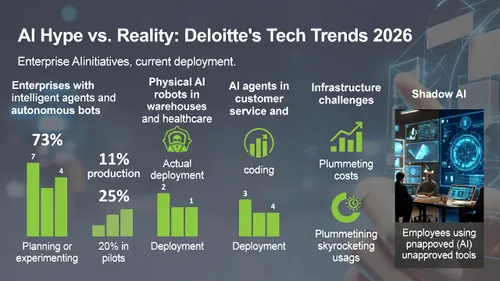
Industry analysts are now describing this as the year AI stopped being a story about model capability and became a story about deployment discipline. Deloitte’s Tech Trends 2026 report found that only 11 percent of companies have AI agents fully operational in production, against 25 percent still experimenting in pilots. The phrase used repeatedly across consulting and analyst reports this year is some version of “from hype to reality.”
On 26 June, at the Nasscom US CEO Forum in New York, the same pattern showed up in India’s technology services sector. Nasscom said nearly 25 percent of Indian IT services companies have moved AI experiments into production, with the industry already generating 10 to 12 billion dollars in AI services revenue.
The Capital Is Real, the Returns Are Uneven
The hyperscaler spending numbers for 2026 are not modest. Amazon is committing roughly 200 billion dollars, Microsoft around 190 billion dollars, Alphabet between 175 and 185 billion dollars, and Meta between 115 and 135 billion dollars to AI infrastructure this year. Analysts already expect the combined figure to top a trillion dollars in 2027.
The justification, according to the companies themselves, is unmet demand rather than speculative bets. Alphabet’s chief financial officer Anat Ashkenazi said the company is seeing unprecedented internal and external demand for AI compute resources, pointing to record revenue and backlog growth in Google Cloud. Google Cloud’s quarterly revenue reached 20 billion dollars, while its contract backlog hit 460 billion dollars, roughly double what it was at the end of the fourth quarter of 2025.
Microsoft frames its spending the same way. The company’s leadership has said Azure remains capacity constrained, turning away AI workloads it cannot yet serve. That demand signal is what hyperscalers point to when investors ask whether the spending is justified.
But spending and adoption are not the same as value creation. MIT’s NANDA initiative surveyed 300 public AI deployments, interviewed 150 business leaders and surveyed 350 employees. Despite the rush to integrate new models, the research found that only about 5 percent of AI pilot programs achieve rapid revenue acceleration, while the vast majority deliver no measurable impact on profit and loss. The report’s lead author told Fortune that the core issue is not model quality but a learning gap in how organisations integrate AI tools into existing workflows.
Why Pilots Stall
The reasons enterprise AI projects fail to scale are now fairly consistent across multiple studies. MIT’s research identified four structural factors: limited disruption outside the technology and media sectors, large firms leading in pilot volume but lagging in successful deployment, AI budgets skewed toward sales and marketing despite stronger returns in back-office functions, and externally built tools succeeding roughly twice as often as internal builds.
A manufacturing executive quoted in the MIT report captured the disconnect bluntly. “The hype on LinkedIn says everything has changed, but in our operations, nothing fundamental has shifted,” the manufacturing chief operating officer told researchers.
Gartner’s findings echo this. The firm projects that more than 40 percent of agentic AI projects will be scrapped by 2027, not because the underlying models fail, but because organisations struggle to operationalise them. The recurring obstacles cited by chief information officers in industry interviews include security review requirements, compliance checks, identity management, audit trails, and the difficulty of integrating agents with existing enterprise systems that were never designed for autonomous action.
Deloitte’s 2026 enterprise survey adds another layer to the problem. Only 11 percent of companies have AI agents fully operational in production environments, even though 25 percent are running pilots, a gap the report calls an “agentic reality check” rooted in integration complexity, data silos, and unresolved ethical concerns.
The Shift From Generative to Agentic AI
Much of the current spending push is tied to a specific technical transition. For the past three years, generative AI inside companies has mostly functioned as a productivity layer: drafting documents, summarising reports, assisting with code. The human directs, the model responds.
In 2026, attention has moved toward agentic systems designed to pursue multi-step goals with limited human oversight, planning actions, calling tools, and adjusting based on results rather than waiting for the next prompt. Gartner predicts that 40 percent of enterprise applications will carry task-specific AI agents by the end of 2026, up from less than 5 percent in 2025.
Even so, full autonomy remains rare. Gartner’s 2026 Hype Cycle for Agentic AI places the technology at the “Peak of Inflated Expectations,” noting that most current deployments stay narrowly scoped to functions such as IT operations, customer support, and finance reconciliation, areas that tolerate human-in-the-loop oversight and deliver faster, more measurable returns.
Meta chief executive Mark Zuckerberg offered a blunt assessment of where consumer-facing agents currently stand when asked about the pace of development. “There’s a lot of agents out there that people are building for different things, but there aren’t that many that I would want to give to my mother,” Zuckerberg told investors during an April earnings call.
Where the Money Actually Pays Off
The clearest finding across multiple reports is that AI investment is currently misallocated relative to where it generates returns. More than half of corporate generative AI budgets go toward sales and marketing tools, yet researchers consistently find the strongest, most measurable return on investment in back-office automation: reducing outsourcing costs, cutting reliance on external agencies, and streamlining repetitive operational work.
The source of the technology matters too. Specialised, vendor-built AI tools succeed at roughly twice the rate of systems built in-house, largely because external vendors focus on fitting a narrow workflow rather than building general-purpose capability that has to be retrofitted into specific business processes later.
A parallel trend complicating governance is the rise of what researchers call shadow AI. Deloitte’s 2026 report found that 48 percent of employees use AI tools without employer approval, a pattern echoed by other workplace surveys showing unauthorised tool use running even higher among security professionals and younger employees. That gap between sanctioned and actual AI use is forcing corporate security teams into a continuous, reactive monitoring posture.
India’s Services Sector Bets on the Deployment Gap
The deployment gap is itself becoming a business opportunity, and India’s technology services industry is positioning around it directly. At the Nasscom US CEO Forum held on 26 June at the Consulate General of India in New York, industry leaders argued that the shift toward agentic AI strengthens, rather than threatens, the case for outsourced technology services.
Nasscom President Rajesh Nambiar said Indian technology services companies have guided global enterprises through multiple major technology transitions over three decades and are positioned to do the same with AI deployment. Cognizant chief executive and Nasscom US CEO Forum chair Ravi Kumar S framed the opportunity around exactly the integration problems identified in the MIT and Gartner research. “The next phase of AI is not about experimentation alone. Enterprises now need to convert AI capability into production value. That requires data readiness, workflow redesign, secure deployment, governance and change management,” Kumar said at the forum.
According to Nasscom, around 85 percent of Indian technology service providers now operate agentic AI platforms, and the industry projects agentic AI could unlock an additional 300 to 400 billion dollars in addressable global technology services spending by 2030, spanning legacy system modernisation, AI operations, cybersecurity, and governance work.
The closing argument from India’s industry body was less about AI replacing services work and more about AI changing what that work looks like: less linear headcount growth, more platform-based and outcome-based delivery built around the governance and integration gaps enterprises are struggling to close on their own.
What happens over the next two to three quarters will likely separate the rhetoric from the record. Hyperscalers have already committed thirty-month spending plans that assume sustained enterprise demand, while the budget review cycles now underway at companies that launched AI pilots back in 2022 and 2023 will determine which projects survive contact with a profit and loss statement. The technology itself is no longer the open question. Whether organisations can rebuild the data, workflows, and accountability structures around it is.
Frequently Asked Questions
What does “AI moving from hype to deployment” actually mean? It refers to the shift from companies experimenting with generative AI tools, such as chatbots or drafting assistants, toward integrating AI directly into production workflows where it is expected to produce measurable cost savings or revenue. Multiple 2026 industry reports, including from MIT, Gartner and Deloitte, use this framing to describe the current state of enterprise AI.
Why do most enterprise AI pilots fail to show a return? MIT’s Project NANDA research attributes most failures to a “learning gap,” meaning companies struggle to integrate AI tools into existing workflows, data systems, and decision-making processes rather than the AI models themselves being inadequate. Poor data readiness, unclear ownership of outcomes, and budgets directed toward lower-ROI functions like sales and marketing are recurring causes.
What is agentic AI, and how is it different from generative AI? Generative AI typically responds to a single prompt, such as drafting an email or summarising a document. Agentic AI refers to systems built to pursue a goal across multiple steps with limited human intervention, planning actions, using tools, and adjusting based on outcomes. Gartner projects 40 percent of enterprise applications will include task-specific agents by the end of 2026.
How much are big tech companies spending on AI infrastructure in 2026? Microsoft, Google, Amazon and Meta are guiding to a combined 725 billion dollars in capital expenditure for 2026, up 77 percent from approximately 410 billion dollars in 2025, driven primarily by data centre construction, GPU procurement and custom AI silicon.
Is India’s IT services industry at risk from AI automation? Nasscom argues the opposite, stating that AI will compress some standardised, repeatable work while expanding demand for AI governance, data readiness, legacy system modernisation and agent management, areas where Indian technology services firms already operate at scale. The industry projects agentic AI could add 300 to 400 billion dollars in addressable global spending for technology services by 2030.
Sources
- Value Add VC: AI Hyperscaler Capex 2026: Microsoft, Google, Meta, Amazon $380B+ Compared by Company
- Yahoo Finance: Google, Microsoft, Meta, and Amazon capex spending to hit $725 billion in 2026, up 77% from last year
- Fortune: Microsoft, Meta, and Google just announced billions more in AI spending
- Fortune: MIT report: 95% of generative AI pilots at companies are failing
- Legal.io: MIT Report Finds 95% of AI Pilots Fail to Deliver ROI, Exposing “GenAI Divide”
- Gartner: 2026 Hype Cycle for Agentic AI
- Gartner Newsroom: Gartner Predicts 40% of Enterprise Apps Will Feature Task-Specific AI Agents by 2026
- Kore.ai: AI Agents in 2026: From Hype to Enterprise Reality
- Quasa: AI Hype vs. Reality: Deloitte’s Tech Trends 2026 Exposes the Gap Between Talk and Deployment
- Business Standard: AI services now $10-12 bn for India IT, set for rapid growth: Nasscom
- PR Newswire: India’s technology services sector will continue to grow in the AI era: Nasscom US CEO Forum
Stay in the Loop
For more stories, breakdowns, and unfiltered takes on what is really happening in Indian and global business and tech, follow TheFounder Nation.
Instagram: thefoundernation
We cover what the mainstream business press won’t.
© TheFounder Nation | All rights reserved Word count: ~1390 | Read time: ~7 minutes Primary keyword: AI hype to real-world deployment 2026 | Secondary: enterprise AI adoption, agentic AI, AI ROI, MIT GenAI Divide, AI capex 2026, Nasscom AI, AI pilot failure, AI governance Meta description: Why 2026 marks AI’s shift from hype to deployment, with capex hitting $725B, 95% of pilots failing ROI, and India’s IT sector betting on the gap. WordPress tags: AI deployment, agentic AI, enterprise AI, AI ROI, AI capex, Nasscom, MIT GenAI Divide, AI governance WordPress category: AI News