
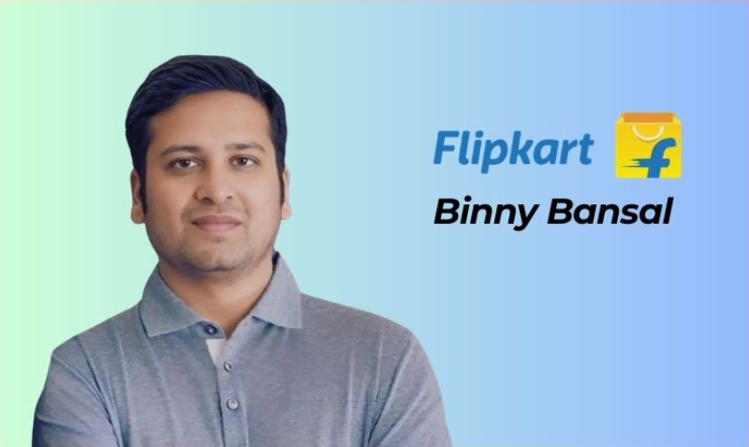
Binny Bansal co-founded Flipkart in 2007 and played a key role in transforming it into India's leading e-commerce marketplace.
From Amazon engineer to Flipkart co-founder, explore Binny Bansal’s entrepreneurial journey behind India’s e-commerce revolution.
Written by TFN Research Desk | covering startups, technology, venture capital, and business strategy.
Table of Contents
- Who is Binny Bansal?
- Early Life and Education
- Career Before Flipkart
- How Flipkart Started
- Funding History
- Revenue Growth and Recent Challenges
- Public Recognition
- Flipkart vs Competitors
- Investor Perspective
- Founder Timeline
- Key Takeaways
- FAQs
- Sources
Who is Binny Bansal?
Binny Bansal co-founded Flipkart in 2007 and rose from COO to Group CEO before resigning in 2018 amid a misconduct inquiry. An IIT Delhi computer science graduate, he was rejected twice by Google before joining Amazon, a setback he has said sharpened his resolve to build his own company.
Early Life and Education
Bansal was born in 1982 or 1983 in Chandigarh. His father served in the army before becoming a bank chief manager; his mother worked in the government sector. He studied at St. Anne’s Convent School, the same school as his eventual co-founder Sachin Bansal, before earning a computer science degree from IIT Delhi in 2005. Rohit Bansal, later a Snapdeal co-founder, was his batchmate. Not publicly disclosed is any childhood venture, though multiple accounts note his two Google rejections, in 2005 and 2006, as a formative setback.
Career Before Flipkart
After IIT, Bansal joined Sarnoff Corporation for about eighteen months, designing a lane-sensor device for cars. He then joined Amazon as a software engineer in January 2007 for roughly nine months. That stint exposed him to large-scale e-commerce operations and led to conversations with Sachin Bansal that eventually became Flipkart, after they discarded an earlier idea for a price-comparison search engine.
How Flipkart Started
In October 2007, Bansal and Sachin Bansal pooled around $6,000 (roughly Rs 4 lakh) to launch Flipkart from a small Koramangala apartment in Bengaluru. The plan was narrow: an online bookstore built on dependable service, at a time when Indians barely trusted entering card details online. Bansal ran operations while Sachin handled direction, a split colleagues later summed up by calling Bansal “the operational guy.” In the earliest months, both founders personally delivered orders on scooters, a routine that taught them what reliable fulfilment required before Flipkart tried to scale it.
Flipkart has raised $12.1 billion across 22 rounds from 128 investors, per Tracxn. Bansal’s 5.5% stake was valued at roughly $1 billion at the 2018 Walmart deal; after selling a remaining 1.8% stake in 2023 at a $35 billion valuation, his cumulative proceeds reached an estimated $1.5 billion.
Why this happened:
These Tofler-sourced figures, filed after Bansal’s exit, show revenue outpacing cost control. Growth came from advertising and marketplace commissions, while logistics revenue slipped on rising third-party competition. The widening FY25 loss reflects heavier spending on quick commerce and fintech, categories Flipkart could not afford to concede.
Public Recognition
Bansal was named among Forbes India’s 86th richest in 2015, featured in Time’s 100 Most Influential People list in 2016, ranked 26th on India Today’s 50 Most Powerful People in 2017, and named “Asian of the Year” by the Straits Times in 2016.
Flipkart still leads on revenue and share; Amazon trails on scale but leads on profitability, while Meesho competes on volume rather than head-on positioning.
Investor Perspective
Bansal’s operational grounding made him the natural counterweight to a co-founder focused on vision and fundraising. His strength was execution: building Ekart, hiring for cultural fit early on, and scaling fulfilment into smaller cities ahead of rivals. The risk that materialised was governance, not the business; his 2018 resignation followed a lack of transparency around a personal-conduct inquiry rather than an operating failure. His post-Flipkart record, spanning 021 Capital, xto10x, and now Opptra, suggests the entrepreneurial instinct survived the exit.
Founder Timeline
- 2005 — Graduates IIT Delhi
- 2005-06 — Rejected by Google twice; joins Sarnoff Corporation
- 2007 — Joins Amazon; co-founds Flipkart
- 2016 — Promoted from COO to CEO
- 2017 — Becomes Group CEO
- 2018 — Walmart acquires 77% stake for $16B; resigns in November
- 2019 — Contributes Rs 125 crore to IIT Delhi’s endowment fund
- 2023 — Exits remaining Flipkart stake at a $35B valuation
- 2024 — Steps down from PhonePe’s board
- 2025 — Launches new venture, Opptra
Key Takeaways
- Two Google rejections redirected Bansal toward Amazon and, eventually, entrepreneurship.
- His operational focus, from scooter deliveries to Ekart, gave Flipkart the fulfilment reliability early Indian e-commerce lacked.
- The COO-to-CEO path shows how execution strength can carry a founder into top leadership as a company scales.
- His 2018 exit stemmed from a governance and transparency lapse, not a business failure.
- Reinvesting in xto10x and Opptra shows a founder rebuilding rather than resting on one exit.
FAQs
Who founded Flipkart?
Binny Bansal and Sachin Bansal, in 2007.
Why did Binny Bansal leave Flipkart?
He resigned as Group CEO in November 2018 after an internal inquiry found no evidence for the core misconduct allegation but cited a lack of transparency in his response.
How much funding did Flipkart raise?
$12.1 billion across 22 rounds, per Tracxn.
Is Flipkart profitable?
Not as of FY25, with a consolidated net loss of Rs 5,189 crore.
What is Binny Bansal’s net worth?
Estimated at approximately $1.4 billion as of early 2026, per Forbes.
What did Bansal do after Flipkart?
He became an anchor investor in 021 Capital, co-founded xto10x Technologies, and launched Opptra in March 2025.
Did Flipkart go public?
No, though a shift of its holding structure to India has fueled IPO speculation.
What made Flipkart different from Amazon in India?
Early investment in trust-building logistics like Ekart, under Bansal’s operational leadership, gave it an edge before Amazon caught up.
Sources
- https://en.wikipedia.org/wiki/Binny_Bansal
- https://en.wikipedia.org/wiki/Flipkart
- https://tracxn.com/d/companies/flipkart/__pEY5Ub_-w20aEOIgCL-qCRVeBd8rtHj_vnmmzHQ8a6E
- https://www.business-standard.com/companies/news/flipkart-internet-fy25-revenue-rises-14-losses-narrow-ipo-prep-125091300087_1.html
- https://www.businessinsider.in/business/startups/news/binny-bansal/articleshow/
- https://www.ashoka.edu.in/profile/binny-bansal/
- https://startuptalky.com/binny-bansal-success-story/
- https://businessoutreach.in/binny-bansal/
© The Founder Nation | All rights reserved | Written by TFN Research Desk