

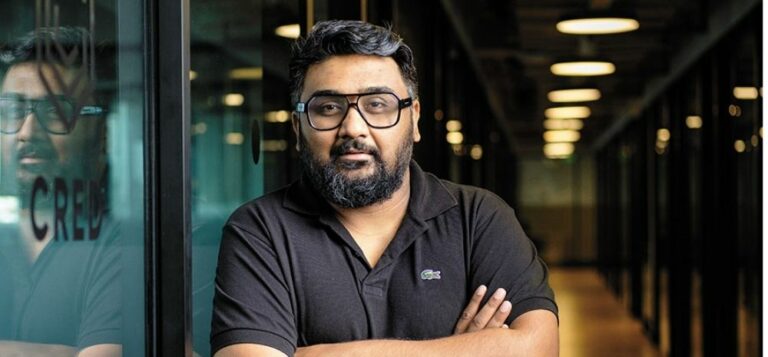
Kunal Shah founded CRED in 2018, building one of India's leading premium fintech platforms focused on rewarding responsible credit card users.
From founding FreeCharge to creating CRED, explore Kunal Shah’s entrepreneurial journey of building one of India’s leading fintech platforms focused on rewards, lending, and financial innovation.
Written by TFN Research Desk | covering startups, technology, venture capital, and business strategy.
Table of Contents
- Who is Kunal Shah?
- Early Life and Education
- Career Before CRED
- How CRED Started
- Funding History
- Revenue Growth and Recent Challenges
- Public Recognition
- CRED vs Competitors
- Investor Perspective
- Founder Timeline
- Key Takeaways
- FAQs
- Sources
Who is Kunal Shah?
Kunal Shah founded CRED, the members-only credit card bill payment platform, in 2018 after selling his earlier venture, FreeCharge, to Snapdeal. A philosophy graduate turned fintech entrepreneur, he became one of India’s most prolific angel investors before, in June 2026, taking on a new role as head of WhatsApp following a $900 million investment tie-up between Meta and CRED.
Early Life and Education
Shah was born on 30 May 1979 in Mumbai to a middle-class Gujarati family; his father ran a small textile business. He studied philosophy at Wilson College, Mumbai, and began working at fifteen to help his family through a financial crisis. He later enrolled in a part-time MBA at NMIMS but dropped out in 2004, preferring to learn by building.
Career Before CRED
In 2009, Shah founded PaisaBack, a cashback and promotions platform for retailers, whose core insight, that rewarding specific consumer behaviour drives engagement, seeded his next venture. In 2010, he co-founded FreeCharge with Sandeep Tandon, rewarding users for online mobile recharges. Snapdeal acquired it in April 2015 for roughly Rs 2,800 crore ($400-450 million), one of India’s largest startup exits at the time. Shah ran it until October 2016, then exited to become a full-time angel investor.
How CRED Started
In 2018, Shah founded CRED on the observation that paying a credit card bill on time went completely unrewarded in India. CRED restricted membership to users with strong credit scores and paid them in rewards, vouchers, and premium brand access for on-time payments. The bet worked: CRED came to process a meaningful share of India’s total credit card bill payments, turning a routine chore into an engagement-driving product, a model many Indian fintech apps have since copied.
Funding History
| Round | Year | Amount | Lead Investor(s) |
| Seed | May 2018 | $999K | QED Innovation Labs |
| Series A | Sept 2018 | Undisclosed | Ribbit Capital, Peak XV Partners |
| Series C | Nov 2020 | $81 million | Sofina, Ribbit Capital |
| Series D | Apr 2021 | $215 million | Alpha Wave, Coatue |
| Series E | Oct 2021 | $251 million | Existing investors, at $4.01B valuation |
| Series F | June 2022 | $140 million | GIC, Tiger Global, Sofina, Falcon Edge |
| Series H | June 2026 | $900 million | Meta Platforms |
CRED has raised $1.84 billion across 13 rounds, per Tracxn, with the June 2026 Series H valuing it at roughly Rs 42,100 crore, coinciding with Shah’s appointment as head of WhatsApp, succeeding Will Cathcart.
Revenue Growth and Recent Challenges
| Fiscal Year | Revenue | Net Loss |
| FY23 | Rs 1,481 crore | Rs 1,347 crore |
| FY24 | Rs 2,473 crore | Rs 1,644 crore |
| FY25 | Rs 2,735 crore | Rs 298 crore |
Why this happened: Revenue grew 67% in FY24 on lending and rewards monetisation, even as losses widened from continued investment in new products like secured loans and the Kuvera acquisition. FY25 marked a sharp turnaround, with losses narrowing to near-breakeven as acquisition and marketing costs fell 40% and 36% respectively, per Fitch estimates.
Public Recognition
Shah was featured in Fortune India’s 40 Under 40 list in 2016 and named “Comeback Kid of the Year” at The Economic Times Startup Awards the same year. He has served as a part-time partner at Y Combinator and an advisor to Sequoia Capital. His June 2026 WhatsApp appointment marked an unusual crossover between Indian fintech and global Big Tech leadership.
CRED vs Competitors
| Brand | Founded | Latest Revenue | Positioning |
| CRED | 2018 | Rs 2,735 crore (FY25) | Premium, credit-score-gated rewards and lending |
| MobiKwik | 2009 | Not publicly disclosed | Broader digital wallet and payments platform |
| PhonePe | 2015 | Not publicly disclosed | Mass-market UPI and financial services super-app |
CRED trades broad reach for a narrower, more affluent user base than PhonePe or MobiKwik, monetising fewer but higher-value customers rather than competing on transaction volume.
Investor Perspective
Shah’s qualification rests on a rare pattern: two successful fintech builds, each solving a specific, previously unrewarded behaviour. His strengths include sharp behavioural instincts, deep investor credibility, and an expanding product suite spanning lending and wealth management. Risks include CRED’s high valuation relative to still-thin profitability and dependence on continued strategic capital. If FY25’s near-breakeven trajectory holds and Meta’s investment deepens integration, CRED’s path to profitability or a future listing looks considerably more credible than a few years ago.
Founder Timeline
- 2004 — Drops out of part-time MBA at NMIMS
- 2009 — Founds PaisaBack
- 2010 — Co-founds FreeCharge
- 2015 — Snapdeal acquires FreeCharge for ~Rs 2,800 crore
- 2016 — Exits FreeCharge; becomes full-time angel investor
- 2018 — Founds CRED
- 2021 — CRED reaches unicorn status at $4.01B valuation
- 2022 — Raises $140M Series F at $6.4B valuation
- 2025 — Net loss narrows to Rs 298 crore
- 2026 (June) — Meta invests $900M; Shah becomes head of WhatsApp
Key Takeaways
- Shah built two companies around rewarding a specific financial behaviour, not just discounting.
- His FreeCharge exit gave him capital and credibility that eased CRED’s early fundraising.
- Restricting CRED to high-credit-score users traded scale for monetisation quality.
- Years of losses gave way to near-breakeven economics by FY25.
- Meta’s 2026 investment and Shah’s WhatsApp role mark an unprecedented Indian-founder crossover into global Big Tech leadership.
FAQs
Who founded CRED?
Kunal Shah, in 2018, as CEO and sole founder.
What did Shah do before CRED?
Co-founded FreeCharge in 2010; Snapdeal acquired it in 2015 for about Rs 2,800 crore.
How much funding has CRED raised?
$1.84 billion across 13 rounds, including a $900 million Series H from Meta in June 2026.
Is CRED profitable?
Not yet, though FY25 net loss narrowed sharply to Rs 298 crore.
What is Kunal Shah’s net worth?
Estimated around Rs 15,000 crore ($500-600 million).
Is Shah still CEO of CRED?
Yes, alongside his new role as head of WhatsApp since June 2026.
What makes CRED different from other payment apps?
It restricts membership to credit-score-qualified users and rewards on-time payment, prioritising monetisation over broad reach.
Sources
- Kunal Shah – Wikipedia
- CRED Cranks Up The Loan Machine — Inc42
- Who is Kunal Shah? New WhatsApp CEO — Sunday Guardian
- CRED – Funding Rounds & List of Investors — Tracxn
- CRED raises $140M in Series F round — YourStory
© The Founder Nation | All rights reserved | Written by TFN Research Desk