

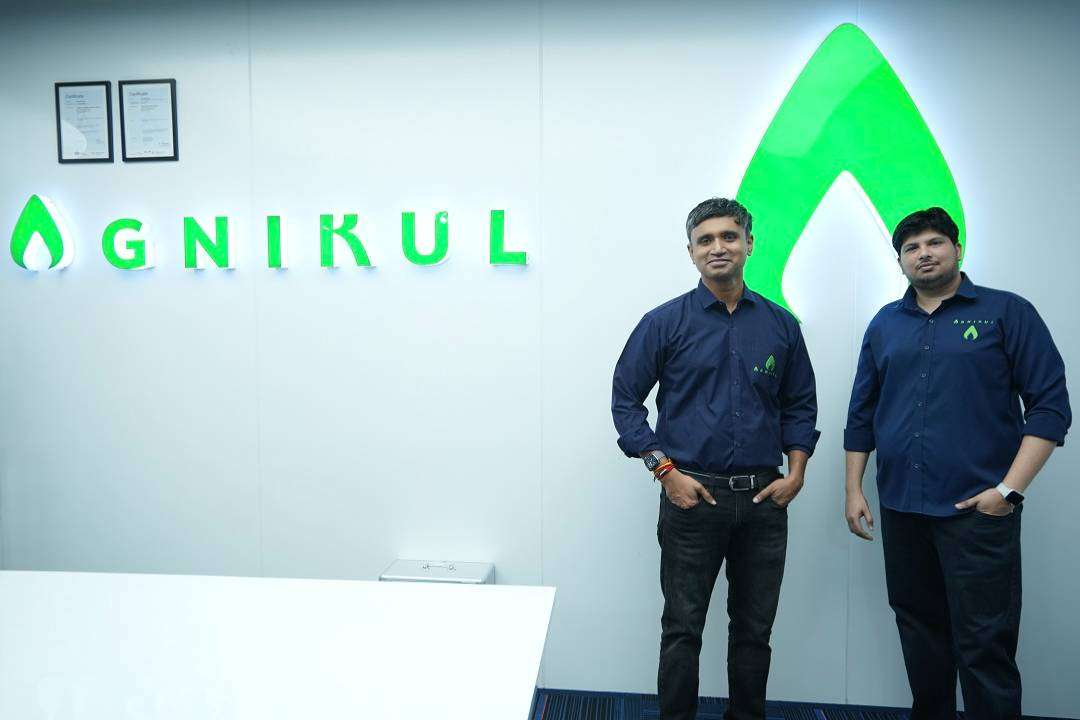
Srinath Ravichandran and Moin S.P.M. founded Agnikul Cosmos in 2017, pioneering India's first 3D-printed rocket engine technology and customizable small-satellite launch vehicles.
Written by TFN Research Desk | covering startups, technology, venture capital, and business strategy.
Table of Contents
- Quick Facts
- Introduction
- The Agnikul Story
- Business Model
- How Agnikul Makes Money
- Funding History
- Revenue and Performance
- Key Takeaways
- FAQs
- Sources
Quick Facts
Srinath Ravichandran: Co-founder and CEO, space technology innovator. Moin S.P.M.: Co-founder. Founded: 2017. Company type: Aerospace manufacturer and space launch provider. Valuation: $500 million (November 2025). Key innovation: World’s first single-piece 3D-printed rocket engines. Headquarters: Chennai, Tamil Nadu.
Introduction
Srinath Ravichandran and Moin S.P.M. founded Agnikul Cosmos in 2017 within IIT Madras, creating India’s pioneering aerospace company focused on customizable small-satellite launch vehicles. The company pioneered single-piece 3D-printed semi-cryogenic engines using additive manufacturing, reducing production timelines from months to days. Agnikul raised $75.5 million across 11 funding rounds achieving $500 million valuation in November 2025. The company successfully launched India’s first semi-cryo engine from private pad (May 2024) and demonstrated cluster engine firing (February 2026). Agnikul developed Agnibaan small-satellite launch vehicle and operates from IIT Madras Research Park. Tamil Nadu government invested Rs 25 crore marking first government equity stake in private space startup. This profile covers Ravichandran’s journey from space research to founding Agnikul.
The Agnikul Story
Srinath Ravichandran worked at IIT Madras recognizing fundamental inefficiencies in rocket manufacturing. Traditional engine production involved assembling hundreds of discrete components through complex welding, consuming months and significant capital. In 2017, Ravichandran and Moin S.P.M. launched Agnikul Cosmos with radical vision: 3D-print entire rocket engines as single integrated pieces.
Operating from IIT Madras Research Park, Agnikul started with Rs 3 crore seed funding. The founders brought academic rigor with entrepreneurial drive, focusing initially on perfecting 3D-printing technology for cryogenic engines requiring precision unprecedented in additive manufacturing. Agnikul’s breakthrough came through Agnilet engine program developing single-piece 3D-printed semi-cryogenic engines.
In May 2024, Agnikul achieved historic milestone: successful India’s first semi-cryo engine launch from private pad. The controlled suborbital flight validated engine performance, propulsion reliability, and flight management integration. The mission was conducted with ISRO and IN-SPACe regulatory framework validation. Building momentum, Agnikul continued advancing Agnite booster engine development. In March 2026, successful Agnite test-fire (one-meter-long 3D-printed engine) demonstrated expanded manufacturing capabilities. In February 2026, cluster stack firing of three semi-cryogenic engines simultaneously validated multi-engine configurations.
Government recognition accelerated growth. In April 2025, Ministry of Electronics selected Agnikul for indigenous foundational model development. In February 2026, Tamil Nadu government’s TIDCO invested Rs 25 crore—first government equity stake in private space startup. This signaled confidence in Agnikul’s technology and business model.
Agnikul’s funding trajectory reflected growing investor confidence. Early supporters included Mayfield India, pi Ventures, Celesta Capital. By 2025, tier-1 investors including HDFC Bank and Bessemer Venture Partners participated. In November 2025, Agnikul raised Rs 150 crore at $500 million valuation.
Strategic partnerships expanded ecosystem. In September 2024, Nibe Space announced constellation with Agnikul partnerships. In July 2026, Agnikul signed MOU with Finnish ICEYE developing SAR satellites, demonstrating international collaborative potential.
Business Model
- Agnibaan customizable orbital launch vehicle (100 kg payload)
- 3D-printed semi-cryogenic engine manufacturing
- End-to-end launch support and integration
- In-house autopilot and avionics systems
- Satellite constellation operations
- Space infrastructure services
How Agnikul Makes Money
- Per-launch pricing for satellite missions
- Customized orbital parameter pricing
- Payload integration fees
- Long-term launch contracts
- 3D-printed engine manufacturing services
- Aerospace component production
- Technology licensing for additive manufacturing
Funding History
| Round | Year | Amount | Lead Investors |
|---|---|---|---|
| Seed | 2017 | Rs 3 crore | Founders + angels |
| Series A | 2019-2020 | Undisclosed | Early-stage VCs |
| Series B | 2021-2022 | Undisclosed | Mayfield, pi Ventures |
| Series C | 2023-2025 | Multiple tranches | HDFC Bank, Celesta |
| Latest | Nov 2025 | Rs 150 crore | Bessemer, others |
| Government | Feb 2026 | Rs 25 crore | TIDCO (Tamil Nadu) |
Agnikul raised $75.5 million achieving $500 million valuation.
Revenue and Performance
- 288 employees (August 2025)
- Customers: India, Middle East, Australia
- First semi-cryo launch: May 2024
- Multi-engine validation: February 2026
- 350-acre manufacturing campus: Allocated in Tamil Nadu
- Manufacturing timeline: 7 days per engine
Key Takeaways
- Srinath Ravichandran founded Agnikul in 2017 pioneering 3D-printed rocket technology
- Raised $75.5 million achieving $500 million valuation (November 2025)
- Pioneered single-piece 3D-printed semi-cryogenic engines
- Successfully launched India’s first semi-cryo engine (May 2024)
- Developed Agnibaan small-satellite launch vehicle
- Received first government equity investment (Rs 25 cr TIDCO)
- International partnerships (ICEYE, satellite operators)
- 350-acre integrated manufacturing campus allocated in Tamil Nadu
FAQs
Who founded Agnikul Cosmos?
Srinath Ravichandran, Moin S.P.M., and others founded Agnikul in 2017 at IIT Madras.
When was Agnikul founded?
Agnikul was founded in 2017 as academic startup within IIT Madras.
What is Agnikul’s current valuation?
$500 million as of November 2025.
How much funding has Agnikul raised?
$75.5 million across 11 funding rounds.
What are 3D-printed rocket engines?
Single-piece 3D-printed semi-cryogenic engines manufactured in 7 days using advanced additive manufacturing.
When did Agnikul launch?
First semi-cryo engine successfully launched May 30, 2024 from private pad.
What is Agnibaan?
Customizable small-satellite launch vehicle carrying 100-kg payloads to low Earth orbit.
Does Tamil Nadu government support Agnikul?
Yes. TIDCO invested Rs 25 crore in February 2026—first government equity stake in private space startup.
Why is Agnikul significant?
Pioneering 3D-printed engine technology revolutionizing rocket manufacturing cost and timelines.
Is Agnikul international?
Yes. Customers across India, Middle East, Australia with partnerships including ICEYE (Finland).
Sources
- Wikipedia: https://en.wikipedia.org/wiki/AgniKul_Cosmos
- Tracxn: https://tracxn.com/d/companies/agnikul/
- Business Standard: https://www.business-standard.com/companies/start-ups/agnikul-raises-17-mn/
©️ The Founder Nation | Written by TFN Research Desk