

Sachin Bansal co-founded Flipkart in 2007, helping transform online shopping in India before launching fintech company Navi Technologies.
From delivering the first Flipkart order on a scooter to building a multi-billion-dollar e-commerce giant, explore Sachin Bansal’s entrepreneurial journey.
Written by TFN Research Desk | covering startups, technology, venture capital, and business strategy.
Table of Contents
- Who is Sachin Bansal?
- Early Life and Education
- Career Before Flipkart
- How Flipkart Started
- Funding History
- Revenue Growth and Recent Challenges
- Public Recognition
- Flipkart vs Competitors
- Investor Perspective
- Founder Timeline
- Key Takeaways
- FAQs
- Sources
Who is Sachin Bansal?
Sachin Bansal is the co-founder of Flipkart, the company that turned online shopping from a novelty into a habit for hundreds of millions of Indians. He served as CEO from 2007 until 2016, then as executive chairman until his exit in 2018. An IIT Delhi computer science graduate, Bansal briefly considered a career in professional gaming before choosing entrepreneurship, a hint of the competitive streak that later defined his approach to building Flipkart.
Early Life and Education
Bansal was born on 5 August 1981 in Chandigarh, to a businessman father and homemaker mother. He studied at St. Anne’s Convent School before securing an all India JEE rank of 2470 on his first attempt, earning him a seat at IIT Delhi, where he graduated in computer science in 2005. Not publicly disclosed is any specific childhood venture, though several accounts note he seriously weighed a career in competitive gaming during his engineering years.
Career Before Flipkart
After IIT, Bansal joined Techspan, a Delhi-based IT services firm, working on routine development assignments. Seeking a more dynamic environment, he moved to Bangalore in 2006 and joined Amazon India as a software engineer for about a year and a half. That stint gave him direct exposure to large-scale e-commerce systems and convinced him that India, still largely untapped for online retail, needed a homegrown version of what he saw functioning abroad.
How Flipkart Started
In October 2007, Bansal and his IIT Delhi batchmate Binny Bansal, no relation, quit their jobs and started Flipkart from a small rented apartment in Bengaluru’s Koramangala neighbourhood. Initial capital was modest, around Rs 4 lakh, and the idea was narrow by design: sell books online before expanding further.
The bet nearly stalled early on. The site recorded no sales for ten days until a customer in Andhra Pradesh ordered a copy of “Leaving Microsoft to Change the World,” delivered personally by the founders on a scooter. That first transaction proved Indian consumers would buy online if the experience felt reliable. Cash on delivery, introduced soon after, addressed the trust deficit keeping most Indians away from e-commerce and became one of the company’s defining innovations.
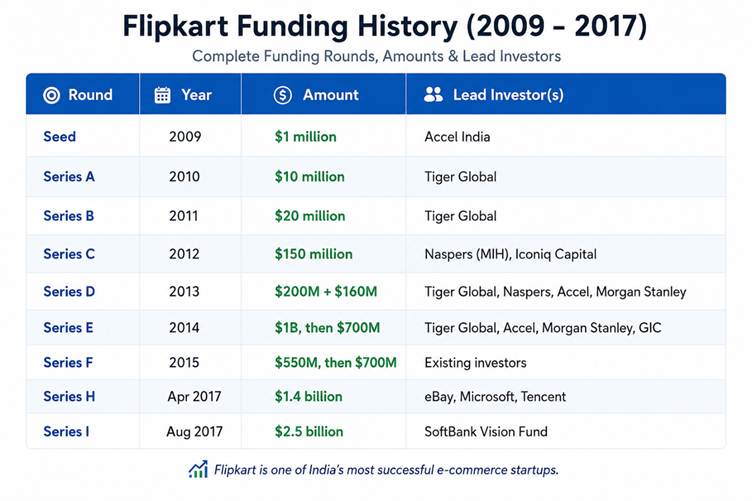
Flipkart has raised a total of $12.1 billion across 22 rounds from 128 investors, per Tracxn. In 2017, SoftBank had reportedly explored a Flipkart-Snapdeal merger that never materialized.
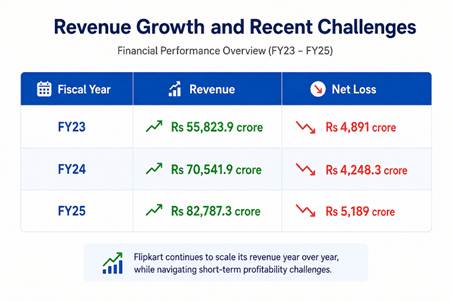
Why this happened: These Tofler-sourced figures show a company still scaling fast but not profitable at the consolidated level. Growth was driven by advertising and marketplace commissions, while logistics revenue declined amid rising third-party competition. The widening FY25 loss, even as the core marketplace unit cut its own losses by 37%, points to heavier investment in quick commerce and fintech, arenas rivals were pushing hard.
Public Recognition
Bansal was named Entrepreneur of the Year by The Economic Times for 2012-13, listed among Forbes India’s 86th richest in 2015, and featured in Time’s 100 most influential people list in 2016 alongside India Today’s 50 most powerful list in 2017. IIT Delhi gave him a Distinguished Alumnus Award the same year.
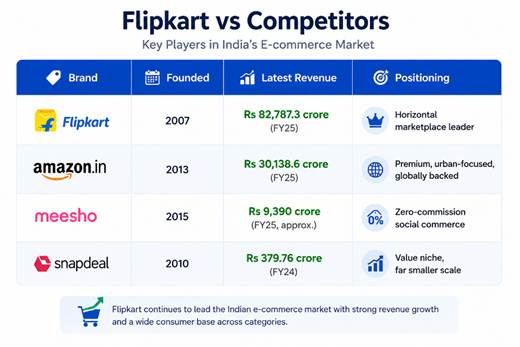
Flipkart leads on revenue and share; Amazon trails but leads on profitability metrics, while Meesho occupies a distinct volume-driven niche.
Investor Perspective
Bansal’s qualification rested less on formal training and more on timing and stubbornness. His Amazon stint gave him a model to adapt, and his willingness to run deliveries personally showed an operator’s instinct many funded founders lack.
Strengths: first-mover trust via cash on delivery, an owned logistics arm in Ekart, and acquisitions like Myntra and PhonePe extending reach.
Risks: thin sector margins, rising acquisition costs from Amazon and Meesho, and years of consolidated losses.
Opportunity: if cost pressures ease and the planned shift of the holding structure to India proceeds, an IPO becomes a realistic next chapter.
Founder Timeline
- 2005 — Graduates IIT Delhi, computer science
- 2005-06 — Works at Techspan, then Amazon India
- 2007 — Co-founds Flipkart with Binny Bansal
- 2009 — First institutional funding from Accel India
- 2012 — Crosses unicorn valuation
- 2014 — Raises over $1.7B across two rounds
- 2016 — Steps down as CEO, becomes Executive Chairman
- 2017 — SoftBank invests $2.5 billion
- 2018 — Walmart acquires 77% stake for $16B; Bansal exits
- 2018 — Founds Navi Technologies with Ankit Agarwal
- 2020 — Becomes Managing Director of Navi
- 2022 — Navi files draft IPO papers for Rs 3,350 crore
Key Takeaways
- Starting narrow, an online bookstore with Rs 4 lakh, let Bansal test demand before scaling into a full marketplace.
- Solving the trust problem via cash on delivery mattered more than technology sophistication in an unfamiliar market.
- Owning logistics through Ekart reduced dependence on external delivery networks.
- Stepping back from CEO to chairman in 2016 let Bansal exit cleanly rather than being pushed out later.
- Consolidated losses can persist for years even at massive revenue scale.
FAQs
Who founded Flipkart?
Sachin Bansal and Binny Bansal, in 2007.
Did Sachin Bansal study at IIT?
Yes, IIT Delhi, computer science, graduating 2005.
How much funding did Flipkart raise?
$12.1 billion across 22 rounds, per Tracxn.
Is Flipkart profitable?
Not as of FY25, with a consolidated net loss of Rs 5,189 crore.
What is Sachin Bansal’s net worth?
Not publicly disclosed precisely; estimated at just over $1 billion around his 2018 exit.
Who are Flipkart’s main investors?
Tiger Global, Accel, Naspers, SoftBank, Microsoft, Tencent, and eBay.
Did Flipkart go public?
No, though a shift of its holding structure to India has fueled IPO speculation.
What did Bansal do after Flipkart?
Founded BACQ Acquisitions, then Navi Technologies, where he is Managing Director.
What made Flipkart different from Amazon in India?
Early localisation, cash on delivery, and homegrown logistics through Ekart.
Any major awards?
The Economic Times Entrepreneur of the Year (2012-13) and Time’s 100 most influential list (2016).
Sources
- Wikipedia — Sachin Bansal biography
https://en.wikipedia.org/wiki/Sachin_Bansal - Wikipedia — Flipkart company history
https://en.wikipedia.org/wiki/Flipkart - Tracxn — Flipkart funding data
https://tracxn.com/d/companies/flipkart/__pEY5Ub_-w20aEOIgCL-qCRVeBd8rtHj_vnmmzHQ8a6E - Business Standard — Flipkart consolidated revenue/loss (FY23–FY25)
https://www.business-standard.com/companies/news/flipkart-internet-fy25-revenue-rises-14-losses-narrow-ipo-prep-125091300087_1.html - Entrackr — Flipkart Internet & Myntra financial results
https://entrackr.com/?s=Flipkart - Quartz India — Flipkart funding timeline
https://qz.com/india/954112/from-1-million-to-1-4-billion-a-timeline-of-flipkarts-investments - CXO Partners — Sachin Bansal life story
https://cxopartners.in/sachin-bansal-life-story/ - Business Standard — Snapdeal FY24 results
Business Standard - Medianama — Amazon Seller Services FY25 results
https://www.medianama.com/2025/09/223-amazon-seller-services-fy25-net-loss-89-rs-374-cr/ - The Arc / Upstox — Meesho FY25 performance
https://upstox.com/ipo/meesho-limited-ipo/
© The Founder Nation | All rights reserved | Written by TFN Research Desk