
Bhavish Aggarwal founded Ola Electric in 2017, building the company into one of India's major electric two-wheeler manufacturers.
Discover how Bhavish Aggarwal built Ola Electric into India’s leading electric two-wheeler company, from its early EV experiments and Etergo acquisition to its 2024 IPO and subsequent challenges.
Written by TFN Research Desk | covering startups, technology, venture capital, and business strategy
Quick Facts
| Founder | Bhavish Aggarwal |
| Education | B.Tech, Computer Science, IIT Bombay |
| Prior Ventures | Founder and CEO, Ola Cabs (ANI Technologies); Microsoft Research India |
| Role | Founder, Chairman and CEO, Ola Electric |
| Founded | 2017 |
| Sector | Electric Vehicles |
Introduction
Before Ola Electric existed, Bhavish Aggarwal, already well-known as the founder of Ola Cabs, ran a small pilot in Nagpur in 2017, deploying electric rickshaws and cabs to see how EVs held up in real Indian conditions. (TVS Weekly) The experiment revealed that available EVs simply weren’t durable enough, and that two-wheelers, not cars, would lead India’s electric transition. (TVS Weekly) Ola Electric Mobility was formally incorporated in February 2017, and by 2024 it had gone from unicorn to publicly listed company, before facing one of Indian startup history’s steepest post-IPO stock declines. (businessmodelcanvastemplate.com)
The Ola Electric Story
Before founding Ola Electric, Aggarwal had already built Ola Cabs into one of India’s largest ride-hailing platforms after quitting Microsoft Research India in 2010. (Rest of World) Ola Electric began as a subsidiary of ANI Technologies, and in a structurally unusual move, Aggarwal personally purchased 92.5% of its stake for just ₹92,500 between December 2018 and January 2019, before the company began raising serious outside capital. (Marcellus)
Rather than build a scooter from scratch, Ola Electric acquired Etergo B.V., an Amsterdam-based EV startup known for its AppScooter and swappable battery technology, in May 2020, for roughly €3.75 million. (TVS Weekly; MarkHub24) To keep costs down for the Indian market, Ola swapped Etergo’s swappable battery for a fixed pack, then built the “Ola Futurefactory” in Krishnagiri, Tamil Nadu, an all-women-staffed plant with an ambitious claimed capacity of 10 million scooters a year, alongside a “Gigafactory” to manufacture its own lithium-ion cells. (TVS Weekly)
That scale-first approach paid off commercially at first: Ola Electric reached unicorn status in 2019 after a $250 million SoftBank round, and by early 2024 commanded a dominant 35% share of India’s EV two-wheeler market. (TVS Weekly) That momentum carried the company through a successful IPO in August 2024, raising ₹5,500 crore and making Ola Electric the first Indian EV company to list publicly. (TVS Weekly)
Business Model
Ola Electric earns revenue primarily through electric scooter sales, alongside emerging energy storage products:
| Revenue Stream | How It Works |
|---|---|
| Electric scooter sales | S1 X, S1 Pro, and Roadster X product lines |
| Battery cell manufacturing | In-house Bharat Cells produced at its Gigafactory |
| Ola Shakti (new) | Residential Battery Energy Storage System, positioned as a replacement for lead-acid inverters |
| Charging infrastructure | Revenue from its network of hypercharger stations |
(Sourced from TVS Weekly)
Funding and IPO History
| Round/Event | Year | Amount | Key Investors |
|---|---|---|---|
| Series A | Feb 2019 | $56 million | Tiger Global, Matrix India, Ratan Tata |
| Series B | Jul 2019 | $250 million | SoftBank Vision Fund ($1B+ valuation) |
| Growth rounds | 2021–2023 | Multiple rounds | Existing investors, Temasek |
| IPO | Aug 2024 | ₹5,500 crore (~$660 million) | Public listing on NSE/BSE |
(Sourced from MarkHub24 and TVS Weekly)
Ola Electric’s IPO shares listed around ₹157, but by early 2026 the stock had fallen to roughly ₹25, a decline of more than 80%. (TVS Weekly) SoftBank, one of its largest early backers, steadily trimmed its holding from 17% at IPO to 13.53% by January 2026. (TVS Weekly)
Revenue and Growth
| Metric | FY24 | FY25 |
|---|---|---|
| Revenue | ₹5,009 crore | Declined amid falling scooter sales |
| Net Loss | ₹1,584 crore | ₹2,276 crore |
(Sourced from Wikipedia and TVS Weekly)
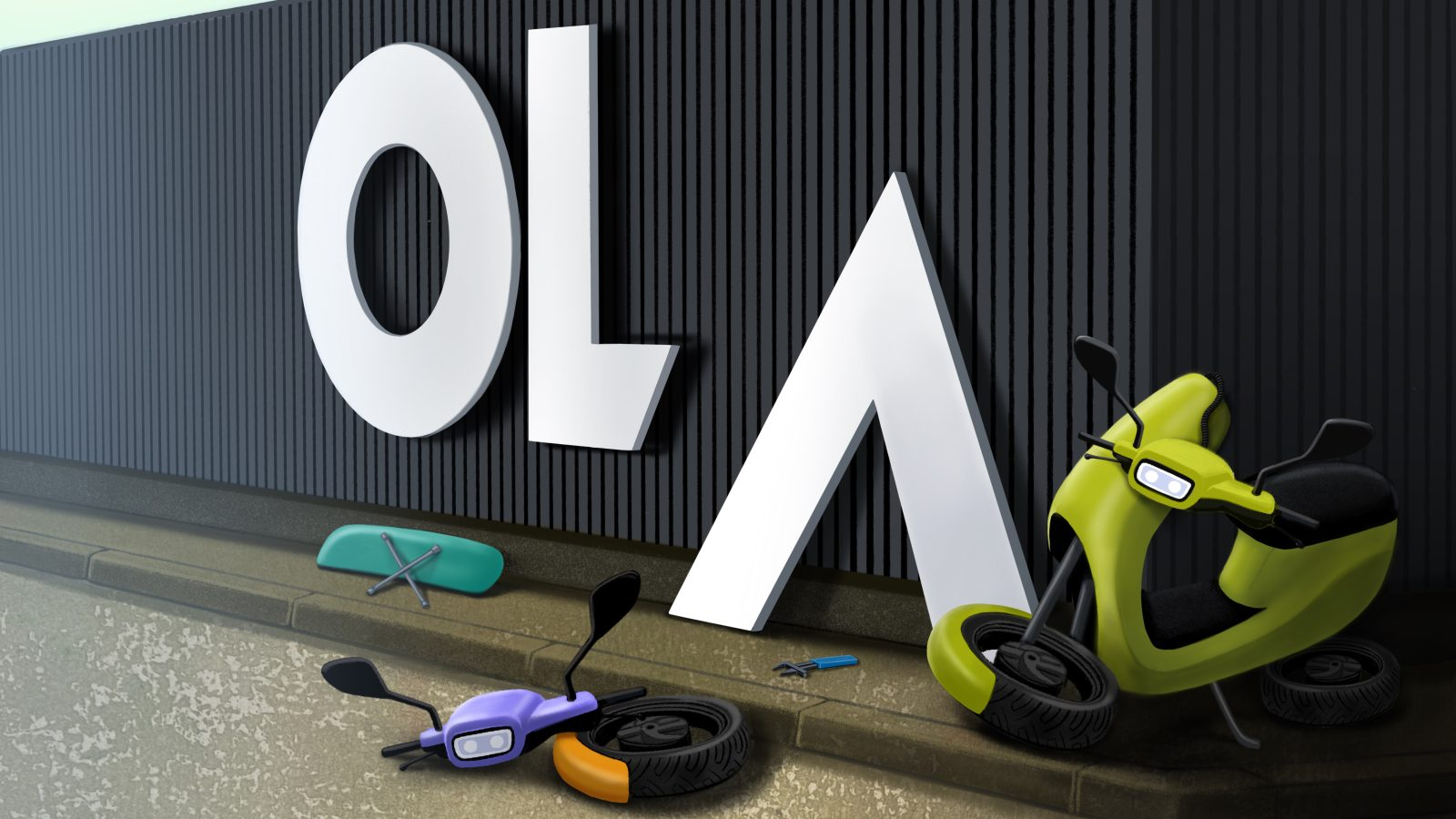
Notably, losses widened every year from ₹199 crore in FY21 to ₹2,276 crore in FY25, with the company spending ₹6,277 crore to generate ₹5,009 crore in FY24 revenue. (TVS Weekly) The core problem was execution, not demand: between September 2023 and August 2024 alone, India’s National Consumer Helpline logged 10,644 complaints against Ola Electric over manufacturing defects, long service wait times, and refused warranty claims, prompting a show-cause notice from the Central Consumer Protection Authority. (TVS Weekly) When a CCPA follow-up called 130 affected customers directly, 103 said they remained unsatisfied with Ola’s service. (TVS Weekly)
Ola Electric vs Competitors
Ola Electric competes with Ather Energy, TVS iQube, Bajaj Chetak, and Hero MotoCorp’s VIDA brand in India’s EV two-wheeler market. (TVS Weekly) As Ola’s service issues mounted, legacy players collectively grew their combined category share from 34% in 2023 to roughly 60% by January 2026, directly at Ola’s expense. (TVS Weekly)
Key Takeaways
- Bhavish Aggarwal founded Ola Electric in 2017, initially as a pilot testing EVs on Indian roads before pivoting to manufacturing.
- The company acquired Amsterdam-based Etergo B.V. in 2020 to accelerate scooter development, and became India’s first EV company to go public in August 2024.
- Ola Electric’s stock has fallen from around ₹157 at IPO to roughly ₹25 by early 2026, driven by severe service and quality complaints.
- Losses widened from ₹199 crore in FY21 to ₹2,276 crore in FY25, even as legacy rivals captured most of its lost market share.
- The company is now pivoting toward Ola Shakti, a home battery storage product, as it works to rebuild its core scooter business.
FAQs
Who founded Ola Electric?
Bhavish Aggarwal founded Ola Electric in 2017.
Is Ola Electric the same company as Ola Cabs?
No, they are separate, related entities under Aggarwal’s leadership; Ola Electric is a publicly listed EV manufacturer, while Ola Cabs (Ola Consumer) is a separate ride-hailing business.
Why did Ola Electric’s stock collapse?
Widespread service and quality complaints, regulatory scrutiny, and a resulting loss of market share to legacy two-wheeler makers drove a sharp decline in the stock.
Who are Ola Electric’s competitors?
Ather Energy, TVS iQube, Bajaj Chetak, and Hero MotoCorp’s VIDA brand.
© The Founder Nation | Written by TFN Research Desk