

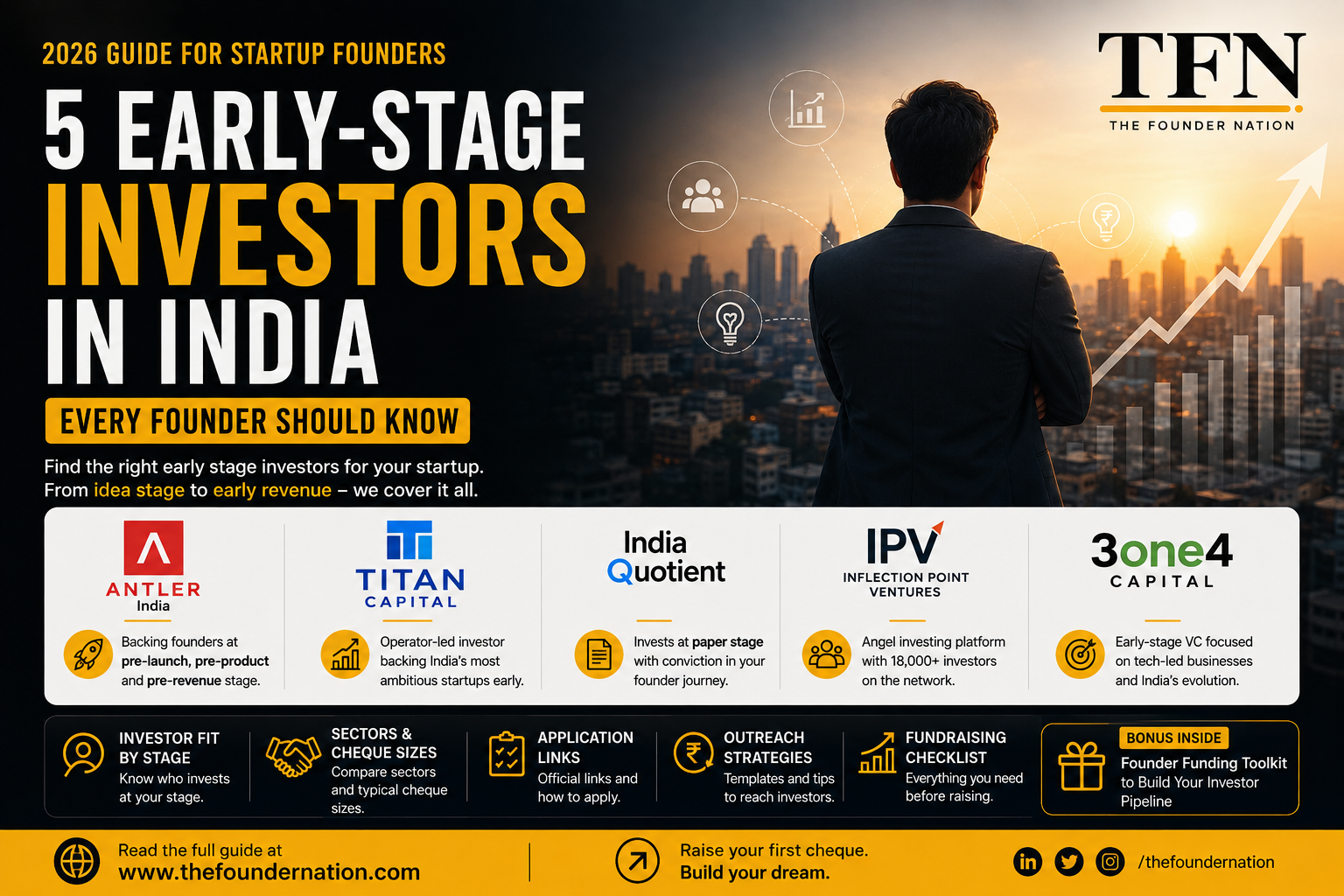
Five early-stage investors in India every startup founder should know in 2026.
Looking for early stage investors in India for your startup? You don’t always need massive revenue, thousands of customers or a fully mature product before you start speaking to investors.
If you have tried raising money for an early-stage startup, chances are you have heard some version of this.
“Pitch deck banao. Revenue dikhao. Phir baat karenge.”
And honestly, the advice is not completely wrong. Investors want to know whether you understand your market, whether customers actually want what you are building and whether your team can execute.
But there is one thing many first-time founders miss:
Not every investor is looking for a startup at the same stage.
Some investors want to see meaningful revenue. Some are comfortable with an MVP and early customers. Others are willing to meet founders when the company is still extremely early.
Antler India, for example, says it works with founders at the pre-launch, pre-product and pre-revenue stages. IndiaQuotient goes even further and says it invests at “paper stage”.
So if you are sitting with an idea, a prototype or a very early startup and thinking, “Bhai, investor milega kahan?”, this list is a good place to start.
We looked at five early-stage investors and investing platforms that Indian founders should know:
Antler India, Titan Capital, IndiaQuotient, Inflection Point Ventures (IPV) and 3one4 Capital.
This guide explains what each one does, the kind of startups they look at, how early you can approach them, what founders should prepare and where you can find the official application or contact route.
What Are Early-Stage Investors?
An early-stage investor backs a company when it is still relatively young and has significant growth ahead of it. That can mean very different things depending on the investor. For one investor, early stage might mean a startup with an MVP and its first customers. For another, it could mean a company that already has revenue but is still preparing for its first institutional round.
And for a small group of investors, early stage can genuinely mean before the product and before revenue.
That is why founders should not judge investors simply by the label “VC”.
The better questions are:
What stage does this investor actually invest at?
What sectors does the investor understand?
Does the investor invest in India-focused businesses?
How much capital does it typically deploy?
Does the investor want a product, customers or revenue?
What does the application process look like?
These questions can save you a lot of time.
The 5 Investors at a Glance
| Investor | Type | Early-Stage Fit | Idea / Pre-Product | Areas of Interest |
|---|---|---|---|---|
| Antler India | VC and founder platform | Very strong | Yes | AI and other technology-led businesses |
| Titan Capital | Early-stage investor | Very strong | Very early | Consumer, AI, SaaS, brands, fintech, logistics and more |
| IndiaQuotient | Pre-seed and seed VC | Very strong | Yes, paper stage | Consumer, SaaS, fintech, B2B marketplaces and more |
| IPV | Angel investing platform | Strong | Case dependent | Broad startup coverage |
| 3one4 Capital | VC | Strong | Depends on company and stage | Technology, SaaS, consumer, fintech and other digital businesses |
This is a starting point, not a guarantee of funding. An investor can be a good stage fit and still decide that a particular startup is not suitable for investment.
1. Antler India
For founders who are still very early
If you are still figuring things out, Antler India is one of the first names worth researching.
Antler’s India platform explicitly says it works with teams at the pre-launch, pre-product and pre-revenue stages. Its current India page also describes Antler as a first believer and institutional cheque for founders.
That is significant because most founders assume they need to build a company first and then approach investors.
Antler’s model is much more comfortable with founders who are still at the beginning of that journey.
What does Antler India focus on?
Antler’s current India positioning has a strong emphasis on AI-first startups, while the firm also invites exceptional founders building in other areas to get in touch.
Its India ecosystem covers businesses across technology and emerging sectors, including AI, software, fintech, consumer technology, deeptech and other technology-led opportunities.
The important point is that the investor is not simply looking for another small business. It is looking for founders who can build companies with significant scale potential.
How early can you approach Antler?
Very early.
Antler explicitly mentions:
Pre-launch.
Pre-product.
Pre-revenue.
That does not mean you can walk in with a vague idea and expect a cheque.
If you are pre-product, you need to compensate for the lack of traction with a strong understanding of the problem, the market and the customer.
You should also be able to explain why you are the right person or team to build this company.
How much does Antler India invest?
Antler’s current India page says its standard deal is up to approximately US$425,000, or around ₹4 crore, for 11% equity.
Founders should still check the current programme terms before applying because investment structures can change between programmes and cohorts.
Who should consider Antler?
Antler is particularly interesting if you are:
- Still validating your idea.
- Pre-product.
- Pre-revenue.
- Building an AI-first company.
- Looking for a structured founder ecosystem.
- Looking for an investor that is comfortable getting involved early.
The biggest mistake would be approaching Antler simply because it invests early.
You still need a compelling reason for the team to believe that you can turn the opportunity into a serious company.
Official application
2. Titan Capital
Early-stage capital with a strong founder focus
Titan Capital is another name that comes up frequently when Indian founders talk about early-stage funding.
Titan describes itself as an operator-led early-stage investor and says the startup team is its number one investment criterion. It also says it is typically the first investor in the companies it backs.
That tells you something important about the firm’s approach.
At the earliest stage, the company may not have enough history for an investor to judge it purely on numbers. The founders therefore become a major part of the investment decision.
What does Titan Capital invest in?
Titan’s portfolio spans a wide range of businesses.
Its current public positioning covers areas including:
Consumer internet, AI, SaaS, brands, fintech and logistics.
The portfolio includes well-known Indian startups and companies such as Urban Company, Ola, Mamaearth, OfBusiness, Razorpay, GIVA and others.
The firm says its portfolio has grown to 250+ companies across India and the US according to its current public profile.
Does Titan invest very early?
Yes.
Titan says it is typically the first investor in the companies it invests in and that it backs founders at the pre-seed and seed stages.
That makes it relevant to founders who have not yet reached a large scale.
But again, early stage does not mean “anything goes”.
Your founding team, market, insight and ability to execute still matter.
What makes Titan interesting for founders?
One of the advantages of an operator-led investor is that the relationship can extend beyond the cheque.
Titan’s website highlights its role in helping founders through the company-building journey, while founder testimonials on the site describe support around fundraising, strategy, negotiation and stakeholder management.
For an early founder, that kind of experience can be valuable because the first institutional investor is often doing much more than simply transferring capital.
How should you approach Titan?
Titan provides a dedicated contact route for founders looking to raise capital.
If you are approaching them, don’t send a generic “please invest in my startup” message.
Tell them what you are building, who it is for, what evidence you have and why you believe Titan is relevant to the company.
Official contact
3. IndiaQuotient
The investor on this list that is especially relevant to idea-stage founders
If you are searching specifically for pre-seed investors in India, IndiaQuotient deserves serious attention.
The reason is very simple.
IndiaQuotient says on its website:
“We invest at paper stage.”
The firm says it can invest with as much conviction when a startup is still at the paper stage as when it has a handful of customers. It says this approach has allowed some founders to skip the traditional angel round.
That is unusually relevant for founders who have not yet built significant traction.
What does “paper stage” actually mean?
It means the company can be extremely early.
You may still be validating the idea. You may not have revenue. You may not have a large user base. You may not even have a finished product.
But that does not mean the investor has nothing to evaluate.
At this stage, the investor is effectively evaluating:
The founder.
The insight.
The problem.
The market.
The ambition.
The ability to execute.
IndiaQuotient’s team page says it looks for strong entrepreneurs operating in ambitious markets and believes the next major companies can be built in India.
What sectors does IndiaQuotient focus on?
IndiaQuotient’s website describes areas including:
- India and global SaaS
- B2B marketplaces
- Brands
- Social and media
- Fintech
- Consumer businesses
The firm’s public positioning is strongly connected to businesses targeting large markets, particularly opportunities emerging from India’s changing consumer and digital economy.
Can an idea alone get funded?
This is where founders need to be careful with the Reel hook.
IndiaQuotient saying it invests at paper stage does not mean that every idea qualifies for investment.
There is a huge difference between:
“I have an idea.”
and:
“I have identified a large problem, I understand the customer better than most people, I have a strong reason to build this and I can explain why this can become a very large business.”
The second is what you want to communicate.
How should you approach IndiaQuotient?
Research the firm and the relevant partner before reaching out.
Your first message should be short and specific.
Explain what you are building, the customer, the problem and why you believe there is a large opportunity.
If you already have validation, show it.
If you don’t, explain what you have learned so far.
IndiaQuotient also publishes founder resources around fundraising, including guidance on building investor lists and researching the right investors before approaching them.
IndiaQuotient founder resources
4. Inflection Point Ventures (IPV)
An early-stage angel investing platform
There is one distinction worth making here.
IPV is often grouped into lists of Indian “VCs”, but the organisation describes itself as a startup investing platform that connects startups with angel investors. Its website currently says it has more than 18,000 investors on the platform.
That makes its model somewhat different from a traditional VC fund.
How does IPV’s startup funding process work?
IPV lays out a structured process for founders.
It begins with the founder submitting information and a pitch deck.
From there, the startup goes through evaluation and screening before progressing to founder discussions and, if the opportunity moves forward, due diligence and investor commitments.
The process ultimately moves toward legal documentation and funding.
That means founders should not interpret “early-stage investor” as “no preparation required.”
If you are approaching IPV, you should have your business information, pitch deck and basic financial information ready.
What does IPV look for?
IPV says:
“We invest first in the Founder, later in the Startup.”
That is particularly relevant to early-stage companies because there may not be enough historical data to judge the business purely on financial performance.
The platform also talks about providing non-monetary support and connecting founders with its investor community.
Why should an early-stage founder consider IPV?
IPV can be useful if you want access to a wider angel investor network rather than relying on a single VC partner.
The platform’s model can also provide access to investors with different operating backgrounds and areas of expertise.
But the process is still a fundraising process.
You should expect questions about the company, market, financials, valuation and use of funds.
Official application
Apply for startup funding through IPV
5. 3one4 Capital
An early-stage VC focused on technology-led businesses
3one4 Capital is another important name for founders building technology-led businesses in India.
The firm describes its investment approach as research-led and focused on India’s evolving startup ecosystem. Its seed and early-stage funds have been recognised among India-focused VC funds.
What does 3one4 Capital invest in?
Its published thesis looks at areas connected to India’s technology and consumption evolution.
The firm’s thesis includes themes such as:
Consumer data generation, consumption evolution and ambient intelligence, alongside its broader technology and India-focused investment approach.
Its investment areas have included businesses across SaaS, consumer internet, fintech, digital health and enterprise and SMB digitisation.
What makes 3one4 different?
3one4’s approach is not simply about finding the next company with impressive early revenue.
The firm’s own writing describes its early-stage investment approach as conviction-driven, research-led, operator-oriented and bottom-up.
That is important for founders because it means the story needs to go beyond:
“Our market is huge.”
You need to explain why this particular company can win in that market.
What should you prepare before contacting 3one4?
This is another area where founders should be realistic.
Being an early-stage investor does not mean you can skip the basics.
If you approach 3one4, be prepared to explain your company, market, team, product and business model. A strong pitch deck will make the conversation much easier.
The exact stage and investment fit should be confirmed with the firm at the time of application.
Official website
Which Investor Should You Approach?
This is probably the most useful part of the list.
You should not apply to all five simply because they are on this page.
Start with your current stage.
If you only have an idea
Your first research list should include Antler India and IndiaQuotient.
Antler explicitly works with pre-product and pre-revenue teams, while IndiaQuotient explicitly says it invests at paper stage.
At this stage, your founder story matters enormously.
You need to answer:
Why this problem?
Why you?
Why now?
Why can this become a large business?
If you are pre-product
Antler and IndiaQuotient are obvious places to research.
You can also explore other early-stage investors if you have strong validation.
This is where customer interviews become extremely useful.
If you don’t have a product, you can still show that you have spoken to potential users and understand their pain.
If you have an MVP
Your investor universe gets bigger.
At this point, you can investigate Antler, Titan, IndiaQuotient, IPV and 3one4, depending on your sector and business model.
Your pitch should now include a demonstration of the product.
If you have early revenue
Now you can start having a much more metrics-driven conversation.
Investors may want to understand:
- Revenue.
- Growth rate.
- Retention.
- Gross margins.
- Customer acquisition.
- CAC.
- LTV.
- Burn.
- Runway.
- Sales pipeline.
The earlier you are, the more investors are likely to focus on the founder and market.
The further you progress, the more data you can give them.
Can You Raise Funding Without Revenue?
Yes.
But there is an important difference between pre-revenue and pre-validation.
Antler explicitly works with pre-revenue founders, and IndiaQuotient says it invests at paper stage.
So revenue is not an absolute requirement for every early-stage investor.
But if you have no revenue, give investors something else to believe in.
For example, you might have:
- Conducted extensive customer interviews.
- Built a prototype.
- Created a waiting list.
- Secured pilot customers.
- Received letters of intent.
- Built a community.
- Developed proprietary technology.
- Identified a strong distribution advantage.
- Built deep expertise in the industry.
Don’t try to manufacture traction.
If you have no traction, say that.
Then explain why you believe the opportunity is worth taking the risk on now.
Can You Raise Funding Without a Product?
Again, yes, in some cases.
Antler explicitly accepts pre-product teams, and IndiaQuotient says it invests at paper stage.
But the absence of a product puts more pressure on your thinking.
You need to be able to explain the customer problem in detail.
You should know how customers currently solve it.
You should understand why existing solutions are not good enough.
You should have a clear view of what you want to build.
And you should know what you need to validate next.
An investor is not simply funding the idea.
They are funding the possibility that you can turn that idea into a company.
What Do Early-Stage Investors Look For?
A strong founding team
At the earliest stage, the founders may be the biggest asset the company has.
Investors want to know whether you understand the problem and whether you have the ability and determination to build the company.
A real problem
Don’t say:
“Everyone will use this.”
Tell investors exactly who has the problem and why it matters.
A large market
If you want to build a venture-backed company, you should be able to explain how large the opportunity could become.
Don’t simply throw a massive TAM number into your deck.
Explain where it comes from.
Customer insight
If you have spoken to 50 potential customers, say so.
If 30 of them described the same pain point, explain what you learned.
Specific evidence is far more convincing than saying “there is huge demand.”
A clear business model
How will the company make money?
Who pays?
How much do they pay?
How often do they pay?
What will the economics look like at scale?
You don’t need every answer on day one, but you should have a hypothesis.
Distribution
How are you going to get your first 100 customers?
And then your first 1,000?
And then your first 100,000?
Your product can be excellent and still fail if you have no realistic way of reaching customers.
A reason you can win
This could be technology, distribution, data, community, brand, network effects, domain expertise, cost advantage or something else.
The important thing is that you can explain why your company will be difficult to replace.
What Should Your Pitch Deck Contain?
A good early-stage pitch deck does not need to be 40 slides.
It needs to make the investor understand the company quickly.
1. Company
Explain what you are building in one clear sentence.
2. Problem
Show the problem from the customer’s perspective.
3. Solution
Explain how your product solves it.
4. Why Now?
Explain what has changed that makes the opportunity particularly relevant today.
5. Market
Explain the size and structure of the opportunity.
6. Product
Show screenshots, a demo, prototype or product flow wherever possible.
7. Traction
Show revenue, customers, users, retention, pilots, waitlist or other validation.
8. Business Model
Explain how you make money.
9. Competition
Show the alternatives customers already use.
10. Differentiation
Explain why you can win.
11. Go-to-Market
Explain how you will acquire customers.
12. Team
Explain why you are the right people to build the company.
13. Fundraise
Tell investors how much you are raising.
14. Use of Funds
Explain where the money will go.
15. Milestones
Explain what this round should allow you to achieve.
How to Approach Investors
One of the easiest ways to hurt your chances is to send the same generic message to every investor.
Don’t write:
“Hello sir, I have a startup idea. Please invest.”
Instead, make it easy for the investor to understand your company.
A good first message should answer four things:
What are you building?
Who is it for?
What evidence do you have?
Why are you contacting this investor?
A Simple Investor Outreach Template
Subject: Raising ₹1 Cr Pre-Seed for [Startup Name]
Hi [Investor Name],
We’re building [one-line description] for [customer segment], solving [specific problem].
Over the last [X] months, we have [brief validation or traction].
We currently have [users, revenue, pilots, waitlist or other evidence].
We’re raising ₹1 crore to help us achieve [specific milestones] over the next [12 to 18 months].
Given your focus on [sector/stage], I believe there could be a strong fit.
Happy to share the deck and demo.
Best,
[Founder Name]
Don’t Just Research the VC. Research the Partner.
This is one of the most useful fundraising lessons for first-time founders.
A VC is not one person.
Different partners can have different sectors, stages and investment interests.
Before contacting a fund, find out:
Which partner invests in my sector?
Which companies have they backed?
What stage do they usually invest at?
Have they invested in a business similar to mine?
What can I learn from their public writing or interviews?
Then personalise your outreach.
IndiaQuotient’s own fundraising resources recommend researching investors and building a structured investor list rather than approaching fundraising randomly.
Build an Investor Pipeline
Don’t manage your fundraising entirely through WhatsApp, email and memory.
Create a simple spreadsheet or CRM.
| Investor | Stage Fit | Sector Fit | Contact | Intro | Meeting | Due Diligence | Status |
|---|---|---|---|---|---|---|---|
| Antler India | Strong | Strong | Pending | Pending | Pending | Not started | Research |
| Titan Capital | Strong | Strong | Pending | Pending | Pending | Not started | Research |
| IndiaQuotient | Strong | Strong | Pending | Pending | Pending | Not started | Research |
| IPV | Strong | Depends on sector | Pending | Pending | Pending | Not started | Research |
| 3one4 Capital | Strong | Strong for tech | Pending | Pending | Pending | Not started | Research |
Track every conversation.
Write down the feedback.
Record the next action.
And most importantly, don’t keep pitching the exact same story if five investors give you the same feedback.
Sometimes the fundraising process itself tells you what needs to change.
Do You Actually Need VC Funding?
This is the question founders often skip.
Not every startup needs venture capital.
If you are building a profitable business that can grow from customer revenue, bootstrapping might make more sense.
If you need capital for product development, you could explore grants or incubators.
If you are building a company with massive potential but significant upfront capital requirements, institutional VC may be the right route.
The point is not to raise money because “startups are supposed to raise money.”
The point is to raise capital because capital helps you build the company faster or better than you could without it.
What Does VC Funding Actually Cost You?
A VC cheque is not free money.
You are usually exchanging equity and certain rights for capital.
Before signing any investment documents, understand the implications of:
- Equity dilution.
- Valuation.
- ESOP pool.
- Liquidation preference.
- Board rights.
- Information rights.
- Pro-rata rights.
- Founder vesting.
- Anti-dilution provisions.
- Investor consent rights.
- Future fundraising implications.
If you are negotiating an investment, get proper legal and financial advice.
The Founder Nation is providing this information for education and awareness, not as legal or investment advice.
Government Funding Alternatives for Indian Startups
VC is only one part of the funding ecosystem.
Indian founders can also explore government schemes, incubators, grants and startup programmes.
Startup India
The official Startup India platform provides information about DPIIT recognition, funding schemes, investor connections and other startup ecosystem initiatives.
DPIIT Recognition
Eligible startups can apply for DPIIT recognition and potentially access benefits under applicable Startup India programmes.
Because eligibility requirements and government programmes can change, founders should check the current official Startup India portal before applying.
Startup India Seed Fund Scheme
The Startup India Seed Fund Scheme is designed to support eligible startups with activities such as proof of concept, prototype development, product trials, market entry and commercialisation.
The official scheme information should be checked for current application windows, eligibility and funding terms before applying.
Startup India Seed Fund Scheme
Early-Stage Fundraising Checklist
Before you start contacting investors, ask yourself:
Company
Is the company legally structured properly?
Founders
Do you have clear founder roles and agreements?
Problem
Can you explain the customer problem in one sentence?
Customer
Do you know exactly who will pay you?
Market
Can you explain why the opportunity is large?
Product
Do you have a product, MVP or prototype?
Validation
What evidence do you have that customers care?
Business Model
How will you make money?
Competition
What alternatives exist today?
Differentiation
Why will you win?
Distribution
How will you acquire customers?
Financials
Do you understand your burn, runway and key metrics?
Fundraise
How much are you raising?
Use of Funds
What will the capital actually achieve?
Investor Fit
Why are you approaching this particular investor?
Pitch
Can you explain the company in less than five minutes?
If you cannot answer several of these questions, that does not necessarily mean you should stop fundraising.
It may simply mean you need to spend some more time validating the business first.
20 Questions an Investor May Ask You
Before taking your first serious meeting, prepare answers to these:
- What exactly are you building?
- What problem are you solving?
- Who has this problem?
- How do you know the problem exists?
- Why is this problem important?
- Why now?
- How big can this market become?
- Who are your competitors?
- Why will you win?
- What is your moat?
- How will you acquire customers?
- How do you make money?
- What traction do you have?
- What have customers told you?
- Why are you the right founder?
- How much are you raising?
- What valuation are you targeting?
- Where will the money go?
- What milestone will this round help you achieve?
- What happens if you don’t raise this round?
That last question is particularly useful.
It forces you to think about whether fundraising is actually necessary right now.
So, Which of These Five Should You Approach?
Here’s the simple version.
You only have an idea
Start researching Antler India and IndiaQuotient.
Both are explicitly comfortable with very early-stage opportunities.
You are pre-product
Antler and IndiaQuotient should be high on your list.
Then look at other investors based on your sector.
You have an MVP
Expand your list.
Titan, IPV and 3one4 can become relevant alongside Antler and IndiaQuotient, depending on the business.
You have early revenue
Build a wider investor pipeline.
At this point, you can evaluate investors based on sector, stage, cheque size, portfolio and value-add rather than simply asking who invests early.
The Real Lesson
The most important thing to take away from these five investors is not:
“These are five VCs who will fund you without revenue.”
That is too simplistic.
The real lesson is:
Find an investor whose risk appetite matches your startup.
If you are still at the idea stage, find investors who genuinely understand idea-stage companies.
If you have an MVP, show it.
If you have customers, show the numbers.
If you have revenue, understand your unit economics.
And throughout the process, remember that investor fit works both ways.
You are not just trying to convince someone to invest in your company.
You are also deciding who you want sitting on your cap table while you build it.
Getting the cheque is only half the job.
Getting the right cheque from the right investor can make a much bigger difference.
Frequently Asked Questions
Which are the best early-stage investors in India?
There is no single best investor for every startup. Antler India, Titan Capital, IndiaQuotient, IPV and 3one4 Capital are all worth researching, but the right choice depends on your startup’s stage, sector, traction and capital requirement.
Which investors fund startups at the idea stage?
Antler India explicitly works with pre-launch, pre-product and pre-revenue teams. IndiaQuotient explicitly says it invests at paper stage.
Can I raise startup funding without revenue?
Yes. Some early-stage investors invest before revenue. However, you still need a convincing reason for the investor to believe that the opportunity and founding team are strong.
Can I raise funding without a product?
Yes, depending on the investor. Antler explicitly works with pre-product teams, while IndiaQuotient says it invests at paper stage.
Does Titan Capital invest at pre-seed?
Titan describes itself as an early-stage investor and says it is typically the first investor in companies it backs, including at the pre-seed and seed stages.
Does IndiaQuotient invest before customers?
Yes. IndiaQuotient explicitly says it invests at paper stage and can invest with the same conviction before a startup has a handful of customers.
Is IPV a VC firm?
IPV describes itself as a startup investing platform connecting startups with angel investors.
Does IPV require a pitch deck?
IPV’s official startup funding process begins with a pitch deck and evaluation information, followed by screening, founder discussions and due diligence.
What sectors does 3one4 Capital invest in?
3one4’s investment thesis covers technology-led opportunities across areas including SaaS, consumer internet, fintech, digital health and enterprise and SMB digitisation. Its broader thesis also focuses on India’s evolving technology and consumption landscape.
Should every startup raise venture capital?
No. Bootstrapping, grants, incubators, angel investment, strategic investment and other forms of financing can sometimes be more appropriate than VC.
What should I send an investor first?
Start with a concise description of your startup, the problem, your customer, any validation or traction you have, how much you are raising and why you believe the investor is a fit.
Official Investor Links
If you are actually planning to raise money, always verify current information on the investor’s own website instead of relying on an old Reel, screenshot or third-party database.
Antler India
Titan Capital
IndiaQuotient
IndiaQuotient founder resources
Inflection Point Ventures
3one4 Capital
3one4 Capital contact and pitch page
More Resources for Indian Founders
If you are building your startup and looking for more opportunities, funding resources and practical founder guides, explore The Founder Nation. The Founder Nation
You can also explore the official Startup India ecosystem for government-backed programmes, startup recognition and funding-related initiatives. Startup India
🎁 Founder Funding Toolkit
Don’t just collect names of VCs. Build your investor pipeline.
We’ve created a practical funding resource that you can use while raising your first round.
Use it to track:
- Investor name
- Investment stage
- Sector
- Official website
- Application link
- Relevant partner
- Introduction source
- First contact
- Meeting
- Feedback
- Follow-up
- Due diligence
- Term sheet
- Final status
[Get the Founder Funding Toolkit]
Share This With a Founder Waiting for Their First Cheque
If you know a founder who keeps hearing:
“Pehle revenue lao.” “Pehle product banao.” “Pehle traction lao.”
Send them this guide. Because sometimes the startup is not necessarily too early.
The founder may simply be talking to the wrong investor.
About The Founder Nation
The Founder Nation (TFN) is a startup and business media platform covering founders, venture capital, startup funding, entrepreneurship, technology, AI, business opportunities and India’s evolving startup ecosystem.
Editorial Disclaimer
This article is published for informational and educational purposes. The Founder Nation does not guarantee that any investor mentioned in this article will fund a particular startup and does not endorse any investment opportunity.
Investment criteria, fund sizes, sectors, programme terms, cheque sizes, eligibility requirements and application processes can change. Information has been compiled from publicly available sources, including the respective investors’ official websites, but founders should independently verify current information before applying.
Nothing in this article constitutes investment, financial, legal, tax or fundraising advice. Founders should seek qualified professional advice before entering into investment agreements or making financial decisions.