

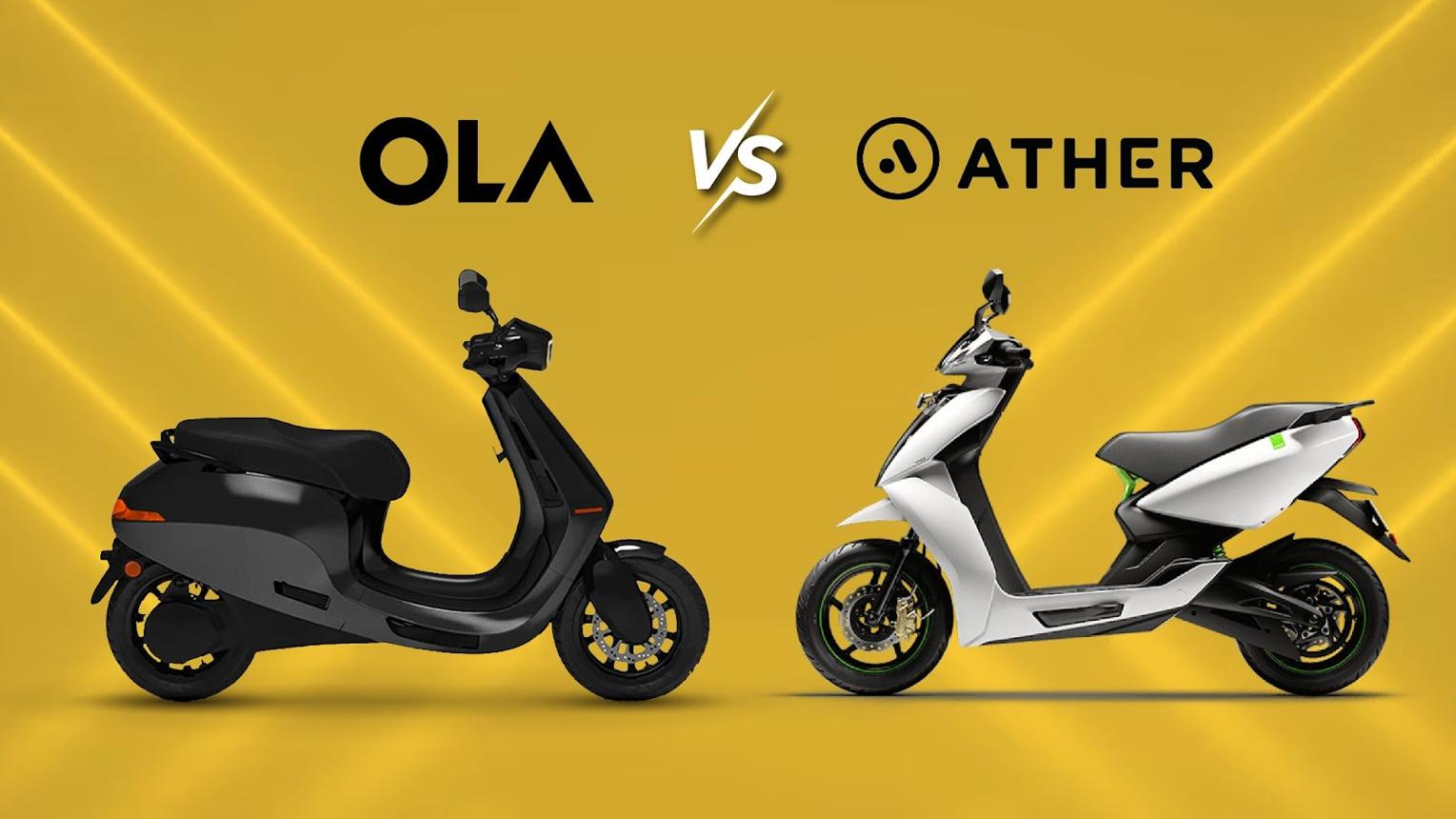
Ather Energy and Ola Electric followed very different strategies to build India's leading EV companies, with quality and long-term execution emerging as key differentiators.
Written by TFN Research Desk | covering startups, technology, digital media, and business strategy.
While Ola Electric blitzscaled to half the electric scooter market and then watched it collapse, Ather built slowly, carefully, and ended up overtaking its rival’s market capitalisation.
In Q4 FY2025, Ather Energy generated Rs 676 crore in operating revenue by selling 47,579 vehicles. Ola Electric generated Rs 611 crore selling 60,083. Ather made more money from fewer vehicles. That ratio is the entire story of what happens when a quality-first strategy meets a volume-first strategy in a market that is maturing. The early adopters who tolerate rough edges have been replaced by mainstream buyers who remember which brand’s scooter was in the news for service failures, and which brand quietly worked.
India EV Strategy • Competitive Analysis • Electric Two-Wheelers • Startup Strategy • Ather vs Ola
Short answer
Ather Energy generated Rs 899 crore in revenue in Q2 FY26, up 54% year on year, while Ola Electric’s revenue fell 43% in the same period. Ather’s stock has risen over 66% since its May 2025 IPO. Ola’s stock has fallen nearly a quarter since its August 2024 IPO. On unit volume year-to-date through September 2025, Ola Electric still leads with approximately 1.5–1.6 lakh units against Ather’s 1.3 lakh. On revenue per vehicle, market capitalisation, and investor confidence, Ather leads decisively.
Why this story matters
The Ather–Ola divergence is not primarily an EV story. It is a story about two approaches to scaling a consumer hardware company in India: build-to-last versus blitzscale-and-fix. The Indian startup ecosystem has lionised blitzscaling for a decade, rewarding aggressive market share capture with cheap capital. The 2025 results from India’s most visible EV rivalry suggest the calculus is changing. Quality compounds in ways that volume does not. The founders who internalise that lesson before their market matures will have a structural advantage over those who learn it when it is too late.
Quick facts
| Metric | Ather Energy | Ola Electric |
|---|---|---|
| Founded | 2013 | 2017 |
| Founders | Tarun Mehta, Swapnil Jain | Bhavish Aggarwal |
| IPO | May 2025 | August 2024 |
| Q2 FY26 revenue | Rs 899 crore (+54% YoY) (Startuppedia, November 2025) | Down 43% YoY |
| Q4 FY25 revenue | Rs 676 crore (E-Vehicle Info, June 2025) | Rs 611 crore |
| Q4 FY25 units sold | 47,579 | 60,083 |
| Revenue per vehicle (Q4 FY25) | ~Rs 1.42 lakh | ~Rs 1.02 lakh |
| Stock performance post-IPO | +66% (Startuptalky, October 2025) | -25% |
| Market cap (October 2025) | Rs 23,601 crore (surpassed Ola first time) (Kotak Neo, December 2025) | Rs 23,200 crore |
| H1 2025 EV market share | ~20% and rising | ~20% and falling (from ~50% peak) |
| Backing | Hero MotoCorp | SoftBank, ANI Technologies |
Background
Ather Energy was founded in 2013 by Tarun Mehta and Swapnil Jain, both IIT Madras graduates, with a mandate to build the best electric two-wheeler in India rather than the cheapest or the biggest. The company raised its first major institutional round from Hero MotoCorp in 2016, giving it patient capital from a strategic partner with deep manufacturing and distribution expertise. For years, Ather was considered the boutique option in a market that Ola Electric was dominating through volume and aggressive pricing.
Ola Electric, founded by Bhavish Aggarwal in 2017, bet on a different thesis: that the Indian EV market would be won by the company that achieved manufacturing scale fastest. Aggarwal built a gigafactory in Krishnagiri, Tamil Nadu, set up a direct-to-consumer sales model, and scaled to over half the electric two-wheeler market at its peak. The strategy worked, until it did not.

Timeline
| Year | Milestone |
|---|---|
| 2013 | Ather Energy founded in Chennai |
| 2016 | Hero MotoCorp invests; Ather gains strategic manufacturing partner |
| 2017 | Ola Electric founded; targets mass market with speed-first strategy |
| 2018 | Ather 340 and 450 launched; premium segment, South India focus |
| 2021 | Ola Electric begins deliveries from Krishnagiri plant; captures ~50% market share |
| 2022 | Ather expands nationally; 450X and 450 Plus gain recognition for reliability |
| 2023 | Quality complaints against Ola Electric increase; service network strain emerges |
| 2024 | Ola Electric IPO at August 2024; Ather files for IPO |
| H1 2025 | Ola Electric H1 sales fall ~50% YoY; Ather monthly sales average over 13,500 units |
| May 2025 | Ather Energy IPO; stock rises 66%+ from debut price |
| Q2 FY26 | Ather revenue Rs 899 crore (+54% YoY); Ola revenue down 43% |
| October 2025 | Ather surpasses Ola’s market capitalisation for the first time; Ather hits 500,000 EV milestone |
How it happened
Move 1: Ather chose depth before breadth
Ather’s decision to focus on South India before expanding nationally was widely read as a capacity constraint. It was actually a quality management decision. By serving a concentrated geography first, Ather could monitor product quality, service responsiveness, and customer satisfaction at manageable scale before adding distribution complexity. When quality concerns began surfacing across the broader EV market, Ather’s products maintained their reputation for reliability and customer satisfaction.
Ola took the opposite path, expanding to 800 stores nationally and then to 4,000 locations while simultaneously managing manufacturing ramp-up, service network development, and product quality. The speed created a fragile system where failure at any one node propagated across the customer experience. In H1 2025, Ola’s sales fell from around 2.29 lakh in H1 2024 to 1.15 lakh, a nearly 50% drop, at a time when the overall EV market was growing.
Move 2: Premium pricing protected margin and signalled quality
Ather’s pricing strategy has always been premium relative to the market. In Q4 FY25, Ather generated Rs 1.42 lakh in revenue per vehicle versus Ola’s Rs 1.02 lakh, selling 21% fewer units but generating 11% more total revenue. That spread is not accidental. A higher average selling price signals quality to buyers in a market where purchase decisions are long-term commitments. It also produces better unit economics at lower volumes, which means Ather was generating stronger margins while building up to Ola’s volumes, not after.
The launch of Ather Rizta, a family-oriented scooter that expanded Ather’s addressable market beyond the early-adopter segment, drove significant volume growth in 2025 without abandoning the premium positioning. Ather’s strong demand for the 450 series and mass-market Ather Rizta helped maintain consistent sales growth throughout a period when Ola was losing share.
Move 3: The technology stack as defensible moat
Ather’s differentiation is not just product quality. It is the Ather Stack, a combination of hardware, software, and data that the company has developed over a decade of Indian road conditions. The company maps potholes and road conditions, making riding better and helping Ather stand out from competitors. Features like this are not replicable by a company that has prioritised manufacturing volume over software and sensor integration. They require years of real-world data from real Indian roads.
This is the architectural decision that separates Ather from a premium scooter brand and positions it closer to a mobility technology company. As the Indian EV market matures beyond early adopters, the buyers who care about ride quality and software reliability over sticker price represent the natural Ather customer and that segment is growing.

The strategy behind the success
Ather’s 2025 results are the compounding of decisions made between 2013 and 2020 that would have looked like competitive disadvantages at the time: choosing premium over mass, choosing South India over national, choosing technology depth over manufacturing speed.
Year 2025 is proving to be a vindication of Ather Energy’s “Build to Last” strategy, even as competitor Ola Electric’s fast-scaling approach seems to be falling apart, as Autocar Professional observed in its mid-2025 competitive analysis. The compound effect of those early decisions is now visible in the revenue per vehicle gap, the stock performance divergence, and the market capitalisation reversal in October 2025.
Business model breakdown
Ather operates a premium product model with a technology subscription layer. The core hardware sale is supported by connectivity services and over-the-air software updates that add features and maintain the product over time. This recurring revenue element, while not yet dominant, gives Ather a long-term relationship with each vehicle rather than a one-time transaction.
By the numbers
| Metric | Figure | Why it matters |
|---|---|---|
| Ather Q2 FY26 revenue | Rs 899 crore (+54% YoY) (Startuppedia, November 2025) | Accelerating while Ola’s falls; structural divergence, not cyclical |
| Ather net loss Q2 FY26 | Rs 154 crore | Narrowing significantly; path to profitability becoming visible |
| Ola Electric Q2 FY26 revenue | Down 43% YoY | Market share loss has revenue consequences beyond unit count |
| Indian E2W market (FY25) | 6.1% EV penetration of two-wheeler sales (Equitymaster, September 2025) | Still early innings; the market is not decided |
| E2W market penetration target | 35–40% by FY31, implying 41% CAGR (Equitymaster, September 2025) | Massive growth available; execution, not market size, is the constraint |
| Indian two-wheeler market | 20 million units in FY25 domestic sales (Equitymaster, September 2025) | Total addressable market is enormous; EV share capture is the game |
Comparison table
| Dimension | Ather Energy | Ola Electric |
|---|---|---|
| Strategy | Build-to-last, premium quality | Blitzscale, mass market volume |
| Pricing | Premium (higher ASP) | Aggressive/competitive pricing |
| Distribution | Graduated national expansion | Direct-to-consumer, 4,000 stores |
| Manufacturing | Bengaluru plant, controlled scale | Krishnagiri gigafactory, rapid ramp |
| Technology differentiation | Ather Stack: software, data, OTA updates | Manufacturing scale, own battery cells |
| Revenue per vehicle (Q4 FY25) | Rs ~1.42 lakh | Rs ~1.02 lakh |
| IPO stock performance | +66% since May 2025 IPO | -25% since August 2024 IPO |
| Customer satisfaction | Strong; maintained through market challenges | Service complaints and quality issues noted |
What competitors missed
Ola Electric’s peak half of the electric two-wheeler market was built on early-adopter demand, FAME-II subsidies, and aggressive pricing. The assumption embedded in that strategy was that market share captured early would be sticky. In consumer durables, it often is. In electric vehicles, where after-sales service and reliability are critical to the ownership experience and word-of-mouth, it is not. Every Ola scooter that required multiple service visits was a negative advertisement to the buyer’s social network.
The Indian EV buyer is evolving. As the segment matures, consumers increasingly prioritise reliability, service quality, and long-term ownership experience over aggressive pricing alone. Ola was built for the 2021 buyer. Ather was built for the 2025 buyer. The market moved to Ather.
Risks and challenges
- Despite strong revenue growth, Ather remains loss-making. Net losses of Rs 154 crore in Q2 FY26, while improved from prior periods, mean the company is still burning cash as it scales. The path to profitability requires sustained volume growth without proportional cost increases.
- The Indian E2W market penetration at 6.1% in FY25 means the mass market has not yet arrived. When it does, price sensitivity increases, and Ather’s premium positioning becomes a harder sell against Bajaj, TVS, and potentially Ola if quality improves.
- Hero MotoCorp, Ather’s largest shareholder, is also a competitor in the traditional two-wheeler market and is developing its own EV products. Managing that strategic tension long-term is a governance challenge.
- Battery technology is improving rapidly, and imported components, particularly from China, remain a supply chain risk for the entire Indian EV industry, not just Ather.
What founders can learn
Quality compounds in consumer hardware in a way that market share does not. Ather’s revenue premium per vehicle in Q4 FY25, Rs 1.42 lakh against Ola’s Rs 1.02 lakh despite selling fewer units, is the financial signature of quality compounding. A buyer who paid a premium, received a reliable product, and had a good service experience is the most powerful marketing asset a consumer hardware company can have. In India’s social networks, particularly in Tier-1 and emerging Tier-2 cities, word-of-mouth from satisfied early buyers is what drove Ather’s consistent monthly growth even when Ola was advertising aggressively.
Market share is a leading indicator; revenue per unit is the right lagging indicator. Ola’s peak at 50% market share looked like a decisive win. Ather’s consistent Rs 1.42 lakh per vehicle when Ola was generating Rs 1.02 lakh was the signal that was actually worth watching. Indian founders under pressure to show growth metrics should be clear about which metric is leading and which is lagging. Unit count is leading. Revenue per unit, customer satisfaction score, and repeat purchase rate are lagging. The lagging metrics predict the long-term outcome.
Scale geography before scaling nationally. Ather’s South India focus was not a mistake. It was a quality management system. You cannot manage product and service quality at a scale you have not yet mastered. Ola’s nationwide rollout at 4,000 stores before the service network was ready generated thousands of unhappy customers whose complaints compounded the brand problem. Indian founders eager to claim national presence before local excellence has been achieved should examine Ather’s geography-first model carefully. [INTERNAL LINK: Micro-SaaS sector analysis — unit economics]
Hero MotoCorp’s backing gave Ather more than capital. Strategic investors are often undervalued against financial investors in Indian startup conversations. Hero MotoCorp’s investment gave Ather manufacturing expertise, supply chain relationships, and distribution knowledge that no financial VC could provide. When choosing investors, particularly in capital-intensive sectors like hardware, the strategic value of the partner matters as much as the valuation.
As Autocar Professional reported in its 2025 competitive analysis, Ather’s products “maintained their reputation for reliability and customer satisfaction” while the broader EV market faced quality concerns. That reputation was not built by marketing. It was built by a decade of product decisions.
Expert analysis
The Ather–Ola divergence has attracted significant investor attention, with Ather’s stock outperforming Ola’s by nearly 90 percentage points since their respective IPOs as of late 2025. Analysts have noted that Ather “continues to show strong sales growth and rising consumer trust despite the negative bottom line” while Ola faces a restructuring of its growth strategy.
Bull case for Ather: As the Indian E2W market penetrates deeper into the mainstream, Ather’s premium brand and quality reputation position it to capture aspirational buyers who are upgrading from traditional two-wheelers and want a product that signals quality and modernity. The Ather Rizta expansion into the family segment has already demonstrated this demand. If E2W penetration reaches 35–40% by FY31 as projected, and Ather captures even 20% of that market, the revenue opportunity is multiples of current levels.
Bull case for Ola: Ola’s gigafactory, own battery cell production (begun in September 2025), and 4,000-store network represent infrastructure investments that will take years to depreciate. If the company resolves its service quality issues and stabilises its leadership team, it retains the manufacturing scale advantage that Ather has not yet matched. The EV market is not decided.
Contrarian view: Both Ather and Ola are being outflanked by the incumbents. TVS Motor held the top position in September 2025 with the highest monthly registrations among electric scooter brands, and Bajaj Auto held the second position. The real competition for India’s electric two-wheeler market may be between the incumbents who built quality and service networks over decades, and the pure-play EV companies still searching for profitability.
The TFN lens: The Quality Compounding Advantage
The Ola–Ather rivalry illustrates a principle that applies across consumer hardware: quality compounds in a way that market share does not. Market share is won by the company with the most aggressive pricing and distribution at the moment of a market’s rapid expansion. Quality is accumulated over thousands of customer interactions and is visible only when the market matures enough for word-of-mouth to function as a buying signal.
When Ola captured 50% of the electric two-wheeler market in 2021, it was the right strategy for that moment. The early EV buyer in India was a tech-forward early adopter willing to tolerate rough edges for the novelty of owning an EV. When the mainstream buyer arrived, the purchase decision shifted from novelty to reliability. Ather’s Quality Compounding Advantage — a decade of product refinement, service network investment, and software development was invisible when the market was early and decisive when the market matured.
For Indian founders building in categories where early adoption is driven by novelty, the lesson from Ather is to invest in quality infrastructure during the novelty phase, because that investment is what creates the moat when the mainstream arrives. [INTERNAL LINK: India unicorn sector analysis]
Future outlook
The Indian electric two-wheeler market is still early. At 6.1% penetration in FY25, the mainstream has not yet arrived. The companies that will dominate the FY31 market at 35–40% penetration are not necessarily the ones that lead today. They are the ones building product quality, service networks, and brand trust now.
Ather’s October 2025 milestone of 500,000 scooters delivered, combined with its stock market cap overtaking Ola’s for the first time, suggests the market is beginning to assign a quality premium to companies that earn it. The challenge for Ather is proving that the premium pricing model can extend into the mass market segments without diluting the quality reputation that generated the premium in the first place. The Ather Rizta is the first test of that thesis.
For Ola, the next 18 months are a proving period. Its own battery cells, expanded service network, and motorcycle launch represent a significant bet on returning to relevance. If the service quality catches up to the distribution scale, Ola’s manufacturing infrastructure could become a genuine advantage. The Indian EV market is large enough for multiple winners. Whether Ola recovers in time to be one of them is the question the market is currently pricing.
The bottom line
Ather proved that you can build a smaller business, sell fewer vehicles, and generate more revenue per sale than the market leader. That is not a compromise. That is a strategy. In consumer hardware, in India or anywhere else, quality is the only durable competitive advantage that grows more valuable as the market matures.
Key takeaways
- Ather generated Rs 676 crore in Q4 FY25 selling 47,579 vehicles. Ola generated Rs 611 crore selling 60,083. Ather’s revenue per vehicle exceeded Ola’s despite lower volume.
- In H1 2025, Ola’s sales fell nearly 50% year on year while Ather’s monthly sales averaged over 13,500 units and grew consistently.
- Ather’s stock rose 66%+ post-IPO in May 2025. Ola’s has fallen 25% since its August 2024 IPO.
- In October 2025, Ather overtook Ola’s market capitalisation for the first time, coinciding with its 500,000th vehicle milestone.
- Quality compounds in consumer hardware. Ather’s product reputation, built over a decade, became the primary growth driver when the Indian EV market shifted from early adopters to mainstream buyers.
- The Indian E2W market is projected to grow from 6.1% penetration in FY25 to 35–40% by FY31, representing a massive opportunity that both companies are still competing for.
Conclusion
Ather and Ola represent two coherent theories of how to build an electric vehicle company in India. Ola’s theory was that the Indian consumer values price and availability above all else, and that manufacturing scale is the decisive competitive variable. Ather’s theory was that the Indian consumer, like consumers everywhere, eventually rewards reliability, and that quality infrastructure built early is the moat that lasts.
The 2025 data is one year of evidence, not a final verdict. The Indian EV market is early and will go through multiple phases of competitive reshuffling before the leaders are clear. What Ather has demonstrated is that the quality theory is viable in India, not just aspirationally but commercially. In a market where blitzscaling has been the dominant playbook, that is a meaningful proof of concept for every Indian founder in a capital-intensive category.
TFN LENS
The Ather–Ola comparison lands at a moment when the Indian startup ecosystem is renegotiating its relationship with blitzscaling. The era of cheap capital rewarding speed above all else is over. What 2025 is demonstrating, in EVs as in fintech and edtech, is that durable businesses are built on unit economics discipline and product quality, not on market share capture funded by subsidised pricing. Ather did not win by being more aggressive. It won by being more patient. For founders building in India’s next wave of consumer hardware, mobility, or deep tech, Tarun Mehta’s “Build to Last” is the case study worth studying before the blitzscaling playbook is written.
Frequently asked questions
Who is winning the Indian electric scooter market, Ather or Ola?
As of late 2025, the answer depends on the metric. On YTD unit volume through September 2025, Ola Electric leads with approximately 1.5–1.6 lakh units to Ather’s 1.3 lakh. On revenue, market capitalisation, stock performance, and revenue per vehicle, Ather leads. In October 2025, Ather overtook Ola in market cap for the first time. The momentum has clearly shifted toward Ather.
Why did Ola Electric’s sales fall in 2025?
Ola Electric’s H1 2025 sales fell nearly 50% compared to H1 2024, from approximately 2.29 lakh to 1.15 lakh units (Autocar Professional, 2025). The primary causes were service quality complaints that accumulated as Ola scaled nationally faster than its service network could support, and mainstream buyers shifting toward brands with stronger reliability reputations. Ola’s market share in the electric two-wheeler segment fell from approximately 50% at its peak to around 20% by mid-2025.
How did Ather Energy’s IPO perform?
Ather Energy’s IPO in May 2025 has seen the stock rise over 66% from its debut price as of late 2025 (Startuptalky, October 2025). This contrasts sharply with Ola Electric’s IPO in August 2024, where the stock has fallen approximately 25% from its listing price over the same period, reflecting the market’s differential view of the two companies’ quality of business.
What is the Ather Rizta and why does it matter?
The Ather Rizta is a family-oriented electric scooter that expanded Ather’s addressable market beyond the early-adopter, tech-forward segment. It has driven significant volume growth in 2025 while maintaining Ather’s premium positioning. The Rizta demonstrates that Ather can expand into more mainstream segments without abandoning the quality credentials built by the 450 series.
What is the Indian electric two-wheeler market size in 2025?
The Indian electric two-wheeler segment reached 6.1% of total two-wheeler sales penetration in FY25. Sales in the first ten months of 2025 crossed 1.1 million units, up 8% year on year after a fivefold increase since 2021 (Startuppedia, November 2025). The total Indian two-wheeler market is approximately 20 million units annually, and E2W penetration is projected to reach 35–40% by FY31, implying a 41% CAGR.
What does Ather’s strategy mean for Indian startup founders?
Ather’s trajectory demonstrates three things for Indian founders. First, quality compounds in consumer hardware: the product reputation built over a decade became the moat when the market matured. Second, revenue per unit is a more important leading indicator of long-term viability than unit count. Third, geographic depth before breadth is a quality management strategy, not just a capacity constraint. The founder tempted by blitzscaling in a consumer hardware category should examine Ola’s 2025 experience before committing to the playbook.
Who backs Ather Energy?
Ather Energy’s primary strategic backer is Hero MotoCorp, which holds a significant stake following its 2016 investment. As of June 2025, co-founders Tarun Mehta and Swapnil Jain collectively held 11.19% of the company, with Hero MotoCorp as the largest institutional shareholder. The strategic relationship with Hero MotoCorp has given Ather access to manufacturing expertise and supply chain capabilities that purely financial investors could not provide.
Is Ather Energy profitable?
Ather is not yet profitable. Net losses in Q2 FY26 were Rs 154 crore, though this represents a significant narrowing compared to prior periods and reflects improving operational leverage as revenue grew 54% year on year. Analysts have noted a “clear path to sustainability” as Ather improves its operating margins and scales volume. The company’s loss-per-vehicle is declining as production efficiency improves.
Sources
- E-Vehicle Info, “Ather Energy Revenue Beats Ola Electric By Rs 65 Cr Despite Selling Fewer Vehicles,” June 2025. e-vehicleinfo.com/ather-energy-revenue-beats-ola-electric
- Startuppedia, “Ather vs Ola 2025: Tarun Mehta-led Ather leads in Q2FY26 with Rs 899 Cr revenue, while Bhavish Aggarwal’s Ola Electric sees a 43% revenue drop,” November 15, 2025. startuppedia.in
- Autocar Professional, “Ola Electric vs Ather Energy: When Strategies Collide,” 2025. autocarpro.in/analysis/ola-electric-vs-ather-energy-when-strategies-clash-127394
- Kotak Neo, “Ather Energy Overtakes Ola Electric: Hits 5 Lakh EV Milestone,” December 2025. kotakneo.com
- Equitymaster, “Best EV Stock: OLA Electric vs Ather Energy,” September 2025. equitymaster.com
- Startuptalky, “Ather vs Ola Electric: EV Tech, Market Share & Growth,” October 2025. startuptalky.com/ather-vs-ola
© 2026 The Founder Nation. All rights reserved.