
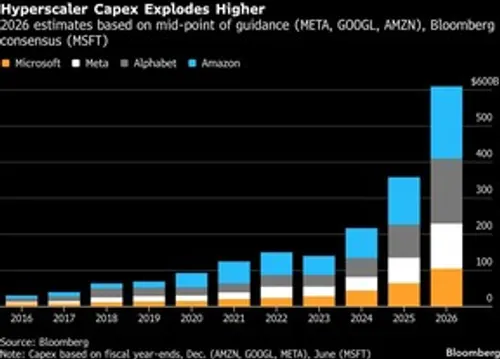
The four largest technology companies in the world are collectively committing $725 billion to AI capital expenditure in 2026, a 77% increase over the already record $410 billion spent in 2025, according to first-quarter earnings data compiled by the Financial Times. Amazon is projecting $200 billion, Alphabet is targeting between $175 billion and $185 billion, Microsoft has set its figure at $190 billion, and Meta is guiding between $115 billion and $135 billion. Goldman Sachs estimates the combined capex of these four companies will reach $5.3 trillion between fiscal 2025 and fiscal 2030.
This is not infrastructure spending in the traditional sense. These are coordinated bets on a single thesis: that whoever controls the AI layer of enterprise software and consumer products will determine who dominates the technology economy for the next decade. The capital is going into GPU clusters, custom silicon, data centres, and the product integrations that deliver AI capabilities to billions of users.
The race has moved well past the research phase. The products are live, the user numbers are in the hundreds of millions, and the revenue is real. What is now being contested is distribution, lock-in, and the ability to embed AI deeply enough into existing workflows that switching costs become prohibitive.
Google: The Clearest Proof of Return on Investment
Of the four major hyperscalers, Google has done the most convincing job of turning AI investment into measurable revenue. Google Cloud revenue grew 63% year-over-year to $20 billion in the most recent quarter, more than doubling its prior growth rate. The enterprise cloud backlog reached $462 billion, nearly doubling quarter-over-quarter. Alphabet CFO Anat Ashkenazi told investors the company is seeing “unprecedented internal and external demand for AI compute resources” and raised the full-year capex guidance to between $180 billion and $190 billion.
Gemini is the product carrying that revenue story. As of Q4 2025, Gemini had surpassed 750 million monthly active users, up from 650 million the prior quarter. Over 120,000 enterprises use Gemini, including 95% of the top 20 global SaaS companies. The Gemini API is processing 85 billion monthly requests, up 142% year-over-year. In the global AI chatbot market, Gemini holds approximately 13.5% share, placing it third behind ChatGPT at 60% and Microsoft Copilot at 14.3%.
The competitive positioning of Gemini centres on three advantages: its native multimodal architecture, which processes text, images, audio, and video as first-class inputs; its integration into Google Search, which commands 77.9% of all global digital queries; and a 1 million token context window that allows enterprise users to load substantial amounts of source material into a single research session. Google’s partnership with Apple, announced in January 2026, adds a fourth distribution channel of material significance. Google’s Gemini models will power a rebuilt Siri and the next generation of Apple Intelligence features, reaching approximately 1.5 billion daily Apple users. The deal is estimated at approximately $1 billion per year, according to Bloomberg reporting.
Microsoft: Embedded Depth Over Headline Numbers
Microsoft’s AI strategy is less about building frontier models and more about distribution. The company’s Copilot brand is embedded across every surface in the Microsoft 365 ecosystem: Word, Excel, PowerPoint, Outlook, Teams, the Windows 11 taskbar, and the Edge browser sidebar. As of early 2026, 85% of Fortune 500 companies already use Microsoft generative AI platforms.
The underlying model powering most Copilot products is OpenAI’s GPT-4o, accessed through Azure OpenAI Service. Microsoft’s $30 billion investment in OpenAI as part of a February 2026 funding round, and the broader $190 billion capex commitment for the year, reflects the company’s position as both investor in and primary infrastructure partner for the world’s leading AI lab. Microsoft CFO Amy Hood told investors that despite the elevated spending, the company expects to remain capacity-constrained through 2026 as it brings GPU, CPU, and storage infrastructure online to meet demand.
The Copilot adoption numbers are more nuanced than the headline enterprise penetration suggests. As of early 2026, only approximately 3.3% of potential Microsoft 365 users have signed up for paid Copilot tiers, indicating that enterprise access and actual daily usage remain different problems. Microsoft’s price increases on Microsoft 365, which took effect in July 2026 and bundle additional Copilot capabilities into standard subscriptions, are a mechanism for converting installed base into AI revenue without requiring a separate purchasing decision.
Meta: The Largest Bet Without the Clearest Return
Of the four hyperscalers, Meta’s AI strategy has attracted the most scepticism from investors. The company raised its 2026 capex guidance to between $125 billion and $135 billion, its stock dropped more than 6% after its most recent earnings call, and Barclays analysts estimated that Meta’s free cash flow could fall by close to 90% as a result of its infrastructure commitments.
The strategic rationale is clear: Meta has 3.35 billion daily active users across its platforms, and making AI a native part of the Facebook, Instagram, WhatsApp, and Threads experience represents the largest distribution opportunity available to any AI product. Meta AI has reportedly reached 1 billion monthly users, more than either Gemini or Copilot, primarily through integration into existing surfaces rather than standalone adoption. The company’s Llama open-source model series also gives it a second strategy: by releasing capable models freely, Meta establishes Llama as the default standard for developers who want flexibility, reduces the commercial advantage of closed-model competitors, and builds the kind of ecosystem dependency that has historically driven enterprise adoption.
CEO Mark Zuckerberg was notably candid on the earnings call about the pace of the consumer agent opportunity, telling investors there are many agents being built but few he would want to give to his mother. The admission reflects an honest assessment of where consumer AI agents are in 2026: compelling in demos, still uneven in production.
Amazon: Infrastructure as the AI Strategy
Amazon’s AI product story is primarily an infrastructure story. The company is projecting $200 billion in capex for 2026, the highest of the four hyperscalers, and is expected to run negative free cash flow of approximately $17 billion to $28 billion this year as a result, according to Morgan Stanley and Bank of America estimates respectively. Amazon has disclosed it may seek to raise equity and debt as its build-out continues.
AWS remains the dominant cloud infrastructure provider globally, and Amazon’s $50 billion investment in OpenAI as part of the February 2026 funding round, combined with a commitment for OpenAI to consume approximately 2 gigawatts of AWS’s proprietary Trainium compute capacity, positions AWS as a preferred infrastructure choice for the companies building the most-used AI products. Amazon’s Alexa platform is also being rebuilt around Anthropic’s Claude models, extending AI capabilities to Amazon’s consumer devices and smart home ecosystem.
Apple: The Partnership Strategy
Apple’s position in the AI product race is structurally different from the other four. The company has faced criticism for moving more slowly on AI product development, but its approach reflects a different set of constraints: a $3.8 trillion market cap built on hardware margin, a privacy positioning that limits the kind of data collection that drives model improvement, and an installed base of devices that must work reliably before they work impressively.
The Google partnership announced in January 2026 resolves the most visible gap in Apple’s AI product line. Rather than spending the capital required to develop models competitive with Gemini or GPT-5, Apple is accessing a custom 1.2 trillion parameter Gemini model built specifically for Siri and Apple Intelligence, freeing its AI budget for on-device inference, privacy infrastructure, and the integration layer that differentiates Apple Intelligence from generic AI assistants.
The competition now is not primarily about which company has the best underlying model. The models are converging in capability quickly enough that differentiation at the product layer matters more than differentiation at the research layer. The hyperscalers that will extract the most value from the $725 billion being spent this year are the ones whose AI products are embedded most deeply into workflows that users cannot easily abandon. That is a distribution and lock-in competition, and in that competition, existing enterprise relationships matter more than benchmark scores.
Frequently Asked Questions
How much is Big Tech spending on AI in 2026? Amazon, Microsoft, Alphabet, and Meta are collectively committing approximately $725 billion in capital expenditure in 2026, up 77% from the $410 billion spent in 2025. Amazon leads at $200 billion, Microsoft is at $190 billion, Alphabet is guiding between $175 billion and $185 billion, and Meta is targeting between $115 billion and $135 billion. Goldman Sachs projects the combined four-company total will reach $5.3 trillion between fiscal 2025 and fiscal 2030.
Which Big Tech company is winning the AI products race? Google has produced the clearest evidence of returns on AI investment, with Google Cloud revenue growing 63% year-over-year to $20 billion and an enterprise backlog of $462 billion. Microsoft has the deepest enterprise penetration through Copilot, with 85% of Fortune 500 companies already using its generative AI platforms. Meta has the largest raw user base for AI, with Meta AI reportedly reaching 1 billion monthly users. No single company has a decisive lead across all dimensions.
What is the Apple and Google AI deal? In January 2026, Apple and Google announced a multi-year partnership under which Google’s Gemini AI models will power a rebuilt Siri and the next generation of Apple Intelligence features. The deal is estimated at approximately $1 billion per year. The first Gemini-powered Siri features are expected to reach consumers through iOS 26.4, currently in developer beta. Apple gains immediate access to a 1.2 trillion parameter Gemini model built specifically for the partnership, avoiding the multi-year and multi-billion-dollar cost of developing comparable models independently.
What is Meta’s AI strategy compared to its competitors? Meta is pursuing two parallel strategies. First, deeply integrating AI into its consumer platforms, Facebook, Instagram, WhatsApp, and Threads, giving it the largest distribution for any AI product. Second, releasing Llama as an open-source model series, establishing it as the default choice for developers who want flexibility without proprietary API dependency. Unlike Google and Microsoft, Meta has yet to produce clear evidence of AI-driven revenue growth, which is driving investor concern despite the scale of its capital commitments.
How does this affect AI startups and smaller companies? The hyperscaler AI buildout is simultaneously an opportunity and a threat for startups. The massive investment in infrastructure is driving down compute costs over time and expanding the range of AI applications that are economically viable. However, the deep embedding of Gemini, Copilot, and Meta AI into existing enterprise productivity tools raises the competitive bar for standalone AI applications. Startups building in categories where the hyperscalers are likely to add AI features face the greatest pressure; those with proprietary data, deep vertical specialisation, or distribution the incumbents cannot easily replicate remain well-positioned.
Sources
- Fortune: Microsoft, Meta, and Google just announced billions more in AI spending
- CNBC: Tech AI spending approaches $700 billion in 2026, cash taking big hit
- Tom’s Hardware: Google, Microsoft, Meta, and Amazon capex spending to hit $725 billion in 2026
- Value Add VC: Big Tech AI Spending 2026: $725B Across MSFT, Google, Meta, Amazon
- AI Business Weekly: Gemini AI Statistics 2026: Users, Growth, and Market Share Data
- Tech-Insider: Apple’s $1B Gemini Deal: Google AI Replaces Siri
- Intuition Labs: Claude vs ChatGPT vs Copilot vs Gemini: 2026 Enterprise Guide
Stay in the Loop
For more stories, breakdowns, and unfiltered takes on what is really happening in Indian and global business and tech, follow TheFounder Nation.
Instagram: thefoundernation
We cover what the mainstream business press won’t.
© TheFounder Nation | All rights reserved Word count: ~1,380 | Read time: ~6 minutes Primary keyword: Big Tech AI products race 2026 | Secondary: Google Gemini Microsoft Copilot Meta AI Apple Intelligence, Big Tech AI spending 2026, $725 billion AI capex, Google Cloud AI revenue, Microsoft Copilot enterprise, Meta AI strategy, Amazon AWS AI, Apple Google AI deal Meta description: Amazon, Microsoft, Google, and Meta are spending $725 billion on AI in 2026. Here is what each company is building, where returns are showing up, and who is winning. WordPress tags: Big Tech, AI Products, Google Gemini, Microsoft Copilot, Meta AI, Apple Intelligence, AI Spending 2026, AI Race WordPress category: AI News