
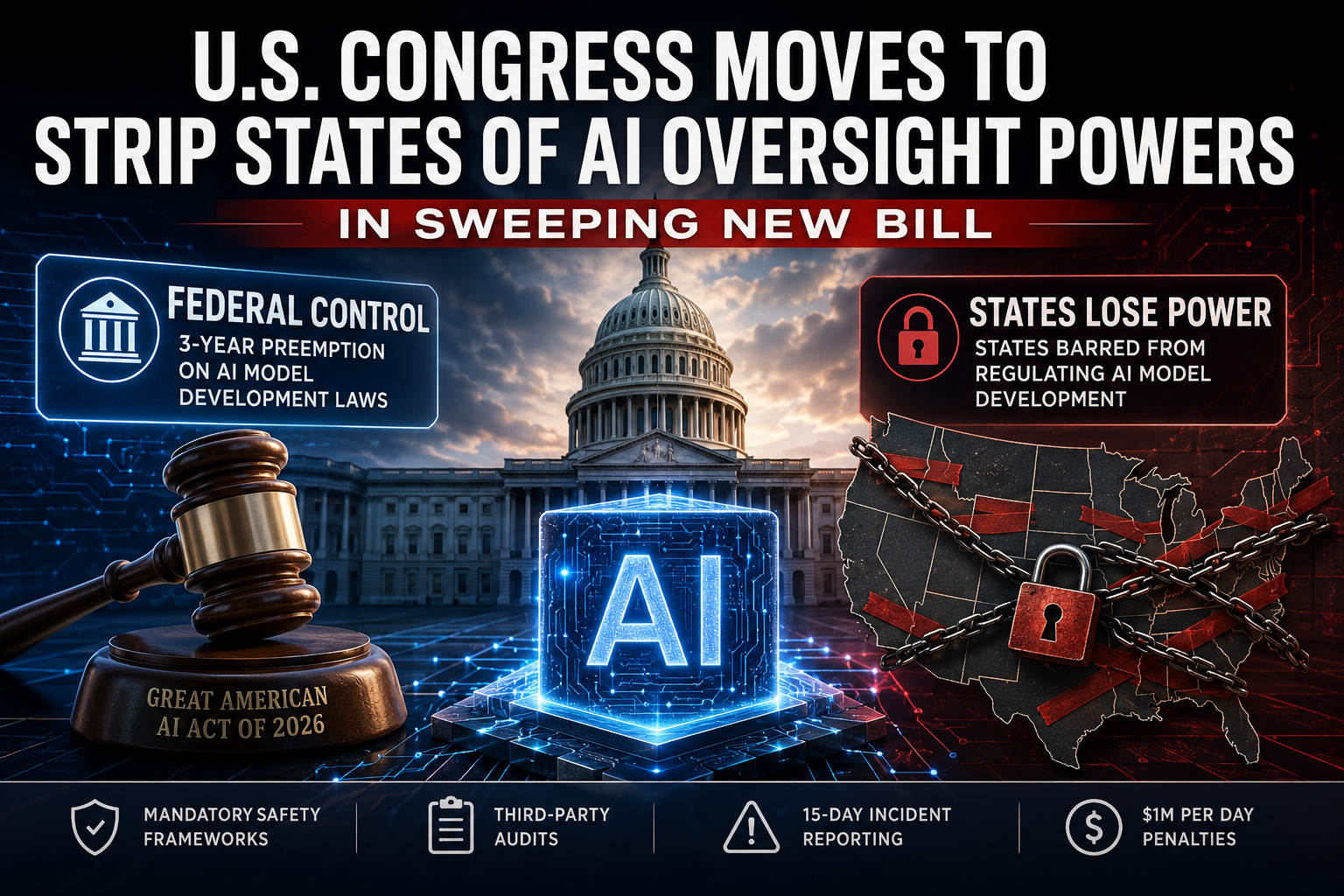
A sweeping new U.S. AI bill would shift authority over model development to the federal government for three years, while imposing audits, safety frameworks, incident reporting, and major penalties on large AI developers.
A bipartisan pair of House lawmakers released a 269-page draft bill on June 4, 2026, that would block states from passing their own laws governing how AI models are built, handing that authority to the federal government for at least three years. The proposal, formally titled the Great American Artificial Intelligence Act of 2026, was unveiled by Republican Jay Obernolte of California and Democrat Lori Trahan of Massachusetts, both members of the House Energy and Commerce Committee.
The bill marks the most substantive attempt yet to establish a unified federal framework for AI regulation in the United States. It would simultaneously impose new safety and transparency obligations on the country’s largest AI developers while removing the ability of states to enact their own rules around model development. The draft is not yet formally introduced in Congress and carries no floor vote timeline. Sponsors have invited public feedback at GAAIA@mail.house.gov.
The announcement landed against a backdrop of escalating federal and state tension over who governs AI. State legislatures had introduced at least 1,561 AI-related bills across 45 states as of March 2026, according to legislative tracking service MultiState, already surpassing the total for all of 2024. Washington has repeatedly failed to pass anything comprehensive, leaving a growing regulatory gap that states have rushed to fill.
What the Bill Actually Does
The core of the Great American Artificial Intelligence Act splits AI regulation into two tracks. Development, meaning everything that happens before a model is released, becomes a federal matter. Deployment and use, meaning how AI systems are applied after release, remains under state control.
The preemption provision would freeze state laws specifically targeting AI model development for three years, with the possibility of congressional reauthorization after that. States would still be able to regulate how employers use AI in hiring, how AI tools interact with consumers, and how AI content is disclosed after distribution. California’s AB 2013, which requires model developers to publicly post training data summaries, and portions of SB 942, the state’s AI content watermarking law, are explicitly identified in accompanying documents as casualties of the preemption.
For the biggest AI companies, the bill introduces binding new obligations. Any developer with more than $500 million in annual gross revenue, a group that includes Anthropic, OpenAI, xAI, and Google DeepMind, would be required to publish detailed risk frameworks, submit to semi-annual third-party audits by licensed Independent Verification Organizations, and report critical safety incidents to federal regulators within 15 days, or within 24 hours if the incident poses an imminent risk of serious harm. Civil penalties for non-compliance could reach $1 million per day. The bill would also codify the Center for AI Standards and Innovation within the Department of Commerce and authorize $100 million per fiscal year for fiscal years 2027 through 2029 to fund its work.
Three Failed Attempts Before This One
The Great American AI Act is not the first time Congress has tried to assert primacy over state AI law. It is the third attempt in roughly 12 months, and the first to make it this far in terms of legislative substance.
In July 2025, the Senate voted 99-1 to strip a proposed 10-year moratorium on state AI regulations from the One Big Beautiful Bill Act before President Trump signed it. A second attempt, attached to the fiscal year 2026 National Defense Authorization Act, also failed. The current draft represents a deliberate recalibration. Rather than a blanket moratorium, it offers states a trade: give up development-stage regulation, keep deployment-stage authority, and get a federal audit regime with real teeth in return.
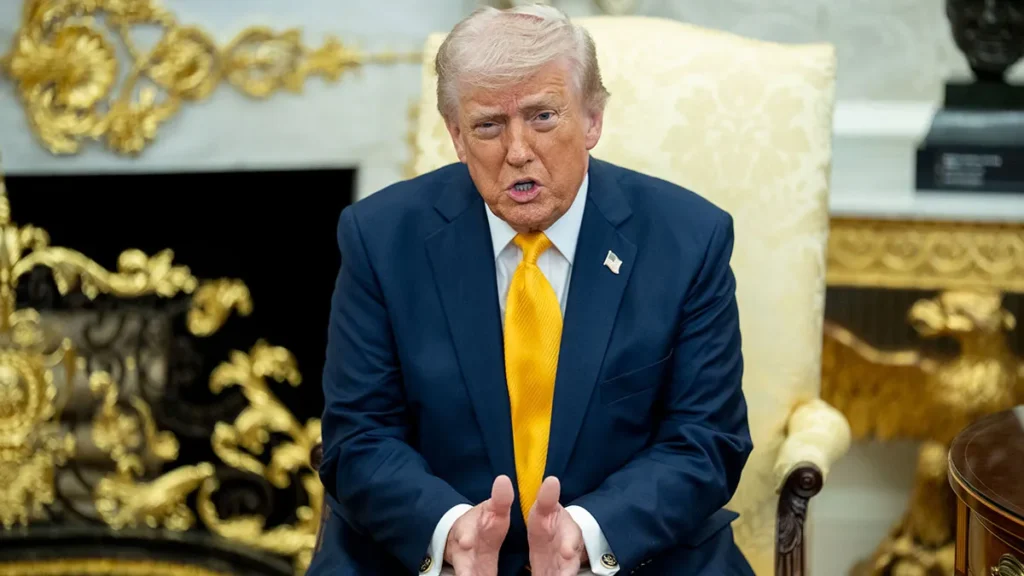
The executive branch has been pushing in the same direction. In December 2025, President Trump signed an executive order directing the Department of Justice to establish an AI Litigation Task Force with the explicit mandate to challenge state AI laws on constitutional grounds. That task force acted in April 2026, filing to block Colorado’s algorithmic discrimination statute, the first federal legal challenge to a state AI law in U.S. history. Colorado’s legislature replaced the original law with a narrower substitute before it ever took effect.
Who Is Against It, and Why
Opposition arrived almost immediately. The House Democratic Commission on AI released a statement within hours of the draft’s publication saying it “does not meet the enormity of the moment.” Labor unions, consumer advocates, and several AI safety organisations followed within days.
Brad Carson, president of Americans for Responsible Innovation, called the preemption provision a “generational mistake.” His group had run advertising campaigns in Massachusetts urging Trahan herself to oppose a ban on state AI legislation before the bill was even released. Brendan Steinhauser of the Alliance for Secure AI said the bill “does not justify preempting states’ ability to pass their own AI safeguards,” adding that a national standard should protect at least as much as it preempts.
The concern that surfaces most often is not about the audits or the transparency requirements. It is about timing. Critics point out that the exact point where preemption bites, AI model development, is also the point in the production chain where safety interventions are most effective. Trahan acknowledged the tension in a public interview, saying: “If there are genuine ambiguities in the text that could swallow state consumer protection law or civil rights enforcement, that is a problem I want to fix.”
An Annenberg Public Policy Center survey conducted earlier in 2026 found that 65 percent of Americans say the federal government has done too little to regulate AI, including 53 percent of Republicans. That number suggests the political appetite for some kind of action exists. Whether this specific bill is the vehicle is a separate question.
What Frontier Labs Would Face Under Federal Oversight
For smaller AI companies and developers working below the $50 million revenue threshold, the bill has minimal direct impact. Its obligations are tiered. A frontier developer is defined as any entity that has trained or initiated the training of a frontier model and earned more than $50 million in gross revenue in the prior calendar year. A large frontier developer crosses the $500 million threshold and faces the full weight of the framework: public risk frameworks, licensed third-party audits, incident reporting on a federal clock, and whistleblower protections that cannot be waived by contract.
The audit regime is considered the most significant element by many observers. Unlike Illinois and New York’s state laws, which set 72-hour incident reporting windows, the federal framework would impose a 15-day standard for most incidents, with 24-hour reporting only when imminent physical harm is at risk. Whether that is more or less demanding than existing state obligations depends on which state a company is based in and which laws currently apply to it.
The Path Forward
As a discussion draft, the bill has no guaranteed path to formal introduction, let alone a floor vote. Observers across the political spectrum have noted that House Republican leadership remains skeptical, and House Democrats are unlikely to hand the majority a policy win of this scale before the midterms. One legal analyst described the current proposal as “a conversation starter developed because of frustration that Congress has not yet really legislated on AI.”
The sponsors disagree with that framing. Obernolte said the draft is “an important step toward building a clear federal framework that promotes innovation, protects Americans from emerging risks, and ensures the United States continues to lead the world in AI.” Trahan, who faced internal party pressure just to sign on to a preemption clause, framed it as a necessary trade: “There is still time to govern AI democratically before we seed the future entirely to the private sector or to our foreign adversaries.”
What happens to the preemption language in revision will determine whether the bill attracts the broader coalition it needs. As drafted, it is bipartisan in name. Whether it can survive the feedback period that way is the real test.
Frequently Asked Questions
What is the Great American Artificial Intelligence Act of 2026? It is a 269-page discussion draft bill released on June 4, 2026, by Representatives Jay Obernolte and Lori Trahan. It proposes the first comprehensive federal framework for governing AI in the United States, pairing new safety and audit obligations on the largest AI developers with a three-year freeze on state laws specifically regulating how AI models are developed. It has not been formally introduced and carries no floor vote timeline.
Which state AI laws would be affected by the bill? The preemption targets state laws that specifically regulate AI model development. California’s AB 2013, which requires model developers to publicly post training data summaries, and portions of SB 942, the AI content watermarking law, are explicitly identified as laws that would be superseded. Frontier safety laws in California, New York, and Illinois would be “federalized” under the bill. State laws governing how AI is used after deployment, including hiring tools, consumer protections, and employment regulations, would not be affected.
Who would be required to comply with the new federal rules? The heaviest obligations fall on large frontier developers, defined as companies with more than $500 million in annual gross revenue that have trained advanced AI models. This group includes Anthropic, OpenAI, xAI, and Google DeepMind. A lower tier of frontier developers, those with more than $50 million in revenue, would face lighter obligations including transparency reporting and safety incident disclosures.
Why do critics oppose the preemption clause? Critics argue that preempting state laws at the development stage removes oversight at the point where safety interventions have the most impact. They note that the three-year freeze, while framed as temporary, would effectively prevent states from addressing documented harms while Congress continues to debate. The ACLU, Americans for Responsible Innovation, the Alliance for Secure AI, and the House Democratic Commission on AI have all expressed opposition to the preemption provision in particular.
Has Congress tried to preempt state AI laws before? Yes, twice. In July 2025, the Senate voted 99-1 to remove a proposed 10-year moratorium on state AI regulations from the One Big Beautiful Bill Act. A second attempt attached to the fiscal year 2026 National Defense Authorization Act also failed. The current draft takes a narrower approach by targeting development-stage regulation only rather than seeking a blanket override of all state AI laws.
Sources
- Roll Call: Bipartisan AI draft proposes three-year preemption of state laws
- Rep. Jay Obernolte (Official): Obernolte, Trahan release a discussion draft of the Great American AI Act
- FedScoop: Bipartisan Great American AI Act draft proposes new federal AI governance framework
- TechTimes: Federal AI Regulation Bill Freezes State Consumer Protections for Three Years, Sparks Revolt
- ACLU: ACLU Reacts to Draft Bipartisan AI Bill That Would Preempt State Laws
- Tech Policy Press: Unpacking the Great American Artificial Intelligence Act of 2026
- Cato Institute: A Primer on the Great American Artificial Intelligence Act
- Americans for Responsible Innovation: Reps. Trahan, Obernolte Propose Bill to Preempt State AI Laws
Stay in the Loop
For more stories, breakdowns, and unfiltered takes on what is really happening in Indian and global business and tech, follow TheFounder Nation.
Instagram: thefoundernation
We cover what the mainstream business press won’t.
© TheFounder Nation | All rights reserved