


China’s biggest tech companies have been quietly shrinking their workforces while simultaneously pouring capital into artificial intelligence. Alibaba reduced its headcount by 34% in 2025, falling from a peak of roughly 250,000 employees to 124,320 by March 31, 2025. Baidu ended the same year with nearly 7% fewer staff. BYD cut roughly 10% of its workforce. The figures were disclosed in annual reports filed in March 2026, with little fanfare and no press releases.
These are not the bold, explicit disclosures seen from U.S. companies. Oracle named AI in its SEC filing. Meta held all-hands meetings. In China, the approach is different. The cuts happen gradually, through contractor terminations, scaled-back hiring of new graduates, forced reassignments, and quiet attrition. Chinese media has coined a phrase for it: “quiet layoffs.”
But the scale is real. And now, Chinese courts are drawing a line.
The Hangzhou Ruling That Changed the Calculus
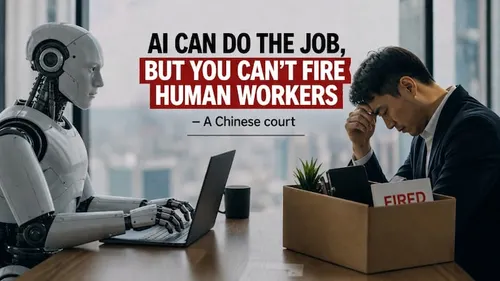
On April 28, 2026, the Hangzhou Intermediate People’s Court published a ruling that has drawn attention far beyond the single case it decided. A quality assurance supervisor identified in court documents only as Zhou had been employed at a tech company in Hangzhou, earning 300,000 yuan ($43,900) annually to verify the accuracy of outputs from large language models. When the company’s AI systems improved to the point where his role could be automated, the company reassigned him to a lower-level position with a 40% pay cut. Zhou refused. The company terminated his contract, citing AI-driven staffing reductions as the grounds.
Zhou took his case to arbitration, won, and the company sued. It lost at district court and lost again at the Hangzhou Intermediate People’s Court on appeal.
The court’s reasoning was precise. It found that the company’s decision to adopt AI was a voluntary strategic choice, not an unforeseeable external event like a natural disaster or a regulatory change that made employment impossible. Under China’s Labor Contract Law, employers can only terminate contracts unilaterally in limited circumstances: employee misconduct, proven incompetence, business closure, or a genuine and objective major change in circumstances. AI adoption, the court concluded, fits none of those categories.
“The termination grounds cited by the company did not fall under negative circumstances such as business downsizing or operational difficulties, nor did they meet the legal condition that made it ‘impossible to continue the employment contract,'” the court said in its published statement.
The Hangzhou case was not isolated. In December 2025, Beijing’s Human Resources and Social Security Bureau published an arbitration ruling involving a data mapping worker identified as Liu, who was dismissed in late 2024 after an AI system took over his map data collection role. The arbitration panel ruled the dismissal illegal on the same grounds: the company’s AI pivot was a deliberate business choice, not an unforeseeable change, and by citing it as grounds for dismissal, the company was shifting the cost of its own technological upgrade onto its employees.
The Quiet Layoffs Underneath
What the court rulings reveal is that explicit AI-driven dismissals are only one part of the picture. Chinese tech companies are also restructuring through subtler means that do not trigger the same legal exposure.
An investigation by Rest of World found that companies including Alibaba, Tencent, Baidu, and ByteDance have been pressuring employees to resign voluntarily rather than firing them outright. Tactics include forced reassignments to roles in lower-tier cities, placement in internal “talent pools” with no clear project and a short window to find a new team, and performance review processes designed to generate voluntary departures. These manoeuvres allow companies to report stable headcounts to investors while attrition does the trimming.
An engineer at Alibaba’s cloud division told Reuters that AI-driven headcount reductions have begun in parts of the company and are likely to unfold through gradual cuts and attrition rather than a single mass round of layoffs.
The roles disappearing fastest are not the hardest to predict. Marketing departments and front-end engineering teams are the primary targets across China’s big tech sector. Companies have begun scaling back entry-level hiring significantly, with a record 12.7 million university graduates entering the labour market in 2026 facing declining starting salaries and fewer open positions. AI-related job postings surged 74% in 2025, but that boom is concentrated in specialist roles that most graduates cannot immediately fill.
A Citibank report estimated that 9.6% of all Chinese jobs, roughly 70 million positions, are at high risk of AI-driven displacement. For workers in their 20s, the figure rises to 13.6%.
Why Chinese Companies Are More Cautious Than American Peers
The contrast with U.S. companies is structural. Chinese labor costs are substantially lower, which reduces the financial urgency to automate. The average monthly salary for high-demand algorithm engineers in China was approximately 20,035 yuan, around $2,900, according to jobs platform Zhilian. A software engineer earning $300,000 in base salary in the U.S. represents a dramatically different cost incentive for automation than one earning a fraction of that.
Beyond cost, Chinese companies operate under a specific political constraint that American companies do not. The Chinese government has set a target of creating more than 12 million urban jobs in 2026 and keeping the urban unemployment rate below 5.5% through 2030. Youth unemployment has remained in the mid-to-high teens in percentage terms for several years, reaching 15.3% in March 2026 even before the current wave of tech restructuring.
“While Chinese companies share financial pressure that American companies are under in reallocating resources to AI businesses, there is a layer of social responsibility they have to fulfill as corporations,” Chen Li, an analyst from Beijing-based think tank Anbound, told Rest of World. Companies seen as going against the government’s employment priorities face political and reputational consequences that do not have a direct equivalent in the United States or Europe.
Under Chinese labor law, any company planning workforce cuts exceeding 10% of its total headcount must obtain government approval before proceeding. That requirement alone incentivises the graduated approach.
What the Rulings Mean for Companies Everywhere
The Hangzhou ruling is drawing attention outside China for a specific reason. It establishes a legal principle that does not yet exist in most other jurisdictions: that AI adoption is a deliberate management choice, and companies cannot shift the financial cost of that choice onto employees by citing automation as grounds for dismissal.
Zhejiang-based lawyer Wang Xuyang, who was not connected to the Hangzhou case, told state-run news agency Xinhua that AI adoption does not automatically justify terminating labor contracts for cost-cutting purposes. “Technological progress may be irreversible,” he said, “but it cannot exist outside a legal framework.”
In the United States, no federal statute gives workers equivalent protection. Illinois requires employers to notify workers if AI is used in hiring, discipline, or discharge decisions. Colorado’s AI Act, taking effect in mid-2026, mandates risk management policies and annual assessments of AI’s employment impact. Neither establishes the legal principle that AI replacement alone cannot justify dismissal.
The EU AI Act classifies AI systems used for workforce management as high-risk, requiring human oversight, worker notification, and logging, but does not create the same direct protection that Chinese courts have now established through case law.
China’s 2026 government work report explicitly called for improving employment measures in response to AI development, signalling that legislative action may follow the judicial precedents being set. For multinational companies operating in China, the rulings are not academic. They define what a valid AI-driven restructuring looks like legally: retraining offers, reasonable reassignment with maintained compensation, good-faith negotiation, and fair severance. Simply pointing to an AI system that now does a job is not enough.
Frequently Asked Questions
Are Chinese companies using AI to replace workers? Yes, though the scale is smaller and less transparent than in the United States. Alibaba reduced headcount by 34% in 2025, Baidu by nearly 7%, and BYD by roughly 10%, all cited in annual reports filed in March 2026. Experts note that broader economic pressures, including a slowing economy, weak consumer demand, and a post-internet-boom correction, are also factors. Marketing and front-end engineering roles are the primary targets for AI replacement across China’s tech sector.
What did the Hangzhou court rule about AI layoffs? The Hangzhou Intermediate People’s Court ruled in April 2026 that a company illegally dismissed an employee after replacing his role with AI. The court found that AI adoption is a voluntary strategic business decision, not an unforeseeable external change, and therefore cannot legally serve as grounds for unilateral contract termination under China’s Labor Contract Law. A similar arbitration ruling was published in Beijing in December 2025 involving a data mapping worker whose role was replaced by an AI system.
Why are Chinese companies less aggressive about AI layoffs than U.S. companies? Three main reasons: Chinese labor costs are significantly lower, reducing the financial urgency to automate; the Chinese government has explicit employment targets and expects companies to treat job creation as a social responsibility; and Chinese labor law requires government approval for workforce cuts exceeding 10% of total headcount, incentivising gradual attrition over mass layoffs.
What is China’s “quiet layoff” strategy? Chinese companies are restructuring through methods that avoid the legal and political exposure of mass layoffs. These include terminating contractors, reducing graduate hiring, forced reassignments to lower-tier cities, and placing employees in internal holding pools with tight windows to find new roles before resignation follows. The approach allows companies to reduce headcount while reporting stable figures and avoiding the government scrutiny that visible mass cuts would trigger.
What are the global implications of China’s AI labor rulings? The rulings establish that AI adoption is a business choice, not a legal justification for dismissal, a principle that does not yet exist in U.S. federal law or most European legal systems. For multinationals operating in China, the practical implication is that AI-driven restructuring requires the same process as any other workforce transition: retraining offers, fair reassignment, and documented good-faith negotiation. Legal scholars are watching whether other jurisdictions adopt similar frameworks as AI displacement becomes more visible globally.
Sources
- Rest of World: Is AI replacing jobs? Chinese tech giants layoff workforce
- Fortune: Chinese court rules firms can’t lay off workers on AI grounds
- NPR: A tech worker in China is laid off and replaced by AI. Is it legal?
- CNBC: AI layoffs hit U.S. but not China jobs — yet
- CNBC: Alibaba workforce shrinks 34% in 2025 as Chinese tech giant doubles down on AI
- The Next Web: Chinese courts rule AI replacement is not legal grounds for firing workers as global tech layoffs hit 78,000
- Futurism: Chinese Court Rules That a Worker Cannot Be Replaced by AI
- The News International: Why China’s AI push is fueling major ‘quiet’ layoffs
- Caixin Global: Chinese Courts Rule Companies Cannot Fire Workers Simply to Replace Them With AI
- China State Council Information Office: Chinese court defends labor rights in new AI-replacement case
Stay in the Loop
For more stories, breakdowns, and unfiltered takes on what is really happening in Indian and global business and tech, follow TheFounder Nation.
Instagram: thefoundernation
We cover what the mainstream business press won’t.
© TheFounder Nation | All rights reserved