

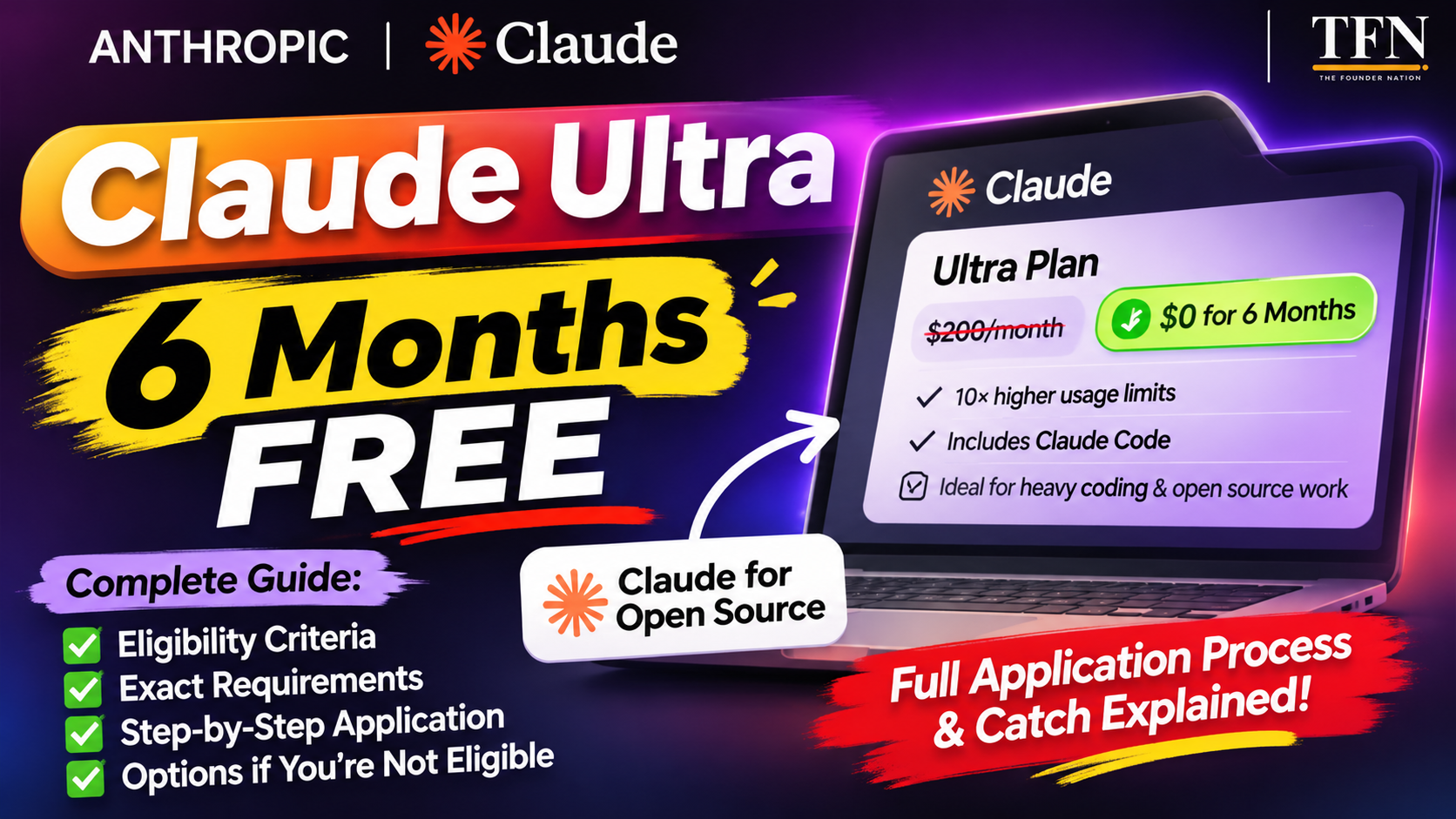
Anthropic’s Claude for Open Source programme offers eligible open-source developers six months of complimentary Claude Ultra.
Anthropic is offering eligible open-source developers six months of free Claude Ultra, its $200-per-month individual subscription plan. The offer includes access to Claude Code and is designed to support the developers who maintain and contribute to open-source software.
However, there is an important catch: this is not a free trial for everyone. You need an established GitHub account, recent open-source activity and a qualifying contribution or maintainer profile. You must also submit an application and receive approval from Anthropic.
In this guide, The Founder Nation explains how to get Claude Ultra free for six months, who can apply, the exact GitHub eligibility requirements, how to complete the application, what to write in the 500-word explanation and what happens after approval.
We also explain what you can do if you do not meet the listed contribution thresholds.
Programme: Claude for Open Source
Benefit: Six months of complimentary Claude Ultra
Regular Ultra web price: $200 per month
Application: GitHub-based application and review
Last verified: 10 November 2026
Official application: https://claude.com/contact-sales/claude-for-oss
Important: Applying does not guarantee approval. Anthropic reviews each application and makes the final decision. Read the official programme terms before submitting your application.
Quick Overview: Claude Ultra Free for 6 Months
| Detail | Information |
|---|---|
| Programme name | Claude for Open Source |
| Company | Anthropic |
| Subscription benefit | Six months of Claude Ultra |
| Regular web price | $200 per month |
| Headline six-month value | $1,200 |
| Claude Code access | Included |
| Application method | GitHub-based application |
| General GitHub age requirement | At least two years |
| Recent activity requirement | Public open-source activity within the previous 90 days |
| Qualification | At least one qualifying eligibility route |
| Application review | Rolling basis |
| Approval guarantee | No |
| Activation window | 90 days after receiving the activation link |
| Recipient limit | Up to 10,000 approved recipients, unless Anthropic increases the cap |
The $1,200 figure represents six months at the published $200 monthly web price. It is not a cash reward or a payment to the applicant.
1. What Is Claude for Open Source?
Claude for Open Source is an Anthropic programme that provides selected open-source software maintainers and contributors with six months of complimentary access to Claude Ultra.
The programme recognises the developers who build, maintain and improve software that other people and organisations depend on.
Open-source software powers a large part of the modern technology ecosystem. Developers use public libraries, frameworks, tools and infrastructure packages to build applications without having to create every component themselves.
However, maintaining these projects requires time and effort. Developers regularly fix bugs, review contributions, improve documentation, release updates and respond to security issues.
Anthropic created this programme to support people doing that work.
Is it a coupon code or a free trial?
No. Claude for Open Source is an application-based benefit.
You cannot simply enter a promotional code or sign up for a regular Claude account to receive six months of Ultra.
Instead, you need to:
- Check the eligibility requirements.
- Apply through Anthropic’s official programme page.
- Sign in using your GitHub account.
- Explain your open-source work and its impact.
- Describe how you plan to use Claude.
- Wait for Anthropic to review your application.
Only approved applicants receive the subscription activation link.
Official programme page: https://claude.com/contact-sales/claude-for-oss
2. What Is Claude Ultra and What Does It Include?
Claude Ultra is Anthropic’s highest-priced individual subscription tier.
There is also a naming detail worth understanding. Anthropic previously called its $200-per-month plan Max 20x. The company subsequently renamed Max 20x to Ultra, without changing its price at the time of the change.
The current Ultra plan provides higher usage capacity, priority access to selected features and access to Claude Code.
How much does Claude Ultra cost?
The current published web price is $200 per month.
| Subscription | Monthly web price | Six-month equivalent |
|---|---|---|
| Claude Ultra | $200 | $1,200 |
| Claude for Open Source benefit | $0 base subscription | $0 base subscription |
The complimentary subscription covers the base Ultra plan for six consecutive months after activation.
What do you get with Claude Ultra?
Claude Ultra includes several benefits:
- Higher usage capacity: Up to 10 times the Pro plan’s weekly usage.
- Claude Code access: Use Claude for terminal-based coding workflows.
- Priority access: Get priority access to selected new models, features and products.
- Longer workflows: Work on more complex, multi-step tasks.
- Monthly API credits: Ultra plans include monthly Claude Platform API credits, subject to the applicable terms.
One important distinction: Claude subscription usage and API credits are not interchangeable. The monthly API credits cannot be used to pay for Claude Code or usage credits within Claude applications.
Why is Claude Ultra useful for developers?
Claude Code can support developers throughout their software development workflow.
For example, it can help with:
- Understanding unfamiliar codebases.
- Finding and fixing bugs.
- Writing test cases.
- Reviewing pull requests.
- Improving code quality.
- Refactoring existing software.
- Writing technical documentation.
- Preparing release notes.
Nevertheless, Ultra is not unlimited. Its usage is subject to weekly limits and other restrictions. Additional usage charges may also apply if you enable usage credits or overage features.
Official references:
- Claude Ultra plan: https://support.claude.com/en/articles/17728952-what-is-the-ultra-plan
- Claude Code subscription access: https://support.claude.com/en/articles/11145838-use-claude-code-with-your-pro-max-or-ultra-plan
3. Who Is Eligible for Free Claude Ultra?
This is the most important part of the programme.
Anthropic has established two eligibility tracks:
- Maintainer Track: For developers who meet at least one of its published open-source impact criteria.
- Ecosystem Impact Track: A discretionary route for people who maintain or significantly contribute to important projects, even if they do not meet the listed numerical thresholds.
You must also satisfy every general eligibility requirement.
The six qualifying criteria under the Maintainer Track
The following table summarises the six alternative criteria published in Anthropic’s official terms.
| Route | Eligibility requirement |
|---|---|
| 1. Package dependencies | Your maintained projects have 500+ dependent repositories OR 100+ dependent packages in aggregate |
| 2. Package downloads | Your maintained packages receive 200,000+ combined monthly downloads |
| 3. Core contributor | You are a listed committer or maintainer of a recognised foundation or language project |
| 4. Active contributor | You authored 100+ pull requests merged into public repositories you do not own in the last 12 months |
| 5. Community builder | A repository you maintain had 20+ unique external contributors with merged PRs in the last 12 months |
| 6. Critical infrastructure | A repository you maintain has an OpenSSF criticality score of 0.4 or higher |
You do not need to satisfy all six criteria. Meeting at least one route may make you eligible for consideration, provided you meet the general requirements.
Let’s understand each route.
4. The Six Open-Source Eligibility Routes Explained
Route 1: Maintainers and library authors with 500+ dependent repositories
This route is for developers who maintain libraries and packages that other software projects depend on.
Anthropic considers projects with:
- 500 or more dependent repositories; or
- 100 or more dependent packages.
The figures are assessed in aggregate across projects you maintain.
For example, imagine you maintain an open-source JavaScript library used by 600 public repositories. If the GitHub dependency graph supports this number, you may meet the first threshold.
Similarly, if your maintained packages are depended on by more than 100 other packages, you may qualify under the second threshold.
The important point is that these must be genuine downstream dependencies, not simply GitHub stars or followers.
Route 2: Packages with 200,000+ monthly downloads
This route is for package maintainers whose software has significant adoption across public package registries.
Anthropic’s threshold is:
200,000 or more combined monthly downloads across public package registries.
Examples of registries include:
- npm
- PyPI
- crates.io
- RubyGems
- Packagist
- Maven
For example, if you maintain three packages with 80,000, 70,000 and 60,000 monthly downloads respectively, their combined monthly downloads would be 210,000.
That may meet the numerical threshold.
However, the packages must be maintained by you. Do not include unrelated downloads or activity from packages you do not maintain.
Route 3: Listed core contributors
This route is for developers with recognised positions in major open-source foundations and language projects.
Anthropic mentions examples such as:
- CPython
- Rust
- Node.js Technical Steering Committee
- Apache Software Foundation projects
- Cloud Native Computing Foundation
- Kubernetes
- Linux kernel
- Django
- Ruby on Rails
You must be a listed committer or maintainer.
Simply using these technologies, contributing a minor change or having a GitHub profile does not automatically make you a core contributor.
If your role appears in the project’s official contributor or maintainer records, provide that evidence in your application.
Route 4: Active contributors with 100+ merged pull requests
This route is especially relevant to developers who regularly contribute to projects maintained by other people.
The threshold is:
100 or more pull requests authored by you and merged into public repositories you do not own during the 12 months before applying.
A pull request, or PR, is a proposed change to a software project.
For example:
- You identify a bug in an open-source library.
- You write a fix.
- You submit a pull request.
- The repository maintainer reviews and merges it.
That is a genuine contribution.
However, simply opening 100 pull requests is not enough. The requirement concerns merged pull requests in repositories you do not own.
Anthropic may also disregard trivial, duplicated or automated contributions.
Route 5: Community builders with 20+ external contributors
This route recognises developers who maintain projects with an active external contributor community.
The requirement is:
One repository you maintain must have had at least 20 unique external contributors with merged pull requests during the previous 12 months.
For example, imagine you maintain a developer tool and 25 different external developers have submitted contributions that were merged into your repository during the past year.
That may meet the community-builder threshold.
Remember that unique contributors matter. Twenty pull requests from one person do not count as 20 unique contributors.
Route 6: Critical infrastructure with an OpenSSF score of 0.4+
This route is intended for maintainers of software that plays an important role in the open-source ecosystem.
Anthropic uses the OpenSSF criticality score as one measure of project importance.
The requirement is:
A repository you maintain must have an OpenSSF criticality score of 0.4 or higher.
OpenSSF stands for Open Source Security Foundation.
Its criticality score helps assess how important a software project is to the wider ecosystem.
You can explore the scoring project here:
Do not assume that a project qualifies because it has many GitHub stars. Check the actual score and ensure you can demonstrate your maintainer role.
5. What If You Do Not Meet Any of These Six Criteria?
You may still be able to apply.
Anthropic provides a second route called the Ecosystem Impact Track.
This route is designed for people who maintain or significantly contribute to projects that the wider open-source ecosystem meaningfully depends on, even if those projects do not meet the numerical thresholds.
Examples could include:
- Infrastructure libraries used by downstream projects.
- Important developer tools.
- Foundational software packages.
- Specialised tools that support critical development workflows.
- Projects with significant ecosystem importance but lower visible download or contributor counts.
You will need to explain:
- What your project does.
- Who depends on it.
- Why the project is important.
- What role you play in maintaining or contributing to it.
- What evidence supports its ecosystem impact.
Anthropic may assess the number of downstream dependants, breadth of usage, criticality of the project’s function and your contribution to it.
This route is discretionary. It is not a guaranteed alternative to the published thresholds.
The takeaway: If you do not meet the numbers, do not automatically assume that you cannot apply. Explain your project’s actual importance with clear evidence.
6. General Requirements Every Applicant Must Meet
Meeting one qualifying route is only part of the process.
Anthropic also lists general conditions that apply to every applicant.
| Requirement | What Anthropic requires |
|---|---|
| Individual applicant | You must apply as a natural person, not a company or organisation |
| Minimum age | At least 18 years old or the age of majority in your jurisdiction, whichever is greater |
| Location | Legal residence in a region where Claude.ai is available, subject to applicable restrictions |
| GitHub account age | Existing account in good standing, at least two years old |
| Recent activity | Public open-source activity within the 90 days before applying |
| Project licence | Maintain or contribute to at least one project under an OSI-approved licence |
| Anthropic affiliation | Applicants must not fall within the specified Anthropic employee, contractor, agent or immediate family/household exclusions |
Why is the two-year GitHub account requirement important?
Your GitHub account must already be at least two years old when you apply.
Creating a new GitHub account today will not make you eligible immediately.
This programme is intended to support developers with an established history of open-source work.
What counts as recent GitHub activity?
You must have public open-source activity within the 90 days before submitting your application.
Examples include:
- Public commits.
- Pull requests.
- Code reviews.
- Project releases.
Your account should show genuine participation in open-source projects.
What is an OSI-approved open-source licence?
OSI stands for Open Source Initiative.
The project you maintain or contribute to must use an OSI-approved licence.
Common examples include:
- MIT License.
- Apache License 2.0.
- BSD licences.
- GNU General Public License (GPL).
You can check the official list here:
A public GitHub repository is not automatically open-source software. It needs a licence that grants the relevant rights to use, modify and distribute the software.
7. How to Apply for Free Claude Ultra: Step-by-Step Guide
The application is submitted through Anthropic’s official programme page.
Here is the process.
Step 1: Open the official application page
Visit:
Read the eligibility requirements and programme conditions before starting.
Avoid unofficial application links shared in social media comments or random messages.
Step 2: Sign in with your GitHub account
The application uses GitHub authentication.
Use the account that contains your actual open-source contributions and project history.
Anthropic uses your GitHub account to assess your eligibility.
Step 3: Enter your personal and contact information
The current application form requests:
- First name.
- Last name.
- Email address.
- GitHub username.
- GitHub repository URL.
If you already have a Claude account, use the associated account email where appropriate.
Anthropic also uses the email associated with your GitHub account to deliver the activation link if your application is approved.
Step 4: Select your GitHub repository
Choose the repository that best represents your open-source work.
Ideally, it should demonstrate your role, project impact and the eligibility route you are applying under.
Make sure the repository is public and its licence is visible.
Step 5: Explain your project’s reach and impact
The form asks you to describe your project’s reach and impact.
This is where you should provide evidence rather than general statements.
Depending on your eligibility route, include:
- Monthly package downloads.
- Number of dependent repositories.
- Number of dependent packages.
- Merged pull requests.
- Unique external contributors.
- OpenSSF criticality score.
- The project’s role in the ecosystem.
For example:
“My package records approximately [verified monthly downloads] monthly downloads on [registry]. It is used by [verified number] dependent repositories, and I have maintained the project since [year].”
Replace every placeholder with accurate information.
Step 6: Explain how you plan to use Claude Ultra
Anthropic asks how you intend to use the subscription for your project.
Avoid generic responses such as:
“I will use Claude for coding and productivity.”
Instead, describe specific workflows.
For example:
“I plan to use Claude Code to understand the project’s codebase, review incoming pull requests, identify bugs, improve test coverage, write documentation and prepare release notes. I will review and test generated changes before merging them.”
Only use this example if it reflects your actual plans.
Step 7: Explain why you qualify
The application includes a short explanation of why you meet the programme requirements.
Anthropic sets a maximum of 500 words for this explanation.
A useful structure is:
- State your eligibility route.
- Introduce your project.
- Explain your role.
- Provide measurable evidence.
- Explain the project’s wider impact.
For example:
Eligibility route: Active Contributor
“I have authored [number] pull requests merged into public repositories that I do not own during the 12 months before this application. My contributions include [specific examples]. I regularly contribute to [project names], where my work focuses on [actual contribution areas]. These contributions support [specific users, developers or projects]. I plan to use Claude Ultra and Claude Code for debugging, testing, code review and documentation workflows that support my continued open-source contributions.”
Keep the explanation factual and within the word limit.
Step 8: Review and submit
Before submitting, check:
- Your GitHub profile is correct.
- Your repository URL works.
- Your email address is correct.
- Your project uses an OSI-approved licence.
- Your recent contributions are visible.
- Your eligibility evidence is accurate.
- Your explanation is within 500 words.
Once you have checked everything, submit the application.
8. What Should You Write in the Claude Ultra Application?
A strong application explains your contribution and its impact.
Anthropic does not simply ask whether you like Claude or want to use it for coding. It wants to understand your open-source work and how the subscription will support it.
Use this framework to prepare your answer.
A. Identify your eligibility route
Start with the exact route you believe you meet.
For example:
- Maintainer and library author.
- Listed core contributor.
- Active contributor.
- Community builder.
- Critical infrastructure.
- Ecosystem Impact Track.
B. Explain your role
Describe whether you created the project, maintain it, contribute regularly or lead its external contributor community.
C. Add measurable evidence
Use verifiable numbers wherever possible.
For example:
- 220,000 monthly downloads.
- 650 dependent repositories.
- 115 merged pull requests.
- 24 unique external contributors.
These are examples of the type of evidence to provide, not actual programme statistics.
D. Explain why the project matters
Explain who uses the software and what problem it solves.
If the project supports other developers, describe how.
E. Explain your planned Claude usage
Connect your intended usage to the work you already perform.
Useful examples include:
- Reviewing incoming pull requests.
- Improving tests.
- Finding bugs.
- Refactoring code.
- Improving documentation.
- Supporting releases.
- Understanding complex codebases.
Remember: Do not invent metrics or use generic AI-generated claims. You can use an AI tool to improve your writing, but the facts and examples must be your own.
9. How Does Anthropic Review Applications?
Submitting an application does not mean you have been approved.
Anthropic reviews applications on a rolling basis. The company evaluates the full context of your open-source work.
It may consider:
- The quality of your contributions.
- The actual impact of your project.
- Your role in maintaining or contributing to it.
- Whether the reported activity is genuine.
- The overall objectives and capacity of the programme.
Does meeting the eligibility threshold guarantee approval?
No.
Anthropic clearly states that the published thresholds are minimum requirements for consideration, not a promise of acceptance.
The final decision rests with Anthropic.
It may also request additional verification or documentation.
How long does approval take?
Anthropic does not promise a fixed review timeline.
Applications are reviewed on a rolling basis, and review times can vary.
The company states that it will contact applicants if they are approved. It does not promise to send rejection notifications.
Therefore, not receiving an email immediately does not necessarily mean that your application has been rejected.
Also, submitting the same application repeatedly will not speed up the process. Duplicate applications may be disregarded.
10. What Happens After Your Application Is Approved?
If Anthropic approves your application, you will receive a unique activation link through the email associated with your GitHub account.
There are several conditions to understand.
You have 90 days to activate your subscription
You must activate the subscription within 90 days of receiving the gift code.
If you do not activate it within this period, the link expires and you forfeit the benefit.
The six-month period begins after activation
Your complimentary Claude Ultra subscription runs for six consecutive months from the date you activate it.
It does not begin on the day you submit your application.
What if you already have a paid Claude subscription?
If you already have a paid Anthropic subscription, your current billing is paused during the six-month benefit period.
At the end of the period, your previous paid subscription resumes at its then-current plan and rate unless you cancel before billing renews.
Anthropic says it intends to notify recipients at least 30 days before billing for a paused subscription resumes.
What if you have a free Claude account?
If you have a free Claude account, the programme subscription is applied to that account.
After the six-month period ends, your account returns to the free plan.
Does Claude Ultra automatically renew after six months?
No. The complimentary programme subscription does not automatically renew as a new paid Ultra subscription.
However, if you had a paid subscription before receiving the benefit, that subscription resumes unless you cancel it.
This is an important distinction: the complimentary benefit ending and a previous paid plan resuming are two different things.
11. Hidden Conditions You Should Know Before Applying
The offer is valuable, but you should understand the terms before submitting your application.
1. The programme has a recipient limit
Anthropic’s terms state that the programme is intended to provide subscriptions to up to 10,000 approved recipients, unless Anthropic increases the cap.
Applications are reviewed on a rolling basis until the recipient cap is reached or the application period closes.
Anthropic can also modify or close the programme.
2. Extra usage may cost money
The base Claude Ultra subscription is complimentary during the six-month period.
However, the terms allow additional usage charges under Anthropic’s standard overage pricing.
Therefore, free base access does not mean unlimited usage or that every additional expense is covered.
Check your usage settings before enabling paid usage credits.
3. Your previous paid plan may resume
If you already pay for Claude, that subscription is paused during the benefit period.
It can resume after six months at the then-current plan and rate unless you cancel before billing renews.
Check your billing settings before the complimentary period ends.
4. The subscription is personal
The benefit belongs to the approved applicant.
You cannot sell, transfer, exchange or share the subscription with another person.
Sharing login credentials is also prohibited.
5. Anthropic may publicly identify recipients
By accepting the programme subscription, you give Anthropic permission to identify you publicly as a programme recipient.
This may include your name, GitHub username and associated open-source projects.
Read the publicity and privacy sections of the terms before accepting.
6. False information can lead to rejection or cancellation
Do not purchase GitHub stars, downloads, fake contributions or bot engagement to meet the eligibility requirements.
Anthropic can reject an application or revoke a previously granted subscription if it identifies false or manipulated information.
7. Duplicate applications are not a shortcut
Anthropic allows one active programme subscription per eligible individual.
Submitting multiple applications under different email addresses or accounts will not improve your chances. Duplicate applications may be disregarded.
12. How to Become Eligible If You Do Not Qualify Today
If you do not meet the requirements today, you can still start building a genuine open-source contribution record.
However, do not chase numbers simply to qualify for a subscription.
The better approach is to contribute to projects you genuinely use and understand.
Step 1: Build an established GitHub presence
If you do not have a GitHub account, create one and start using it for real projects.
Remember that the programme requires an account that is at least two years old. A new account will not meet that requirement immediately.
Step 2: Find an open-source project
Start with software you already use or understand.
You can explore projects involving:
- Developer tools.
- Libraries and frameworks.
- Testing utilities.
- Infrastructure software.
- Open-source applications.
- Documentation and developer education.
Step 3: Make useful contributions
Look for real problems rather than easy ways to increase your contribution count.
Examples include:
- Fixing bugs.
- Improving documentation.
- Adding meaningful test cases.
- Resolving performance issues.
- Improving accessibility.
- Updating outdated code.
- Fixing error handling.
Step 4: Work with project maintainers
Read the contribution guidelines before submitting changes.
Ask questions when needed and respond to code-review feedback.
Open-source development is not just about writing code. It also involves collaboration, communication and long-term maintenance.
Step 5: Maintain consistent public activity
The programme requires public open-source activity within the 90 days before applying.
Keep contributing and maintain a genuine public record of your work.
Step 6: Work towards meaningful impact
Over time, you may become a regular contributor, maintainer or community builder.
Focus on creating software that other developers genuinely value and depend on.
Important: Anthropic specifically says that trivial, duplicated and automated activity may be disregarded. Submitting meaningless pull requests to reach 100 will not help you build a credible application.
13. Is Claude Ultra Worth Applying For?
For developers who actively maintain open-source projects or contribute to public repositories, this programme is worth considering.
Six months of complimentary access to a $200-per-month plan can provide meaningful value, particularly for developers who regularly use Claude Code.
It may be especially useful for:
- Independent developers maintaining popular libraries.
- Open-source project maintainers.
- Developers contributing to large public repositories.
- People building developer infrastructure.
- Contributors working on foundational software.
- Technical community builders.
However, the programme is not a general free AI subscription offer.
If you do not maintain or contribute to open-source software, you may not qualify today.
The best approach is to check the requirements, gather evidence and submit an application only if you can support your claims.
14. Frequently Asked Questions About Free Claude Ultra
Is Claude Ultra free for six months?
Anthropic offers six months of complimentary Claude Ultra to approved applicants through its Claude for Open Source programme. You must meet the eligibility requirements and receive approval.
Is Claude Ultra the same as Max 20x?
Yes. Anthropic renamed its Max 20x plan to Ultra. The current published web price is $200 per month. The open-source programme page may still display the older Max 20x name.
Does the free Claude Ultra offer include Claude Code?
Yes. Claude Code access is included with the Ultra subscription. Its usage counts towards the applicable subscription limits.
Can students apply for free Claude Ultra?
Being a student alone does not qualify someone. A student can apply if they independently meet the open-source eligibility criteria and all general requirements.
Can developers from India apply?
The programme is open to eligible individuals worldwide, subject to legal and regional restrictions. Applicants must meet the same published requirements.
Do I need 5,000 GitHub stars?
No. The current official programme terms do not list a 5,000-star requirement. They describe dependency, package-download, core-contributor, merged-PR, community-builder and critical-infrastructure criteria.
Is a two-year-old GitHub account mandatory?
Yes. The general eligibility requirements state that applicants must have an existing GitHub account in good standing that is at least two years old.
Do I need recent GitHub activity?
Yes. You need public open-source activity within the 90 days before applying. This can include commits, pull requests, reviews or releases.
What if I do not meet the 100 merged pull request requirement?
You may qualify through another route, such as package maintenance, community building, core contributor status or critical infrastructure. You can also apply through the discretionary Ecosystem Impact Track if your project has meaningful ecosystem importance.
How many words can I write in the application?
Anthropic’s terms set a maximum of 500 words for the explanation of why you qualify.
How long does Anthropic take to approve applications?
Anthropic reviews applications on a rolling basis but does not promise a fixed review timeline. It contacts applicants if they are approved.
Will I receive a rejection email?
Anthropic’s terms state that it does not send notifications for applications that are not approved. Therefore, no response should not automatically be treated as a final rejection.
What happens if I do not activate my subscription?
The activation link expires if you do not activate it within 90 days of receiving the gift code. You will forfeit the benefit.
Will I be charged after six months?
The complimentary subscription does not automatically renew into a new paid Ultra subscription. However, if you had a paid plan paused during the benefit period, that plan resumes unless you cancel before billing renews.
Can I share or sell my free Claude Ultra account?
No. The subscription is personal to the approved applicant. Selling, transferring or sharing access is prohibited under the programme terms.
Can I apply more than once?
Duplicate or concurrent applications will not improve your chances and may be disregarded. Previous recipients may reapply after their benefit period if the programme is still accepting applications, subject to the then-current terms.
Final Takeaway: Check Your Eligibility Before Applying
Six months of Claude Ultra is a valuable opportunity for open-source developers, especially those who regularly use Claude Code.
However, the important part is understanding what Anthropic is actually offering.
This is a programme for people who build, maintain and contribute to open-source software. It is not a free subscription giveaway for every student, developer or AI enthusiast.
Check your GitHub account age, recent public activity, project licence and eligibility route. Then prepare an application supported by real evidence.
If you qualify, apply through the official page. If you do not qualify today, focus on making useful contributions to projects that other developers depend on.
Apply for Claude Ultra through the official programme:
Read Anthropic’s complete Terms and Conditions:
Editorial disclaimer: This article is for informational and educational purposes. The Founder Nation is not affiliated with or endorsed by Anthropic. Programme availability, eligibility, pricing and conditions may change. Anthropic’s official website and terms take precedence over this article.
About The Founder Nation
The Founder Nation is a startup media and knowledge platform covering entrepreneurship, funding opportunities, venture capital, artificial intelligence, technology and the people building the next generation of businesses.
We help founders, aspiring entrepreneurs and startup enthusiasts discover useful resources, understand emerging opportunities and stay informed about India’s startup ecosystem.
Explore more startup resources, founder stories and AI insights at https://www.thefoundernation.com/.