

Discover India’s fastest-growing startup hubs beyond Bengaluru, from Hyderabad and Pune to Kochi and Jaipur. Learn which cities are attracting founders, investors, and government support, and what makes each ecosystem unique.
Written by TFN Research Desk | covering startups, technology, venture capital, and business strategy.
For years, the conversation about India’s startup ecosystem began and ended in Bangalore. If you were serious about building a technology company, you moved to Koramangala or Indiranagar, found a co-working desk near a WeWork, and started talking to investors on Cunningham Road. The geography was so fixed that “Indian startup ecosystem” and “Bangalore” became interchangeable terms in pitch decks, analyst reports, and founder advice columns
That map is changing faster than most people realize.
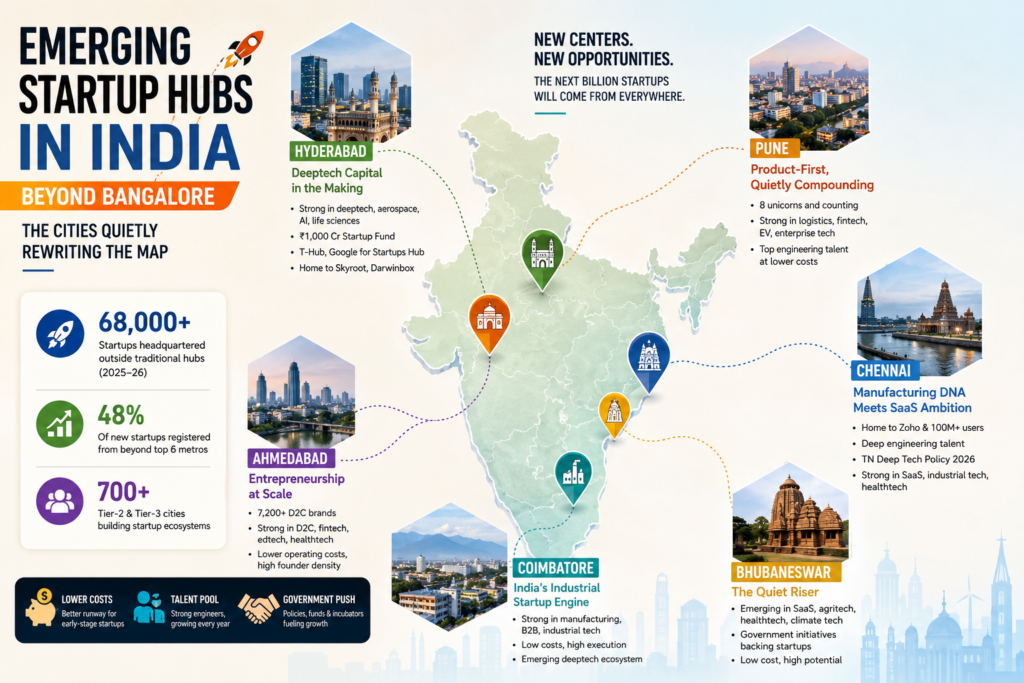
As of 2025-26, more than 68,000 startups are headquartered outside India’s traditional hubs Bengaluru, Delhi-NCR, Mumbai, Hyderabad, Chennai, Pune, Ahmedabad, and Kolkata. For the first time in India’s startup history, 48% of newly registered startups came from beyond the top six metros. Tier-2 and Tier-3 cities are not producing overflow from the main hubs. They are building distinct ecosystems with their own sector specializations, investor networks, and cost advantages.
The shift is real. But it is uneven, and it rewards founders who understand which cities are genuinely building infrastructure versus which ones are simply generating registration numbers without the capital, talent, or support systems to back them up.
Here is what is actually happening in the cities that matter.
Hyderabad: The Deeptech Capital in the Making
Of all the cities competing to be India’s second startup city, Hyderabad has the most credible claim and it is pursuing a different thesis than Bangalore.
Where Bangalore built its reputation on consumer internet and enterprise SaaS, Hyderabad is going deep on hardware, aerospace, life sciences, and AI infrastructure. T-Hub, the Telangana government’s flagship startup incubator, is one of the largest in Asia and has produced graduates that have gone on to raise international rounds. The government recently announced a ₹1,000 crore Startup Fund and hosts India’s first Google for Startups Hub.
The data reflects this trajectory. According to Inc42’s 2025 investor survey, 45% of investors identified Hyderabad as the next major epicentre of India’s startup revolution higher than any other city. Darwinbox, the HR software platform, has raised over $307 million and is headquartered here. Skyroot Aerospace, which became the third Indian startup unicorn of 2026 after raising at a $1 billion-plus valuation, is based in the city. These are not consumer apps built on growth hacks. They are deeply technical companies that require domain expertise, long development cycles, and patient capital.
The limitation is honest to name: Hyderabad still has only three unicorns, and late-stage capital remains concentrated in Bangalore and Mumbai. A founder building here will find strong seed support and government backing, but will likely still need to cultivate relationships with investors in other cities to close a Series B or beyond.
Pune: Product-First, Quietly Compounding
Pune does not make as much noise as it should. That is partly culture the city has a tendency to build sustainably rather than chase headlines and partly because its success stories compound slowly before they break through.
With eight unicorns, Pune has produced more billion-dollar companies than most people credit it for. FirstCry, Xpressbees, and ElasticRun are all headquartered here. The city’s product-first culture comes directly from its engineering colleges COEP, VIT Pune, and the symbiosis cluster and from its proximity to the manufacturing belt that runs through Maharashtra. Founders in Pune tend to build companies that solve operational problems: logistics, supply chain, electric mobility, fintech for mid-market businesses.
The startup environment benefits from a talent pool that is less competitive and less expensive than Bangalore, while still being technically strong. A senior engineer who commands ₹30–40 lakh in Bangalore might cost 25–30% less in Pune for the same output quality. For capital-efficient founders focused on unit economics, that margin compounds meaningfully over two or three years of early-stage operations.
The electric mobility cluster is worth watching specifically. Several EV startups, battery technology companies, and charging infrastructure players have chosen Pune as their base, partly because of proximity to Tata Motors, Bajaj Auto, and the auto manufacturing corridor. This is sector-specific infrastructure that most other cities cannot replicate.
Chennai: Manufacturing DNA Meets SaaS Ambition
Chennai is the easiest city to underestimate in India’s startup conversation. It does not have Bangalore’s glamour or Hyderabad’s government backing. What it has instead is an industrial base that most Indian cities would envy, a deep pool of engineering talent from IIT Madras and Anna University, and a culture of building quietly for decades before going public.
Zoho is the proof of concept. Built entirely in Chennai, bootstrapped for most of its history, and now one of the most profitable SaaS companies in the world with 100 million users across its product suite Zoho is the counter-argument to every founder who believes you need Bangalore and venture capital to build a technology company of consequence.
Tamil Nadu’s policy posture is accelerating the ecosystem. In early 2026, Chief Minister M.K. Stalin launched India’s first dedicated Deep Tech Startup Policy at the UmagineTN 2026 summit. The policy targets support for 100 deep tech startups and plans to mobilise ₹100 crore in public and private investment over five years. The state has registered a 36% CAGR in startup numbers between 2020 and 2025, and now counts over 12,000 startups with half of them reportedly led by women founders. Chief Minister Stalin also announced a ₹100 crore Co-creating Fund to invest in VC funds backing Tamil Nadu companies.
Chennai has five unicorns and a cluster of soonicorns in SaaS, logistics, and deep tech. Coimbatore is emerging as a secondary node for manufacturing tech and agri-tech. The city has a funding gap relative to its talent density, which means founders who are comfortable raising capital remotely from Bangalore or Mumbai investors can find exceptional early-stage arbitrage here.
Kochi and the Kerala Story
Kerala’s startup story is the most overlooked in mainstream coverage, and it deserves considerably more attention than it gets.
Kerala Startup Mission (KSUM) is the oldest state startup agency in India that is still actively operational, founded in 2006. It has supported over 6,400 startups, set up 67 incubators, and facilitated approximately $665 million in ecosystem funding. Kochi runs India’s only Super Fab Lab , a 10,000 sq ft hardware prototyping facility built in partnership with MIT which gives hardware founders access to infrastructure that simply does not exist in most other Indian cities.
The metric that stands out: Kerala’s startup ecosystem value surged 147% in 2025, the highest growth rate among all established startup states. Operational costs in Kochi are 60–70% lower than Bangalore. Angel networks in the state benefit from Kerala’s diaspora, particularly the NRI community in the Gulf, which is increasingly channelling capital back into local startups. For fintech, healthtech, and hardware founders, Kochi offers a combination of institutional support, low burn, and diaspora capital that is genuinely differentiated.
Jaipur: The Tier-2 Proof of Concept
Jaipur is the clearest evidence that unicorn-scale outcomes are possible without a Bangalore address.
CarDekho, the auto marketplace that has raised over $700 million and achieved unicorn status, was built out of Jaipur. Finova Capital, a lending platform focused on underserved SMEs, is headquartered here and is widely tracked as a soonicorn. These are not outliers. They are the product of a city with a genuine consumer market, proximity to the Delhi-NCR investor network, and a cost structure that lets founders extend runway by 18 to 24 months compared to operating in a Tier-1 metro.
Rajasthan’s iStart portal has over 7,100 registered startups, making it the strongest performing Tier-2 state on enrollment. The state’s strength aligns with its local industry: CleanTech, AgriTech, and handicraft-linked technology ventures that have authentic relationships with local supply chains and consumer bases.
The limitation here is access to late-stage capital. Jaipur founders can find strong seed support and angel backing, but institutional rounds above ₹50 crore typically still require building relationships with funds whose partners are based elsewhere. Founders who solve for this early by building investor relationships in NCR and Mumbai before they need the capital tend to do significantly better at growth stage.
The Funding Gap Nobody Talks About
Here is the structural problem that every conversation about emerging startup hubs eventually runs into: startup formation has decentralised, but capital has not.
Between 2016 and 2025, startups outside India’s main hubs accounted for 8.6% of total funding rounds but attracted only 2.1% of total capital deployed. The average cheque size in these markets ranges from $230,000 to $3 million overwhelmingly seed and early validation, not growth capital. Funding peaked at $880 million for non-hub cities in 2022 and dropped sharply to $353 million in 2023, tracking the broader funding winter with less cushion.
This creates an asymmetry that founders need to understand before choosing a city. The early stages of a startup ideation, prototype, product-market fit can be done more cheaply and often more effectively in a Tier-2 city. The late stages, where large capital enters and investor relationships drive outcomes, still heavily favour proximity to Bangalore, Mumbai, and Delhi-NCR.
The most practical playbook for founders in 2026 is a two-phase approach: validate in a cost-effective emerging hub, build proof of demand, then establish a presence in a Tier-1 city for the fundraising conversation. Several successful founders from Jaipur, Kochi, and Pune have run this exact sequence.
| City | Unicorns | Key Sectors | Standout Advantage | Funding Access |
| Hyderabad | 3 | Deeptech, Aerospace, HR Tech | T-Hub, ₹1,000 Cr state fund | Growing but limited late-stage |
| Pune | 8 | Logistics, EV, Fintech, SaaS | Product culture, auto proximity | Moderate, ties to Mumbai |
| Chennai | 5 | SaaS, Manufacturing, Deep Tech | Zoho benchmark, Tamil Nadu policy | Improving, still underfunded vs talent |
| Kochi | Emerging | Hardware, Healthtech, Fintech | KSUM, MIT Super Fab Lab, NRI diaspora | Strong seed, diaspora capital |
| Jaipur | 1+ | AgriTech, CleanTech, Consumer | CarDekho proof, iStart portal | Strong seed, NCR proximity |
What Is Actually Driving the Shift
Three structural forces are making this decentralisation durable rather than cyclical.
Reverse migration has created a talent base. The COVID-era exodus from metros brought experienced engineers, product managers, and operators back to their home cities. Many of them did not go back to Bangalore. They stayed, and they started companies. That single cohort of experienced builders changed the talent density in cities like Jaipur, Kochi, and Indore in ways that two-year government incubator programs could not replicate.
5G and digital infrastructure have removed the location penalty. A SaaS company can serve enterprise clients across India and internationally from Chennai or Kochi as effectively as from Bangalore, now that infrastructure quality has equalised. The operational reason to be in a Tier-1 city access to buyers, to partners, to enterprise sales channels has weakened as those relationships moved online.
State governments are competing for startups in a way they were not five years ago. Kerala’s 147% ecosystem growth in 2025 is partly a function of KSUM’s decade of patient institution-building, but it is also a product of the state actively competing for founders the way states used to compete for manufacturing plants. This policy competition is creating genuine infrastructure not just branding in states that previously had neither.
The Take Nobody Will Say Out Loud
The real story about India’s emerging startup hubs is not that Bangalore is being replaced. It is that Bangalore was always a constraint disguised as an opportunity.
A founder who moves to Koramangala to be close to investors and peers is also taking on a burn rate that is 60 to 70% higher than operating in Kochi or Jaipur. They are competing for the same senior engineers as every other startup in the city. They are paying Bangalore rent on a pre-product budget. For many founders, especially those building for Tier-2 and Tier-3 consumers who have never been to Koramangala, that proximity to the startup ecosystem actively distorts their understanding of who they are actually building for.
The best consumer internet companies of the next decade are more likely to be built by founders who grew up in the markets they are serving not by founders who relocated to Bangalore and tried to imagine those markets from a co-working space. Jaipur gives you better access to the Rajasthan consumer than any Bangalore office ever will. Kochi gives you a healthcare system, a manufacturing base, and a diaspora community that has been solving logistics and financial access problems for decades.
Capital follows proof. And proof, it turns out, does not require a Bangalore postcode.
Frequently Asked Questions
Which Indian cities are emerging as the strongest startup hubs outside Bangalore? Hyderabad, Pune, and Chennai are the most developed alternatives at the moment, with existing unicorns and institutional investor presence. Kochi and Jaipur are the strongest Tier-2 cities, supported by dedicated state startup missions and proven outcomes like CarDekho and the KSUM ecosystem. Cities like Indore, Bhubaneswar, and Lucknow are building startup density but remain earlier-stage as ecosystems.
Is it actually possible to raise venture capital from a city outside Bangalore or Delhi? Yes, especially at seed and early stage, where angel networks, micro-VCs, and state startup funds are active across most major emerging hubs. Late-stage capital Series B and beyond is still predominantly controlled by fund partners based in Bangalore, Mumbai, and Delhi-NCR. Founders in Tier-2 cities typically need to build investor relationships in Tier-1 cities well before they need the capital, rather than assuming investors will come to them.
What cost advantages do Tier-2 startup hubs offer founders? Operational costs in cities like Kochi and Jaipur run 50 to 70% lower than Bangalore for comparable teams and office space. This translates practically to 18 to 24 months of additional runway for a pre-Series A company operating on the same amount of capital. For founders where runway is the binding constraint which is most founders the cost arbitrage is significant.
What is KSUM and why does Kerala’s startup ecosystem stand out? Kerala Startup Mission (KSUM) is India’s oldest state startup agency, founded in 2006. It has supported over 6,400 startups, operates 67 incubators, and runs India’s only MIT-partnered Super Fab Lab hardware prototyping facility in Kochi. Kerala’s startup ecosystem value grew 147% in 2025, the highest rate among all established startup states. The NRI diaspora in the Gulf adds a diaspora capital layer that most other states do not have access to.
Why is Chennai often underestimated as a startup hub? Chennai’s startup culture prioritises capital efficiency and long-term building over headline fundraising, which makes it less visible in media coverage that tracks round announcements. Zoho’s history bootstrapped, Chennai-based, 100 million users, deeply profitable is the clearest example of what Chennai-style building produces. Tamil Nadu’s 2026 Deep Tech Startup Policy is the state’s most significant policy signal to date that it is ready to compete for capital-intensive founders as well.
What sectors tend to thrive in India’s emerging startup hubs? Each city has developed natural sector advantages. Hyderabad concentrates in deeptech, aerospace, and HR software. Pune in logistics, EV, and supply chain tech. Chennai in SaaS and manufacturing tech. Kochi in healthtech, hardware, and fintech. Jaipur in agritech, cleantech, and consumer brands serving Tier-2 markets. The strongest founders in each city tend to be solving problems they have genuine proximity to not importing problems from the Bangalore playbook.
What is the two-phase playbook for founders building outside Bangalore? Validate and build product-market fit in the Tier-2 city, taking advantage of lower burn and proximity to the actual customer base. When approaching growth-stage fundraising, establish a presence or at minimum a regular cadence of relationship-building in Bangalore, Mumbai, or Delhi-NCR, where the institutional capital that funds Series B and beyond is primarily concentrated. Several successful founders from Jaipur, Kochi, and Pune have used this exact sequence.
Stay in the Loop
For more stories, breakdowns, and unfiltered takes on what is really happening in Indian and global business and tech, follow TheFounder Nation.
Instagram Handle : https://www.instagram.com/thefoundernation?igsh=MTZobDUwc2xqZWdhOA==
We cover what the mainstream business press won’t.
© TheFounder Nation | All rights reserved