
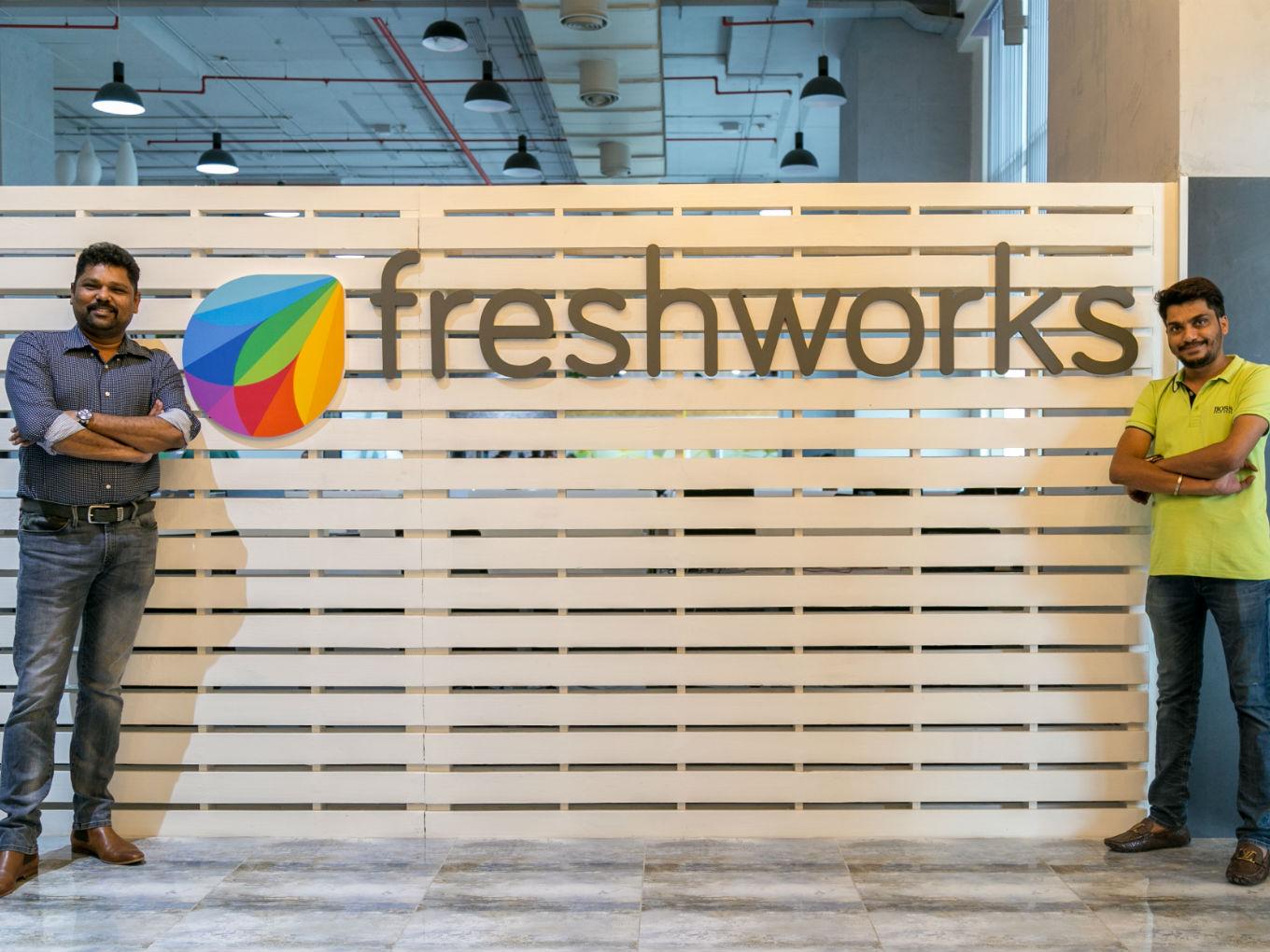
Freshworks grew from a Chennai startup into India's first SaaS company to list on Nasdaq, proving that global software businesses can be built from India.
While Silicon Valley was building social networks and search engines, a VP at a Chennai software company had a broken TV and a very specific idea about what needed to change.
Topic tags: Founder Stories • SaaS • Indian Startups • Freshworks • Nasdaq
In 2009, Girish Mathrubootham was relocating from Austin, Texas, back to Chennai, India. His 40-inch Samsung LCD TV arrived broken after two and a half months of shipping. What followed were months of phone calls, unanswered emails, and an insurance claim that went nowhere, until he posted about the experience on an online forum, and the post went viral (Thought Economics, September 2025). The insight that emerged was not about social media virality. It was about the fact that companies had no meaningful tools to manage customer support at scale, and the existing tools were either too expensive or too complex for small and mid-sized businesses. In 2010, he quit his job as VP of Product Management at Zoho and started building the solution himself.
Fifteen years later, Freshworks reported revenue of 838.8 million dollars in 2025 and posted its first GAAP-profitable year with net income of 183.7 million dollars (Wikipedia, Freshworks).
Why this story matters
Freshworks is the most complete proof point in the Indian startup ecosystem that a global software company of genuine scale can be built from India, for the world, without relocating the engineering team, without pivoting the product repeatedly, and without chasing the latest technology trend until the business model is proven.
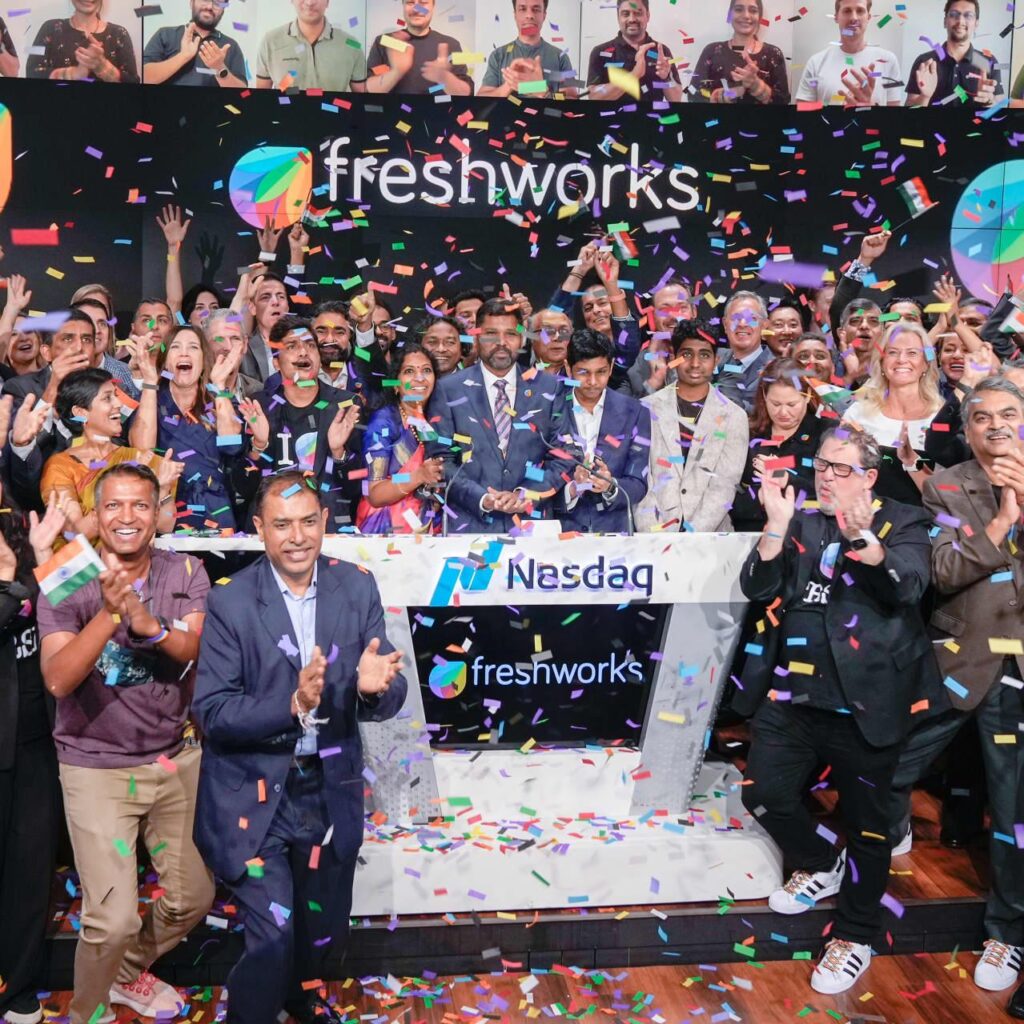
The company became the first Indian SaaS company to list on Nasdaq, in September 2021 at a valuation of 10.1 billion dollars (Brandz Magazine, December 2025). More than 500 Freshworks employees became millionaires through stock options on listing day, making it one of the largest single wealth-creation events in India’s startup history. For Indian founders building B2B software in 2026, Freshworks is not a historical case study. It is the operating template.
Quick facts
| Metric | Value | Source |
|---|---|---|
| Founded | 2010 (as Freshdesk) | Wikipedia |
| Founder | Girish Mathrubootham, Shan Krishnasamy | Wikipedia |
| Founded in | Chennai, India | Deccan Founders, June 2025 |
| IPO | September 2021, Nasdaq | Brandz Magazine, December 2025 |
| IPO valuation | $10.1 billion | Finowings, November 2024 |
| Revenue (2025) | $838.8 million | Wikipedia |
| Net income (2025) | $183.7 million | Wikipedia |
| First GAAP-profitable year | 2025 | Wikipedia |
| Current CEO | Dennis Woodside (since May 2024) | Wikipedia |
| Girish’s next chapter | Together Fund, venture capital | Business Today, September 2025 |
Background
Girish Mathrubootham was born in 1974 in Trichy, Tamil Nadu, and joined Zoho Corporation as VP of Engineering, eventually overseeing product strategy and customer support (Velocity Blog, March 2025). His years at Zoho gave him a direct view of the gap he would later build his company around: customer support software was either prohibitively expensive for the enterprise segment or clunky, fragmented, and hard to integrate for small and mid-sized businesses.
The broken TV incident in 2009 crystallised the problem personally. He started writing about it on a forum, and the response confirmed that businesses everywhere were struggling to manage customer feedback and support tickets through the same broken systems. In 2010, he co-founded Freshdesk with Shan Krishnasamy, his colleague from Zoho, in Chennai.
The company applied to Y Combinator and was rejected. It applied to Sequoia Capital and got a meeting. What happened between the application and the meeting accelerated the company’s visibility in a way that no pitch deck could have.
How it happened
Move 1: A Twitter feud with Zendesk that turned into the company’s first major growth event
In 2011, Zendesk, the dominant player in the customer support software space, publicly accused Freshdesk of unethical marketing tactics on Twitter. The accusation backfired spectacularly. The feud went public, gave Freshdesk global visibility in a market where it was otherwise unknown, and positioned the company as the scrappy underdog fighting the incumbent (Deccan Founders, June 2025). Sequoia Capital invested one million dollars shortly after. The Twitter moment did not make Freshdesk successful, but it demonstrated that Girish understood how to use attention, however it arrived, to build credibility.
Move 2: Building a suite rather than a single product, but only after the first product was proven
Freshdesk, the customer support product, was the anchor. But Girish and his team understood early that enterprise buyers buy workflows, not individual tools, and that a company with one product is permanently a feature risk away from irrelevance. The company launched Freshservice, an IT service management tool, in 2014. Freshsales, a CRM, followed in 2016. The company renamed itself Freshworks in 2017 to reflect the expanded suite (Wikipedia).
The sequencing matters. Freshworks did not try to build a suite from day one. It built a single product, proved it worked and customers would pay for it, and expanded into adjacent categories only after the original product was generating real revenue. This is the sequencing that Dunzo, to use a counterexample from the same era, failed to observe when it pivoted from hyperlocal delivery into quick commerce before the original model was financially stable.
Move 3: Staying in India for engineering while growing revenue globally
Freshworks moved its headquarters to San Mateo, California, in 2018 to be closer to its primary enterprise customer base in the United States (Wikipedia). But the engineering and product teams stayed predominantly in India, and the company’s identity was always explicitly Indian, from Girish’s public statements about building from Chennai for the world, to the choice to make the company’s IPO a moment of pride for the entire Indian startup ecosystem rather than something to be quietly assimilated into a US technology story.
Girish was vocal in his shareholder letter about values: empathy, customer happiness, and the pride of building from India for the world (Deccan Founders, June 2025). That framing, uncommon in tech IPOs that typically lead with market size and revenue multiples, reflected a deliberate belief that the culture of the company was part of its competitive advantage, not separate from it.
What competitors missed
Zendesk, the incumbent, underestimated how much of the market sat below its pricing floor. Freshdesk was built specifically for the small and mid-sized businesses that Zendesk’s pricing and complexity had priced out, and it won that segment by being meaningfully simpler and meaningfully cheaper, not by being marginally better on enterprise feature checklists (Deccan Founders, June 2025). Zendesk was later acquired by private equity firms after losing ground to competitors including Freshworks and Salesforce, a reversal that Girish Mathrubootham’s early focus on the underserved segment had been quietly setting up for years.
The broader miss among SaaS competitors was assuming that India could not produce a global enterprise software company of genuine scale. Freshworks disproved this not by building something India-specific but by building something globally useful from an Indian base, using India’s engineering cost advantage not as a margin strategy but as a capability strategy that let the company invest more in product than a US-headquartered competitor at the same revenue level could afford.
Risks and challenges
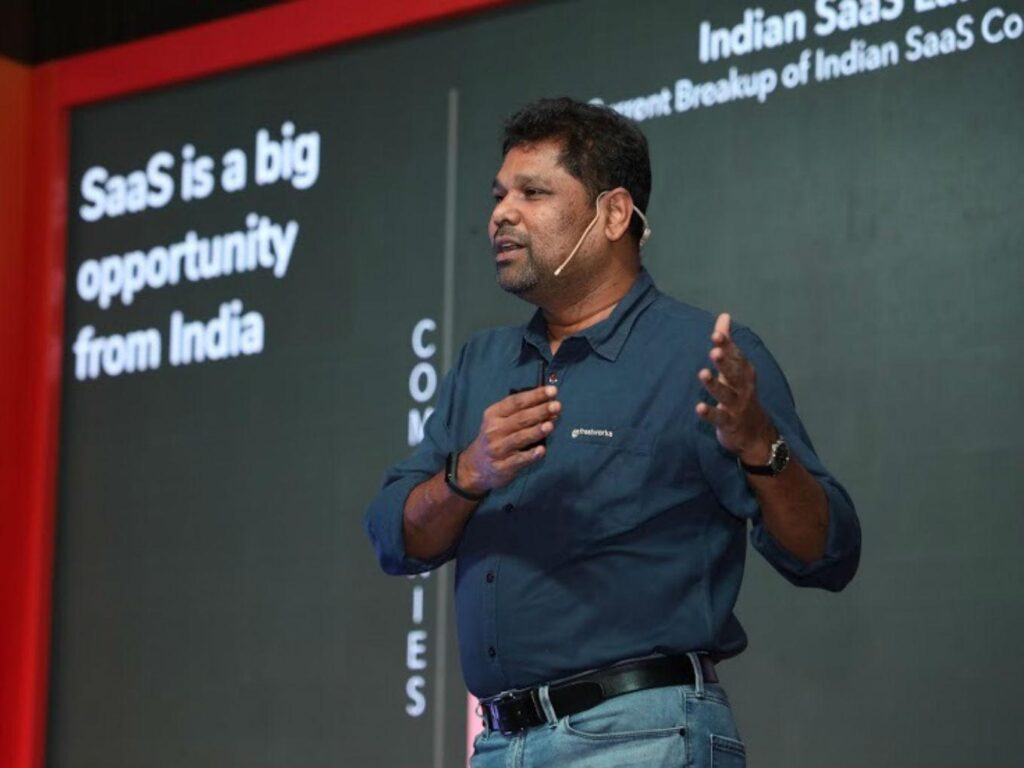
Founder exit risk. Girish stepped down as executive chairman on December 1, 2025, formally ending his 15-year involvement with the company (Business Today, September 2025). Dennis Woodside has been CEO since May 2024. Freshworks remains profitable and growing, but the cultural identity and customer-first philosophy that Girish embedded is now being maintained by a leadership team that did not build it from scratch.
AI disruption of the customer support category. Freshworks has invested in its Freddy AI product suite to embed AI across customer support, ITSM, and CRM. But the category it operates in, software for managing customer and IT service interactions, is precisely the category that AI agents are expected to disrupt most directly. If AI automates a large share of customer support interactions, the software layer managing those interactions becomes less necessary, not more.
Competition from Salesforce and ServiceNow at the upper end of the market remains a constraint on Freshworks’ ability to move aggressively upmarket without a confrontation it may not win.
What founders can learn
The product that starts a company does not have to be the product that makes it big, but the sequencing of when to expand matters enormously. Freshworks expanded into CRM and ITSM only after customer support revenue was real and growing. Founders who build a suite from day one tend to spread themselves thin before any one product is proven, a failure mode that Freshworks explicitly avoided.
Building from India for the world is a real strategy, not a consolation prize. Freshworks’ engineering cost advantage was not a substitute for product quality, it was what let Freshworks invest more in product quality than a US-based startup at the same revenue level could afford. Indian founders should treat this not as a cost story but as a capability-per-dollar story.
The underserved segment is often the most durable entry point. Freshdesk did not try to out-feature Zendesk for enterprise customers. It priced below Zendesk’s floor and won customers Zendesk had never bothered to pursue. The incumbents’ neglect of the lower market created Freshworks’ entire early growth path.
Expert analysis
Bull case. Freshworks achieved GAAP profitability in 2025 at 838.8 million dollars in revenue with 183.7 million dollars in net income, demonstrating that the company has matured from a growth-stage SaaS business into a sustainably profitable one (Wikipedia). Its 2026 acquisition of FireHydrant, an AI-driven incident management platform, signals continued expansion into IT service intelligence, the highest-growth area within its existing customer base.
Bear case. The AI disruption of customer support is a genuine existential threat to the category Freshworks was built on. If AI agents handle a large share of tier-one customer support interactions without human intervention, the ticket management software that Freshdesk pioneered becomes a smaller part of a significantly changed workflow.
Contrarian view. Girish Mathrubootham’s departure from Freshworks may ultimately prove to be the signal that the company has graduated from a founder-dependent startup to an institutionally durable software business, a transition that most Indian startup founders never reach. Dennis Woodside’s appointment and the 2025 profitability milestone together suggest Freshworks is building for decades, not the next funding round, which may be the most important thing Girish accomplished on his way out.
TFN LENS
The Freshworks story is the most direct evidence available to Indian founders that the “build in India, sell to the world” thesis is not aspirational, it is operational. Girish Mathrubootham did not move to Silicon Valley to build his company. He moved his headquarters there for enterprise sales proximity and left his engineering culture in Chennai, and the combination produced a company that is simultaneously Indian in its roots and global in its reach.
The sharper lesson for Indian founders in 2026 is about sequencing and patience. Freshworks took 11 years from founding to IPO. It spent most of that time solving one category of problem well before expanding to adjacent ones. It reached profitability in year 15. Founders who treat that timeline as a sign of insufficient ambition are misreading it. The founders who produce the next Freshworks from India will likely be the ones patient enough to prove one thing fully before building the second.
Building something of your own? Follow The Founder Nation and NamasteVC for curated startup funding news, grant alerts, and founder stories from India’s startup ecosystem, delivered straight to your feed, every week.
Frequently asked questions
Who founded Freshworks and why?
Freshworks was co-founded in 2010 by Girish Mathrubootham and Shan Krishnasamy in Chennai, India. Girish was inspired by a personal experience with poor customer support after his TV was broken during an international move, which exposed the lack of affordable, usable customer support tools for small and mid-sized businesses (Thought Economics, September 2025).
When did Freshworks go public and at what valuation?
Freshworks listed on Nasdaq in September 2021 under the symbol FRSH at a valuation of approximately 10.1 billion dollars, raising 1.03 billion dollars in its IPO and becoming the first Indian SaaS company to go public in the United States (Finowings, November 2024).
Is Freshworks profitable?
Yes. Freshworks reported its first GAAP-profitable year in 2025 with net income of 183.7 million dollars on revenue of 838.8 million dollars (Wikipedia).
Who is the current CEO of Freshworks?
Dennis Woodside has been CEO of Freshworks since May 2024. Girish Mathrubootham, the founder, stepped down as executive chairman on December 1, 2025, to focus full-time on Together Fund, his venture capital firm for early-stage founders (Business Today, September 2025).
What products does Freshworks offer?
Freshworks offers a suite of cloud-based business software including Freshdesk (customer support), Freshservice (IT service management), Freshsales (CRM), Freshchat (messaging), and Freshmarketer (marketing automation), plus Freddy AI embedded across products, and acquired FireHydrant (AI incident management) in January 2026 (Wikipedia).
©️ The Founder Nation | All rights reserved | Written by TFN Research Desk |