
Google is pushing Gemini beyond the traditional chatbot, building an agentic AI ecosystem designed to work proactively across Search, Workspace, and everyday digital tasks.
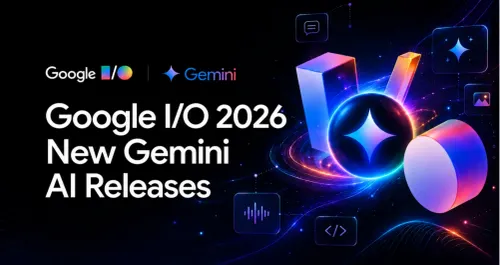
Google used its I/O 2026 developer conference in May to announce what it called the official beginning of the “agentic Gemini era,” a shift in which the company’s AI no longer waits for you to ask it something but instead works on your behalf around the clock. The event, held on May 19 and 20 in Mountain View, California, produced two new flagship models, a redesigned Gemini app, sweeping changes to Search, and a string of new hardware — all built around the same central claim: AI is no longer a tool you use, it is a system that acts for you.
The marquee model launches were Gemini 3.5 and Gemini Omni. Gemini 3.5 is designed for agents and coding, combining what Google describes as frontier intelligence with the ability to take action across multi-step workflows. Gemini Omni is a generative model capable of producing any output from any input, with video as the initial focus. Together, they form the foundation for nearly every other announcement Google made in May.
The breadth of the announcement package reflects a company that has spent years building toward a moment. Gemini serves more than 900 million users monthly across 230 countries, according to Google. The I/O 2026 announcements are an attempt to turn that installed base into the foundation for an entirely new layer of AI-driven behaviour across products users already open every day.
Two New Models, Two Different Bets
Gemini 3.5 Flash is the first release in the 3.5 family and is generally available now through Google’s Antigravity platform, the Gemini API, Google AI Studio, and Android Studio. On the benchmarks Google chose to publish, it outperforms Gemini 3.1 Pro on agentic and coding tasks, scoring 76.2% on Terminal-Bench 2.1, 1656 Elo on GDPval-AA, and 83.6% on MCP Atlas. Google says it delivers comparable performance to larger flagship models at less than half the cost. Gemini 3.5 Pro is already in internal testing and is scheduled for rollout the following month.
Gemini Omni is a different kind of model. Where 3.5 is built for execution, Omni is built for creation. It can take text, images, audio, and video as combined input and generate high-quality video grounded in Gemini’s real-world knowledge. Google says Omni has a stronger grasp of physics, including gravity, kinetic energy, and fluid dynamics, making generated scenes more realistic. Every video produced by Omni carries Google’s SynthID watermark, which can be verified in the Gemini app, Chrome, and Search.
Gemini Spark: The Always-On Agent
The announcement that attracted the most attention, and the most questions, was Gemini Spark. Google describes it as a 24/7 personal AI agent that works in the background, under user direction, to manage tasks across Gmail, Calendar, Docs, Sheets, Slides, and other Workspace tools. Unlike standard assistants, Spark operates as a cloud-based agent that continues working even after a user closes their laptop or locks their phone.
Spark is built on Gemini 3.5 and runs on the Antigravity harness. It can parse incoming emails for deadlines, prepare daily briefings, draft documents from raw notes, flag hidden subscription fees from bank statements, and create complete multi-step workflows users can configure once and leave running. Google says it checks in before taking major actions, though early testers at publications including TechCrunch noted that the definition of “major” is not yet clearly defined, and will likely evolve as feedback comes in.
The privacy dimension of Spark has been the sharpest point of discussion since launch. For the agent to function, users must grant it broad access to their emails, calendars, documents, contacts, and browsing context. TechRadar’s review described the experience as “helpful, certainly. Also slightly uncanny.” TechBuzz’s early access testing found the technology impressively capable but raised questions about the scope of permissions required and what happens when an always-on cloud agent has persistent access to the totality of a user’s digital life. Google has emphasised that Spark is always user-directed, and that users can configure what it sees and what it acts on.
Spark is rolling out first to Google AI Ultra subscribers in the United States as a beta. The $100 and $200 Ultra tiers both receive access.
Search Gets Its Biggest Redesign in 25 Years
Google described the Search changes announced at I/O as the largest upgrade to the product in over 25 years. The Search box has been rebuilt with AI, now expanding dynamically to accommodate longer, more detailed queries and offering AI-powered suggestions that go beyond autocomplete. AI Mode, which passed one billion monthly users, has been merged with AI Overviews into a single experience and now defaults to Gemini 3.5 Flash globally.
The more substantive change is the introduction of information agents in Search. These agents run in the background around the clock, monitoring topics on a user’s behalf and sending detailed updates when conditions are met. A user apartment hunting in a specific neighbourhood can describe their exact requirements and have an agent continuously scan listings, alerting them only when something matches. The agents also handle bookings, handling local experiences and services by sourcing current pricing and availability and providing direct booking links.
Antigravity, Google’s agent-first development platform, is now embedded in Search. It gives Search the ability to generate custom user interfaces on the fly, assembling interactive visuals, tables, graphs, and simulations tailored to a specific question in real time. For ongoing projects, Search can build entire custom dashboards or trackers that users return to repeatedly. The generative UI feature will be available to all users for free this summer. Custom dashboards are coming later, starting with subscribers.
New Hardware Built for the Agentic Layer
The Android Show, held alongside I/O, introduced hardware specifically designed around the new AI capabilities. The Googlebook is a new laptop category built from the ground up for Gemini Intelligence, featuring a Magic Pointer for contextual suggestions and tight integration with Android devices. Manufacturing partners include Acer, Asus, Dell, HP, and Lenovo.
Android Halo is a new space on Android phones that shows users what their agents are doing and allows them to receive assistance without interrupting whatever they are working on. For wearables, Google introduced Fitbit Air, its smallest tracker yet, which includes 24/7 heart rate monitoring, Afib alerts, SpO2 tracking, sleep stages, and heart rate variability in a device described as a “tiny, discreet pebble.” The company also revealed upcoming intelligent eyewear under the Android XR line that allows users to get directions, send texts, and take photos without reaching for their phone.
Beyond the Consumer: Science, Quantum, and Enterprise
Away from the consumer product announcements, Google made several commitments with a longer horizon. Gemini for Science is a new collection of tools and experiments designed to expand AI’s role in research, covering climate, life sciences, and other fields. The REPLIQA initiative commits $10 million to five universities to apply quantum science and AI to life sciences research. AlphaEvolve, Google’s AI system for solving complex real-world problems, received an update showcasing its application to supply chain optimisation, chip design, molecular simulation, and electrical power grid management.
On the enterprise side, Google Cloud announced several additions tied to Gemini 3.5, including Gemini Spark for Workspace customers, a security agent called CodeMender that finds and fixes code vulnerabilities, and a new Managed Agents API that allows developers to build and run custom agents in secure, Google-hosted environments.
The scale of what Google announced in May is notable not just for its breadth but for its consistency of direction. Every piece, from the models to the hardware to the search redesign, points toward the same outcome: a version of Google’s products where AI is not an add-on feature but the primary way the system works. Whether users will accept that trade, and the level of access it requires, is the question that will shape how much of this actually lands.
Frequently Asked Questions
What is Gemini 3.5 and how is it different from previous Gemini models? Gemini 3.5 Flash is the first model in Google’s new 3.5 family, designed specifically for agentic work and coding. It outperforms Gemini 3.1 Pro on key benchmarks while delivering comparable results to larger flagship models at less than half the cost. Unlike earlier Gemini versions that primarily responded to prompts, 3.5 is built to independently execute complex, multi-step workflows across apps. Gemini 3.5 Pro is in internal testing and is expected to roll out in June 2026.
What is Gemini Spark and who can access it? Gemini Spark is a 24/7 cloud-based AI agent that works in the background across Google’s Workspace apps, including Gmail, Calendar, Docs, and Sheets, even when a user’s device is closed or locked. It can handle multi-step tasks, send daily briefings, draft documents, manage workflows, and flag important updates autonomously, under user direction. It is currently rolling out as a beta to Google AI Ultra subscribers in the United States, available on both the $100 and $200 Ultra tiers.
What changed about Google Search at I/O 2026? Google announced the biggest Search redesign in over 25 years, including a rebuilt AI-powered Search box, information agents that run 24/7 to monitor topics on a user’s behalf, and generative UI capabilities that assemble custom layouts, interactive visuals, and dashboards for specific questions on the fly. AI Mode, which has passed one billion monthly users, has been merged with AI Overviews into a single experience with Gemini 3.5 Flash as the global default model.
What is Gemini Omni? Gemini Omni is a new multimodal generative model that can produce video output from any combination of text, images, audio, and video inputs. It is designed to combine Gemini’s reasoning capabilities with Google’s generative media models, producing realistic video grounded in real-world knowledge. All Omni-generated videos carry Google’s invisible SynthID watermark. Omni Flash is expected to roll out to developers and enterprise customers via the Gemini API in the weeks following I/O.
What privacy concerns have been raised about Gemini Spark? Because Spark works autonomously in the background across Gmail, Calendar, and Workspace, it requires broad access to a user’s emails, contacts, schedules, and documents to function effectively. Early reviewers noted that the system works impressively well but raises unresolved questions about how much context a persistent cloud agent accumulates over time and what oversight users actually have over its decisions. Google says users control what Spark can see and that the agent checks in before major actions, though reviewers have noted that the definition of “major” is still being refined.
Sources
- Google Blog (Official): The latest AI news we announced in May 2026
- Google Blog (Official): 100 things we announced at Google I/O 2026
- Google Blog (Official): The Gemini app becomes more agentic, delivering proactive, 24/7 help
- Google Blog (Official): Google Search’s I/O 2026 updates: AI agents and more
- Google Cloud Blog: Innovations from Google I/O 26 on Google Cloud
- TechCrunch: I put Google’s 24/7 AI assistant Gemini Spark to work, and it’s actually pretty useful
- TechRadar: Google I/O 2026 made one thing clear — Gemini is becoming impossible to avoid
- Business Standard: Google reshuffles Gemini AI plans with new Ultra tier, revises usage limits
Stay in the Loop
For more stories, breakdowns, and unfiltered takes on what is really happening in Indian and global business and tech, follow TheFounder Nation.
Instagram: thefoundernation
We cover what the mainstream business press won’t.
© TheFounder Nation | All rights reserved