

Explore the biggest startup funding rounds of June 2026 and uncover the investment trends shaping AI, fintech, energy, and biotech. Discover what these mega deals reveal about where venture capital is flowing and what founders can learn from them.
Written by TFN Research Desk | covering startups, technology, venture capital, and business strategy.
There is a strange thing that happens every time a startup announces a mega round. The headlines focus on the number. The founder tweets a thread. The LinkedIn congratulations roll in. And somewhere in the noise, the actual signal gets buried.
June 2026’s funding landscape is worth reading more carefully than most. Because the rounds being written this month are not random bets on promising pitches. They are concentrated, deliberate, and revealing about what investors believe is coming, what categories they have decided are infrastructure for the next decade, and which founders have managed to build enough proof to attract capital at a moment when proof is finally required again.
The numbers are staggering. In just the first half of 2026, US startups alone have pulled in $384 billion in equity funding more than double the $171 billion raised in the same period last year. Something has structurally shifted in how capital is moving. The question worth asking is not who raised what. It is why these companies, why now, and what it tells a founder watching from the outside.
The Month’s Biggest Rounds, Broken Down
Let’s start with the numbers before we get to the pattern.
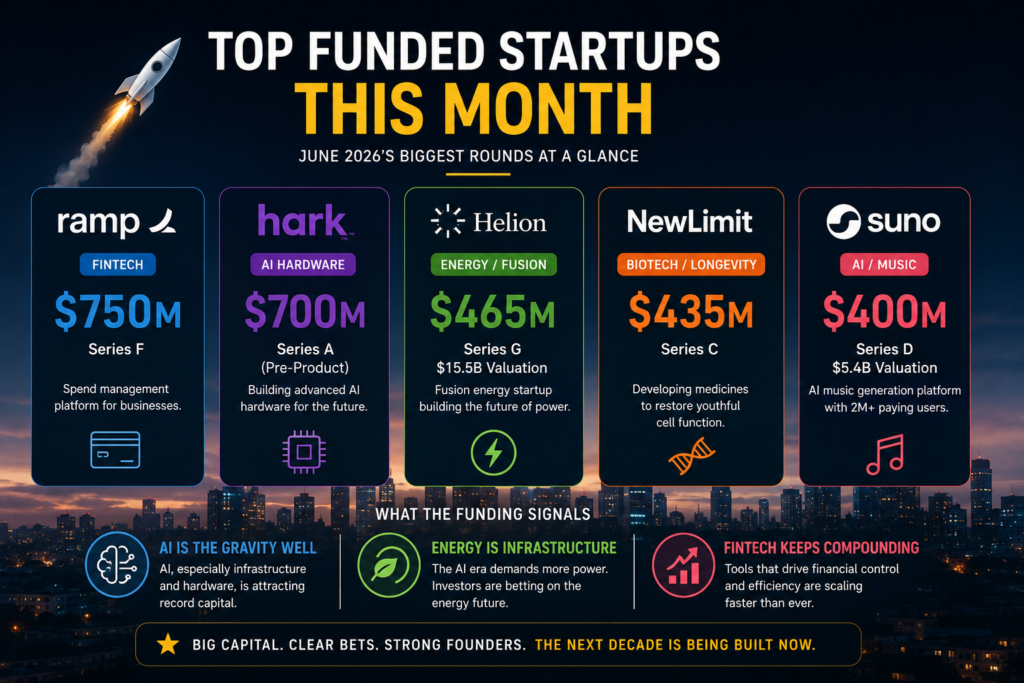
Ramp closed a $750 million Series F on June 4th, led by Iconiq, GIC, and Ontario Teachers’ Pension Plan. That round set a $44 billion valuation for a seven-year-old spend management company that helps businesses control where their money goes. Ramp has now raised over $3 billion in total.
Hark, a one-year-old AI hardware startup based in San Jose building what it describes as “advanced personalized intelligence and next-generation hardware,” landed a $700 million Series A. The round was led by Parkway Venture Capital and backed by chip giants Nvidia, Intel Capital, AMD, and Qualcomm Ventures, alongside ARK Invest, Prime Movers Lab, and Salesforce Ventures. Hark plans to release its first product later this summer. A $700 million Series A before a single product has shipped is the definition of betting on a category, not a company.
Helion, the fusion energy startup based in Everett, Washington, pulled in $465 million in Series G funding led by Thrive Capital, pushing its post-money valuation to $15.5 billion. The company has now raised over $1.5 billion in total and holds a power purchase agreement with Microsoft to deliver electricity from its fusion plant starting in 2028.
NewLimit, a longevity medicine company co-founded by Coinbase CEO Brian Armstrong, closed a $435 million Series C led by Founders Fund. The company is working on medicines that restore youthful cell function through epigenetic reprogramming an area that was considered speculative science five years ago and is now attracting some of the most serious capital in biotech.
Suno, the AI music generation platform, raised $400 million in a Series D led by Bond Capital, valuing the company at $5.4 billion. The round came just six months after Suno’s $250 million Series C, which had valued it at $2.45 billion. Suno now counts over 2 million paying subscribers and is the third most-popular app on Apple’s App Store in the music category this despite active litigation from multiple music labels over training data.
Three Categories Are Getting Almost All the Money
Look across these rounds and two or three categories keep appearing. That is not a coincidence.
AI is the gravity well. Not every AI company is getting funded, but AI companies with real revenue, specific category ownership, or strategic hardware positioning are attracting the largest cheques in startup history. Hark raising $700 million before shipping a product is only possible because chip manufacturers and large-scale investors are willing to bet on the hardware-AI interface as infrastructure. When Nvidia and Qualcomm co-invest in a Series A, they are not writing a venture cheque. They are reserving a seat at a category table.
Energy is being treated as infrastructure. Helion’s raise is part of a broader trend that is easy to miss inside the AI news cycle. The compute required to run the next generation of AI is creating a genuine electricity supply problem. Microsoft, Google, and Amazon have all signed nuclear and fusion power purchase agreements in the last two years. Helion has one with Microsoft and another with Nucor for a larger plant in the 2030s. Investors are not backing fusion because the technology is proven. They are backing it because the demand-side pressure from AI infrastructure creates a commercial window that did not exist five years ago.
Fintech picks up when financial control is in demand. Ramp’s valuation $44 billion for a spend management platform might seem aggressive until you consider that enterprise finance teams are actively looking for tools that can automate and audit spending in an era of AI-enabled procurement. Ramp is not just corporate cards. It is becoming the financial operating system for companies that want to know where every dollar is going. That positioning is worth more in a tightened capital environment than it would have been during the zero-interest era.
What Investors Are Actually Rewarding
Sequoia, Andreessen Horowitz, Founders Fund, Thrive Capital, Iconiq, and Bond Capital are not writing large cheques at random. The pattern across June’s biggest rounds points to a specific thesis.
Proof beats promise at growth stage. Suno has 2 million paying subscribers. Ramp has enterprise clients managing billions in spend on its platform. NewLimit’s founders have scientific credibility and a well-defined therapeutic target. The era of funding a slide deck at Series C is effectively over — at least for founders who are not already known quantities.
The round size is part of the strategy. A $700 million Series A for Hark is not just capital. It is a signal designed to shape the market. Competitors, enterprise buyers, and talent all read funding announcements as proof of category leadership. In AI hardware, where talent and manufacturing partnerships require long-lead commitments, a massive round locks in multiple advantages at once.
Investors are backing systems, not features. The companies getting the largest cheques are not single-feature products. Ramp is a financial operating system. Helion is energy infrastructure. NewLimit is building a platform for understanding and reversing cellular ageing. Each of these addresses a system-level problem with compounding value over time.
The India Context: What These Rounds Signal for Indian Founders
Indian founders often read US funding news as inspiration without translating the signal. That is a mistake.
The concentration of capital in AI, energy, and fintech is not US-specific. The same investor logic back systems that solve expensive workflow problems, not features that add convenience is now playing out across Indian VC as well. Accel, Sequoia India, Peak XV, and Elevation Capital have all shifted emphasis toward profitability, retention, and defensible category ownership over the last eighteen months.
Indian founders in fintech, AI tooling, and industrial software are well-positioned to benefit from this logic but only if they can demonstrate the kind of proof of demand that Suno and Ramp showed before their growth-stage rounds closed. The geography is different. The investor criteria is converging faster than most founders realize.
The Round Size Illusion
One thing worth naming directly: the headline number of a funding round is one of the most misleading signals in the startup ecosystem.
A $750 million round for Ramp at a $44 billion valuation tells you Ramp is a great business. It tells you almost nothing useful about what a pre-seed founder should do tomorrow. The distance between a Series F fintech company with enterprise clients and a founder building their first version of anything is not measured in dollars. It is measured in proof.
The useful question is not “how do I raise a round this large.” It is “what proof did each of these companies have before investors wrote cheques at this size.” Ramp had revenue, retention, and a clear path to expanding gross margin before its first large institutional round. Suno had a product that millions of people used before Bond Capital led a $400 million Series D.
That sequencing is the lesson. Proof first. Capital second. The round sizes make the news. The proof behind them is what matters.
The Take Nobody Will Say Out Loud
The June 2026 funding environment is generating one uncomfortable truth that nobody in venture wants to say clearly: the bar for getting funded at growth stage has quietly moved to where the bar for IPO readiness used to be five years ago.
Suno raised $400 million at a $5.4 billion valuation with 2 million paying subscribers, active litigation from the music industry, and a product that was not commercially sanctioned until a label partnership closed during this round. That combination would have been unfundable in 2019. It is fundable in 2026 because the pace of AI consumer adoption has compressed the timelines investors use to evaluate product-market fit.
What that means in practice is this: investors are not funding potential anymore. They are funding demonstrated demand in a category they believe will be significant. If you have that, the round sizes being written this month suggest capital is not the constraint. If you do not have it, no amount of AI positioning language in your deck will move the needle. The market has gotten very good, very quickly, at telling the difference.
Frequently Asked Questions
What is a venture funding round and why do companies announce them? A venture funding round is when a startup raises capital from investors in exchange for equity. Companies announce rounds publicly to signal momentum, attract talent, build customer trust, and generate interest from future investors. The announcement itself is part of the strategy particularly at growth stage, where market perception of category leadership affects everything from hiring to enterprise sales cycles.
Why is AI attracting such large funding rounds in 2026? AI is attracting outsized capital because it is being treated as infrastructure rather than a product category. The compute, energy, and tooling required to build and deploy AI systems at scale represent multi-decade capital allocation decisions. Investors are not just backing AI applications they are backing the layers below AI applications: hardware, energy, and financial infrastructure. That is why rounds for companies like Hark and Helion are as large as they are.
What does a $44 billion valuation for Ramp actually mean? A valuation is the price investors agreed to pay divided by the equity stake they received. Ramp’s $44 billion valuation means investors collectively believed the business was worth that amount at the time of the June 2026 round. It does not mean the company could be sold for that today. Valuations at late-stage rounds are forward-looking bets on what a company could be worth at IPO or acquisition, not current market price.
Why are longevity and biotech startups attracting VC capital? Longevity medicine has moved from speculative science to an investable category over the last three to four years. The convergence of AI-driven drug discovery, improved genomics tools, and better clinical trial design has made it possible to build credible development timelines for medicines targeting ageing mechanisms like epigenetic reprogramming. NewLimit’s $435 million round reflects investor confidence in both the science and the commercial precedent being set by other longevity companies moving toward clinical trials.
Should Indian founders pay attention to US funding trends? Yes not to replicate them, but to understand the investor thesis driving them. The same logic that is producing $400–750 million growth rounds in the US is shaping how Indian VCs evaluate fintech, AI tooling, and industrial software companies in India. The specific numbers and sectors differ, but the underlying criteria proof of demand, defensible category ownership, unit economics that improve with scale are converging globally.
What is the most common mistake founders make when reading funding announcements? Benchmarking the wrong thing. Founders often read a large round and ask “how do I raise something like this.” The better question is “what did this company need to prove before capital at this scale was available.” Ramp, Suno, and NewLimit all had significant proof of demand and market validation before investors wrote growth-stage cheques. The round sizes are the result of that proof, not the cause of it.
What sectors look likely to see continued large rounds in the second half of 2026? Based on current patterns, AI infrastructure, fusion and nuclear energy, longevity medicine, fintech systems, and AI-enabled hardware are all attracting sustained institutional interest. Defense tech and quantum computing are also surfacing in funding data for companies that can demonstrate near-term commercial applications. The common thread is system-level positioning in categories with long-horizon commercial demand.
Source
TechCrunch — Ramp raises $750M at $44B valuation
https://techcrunch.com/2026/06/04/ramp-raises-750m-at-44b-valuation-as-investors-hunger-for-fintechs-with-an-ai-story/
TechCrunch — Hark raises $700M Series A for its secretive “universal” AI interface
https://techcrunch.com/2026/05/21/hark-raises-700m-series-a-for-its-secretive-universal-ai-interface/
Helion Energy (press release via BusinessWire) — Helion raises $465M Series G funding round
https://www.businesswire.com/news/home/20260604740624/en/Helion-Raises-$465-Million-Series-G-Funding-Round-to-Meet-Surging-Global-Demand-for-Power
TechCrunch — Helion, the Sam Altman-backed fusion startup, raises $465M
https://techcrunch.com/2026/06/04/helion-the-sam-altman-backed-fusion-startup-raises-465m-to-build-a-power-plant-for-microsoft/
STAT News — Longevity startup NewLimit raises $435M ahead of first clinical trial
https://www.statnews.com/2026/06/02/longevity-startup-newlimit-announces-435-million-clinical-trial-financing/
Music Business Worldwide — Suno raises over $400M, pushing valuation to $5.4 billion
https://www.musicbusinessworldwide.com/suno-raises-over-400-million-pushing-valuation-to-5-4-billion/
TechCrunch — India startup funding hits $11B in 2025 as investors grow more selective
https://techcrunch.com/2025/12/27/india-startup-funding-hits-11b-in-2025-as-investors-grow-more-selective/
Inc42 — Meet the top 10 Indian startup investors of Q1 2026 (Accel, Sequoia India, Peak XV context)
https://inc42.com/buzz/meet-the-top-10-indian-startup-investors-of-q1-2026/
Stay in the Loop
For more stories, breakdowns, and unfiltered takes on what is really happening in Indian and global business and tech, follow TheFounder Nation.
Instagram Handle : https://www.instagram.com/thefoundernation?igsh=MTZobDUwc2xqZWdhOA==
We cover what the mainstream business press won’t.
© TheFounder Nation | All rights reserved