

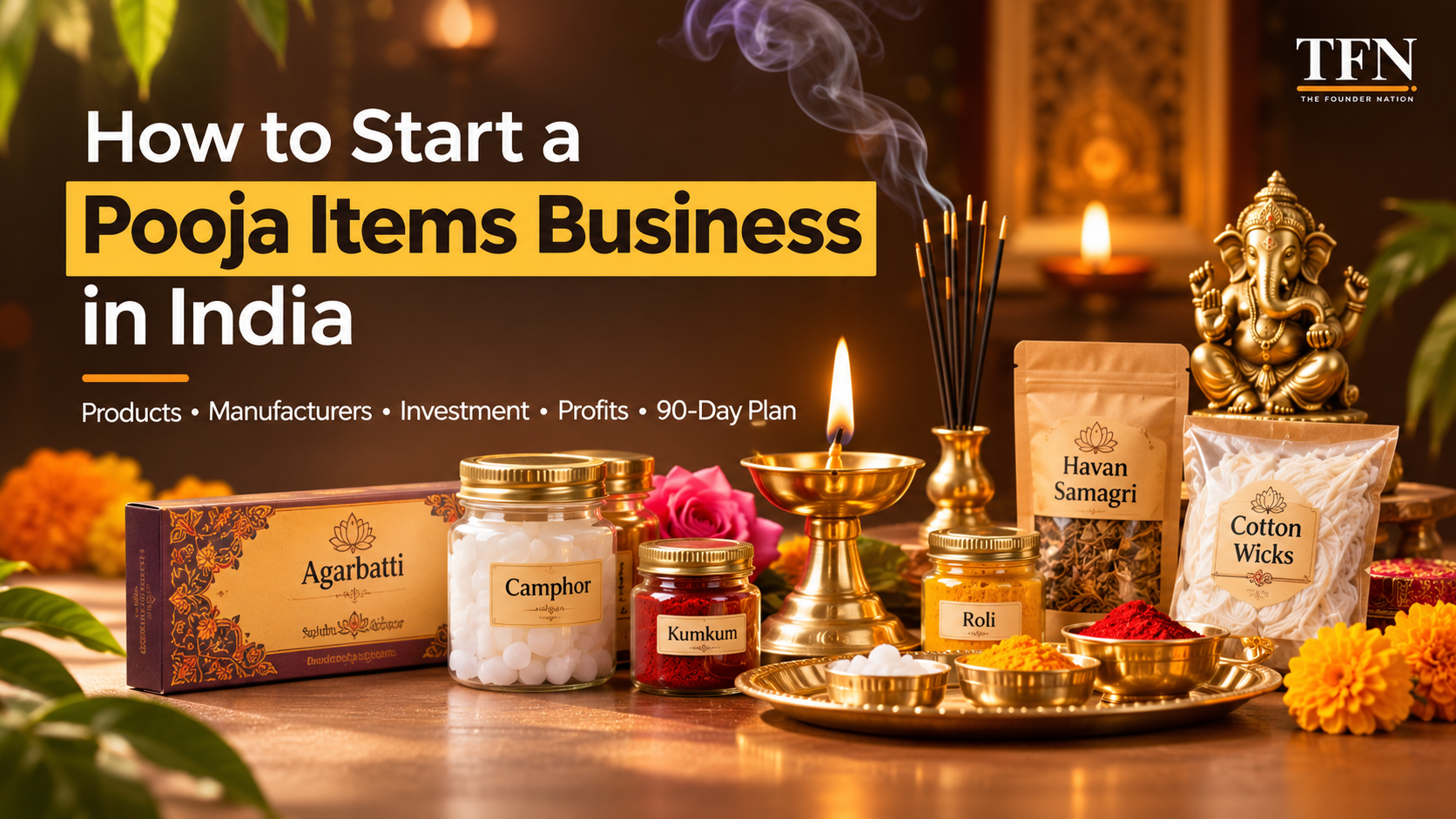
Explore the products, manufacturers, investment and profit opportunities in India's pooja products market.
How to start a pooja items business in India is an interesting opportunity for entrepreneurs looking to build a consumer brand in an established and growing devotional products market.
Think about the last time you purchased camphor, agarbatti, cotton wicks, kumkum or diya oil. You probably remember the shop, but do you remember the brand name of every product?
That is where the opportunity lies. Millions of Indian households purchase pooja essentials regularly, yet several product categories remain fragmented across regional manufacturers, local wholesalers and smaller brands.
For entrepreneurs, this creates an opportunity to build a recognisable consumer brand around everyday devotional essentials. And the best part? You do not necessarily need to own a factory.
With private-label manufacturing, wholesale sourcing, attractive packaging and the right distribution strategy, you can start small and gradually build a scalable pooja products brand.
India’s next big consumer brand might not come from fashion, food or electronics. It could come from something that millions of Indian households purchase every single day: pooja samagri.
Think about the last time you purchased camphor, agarbatti, cotton wicks, kumkum, diya oil or a pooja thali. You probably remember the shop, but do you remember the brand of every product?
That is an interesting business opportunity.
India has an established market for religious and devotional products, yet many categories continue to be served by regional manufacturers, local wholesalers and relatively small brands. Customers purchase these products regularly, but the shopping experience is often fragmented.
For entrepreneurs, this creates an opportunity to build a recognisable consumer brand around everyday devotional essentials.
And you do not necessarily need to own a factory.
You can source products from existing manufacturers, use private-label production, create your own packaging, sell through e-commerce and retail stores, and gradually expand into festival kits and premium devotional products.
In this guide, we explore how to start a pooja items business in India, 30+ products you can sell, where to find manufacturers, the best wholesale sourcing hubs, private-label opportunities, factory-to-retail pricing, investment requirements, profit calculations, licences, marketing strategies and a practical 90-day launch plan.
The opportunity is not simply to sell pooja samagri. It is to build a trusted Indian devotional products brand.
Table of Contents
- Why the Pooja Products Business Is a Big Opportunity
- Understanding the Indian Pooja Products Market
- 30+ Pooja Products You Can Sell
- Which Pooja Products Should You Start With?
- India’s Major Pooja Products Manufacturing Hubs
- How to Find Pooja Items Manufacturers and Wholesale Suppliers
- Private Label vs Wholesale vs Own Manufacturing
- Factory Price vs Retail Price: Understanding the Economics
- Pooja Products Profit Margin: A Practical Calculation
- Investment Required to Start a Pooja Business
- Licences, GST and Legal Requirements
- How to Build a Recognisable Pooja Products Brand
- Packaging and Product Differentiation
- How to Market and Sell Pooja Products
- Competitor Analysis: Indian Brands to Study
- How to Build a ₹100 Crore Pooja Products Brand
- Your First 90 Days: Business Launch Roadmap
- Common Mistakes to Avoid
- Frequently Asked Questions
1. Why the Pooja Products Business Is a Big Opportunity
Look at the mandir in a typical Indian household.
You will probably find agarbatti, camphor, cotton wicks, kumkum, diya oil, dhoop, a bell and other devotional essentials.
These are not products that customers purchase only once. Several of them are consumed regularly and need replenishment.
That creates an interesting combination for entrepreneurs:
- Existing customer demand.
- Recurring consumption.
- Multiple product categories.
- Established manufacturing ecosystems.
- Opportunities for private labelling.
- Festival-driven sales.
- Potential for online and offline distribution.
Five reasons this business deserves attention
1. Recurring demand
Agarbatti, camphor, cotton wicks and dhoop are consumable products. Customers purchase them repeatedly, creating opportunities for repeat orders and monthly subscription boxes.
2. Fragmented product categories
While large brands already dominate certain segments such as incense, several adjacent devotional product categories remain distributed across regional manufacturers, wholesalers and smaller brands.
This creates opportunities for better packaging, standardised quality and a more convenient shopping experience.
3. Manufacturing infrastructure already exists
You do not need to establish a factory to enter the market.
India has established production and trading clusters for incense, brassware, fragrances, cotton wicks, religious powders and traditional handicrafts.
4. Multiple customer segments
Your customers could include:
- Individual households.
- Religious product retailers.
- Temples.
- Priests and religious service providers.
- Wedding planners.
- Corporate gifting companies.
- Online shoppers.
- Indian communities living abroad.
5. Festival-driven revenue opportunities
Diwali, Navratri, Ganesh Chaturthi, Shivratri, Janmashtami, Chhath Puja and other occasions create opportunities for specialised product collections and ready-to-use kits.
The opportunity is to build a brand that serves everyday requirements as well as seasonal purchases.
2. Understanding the Indian Pooja Products Market
Before investing in inventory, understand the size and structure of the opportunity.
According to a report published by The Financial Express on March 31, 2026, industry estimates place India’s overall pooja-needs market at approximately ₹40,000 crore.
Within this market, pooja samagri such as cotton wicks, oil and camphor accounts for an estimated ₹17,000 crore. Flowers and prasad represent another significant category.
The same report highlights the growing role of online-first brands, quick commerce and consumer demand for standardised quality and ready-to-use devotional kits.
Source: Financial Express – Q-comm lifts online puja needs brands.
The Indian agarbatti market
Incense is one of the most established categories in the devotional products industry.
According to a Press Information Bureau release dated December 26, 2025, India’s agarbatti industry is estimated at approximately ₹8,000 crore annually, with exports of around ₹1,200 crore to more than 150 countries.
India is also identified as the world’s largest producer and exporter of agarbattis.
Source: Ministry of Consumer Affairs and PIB – New BIS Standard for Incense Sticks, December 2025.
Market opportunity at a glance
| Market segment | Reported estimate |
|---|---|
| Overall Indian pooja-needs market | ₹40,000 crore |
| Pooja samagri segment | ₹17,000 crore |
| Indian agarbatti industry | ₹8,000 crore |
| Agarbatti exports | ₹1,200 crore |
These are estimates from different industry sources and definitions. They should not be added together or interpreted as audited market-size figures.
What is changing in the market?
The market is gradually moving beyond traditional unbranded purchases.
Some emerging consumer trends include:
- Branded devotional products: Customers are becoming more conscious of packaging, quality and product consistency.
- Online purchasing: Marketplaces and quick-commerce platforms make everyday pooja products easier to access.
- Ready-to-use kits: Customers increasingly value convenience, especially during festivals and religious ceremonies.
- Premium devotional products: Better-designed brassware, premium incense and curated gifting collections create opportunities for higher-value products.
- Sustainable alternatives: Products made from recycled temple flowers and responsibly sourced materials are creating new positioning opportunities.
The business opportunity is not that customers need to be taught to purchase pooja products. They already do.
The opportunity is to improve how they discover, purchase and experience these products.
3. 30+ Pooja Products You Can Sell
One of the biggest advantages of the pooja products business is the variety of products available.
However, launching everything together is not a good strategy.
Start by understanding the different product categories, their consumption patterns and their suitability for online and offline distribution.
Category 1: Daily-use pooja essentials
These products are suitable for a beginner because several are lightweight, consumable and relatively easy to package.
| Product | Opportunity |
|---|---|
| Agarbatti | Multiple fragrance and premium variants |
| Dhoop sticks | Traditional and premium formulations |
| Dhoop cones | Convenient alternative format |
| Sambrani cups | Ready-to-use fragrance products |
| Camphor tablets | Quality and purity positioning |
| Bhimseni camphor | Premium product positioning |
| Cotton wicks | Consistency and hygienic packaging |
| Ghee battis | Ready-to-use convenience |
| Diya oil | Different pack sizes |
| Loban and guggal | Traditional devotional products |
| Pooja attar | Fragrance-led positioning |
| Gulab jal | Devotional and ritual use |
Recommended starting products: Agarbatti, camphor, cotton wicks, dhoop and ghee battis.
Category 2: Tilak and shringar products
These products can be sold in small retail packs and combined into curated collections.
- Kumkum
- Roli
- Haldi
- Chandan powder
- Chandan paste
- Ashtagandha
- Sindoor
- Hanuman sindoor
- Alta
- Akshat
- Gulal
- Mehendi
- Mata shringar sets
- Chunri
The opportunity is to offer consistent quality, clear ingredient information and hygienic packaging.
For products applied to skin, ensure appropriate ingredient safety and testing.
Category 3: Sacred threads, beads and religious accessories
- Kalawa or mauli
- Janeu
- Rudraksha beads
- Rudraksha malas
- Tulsi malas
- Sphatik malas
- Kamal gatta malas
- Gomti chakra
- Kauri shells
- Shankh
- Kusha grass
- Gangajal
- Panchgavya
Authenticity is especially important in this category. Do not make certification or origin claims without supporting documentation.
Category 4: Havan and yagya products
This category serves households, temples, priests and people organising religious ceremonies.
Products include:
- Havan samagri
- Havan cups
- Samidha
- Mango wood sticks
- Navgraha samidha
- Cow-dung cakes
- Jau and til
- Guggal
- Loban
- Havan kund
- Ready-to-use havan kits
One interesting opportunity is to create complete, clearly labelled havan kits that contain all the essential ingredients for a particular ritual.
Category 5: Brass and copper pooja products
This category is more suitable for premium products and gifting.
- Brass diya
- Panchmukhi diya
- Brass pooja thali
- Kalash
- Lota
- Panchpatra
- Achmani
- Brass bells
- Kapoor dani
- Dhoop dani
- Kumkum boxes
- Copper vessels
- Temple lamps
- Urli
These products generally have longer replacement cycles than consumables, so inventory planning is important.
Category 6: Clay and eco-friendly devotional products
- Plain clay diyas
- Designer diyas
- Terracotta idols
- Clay Ganesh idols
- Seed idols
- Cow-dung diyas
- Decorative diya sets
These products offer seasonal opportunities, particularly during Diwali and Ganesh Chaturthi.
Category 7: Idols, frames and Laddoo Gopal products
- Brass idols
- Bronze idols
- Marble idols
- Polyresin idols
- Laddoo Gopal
- Laddoo Gopal poshak
- Mukut
- Shringar jewellery
- Jhula
- Yantras
- Religious photo frames
Small devotional accessories and clothing can offer a more accessible starting point than large, expensive idols.
Category 8: Pooja textiles and decoration
- Pooja aasan
- Pooja vastra
- Mandir cloth
- Toran
- Door hangings
- Decorative garlands
- Temple backdrops
- Chunri
- Gamcha
- Laddoo Gopal dresses
This category is particularly suitable for visual branding and festival collections.
Category 9: Festival and ritual kits
This could become one of the most interesting categories for a new brand.
Instead of selling individual products, create complete kits for specific occasions.
| Kit | Target occasion |
|---|---|
| Daily pooja essentials box | Everyday worship |
| Lakshmi-Ganesh pooja kit | Diwali |
| Navratri pooja kit | Navratri |
| Ganesh Chaturthi kit | Ganesh Chaturthi |
| Satyanarayan Katha kit | Religious ceremonies |
| Griha Pravesh kit | Housewarming |
| Karva Chauth kit | Karva Chauth |
| Chhath Puja kit | Chhath |
| Shivratri kit | Mahashivratri |
| Janmashtami kit | Janmashtami |
| Raksha Bandhan pooja kit | Raksha Bandhan |
| Havan kit | Havan and yagya |
Customers are not just purchasing individual ingredients. They are paying for convenience and completeness.
Category 10: Prasad and fresh devotional products
- Mishri
- Batasha
- Elaichi dana
- Makhana
- Dry fruits
- Flowers
- Garlands
- Tulsi leaves
- Bel patra
- Durva
These products require additional care.
Food products may require FSSAI compliance, while fresh flowers and leaves require reliable local delivery and inventory management.
For a first-year business, it is generally easier to concentrate on shelf-stable products.
4. Which Pooja Products Should You Start With?
A common mistake is launching 30–50 SKUs immediately.
This creates inventory complexity, packaging costs and working-capital pressure.
A better strategy is to launch a focused collection.
Recommended initial product portfolio
| Product | Why start with it? | Suggested format |
|---|---|---|
| Agarbatti | Established repeat demand | Multipacks |
| Camphor | Everyday consumption | Sealed jars |
| Cotton wicks | Lightweight and consumable | Value packs |
| Dhoop | Repeat purchase | Retail boxes |
| Kumkum and chandan | Small, easy-to-package products | Combo packs |
| Ghee battis | Convenient product | Ready-to-use packs |
After validating these products, introduce:
- Daily pooja essentials box.
- Monthly pooja replenishment box.
- Diwali pooja kit.
- Navratri kit.
- Premium brass diya collection.
Product selection scorecard
Before choosing your first product, evaluate:
| Parameter | What to check |
|---|---|
| Demand | Is it purchased regularly? |
| Repeat rate | How frequently does the customer replenish it? |
| Landed cost | What is the complete cost after packaging and freight? |
| Shelf life | Can inventory be stored safely? |
| Shipping | Is it lightweight and easy to ship? |
| Differentiation | Can you improve the product or customer experience? |
| Competition | Are established brands already strong? |
| Compliance | What product-specific regulations apply? |
Our recommendation: Begin with five to eight daily-use products and two or three carefully designed kits.
5. India’s Major Pooja Products Manufacturing Hubs
You do not need to manufacture every product yourself.
India has several established production and trading clusters for devotional products.
The following locations are useful starting points for supplier discovery. They are not guarantees that every manufacturer in a particular city offers private labelling.
1. Bengaluru and Mysuru, Karnataka – Agarbatti and incense
Bengaluru and Mysuru have a long-standing association with India’s incense industry.
Products to source:
- Agarbatti
- Masala agarbatti
- Perfumed incense
- Dhoop sticks
- Sambrani
- Raw incense sticks
- Premium fragrance variants
Ask manufacturers about:
- Private-label production.
- Custom fragrances.
- Stick length and burning duration.
- Fragrance consistency.
- Raw-material specifications.
- Packaging and printing.
2. Indore, Madhya Pradesh – Agarbatti and dhoop
Indore is another important incense manufacturing destination.
Products to investigate:
- Agarbatti
- Dhoop sticks
- Dhoop cones
- Masala incense
- Fragrance-based devotional products
The success of brands such as Zed Black demonstrates that incense brands can build significant distribution beyond traditional manufacturing centres.
3. Moradabad, Uttar Pradesh – Brass pooja articles
Moradabad is popularly known as the Brass City of India.
Its metal craft industry is recognised under the Uttar Pradesh One District One Product initiative.
Products to source:
- Brass diyas
- Pooja thalis
- Kalash
- Bells
- Kapoor dani
- Panchpatra
- Brass idols
- Decorative temple products
Explore the official UP ODOP portal.
When requesting quotations, ask for the weight, material composition, finish, coating, MOQ and packaging specifications.
4. Rajkot and Ahmedabad, Gujarat – Cotton wicks and accessories
Investigate manufacturers and wholesalers for:
- Cotton wicks
- Round batti
- Long wicks
- Ghee battis
- Religious threads
- Small devotional accessories
Check cotton quality, dimensions, burning consistency and packaging.
5. Agra and Jalna – Kumkum, roli and religious powders
Explore suppliers for:
- Kumkum
- Roli
- Haldi
- Sindoor
- Chandan powder
- Ashtagandha
- Religious powders
Since these products may come into contact with skin, ingredient safety and appropriate testing are important.
6. Haridwar, Rishikesh and Delhi – Havan products
These destinations are useful for discovering:
- Havan samagri
- Samidha
- Guggal
- Loban
- Cow-dung products
- Religious accessories
- Ready-to-use havan kits
Delhi’s Sadar Bazar, Chandni Chowk and Khari Baoli are useful for wholesale discovery and price comparison.
7. Kannauj, Uttar Pradesh – Attar and fragrances
Kannauj is known for its traditional perfume industry.
Explore:
- Attar
- Itra
- Rose-based fragrances
- Sandalwood fragrances
- Fragrance oils
Check ingredient documentation and intended product use.
8. Swamimalai and Thanjavur, Tamil Nadu – Bronze idols
These areas are known for traditional bronze craftsmanship.
Potential products:
- Bronze idols
- Panchaloha idols
- Traditional lamps
- Premium devotional gifts
These are better suited to a premium collection.
9. Nachiarkoil, Tamil Nadu – Traditional lamps
Nachiarkoil is associated with traditional Kuthuvilakku craftsmanship.
Explore:
- Kuthuvilakku
- Traditional brass lamps
- Temple lamps
- Decorative metal products
10. Mathura and Vrindavan, Uttar Pradesh – Religious accessories
Potential products include:
- Laddoo Gopal poshak
- Tulsi malas
- Mukut
- Jhula
- Shringar accessories
- Religious textiles
- Devotional gifts
Complete sourcing directory
| Product category | Sourcing locations |
|---|---|
| Agarbatti and dhoop | Bengaluru, Mysuru, Indore |
| Raw bamboo incense sticks | Assam, Tripura and Northeast India |
| Camphor | Maharashtra, Tamil Nadu |
| Brass products | Moradabad, Aligarh |
| Cotton wicks | Rajkot, Ahmedabad, Bengaluru |
| Kumkum and roli | Agra, Jalna, Jaipur |
| Havan samagri | Haridwar, Delhi, Lucknow |
| Attar and fragrance | Kannauj |
| Bronze idols | Swamimalai, Thanjavur |
| Traditional lamps | Nachiarkoil |
| Clay diyas | Delhi, Mumbai, Kolkata and regional pottery clusters |
| Religious textiles | Mathura, Vrindavan, Balotra and Surat |
Important: Treat these as sourcing leads. Verify the actual manufacturing address and product capabilities rather than assuming that every wholesaler is a manufacturer.
6. How to Find Pooja Items Manufacturers and Wholesale Suppliers
Identifying the right manufacturing location is only the first step.
You need to find suppliers who can provide consistent quality, competitive pricing, suitable MOQs and reliable delivery.
Here are five practical ways to discover them.
Method 1: IndiaMART
Website: https://www.indiamart.com/
Search for:
- Agarbatti private-label manufacturer.
- Camphor tablet manufacturer.
- Cotton wick manufacturer.
- Brass pooja thali manufacturer Moradabad.
- Kumkum wholesale supplier.
- Havan samagri manufacturer.
- Pooja kit manufacturer.
- Dhoop cone manufacturer.
Contact multiple suppliers and compare their quotations.
Method 2: TradeIndia
Website: https://www.tradeindia.com/
Use the platform to identify manufacturers, wholesalers and exporters.
Compare MOQ, product specifications, pricing and packaging capabilities.
Method 3: Google Maps
Search for manufacturers in the locations mentioned above.
Examples:
- Agarbatti manufacturers in Mysuru.
- Brass diya manufacturers in Moradabad.
- Cotton wick manufacturers in Rajkot.
- Pooja samagri manufacturers in Haridwar.
- Kumkum manufacturers in Agra.
Check business addresses, manufacturing claims and publicly available contact information.
Method 4: Industry exhibitions
Trade exhibitions can help you meet manufacturers directly, inspect samples and negotiate bulk orders.
Look for events covering:
- FMCG.
- Handicrafts.
- Home and lifestyle.
- Fragrances and perfumery.
- Packaging.
- Religious products.
- Consumer brands.
Method 5: Direct manufacturer outreach
Contact manufacturers and ask whether they provide:
- White labelling.
- Private labelling.
- Contract manufacturing.
- Custom packaging.
- Custom fragrance development.
- Small initial production batches.
Manufacturer discovery examples
The following are potential incense-sector leads identified in supplier directories. This is a discovery shortlist, not an endorsement or verified quality ranking.
| Supplier name | Listed location | Product area |
|---|---|---|
| Indian Agarbatti Manufacturers | Bengaluru | Masala incense and dhoop |
| Raj Fragrance | Bengaluru | Incense and sambrani |
| N K Subbiah Setty & Sons | Bengaluru | Masala agarbatti |
| Deep Agarbati Company | Bengaluru | Agarbatti |
| Chamundi Agarbathi India Pvt. Ltd. | Bengaluru | Masala incense |
| Sree Vani Perfumery Works | Bengaluru | Incense |
| Shakunthala Agarbathi Company | Bengaluru | Bamboo masala incense |
| Divine Industries | Rajkot | Incense and dhoop cups |
| Ketan Agarbatti Works | Ahmedabad | Raw and finished incense |
| Sudha Milan Perfumery Works | Indore | Incense and dhoop |
These names should be independently checked for current operations, exact product capabilities and private-label availability before any commercial engagement.
For camphor, you can also investigate established businesses such as Mangalam Organics, Oriental Aromatics and Kanchi Karpooram. Contact the companies or their authorised distributors to establish whether they support your required business model.
Copy-paste manufacturer enquiry template
Subject: Private Label Manufacturing Enquiry – Pooja Products
Namaste,
We are developing a consumer brand in the pooja and devotional products category and are looking for a reliable manufacturing partner.
We would like to explore private-label manufacturing for the following products:
- Agarbatti
- Camphor tablets
- Cotton wicks
- Dhoop sticks
- Kumkum and chandan
Please share the following details:
- Wholesale price per kg/unit.
- MOQ for private labelling.
- MOQ for custom packaging.
- Product specifications.
- Sample availability and charges.
- Manufacturing lead time.
- Available packaging options.
- GST invoice availability.
- Relevant quality certifications and test reports.
- Shipping and dispatch arrangements.
We would initially like to test samples before proceeding with a commercial order.
Please share your product catalogue and quotation.
Thank you.
Manufacturer verification checklist
Before placing an order:
- Verify the GSTIN through the official GST portal.
- Request the manufacturer’s business and factory address.
- Obtain samples from at least three suppliers.
- Compare product weight, quality and consistency.
- Request applicable test reports.
- Confirm MOQ and payment terms in writing.
- Check whether packaging and labelling are included.
- Obtain a GST invoice.
- Clarify defective-product replacement policies.
- Start with a controlled order rather than committing to large inventory.
Never treat a marketplace verification badge as a guarantee of manufacturing quality.
7. Private Label vs Wholesale vs Own Manufacturing
You can enter the pooja products business through three major models.
Model A: Wholesale sourcing and reselling
Purchase finished products from existing manufacturers or wholesalers and sell them under the original brand or as permitted through your distribution arrangement.
Advantages:
- Lower initial complexity.
- No manufacturing infrastructure.
- Faster product testing.
- Easier inventory management.
Disadvantages:
- Limited product differentiation.
- Price competition.
- Less control over packaging and specifications.
Model B: Private-label manufacturing
Partner with existing manufacturers who produce products under your brand.
For example, a manufacturer in Mysuru already produces agarbatti. You select the fragrance, product specifications, packaging and branding, and sell the finished product under your own name.
Your business focuses on:
- Brand development.
- Product selection.
- Packaging.
- Quality control.
- Marketing.
- Distribution.
- Customer acquisition.
Advantages:
- Your own brand identity.
- Better packaging control.
- Product differentiation.
- Potential for stronger customer retention.
- No need to establish a factory.
Disadvantages:
- MOQ requirements.
- Packaging investment.
- Supplier dependency.
- Quality-control responsibilities.
Model C: Own manufacturing
Establish your own manufacturing facility.
This requires investment in machinery, labour, raw materials, infrastructure, quality systems and operational management.
It offers greater control, but increases the complexity and capital requirements of the business.
Business model comparison
| Parameter | Wholesale | Private label | Own manufacturing |
|---|---|---|---|
| Initial investment | Low | Medium | High |
| Brand control | Low | High | Very high |
| Product control | Limited | High | Very high |
| Manufacturing responsibility | Supplier | Supplier | You |
| Scalability | Moderate | High | High |
| Operational complexity | Low | Medium | High |
Recommended approach: Start with wholesale sourcing or private labelling. Move towards manufacturing only when you have validated demand, stable sales and sufficient working capital.
8. Factory Price vs Retail Price: Understanding the Economics
One of the most interesting aspects of the pooja products business is the difference between bulk procurement costs and retail selling prices.
However, a higher retail price does not automatically mean higher profit.
The following are indicative market examples drawn from supplier and retail listings reported in 2025–2026 research. They are not binding quotations. Prices depend on quality, quantity, location, packaging and taxes.
| Product | Indicative wholesale price | Illustrative retail reference |
|---|---|---|
| Raw agarbatti | ₹55–₹135/kg | Varies by finished pack |
| Scented loose agarbatti | ₹100–₹400/kg | Premium packs can command substantially higher per-kg prices |
| Pure camphor | ₹550–₹1,100/kg | Around ₹1,950/kg in a branded 100 g jar example |
| Kumkum/roli | ₹65–₹100/kg | Around ₹500/kg in a branded 30 g pack example |
| Havan samagri | ₹40–₹92/kg | Around ₹150 for a branded 1 kg pack example |
| Brass bells | Varies by weight and finish | Premium online listings can command significantly higher prices |
These comparisons are useful for understanding pricing opportunities, not for assuming that every supplier offers the same price or that the entire difference is profit.
Where does the price difference go?
Consider a branded camphor product.
The final retail price may include:
- Raw material.
- Processing.
- Quality testing.
- Packaging.
- Freight.
- Warehousing.
- Distributor margin.
- Retailer margin.
- Marketplace commission.
- Advertising.
- Taxes.
- Business overheads.
Your job is to create a product that customers trust while maintaining commercially sustainable unit economics.
9. Pooja Products Profit Margin: A Practical Calculation
Let’s understand how the economics could work.
Consider an illustrative branded agarbatti pack.
| Particulars | Amount |
|---|---|
| Product procurement | ₹25 |
| Packaging | ₹8 |
| Labour and packing | ₹3 |
| Freight allocation | ₹4 |
| Total landed product cost | ₹40 |
| Illustrative selling price | ₹99 |
| Gross difference | ₹59 |
The gross difference is approximately 59.6% of the selling price.
But this is not your net profit.
Actual contribution calculation
Assume the product is sold online.
| Particulars | Amount |
|---|---|
| Selling price | ₹99 |
| Landed product cost | ₹40 |
| Marketplace/payment costs | ₹12 |
| Fulfilment and shipping subsidy | ₹10 |
| Advertising allocation | ₹12 |
| Returns and damage provision | ₹3 |
| Contribution before overheads and applicable taxes | ₹22 |
This represents approximately 22% of the selling price.
Actual platform charges, shipping and tax treatment will vary. The example excludes fixed salaries, rent and other overheads.
Why product bundles can be attractive
A ₹49 product sold individually may not have enough room to absorb shipping and customer acquisition costs.
But consider a daily pooja essentials box containing:
- Agarbatti.
- Camphor.
- Cotton wicks.
- Dhoop.
- Kumkum.
By combining products, you can potentially:
- Increase average order value.
- Improve customer convenience.
- Distribute shipping costs across multiple products.
- Create a distinctive branded experience.
- Encourage repeat purchases.
The three margins every entrepreneur should understand
Gross margin: Revenue minus the cost of goods sold.
Contribution margin: Revenue minus variable costs such as packaging, shipping, marketplace fees, payment charges and advertising.
Net profit margin: What remains after all business expenses, including salaries, rent, administration and other overheads.
Always calculate all three before scaling a product.
10. Investment Required to Start a Pooja Business
The investment depends on your business model and the number of products you want to launch.
Here are two illustrative scenarios.
Model A: Small kit and combo brand
This model involves sourcing finished products, creating curated kits and selling through direct channels.
| Expense | Estimated investment |
|---|---|
| Initial inventory | ₹1,50,000 |
| Packaging design and first print run | ₹50,000 |
| Trademark filing allowance | ₹9,000 |
| Registration and professional assistance allowance | ₹5,000 |
| Product photography and videos | ₹20,000 |
| Online store setup | ₹15,000 |
| Initial marketing and sampling | ₹75,000 |
| Working capital buffer | ₹50,000 |
| Total | ₹3,74,000 |
Model B: Private-label brand launch
This model assumes a more serious six-month launch with multiple SKUs and a small operating team.
| Expense | Estimated investment |
|---|---|
| Inventory across multiple SKUs | ₹10,00,000 |
| Packaging and printing | ₹2,50,000 |
| Warehouse and storage | ₹2,00,000 |
| Team expenses for six months | ₹3,60,000 |
| Marketing and content | ₹6,00,000 |
| Marketplace and quick-commerce setup allowance | ₹1,00,000 |
| Trademark, testing and compliance allowance | ₹50,000 |
| Working capital buffer | ₹3,00,000 |
| Total | ₹28,60,000 |
These are planning scenarios, not mandatory capital requirements. Actual expenditure will depend on MOQ, geography, inventory turnover, team size and sales channels.
Which model should you choose?
If you are a first-time entrepreneur, start with the kit and combo model.
Validate customer demand and identify your best-selling products.
Once you understand which SKUs generate repeat orders, move the most successful products into private-label manufacturing.
Do not invest ₹25–30 lakh simply because you want to build a large brand. Invest when the business model justifies it.
11. Licences, GST and Legal Requirements for a Pooja Products Business in India
Before selling products, understand the legal and regulatory requirements.
Different categories can have different compliance obligations.
1. Business registration
You can establish your business as:
- Sole proprietorship.
- Partnership.
- Limited Liability Partnership.
- Private Limited Company.
A proprietorship may be suitable for initial market validation. An LLP or private limited company may be appropriate when there are multiple founders, investors or expansion plans.
2. GST registration
GST requirements depend on turnover, product classification, supply arrangements, interstate transactions and other statutory conditions.
Do not assume that every pooja product has the same GST rate.
For example, the CBIC GST schedule lists agarbatti, lobhan, dhoop batti, dhoop and sambrani under the 5% category.
Certain specifically listed pooja samagri products, including diya wicks, roli and kalawa, are listed under the nil-rate category.
Different products can fall under different HSN classifications.
Official reference: https://cbic-gst.gov.in/gst-goods-services-rates.html
Have a tax professional confirm the correct HSN and GST rate for each SKU.
3. Udyam registration
MSME registration through the Udyam portal can be useful for eligible businesses.
Official website: https://udyamregistration.gov.in/
The official registration process is free.
4. Trademark registration
Registering your brand name and logo can help protect your brand identity.
Trademark classification depends on the products and services you intend to sell.
Potentially relevant classifications may include:
- Class 3: Incense and certain fragrance products.
- Class 4: Candles, wicks and certain fuels.
- Class 11: Certain lighting products.
- Class 21: Household and certain devotional articles.
Confirm the correct classification with a trademark professional before filing.
Official website: https://ipindia.gov.in/
5. Legal Metrology and packaged commodities
If you sell pre-packaged retail products, check the Legal Metrology Act and Legal Metrology (Packaged Commodities) Rules.
Depending on the product and applicable rules, packaging declarations may include:
- Manufacturer or packer name and address.
- Generic name of the product.
- Net quantity.
- MRP inclusive of applicable taxes.
- Consumer-care information.
- Other mandatory declarations.
Manufacturers, packers and importers should check applicable registration requirements.
Official website: https://consumeraffairs.gov.in/
6. BIS standard for agarbatti
An important development for incense entrepreneurs is IS 19412:2025 – Incense Sticks (Agarbatti) – Specification.
The standard was released by BIS on December 26, 2025.
It addresses product quality, burning performance, raw materials and prohibited substances, including specified insecticidal chemicals and synthetic fragrance intermediates.
If you are sourcing agarbatti, ask manufacturers about their conformity with the standard, relevant test reports and eligibility to use the BIS Standard Mark.
Do not assume that every product automatically carries BIS certification or that the standard creates a blanket compulsory certification requirement for every seller.
Official reference: https://www.pib.gov.in/PressReleasePage.aspx?PRID=2208829
7. FSSAI
If you sell edible products such as mishri, dry fruits, packaged prasad or edible ghee, applicable FSSAI registration or licensing requirements may apply.
Official website: https://www.fssai.gov.in/
8. Other local requirements
Depending on your business location and operations, you may need to consider:
- Shop and Establishment registration.
- Local trade permissions.
- Fire safety requirements.
- Warehouse permissions.
- Employment-related registrations.
- Product-specific testing and safety documentation.
Always check requirements with a qualified CA or compliance professional before launching.
12. How to Build a Recognisable Pooja Products Brand
The biggest mistake would be launching another generic brand that sells the same products with a different logo.
A brand needs a reason to exist.
Here are five possible positioning strategies.
Strategy 1: Quality-first devotional essentials
Focus on consistent quality across everyday products.
Potential differentiators:
- Consistent fragrance.
- Reliable burning performance.
- Clear product specifications.
- Hygienic packaging.
- Batch-level quality control.
- Transparent ingredient information.
Strategy 2: Premium devotional lifestyle brand
Create an aspirational brand around:
- Premium agarbatti.
- Designer brass diyas.
- Premium pooja thalis.
- Curated gift boxes.
- Decorative temple accessories.
This strategy relies on design, product presentation and customer experience.
Strategy 3: Convenience-led pooja brand
Make ritual preparation easier through:
- Daily pooja boxes.
- Monthly replenishment kits.
- Ready-to-use havan kits.
- Festival-specific collections.
- Complete griha pravesh kits.
Strategy 4: Sustainable devotional brand
Explore products made using responsibly sourced materials and sustainable manufacturing processes.
Potential ideas:
- Incense made using recovered temple flowers.
- Recyclable packaging.
- Responsible artisan sourcing.
- Natural-material decorative products.
Substantiate every environmental claim.
Strategy 5: Regional and cultural specialisation
Build a brand around a particular regional tradition or customer segment.
Examples:
- North Indian pooja essentials.
- South Indian devotional products.
- Traditional temple-inspired gifts.
- Regional festival collections.
A focused initial audience can make brand positioning easier.
13. Packaging and Product Differentiation
Packaging is not just about making products look attractive.
It can influence customer trust, shelf visibility, perceived value and repeat purchases.
What should good pooja product packaging include?
- Clear brand identity.
- Product name and specifications.
- Net quantity.
- Applicable legal declarations.
- Manufacturing and batch details where required.
- Consumer-care information.
- Appropriate protective packaging.
- Relevant safety information.
Packaging ideas by product
| Product | Recommended packaging |
|---|---|
| Camphor | Secure sealed jar |
| Agarbatti | Fragrance-protective box |
| Cotton wicks | Resealable pouch |
| Kumkum | Small sealed container |
| Dhoop | Protective retail box |
| Havan samagri | Sealed pouch |
| Brass diya | Protective gift box |
| Festival kit | Organised premium box |
Product differentiation examples
Instead of selling ordinary agarbatti, create a clearly differentiated fragrance collection.
Instead of selling loose cotton wicks, offer a hygienically packed monthly supply.
Instead of selling five separate products, offer a daily pooja essentials box.
The goal is to create a reason for customers to choose your product beyond price.
14. How to Market and Sell Pooja Products
A strong product alone is not enough.
You need a distribution and customer acquisition strategy.
1. Local retail stores
Start with:
- Pooja shops.
- Kirana stores.
- General stores.
- Religious goods retailers.
- Gift shops.
- Temple-adjacent shops.
Offer attractive packaging, consistent supply and a commercially workable retailer margin.
2. Amazon and Flipkart
Online marketplaces can help you reach customers across India.
Potential product listings:
- Agarbatti multipacks.
- Camphor jars.
- Cotton wick packs.
- Daily pooja kits.
- Havan kits.
- Premium brass products.
- Festival gift boxes.
Invest in professional product photography, relevant search keywords and accurate descriptions.
3. Quick commerce
Explore platforms such as:
- Blinkit.
- Zepto.
- Swiggy Instamart.
Everyday devotional products may suit customers who need quick replenishment.
However, onboarding, commercial terms, geographic availability and inventory requirements vary by platform.
4. Your own website
A direct-to-consumer website gives you more control over the customer experience.
Include:
- Product collections.
- Festival kits.
- Detailed product information.
- Replenishment options.
- Customer reviews.
- Educational content.
- Corporate gifting enquiries.
5. Instagram and YouTube
Use content to build trust and product awareness.
Potential content ideas:
- How to choose good-quality camphor.
- Different types of agarbatti.
- How to identify cotton wick quality.
- What goes into a daily pooja kit?
- How traditional brass diyas are manufactured.
- Behind-the-scenes artisan stories.
- Festival preparation guides.
6. Temple and institutional distribution
Explore partnerships with:
- Temples.
- Religious institutions.
- Priests.
- Wedding planners.
- Religious ceremony organisers.
- Corporate gifting companies.
Institutional orders can generate larger sales volumes, but require suitable pricing, fulfilment and payment terms.
7. Subscription and repeat-purchase strategy
Consumable products offer opportunities for repeat sales.
For example:
Monthly Pooja Essentials Box
- Agarbatti.
- Camphor.
- Cotton wicks.
- Dhoop.
- Kumkum.
Offer monthly or quarterly replenishment based on actual customer consumption.
Do not force subscriptions. Give customers a convenient way to reorder.
Sales channel comparison
| Channel | Best suited for | Main challenge |
|---|---|---|
| Local retail | Daily-use essentials | Retailer margins |
| Amazon | Nationwide reach | Fees and competition |
| Flipkart | Marketplace distribution | Price competition |
| Own website | Customer relationships | Customer acquisition |
| Quick commerce | Urgent replenishment | Platform onboarding |
| B2B distribution | Bulk orders | Credit and working capital |
| Temple partnerships | Institutional demand | Relationship building |
15. Competitor Analysis: Indian Pooja Brands to Study
Before entering the market, understand companies that have already built recognisable businesses in different devotional product categories.
1. Zed Black – Incense and agarbatti
Zed Black is associated with Mysore Deep Perfumery House and has established a strong presence in the incense market.
Study its:
- Product portfolio.
- Packaging.
- Fragrance range.
- Retail distribution.
- Brand communication.
2. Cycle Pure Agarbathies – Established incense brand
Cycle Pure demonstrates the importance of consistency, distribution and long-term brand recognition.
Study its:
- Product variants.
- Retail presence.
- Premium offerings.
- Brand positioning.
3. ITC Mangaldeep – Consumer distribution
Mangaldeep demonstrates how an established FMCG company can use its distribution capabilities to build a strong position in incense.
Study its retail reach and product positioning.
4. Phool – Sustainability-led differentiation
Phool has built a distinctive business around products made using discarded temple flowers.
Its approach demonstrates how sustainability, product innovation and storytelling can create differentiation.
5. OM Bhakti – Everyday devotional essentials
OM Bhakti focuses on products such as cotton wicks, pooja oil and camphor.
It demonstrates how relatively ordinary products can become branded consumer offerings through consistency and positioning.
6. ServDharm – Online devotional commerce
ServDharm is an example of a broader online devotional-commerce model.
Its approach illustrates how a company can work with multiple suppliers and focus on sourcing, quality checks, packaging and distribution rather than manufacturing everything itself.
Competitor comparison
| Brand | Category | Strategic lesson |
|---|---|---|
| Zed Black | Incense | Distribution and product portfolio |
| Cycle Pure | Incense | Brand recognition |
| ITC Mangaldeep | Incense | FMCG distribution |
| Phool | Sustainable devotional products | Differentiation and storytelling |
| OM Bhakti | Everyday pooja essentials | Branding commodity products |
| ServDharm | Devotional commerce | Multi-supplier business model |
The objective is not to copy an existing company.
It is to identify an underserved customer segment, improve the product experience and create a distinctive brand.
16. How to Build a ₹100 Crore Pooja Products Brand
A ₹100 crore consumer brand is an ambitious long-term objective.
But it helps to understand the business mathematics required to reach that scale.
Assume your company eventually achieves ₹100 crore in annual net sales.
That is approximately:
- ₹8.33 crore per month.
- ₹27.4 lakh per day.
How many orders would you need?
| Average order value | Approximate annual orders |
|---|---|
| ₹99 | 1.01 crore |
| ₹199 | 50.25 lakh |
| ₹299 | 33.45 lakh |
| ₹499 | 20.04 lakh |
| ₹799 | 12.52 lakh |
These calculations assume the average order value represents net sales per order and exclude adjustments for returns and cancellations.
What does this mean?
Selling only ₹49–₹99 products individually may make it difficult to achieve sustainable online economics.
A more diversified portfolio could include:
- Low-priced daily-use essentials.
- Mid-priced monthly pooja boxes.
- Premium festival kits.
- Higher-value brass and copper products.
- Corporate and institutional gifting.
A possible growth roadmap
Stage 1: Product validation
Launch a small product range and identify products with consistent demand.
Stage 2: Brand development
Develop packaging, product quality standards and repeat-purchase relationships.
Stage 3: Distribution expansion
Enter marketplaces, retail stores and selected quick-commerce markets.
Stage 4: Product portfolio expansion
Introduce premium products, festival kits and regional collections.
Stage 5: National distribution
Build distributor relationships, institutional sales and wider retail availability.
Why offline distribution matters
A ₹100 crore business cannot necessarily depend on direct-to-consumer online sales alone.
Established brands benefit from retail distribution, wholesalers, distributors, supermarkets and other physical channels.
A successful entrepreneur should plan distribution from the beginning, even if the initial business starts online.
The ultimate goal is not just to generate ₹100 crore in gross orders. It is to build a company with repeat customers, positive contribution margins, sustainable cash flow and reliable distribution.
17. Your First 90 Days: Pooja Business Launch Roadmap
Here is a practical execution plan for an entrepreneur starting from scratch.
Days 1–15: Market research and product selection
Tasks:
- Study 15 competing brands.
- Identify 20 potential products.
- Visit local pooja shops.
- Interview at least 20 potential customers.
- Compare retail pricing.
- Identify five to eight initial products.
- Finalise your business positioning.
Deliverable: Initial product shortlist and business model.
Days 16–30: Supplier discovery
Tasks:
- Identify at least 15 potential manufacturers.
- Contact suppliers across multiple sourcing hubs.
- Request quotations.
- Compare MOQs and landed costs.
- Order samples from at least three suppliers per priority category.
- Test product quality.
- Evaluate private-label options.
Deliverable: Shortlisted manufacturers and tested samples.
Days 31–45: Branding and compliance
Tasks:
- Finalise brand name.
- Conduct a preliminary trademark search.
- Develop logo and packaging.
- Finalise product specifications.
- Calculate unit economics.
- Confirm applicable registrations and product requirements.
- Finalise supplier agreements.
Deliverable: Brand identity and launch-ready products.
Days 46–60: Initial production
Tasks:
- Place a controlled initial order.
- Finalise packaging.
- Establish inventory tracking.
- Set up your website.
- Prepare marketplace listings.
- Create product photography.
- Develop social media accounts.
Deliverable: Initial inventory and sales infrastructure.
Days 61–75: Market launch
Tasks:
- Launch your first products.
- Start social media campaigns.
- Approach local retailers.
- Run small advertising experiments.
- Collect customer feedback.
- Track returns and customer complaints.
- Monitor product-level contribution margins.
Deliverable: First paying customers and initial sales data.
Days 76–90: Optimisation and expansion
Tasks:
- Identify best-selling products.
- Improve packaging and product descriptions.
- Negotiate better supplier terms.
- Introduce bundles.
- Develop repeat-purchase campaigns.
- Explore the next distribution channel.
- Plan your next 90 days.
Deliverable: A validated initial business model and expansion strategy.
18. Common Mistakes to Avoid
1. Launching too many products
A large catalogue creates inventory complexity. Start small and expand based on actual demand.
2. Competing only on price
If your only differentiator is being cheaper, competitors can easily undercut you.
Build differentiation through quality, packaging, consistency and convenience.
3. Ignoring quality control
Customers notice fragrance consistency, product weight, burning performance and packaging quality.
Establish product specifications and inspect every initial batch.
4. Ordering too much inventory
Low wholesale prices do not justify buying more stock than you can sell.
5. Ignoring logistics
Shipping low-priced products individually can make the business uneconomical.
Explore product bundles and higher average order values.
6. Depending on one manufacturer
Identify alternative suppliers for important products.
7. Ignoring regional preferences
Different parts of India have different rituals, product preferences, fragrances and cultural practices.
8. Misjudging seasonal demand
Festival inventory can become dead stock after the occasion.
Use pre-orders, smaller batches and products that can be reused in your everyday catalogue.
9. Making unsupported claims
Avoid claims such as 100% pure, chemical-free, certified natural or medically beneficial without adequate evidence.
10. Confusing gross margins with actual profit
Always include advertising, platform fees, packaging, logistics, returns and overheads in your calculations.
19. Frequently Asked Questions About Starting a Pooja Items Business in India
Q1. Is the pooja items business profitable in India?
The business can be profitable when entrepreneurs have reliable suppliers, differentiated products, effective distribution and controlled operating costs. Actual margins vary by product, sales channel and customer acquisition costs.
Q2. How much investment is required to start a pooja samagri business?
A small validation-stage business may start with approximately ₹1–2 lakh, depending on inventory and business model. A more developed kit and combo brand may require ₹3–5 lakh, while a serious private-label launch can require ₹25–30 lakh or more.
These are planning estimates, not fixed industry requirements.
Q3. Can I start a pooja products brand without manufacturing?
Yes. You can purchase finished products from existing suppliers or partner with manufacturers through private-label and contract-manufacturing arrangements.
Q4. Where can I buy pooja items wholesale in India?
Important sourcing locations include Bengaluru, Mysuru, Indore, Moradabad, Rajkot, Ahmedabad, Agra, Haridwar, Kannauj and Mathura.
The appropriate location depends on the product category.
Q5. Which pooja products have repeat demand?
Agarbatti, camphor, cotton wicks, dhoop, ghee battis and diya oil are examples of consumable products that customers regularly replenish.
Q6. Which pooja products are best for beginners?
Start with agarbatti, camphor, cotton wicks, dhoop and a small daily-use essentials collection. These products are generally easier to test than heavy brassware and fragile idols.
Q7. How do I find private-label agarbatti manufacturers?
Explore Bengaluru, Mysuru and Indore. Search on IndiaMART and TradeIndia, contact manufacturers directly, request samples and compare MOQs, fragrances, packaging and manufacturing capabilities.
Q8. Can I sell pooja kits on Amazon?
Yes, subject to applicable marketplace requirements and product compliance. Create accurate listings with clear product descriptions, quantities and appropriate packaging declarations.
Q9. Do pooja products require GST?
GST treatment depends on the product’s HSN classification and applicable tax provisions. Some products are nil-rated, while others attract GST. Confirm the classification of each SKU with a tax professional.
Q10. Do I need a factory to start an agarbatti business?
No. You can work with an existing manufacturer through private-label or contract-manufacturing arrangements.
Q11. Can I start a pooja products business from home?
A small business selling curated kits or sourced products may be operated from home, subject to applicable business, storage, labelling and local requirements.
Q12. Is the pooja products market seasonal?
Some products experience festival-driven demand, but everyday consumables such as agarbatti, camphor and cotton wicks can generate regular replenishment demand.
Q13. Which pooja products have higher margins?
Certain powders, premium incense, curated kits and specialised devotional accessories may offer attractive price differences between procurement and retail. However, actual profitability depends on landed costs, distribution margins, marketing and returns.
Q14. Can I export pooja products from India?
Yes, products such as incense, traditional lamps, handicrafts and devotional accessories may have export opportunities. Exporters must comply with customs, product-safety, labelling and destination-country requirements.
Q15. Can a pooja products brand become a ₹100 crore business?
It is an ambitious but possible long-term business objective. Achieving this scale requires strong product-market fit, repeat purchases, reliable supply chains, national distribution, working capital and sustainable unit economics.
Final Thoughts: Is This India’s Next Consumer Brand Opportunity?
The interesting thing about the pooja products category is that the demand already exists.
People are not waiting to be convinced to purchase agarbatti, camphor, cotton wicks, diya oil and other devotional essentials.
They already purchase them.
The opportunity is to give customers a better experience through consistent quality, convenient packaging, transparent product information, thoughtful design and dependable availability.
You do not need to manufacture everything yourself.
You need to understand the customer, identify the right suppliers, build a differentiated product portfolio and create a brand people trust.
A business that starts with five everyday essentials could eventually expand into festival kits, premium devotional products, gifting, retail distribution and international markets.
The ₹100 crore question is ambitious. But every large consumer brand starts with a much smaller question:
What is one everyday product that you can make significantly better for the customer?
That is where the opportunity begins.
About The Founder Nation
The Founder Nation (TFN) is a startup and entrepreneurship-focused media platform building a community around founders, investors, business ideas, funding opportunities and the Indian startup ecosystem.
We publish practical business guides, startup insights, funding updates and resources to help entrepreneurs discover opportunities and build better businesses.
Explore more business ideas and startup resources at The Founder Nation.