
Written by TFN Research Desk | covering startups, technology, digital media, and business strategy.
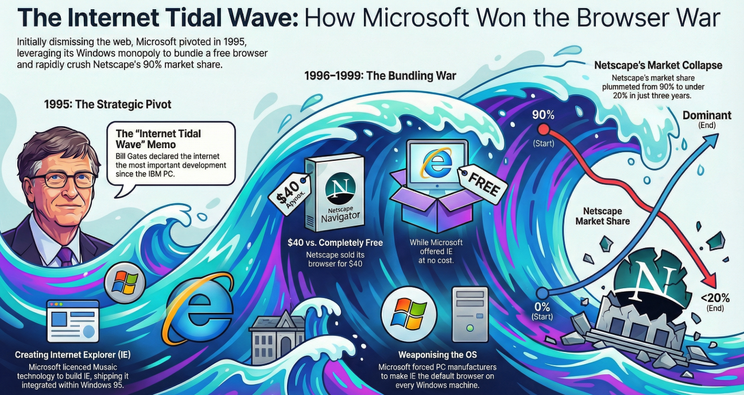
In 1995, Bill Gates sent a memo to his leadership team.
The memo stated that the internet was the future of computing, and Microsoft was at risk of being irrelevant if Netscape’s browser became the dominant platform.
Netscape Navigator was superior to anything Microsoft had. The browser had 90% market share. It was fast, feature-rich, and everyone wanted it.
Microsoft had a much worse browser called Internet Explorer. The company could have invested billions in R&D to make a better product. That is what a normal company would do.
Microsoft did something different.1
The company bundled Internet Explorer directly into Windows operating system. Starting with Windows 95, every Windows PC came with IE pre-installed as the default browser.
Netscape could not compete with “bundled for free on every PC.” Within 5 years, Netscape had collapsed. Internet Explorer had 90% market share. Microsoft had won.2
This victory was not because IE was better. It was because bundling created switching costs that pure product competition could not overcome.
This bundling playbook became the template for every major Microsoft business decision for the next 30 years.
The Scoreboard: Microsoft’s Dominance Growth (1995-2026)
| Year | Market Cap | Primary Business | Competitive Threat | Response |
|---|---|---|---|---|
| 1995 | $60B | DOS/Windows | Netscape browser | Bundle IE with OS |
| 2000 | $600B | Office | Lotus/Corel | Bundle Office with Windows |
| 2005 | $250B | Office/Windows | Google Docs | Bundle Office 365 with cloud |
| 2010 | $250B | Office/Windows | Cloud platforms | Bundle Azure with enterprise deals |
| 2015 | $400B | Office/Cloud | Slack | Bundle Teams with Office 365 |
| 2020 | $1.6T | Cloud/Office | Google Workspace | Bundle Teams/Azure/Office |
| 2026 | $3.0T | Cloud/Productivity | OpenAI competition | Bundle Copilot into everything |
Microsoft’s market value grew 50x in 30 years, not because the company was the most innovative, but because it mastered bundling strategy.3
The Bundling Playbook: How It Works
Microsoft’s strategy is simple but devastatingly effective.
Step 1: Identify a competitor with a better product or superior market position.
Example: Slack was a better collaboration tool than Microsoft Teams. But Slack was standalone.
Step 2: Create a competitive product that is “good enough” but not superior.
Example: Microsoft Teams was not as good as Slack initially, but it was adequate for team communication.
Step 3: Bundle the competitive product with existing products that customers already use.
Example: Bundle Teams with Office 365 so that every Office customer automatically has Teams included.
Step 4: Price the bundle below the cost of the standalone products.
Example: Office 365 + Teams together is cheaper than buying Office separately and then buying Slack separately.
Step 5: Over time, improve the bundled product and migrate users from standalone competitors.
Example: Teams steadily improved its collaboration features, and the network effect of having everyone use Teams (because it was bundled) created lock-in.4
The genius of this playbook is that it does not require the bundled product to be better. It just requires the bundle to be cheaper and more convenient than the alternative of buying best-of-breed products separately.
Why Bundling Wins Against Better Products
This is the uncomfortable truth that disrupts the conventional startup narrative.
A startup with a better product loses to a bundled product from an incumbent because the incumbent has an existing customer base.
Slack has a better product than Teams. But Slack cannot win because:
- Microsoft can give Teams away for free (it is bundled)
- Slack costs $8-20 per user per month
- An enterprise customer already paying for Office 365 gets Teams at zero marginal cost
- The customer chooses Teams because the switching cost from Slack does not justify the additional cost
From a product quality perspective, Slack should win. From an economics perspective, Teams dominates.5
This pattern repeats across Microsoft’s entire business:
- Netscape was a better browser. IE was bundled. IE won.
- Lotus 1-2-3 was a better spreadsheet. Excel was bundled. Excel won.
- Slack is a better chat platform. Teams is bundled. Teams won.
- Google Docs is a better collaborative document. But Office is bundled with enterprise. Office wins.6
In each case, the bundled product won not because it was better, but because switching cost made the alternative irrational.
The Antitrust Vulnerability: Why Microsoft Is Targeted
Microsoft’s bundling strategy has attracted antitrust scrutiny repeatedly.
In 2000, the US Department of Justice sued Microsoft for bundling IE with Windows. The government argued that this was anticompetitive monopoly leverage.7
The case was technically a win for Microsoft (no forced breakup), but the company agreed to some restrictions and faced years of regulatory pressure.
By 2024-2026, Microsoft is again facing antitrust scrutiny, this time for bundling AI features and cloud services with productivity software.8
Regulators understand that bundling, when used by a dominant player, can eliminate competition regardless of product quality. This is why antitrust enforcement focuses on bundling practices.
Microsoft’s strategy is legally defensible in most cases (bundling is not illegal per se), but it is politically vulnerable and subject to regulatory risk.9
The Take Nobody In The Industry Wants To Say Out Loud
Our editors weigh in.
Microsoft won not because it was the most innovative company. Microsoft won because it understood that in a market with switching costs, the incumbent with the most bundled products always wins.
This should terrify every startup building a “better product” to compete with Microsoft.
You cannot beat Microsoft on product quality. You can only beat Microsoft by:
- Going into a market Microsoft has not yet bundled (which is shrinking)
- Building a product so superior that customers tolerate the switching cost (possible but rare)
- Finding a customer segment where bundling does not apply (small businesses, specific verticals)
- Building a new platform where bundling has not yet happened (AI, spatial computing)
Any other strategy is hopeless.
This is not unique to Microsoft. It is the fundamental truth of technology markets: bundling and switching costs beat pure innovation.
The companies that understand this (Microsoft, Apple, Google) dominate. The companies that ignore it and build pure point solutions lose.
Frequently Asked Questions
Why did not Netscape just bundle its browser too? Netscape was not an OS company. It could not bundle the browser because it did not own the platform. Only the OS owner can effectively bundle.10
Could Slack have beaten Microsoft if it bundled with something? No, because Slack did not own an existing widely-adopted platform to bundle with. Slack could only buy an existing platform (which it tried by being acquired by Salesforce) or build one (which it never did).11
Is Microsoft still bundling today? Yes. Microsoft is bundling AI (Copilot) into everything, bundling GitHub into Azure, bundling LinkedIn into Microsoft Graph, bundling Teams into Office 365. The strategy is consistent across 30 years.12
Will regulators break up Microsoft for bundling? Unlikely in the short term. Regulators would need to prove anticompetitive intent and actual market harm. Microsoft’s bundling is popular with customers (they get better price for more products) which makes regulatory action difficult.13
What can competitors do? Build superior products in emerging categories where bundling has not yet happened. Apple does this by bundling at the device layer. Google tries to compete with bundling at the cloud layer. New entrants should focus on products Microsoft has not yet bundled.14
Is this strategy sustainable long-term? Only if Microsoft continues to own critical infrastructure (Windows, Office, Azure). If platforms shift (to AI, to quantum, to something unknown), Microsoft’s bundling advantage could evaporate. But for the past 30 years, it has been unstoppable.15
Stay in the Loop
For more stories, breakdowns, and unfiltered takes on what is really happening in business and tech, follow TheFounder Nation.
Instagram Handle : https://www.instagram.com/thefoundernation?igsh=MTZobDUwc2xqZWdhOA==
We cover what the mainstream business press won’t.
© The Founder Nation | All rights reserved | Written by TFN Research Desk